
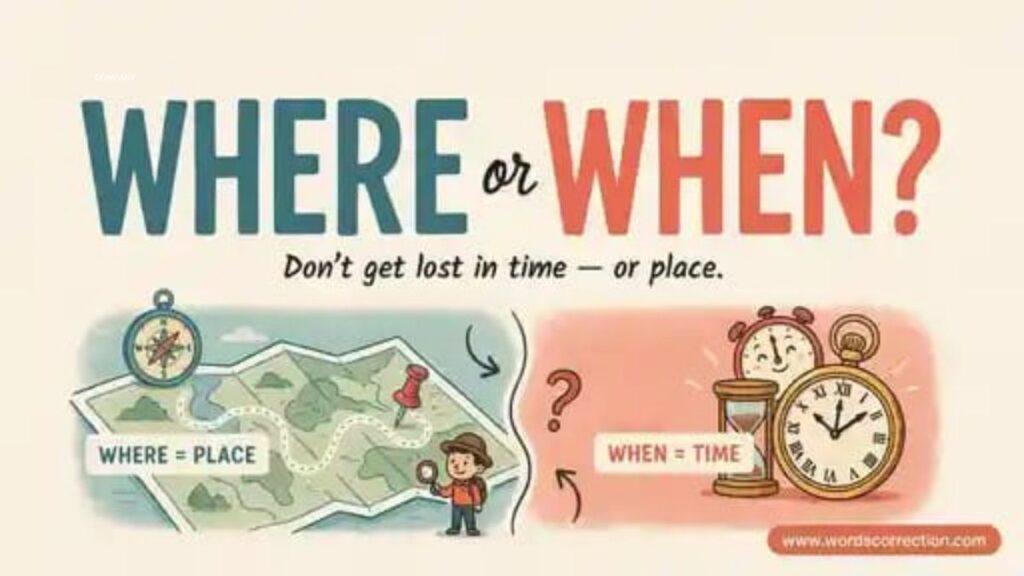
The difference between “where” and “when” may seem simple, yet these two small words often create surprisingly big grammar mistakes. Confusing them can make an otherwise clear sentence sound awkward or change its intended meaning. “Where” points to a place or location, while “when” refers to a time, moment, or occasion. For example, asking “When is the library?” when you mean “Where is the library?” can leave your listener wondering whether the library has suddenly become a date. In this guide, we’ll explain the where or when difference and uses, explore common mistakes, provide practical examples, and show you how to choose the correct word confidently.
Where or When Quick Answer
The basic difference between where and when is simple:
- Where asks about a place or location.
- When asks about time or an occasion.
| Word | Main Meaning | What It Asks About | Example |
| Where | Place or location | Where someone or something is | Where do you live? |
| When | Time or occasion | When something happens | When did you arrive? |
Think of the distinction as place vs. time.
If you want to know a location, use where:
Where are you going?
If you want to know the time, use when:
When are you going?
The first question expects an answer such as to the store or to New York. The second expects an answer such as tomorrow or at 5 p.m.
That basic contrast explains most cases of where vs when.
What Does “Where” Mean?
The where meaning centers on location, place, or position.
You can use where to ask about a physical location:
Where does Maria live?
You can also use it to ask where an activity takes place:
Where did the meeting take place?
In both cases, the answer identifies a place.
However, where doesn’t always refer to a physical location. It can also describe a figurative position or situation:
I don’t know where we stand on this issue.
Here, where describes a person’s or group’s position regarding an issue rather than a physical place.
What Does “When” Mean?
The when meaning centers on time, an occasion, or a particular point in time.
For example:
When did the movie start?
The answer might be at 8 p.m.
However, when doesn’t always require an exact clock time:
When did you visit Paris?
Possible answers include last summer, in 2024, or when I was in college.
Therefore, when refers to time in a broad sense. It can identify a precise moment, a period, an occasion, or the time relationship between two events.
Learn the difference between more words people mix up
Emerse or Immerse Correct Spelling and Use
Where vs. When at a Glance
A simple mental test can solve most where or when questions.
If the answer would be a place, use where.
If the answer would be a time or occasion, use when.
For example:
| Question | Expected Answer | Correct Word |
| ___ do you work? | At a hospital | Where |
| ___ does the train leave? | At 7:30 | When |
| ___ did they meet? | At the library | Where |
| ___ did they meet? | Last Friday | When |
| ___ is the party? | At Sarah’s house | Where |
| ___ is the party? | Saturday night | When |
Notice that where and when can appear in very similar sentence structures. The difference comes from the information the speaker wants.
Learn the difference between everyday English mistakes
Lader or Ladder Which One Is Correct?
Where Meaning and Uses
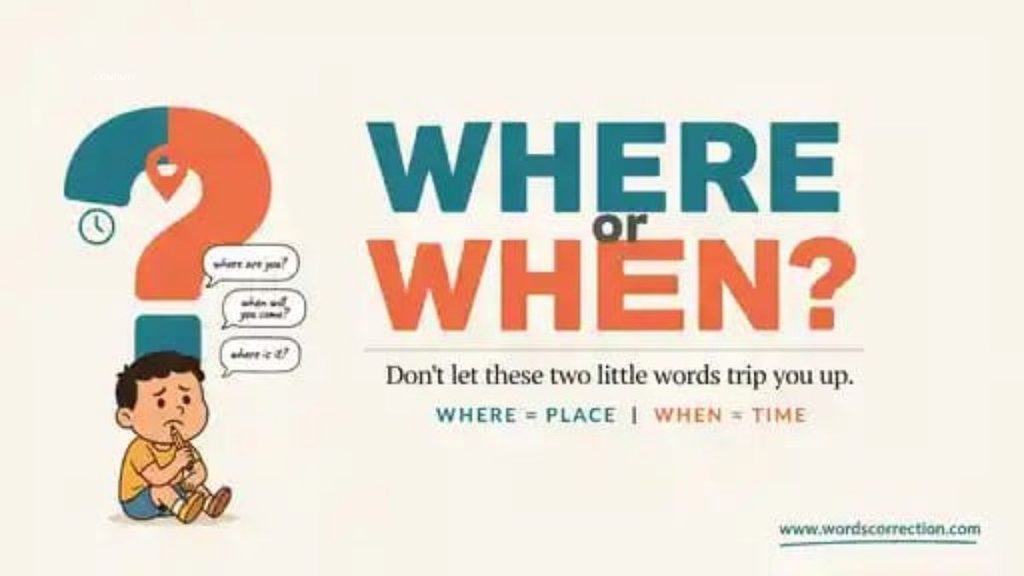
Understanding where or when grammar begins with recognizing the role of where.
Where for Asking About a Place
The most common use of where involves questions about location.
Examples include:
- May I ask where you live?
- Could you please tell me where the keys are?
- Do you happen to know where they went?
- Could you direct me to the nearest pharmacy?
- Could you please confirm where the concert will take place?
Each question asks for a specific place or location.
Consider this example:
Where are you going?
A natural answer might be:
I’m going to the library.
The question doesn’t ask when the person will leave. It asks about the destination.
Where in Relative Clauses
English also uses where as a relative adverb.
Consider:
This is the restaurant where we had dinner.
The clause where we had dinner provides additional information about the restaurant.
The same idea appears in:
That’s the school where my mother teaches.
We visited the town where the festival began.
I remember the park where we used to play.
In each example, where connects a location with information associated with that location.
This is an important part of where or when usage because where isn’t restricted to direct questions.
Where for Describing Position or Situation
Although where refers to place, English can use the concept of location in a figurative way.
For example:
We need to decide where the project stands.
The word doesn’t refer to a physical location. Instead, it describes the project’s current position or status.
Another example is:
I don’t know where we stand on this issue.
Again, there is no physical place involved. The sentence refers to a position within a discussion or relationship.
This broader meaning shows why defining where only as a word for physical locations can be misleading. Its central concept is location or position, whether literal or figurative.
Learn the difference between commonly misused words
Presence or Presense Which Spelling Is Correct?
When: Meaning and Uses
If where is used for places, when is used for time.
That’s the most useful rule to remember.
When for Asking About Time
Use when when you want information about a point or period in time.
Examples include:
Could you please tell me when you arrived?
Do you know when the store will open?
May I ask when your birthday is?
When does the semester begin?
The answer can be highly specific:
At 9:15.
It can also be broad:
Next week.
Or it can refer to another event:
When the meeting ends.
All of these answers relate to time.
When in Time Clauses
One of the most common uses of when appears in clauses that explain when something happens.
For example:
Call me when you get home.
The word when introduces the time relationship between two events.
More examples include:
I’ll start cooking when everyone arrives.
She smiled when she heard the news.
When the rain stopped, we went outside.
In each sentence, when connects events according to their timing.
When for Occasions and Circumstances
A when question doesn’t necessarily ask for an exact date or clock time.
Consider:
When did you realize you wanted to become a teacher?
A possible answer is:
When I was in high school.
Here, when refers to a period or occasion.
Similarly:
I remember when we first met.
In this sentence, when refers to the occasion on which the meeting happened.
Learn the difference between basic English word mistakes
Gos or Goes Which One Is Right?
Where or When Key Differences
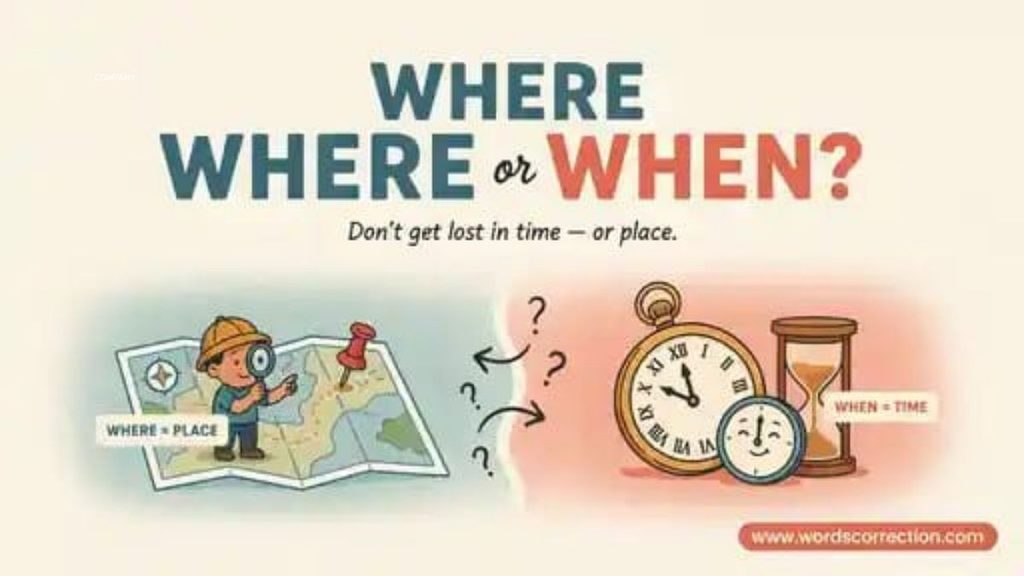
The clearest where and when difference comes down to the type of information each word represents.
Where Refers to Location
Use where when you’re asking or talking about where something happens.
Examples:
Where did the event take place?
This is the building where the company started.
Do you know where she lives?
The expected information concerns a location.
When Refers to Time
Use when when you’re asking or talking about when something happens.
Examples:
When did the event happen?
I remember when the company started.
Do you know when she moved here?
The expected information concerns a time, period, or occasion.
The Simple “Place or Time?” Test
Here’s the easiest way to remember how to use where and when:
Where = place. When = time.
Imagine someone tells you:
“The concert is at the stadium on Saturday.”
You can ask two different questions:
Where is the concert?
Answer: At the stadium.
When is the concert?
Answer: On Saturday.
The event remains the same. The information being requested changes.
That distinction captures the central idea behind where vs when grammar.
Where and When Cannot Usually Be Swapped
Changing the question word can completely change the meaning.
Compare:
Where did you meet?
This asks for a location.
When did you meet?
This asks for a time.
Neither word is automatically more correct. The correct choice depends on the intended meaning.
Learn the difference between often confused words
To or Too Clear Difference, Meaning and Usage
Where or When in Questions
The interrogative words where and when help speakers request different kinds of information.
Direct Questions With Where
Use where to ask about location:
- Where do you live?
- Where are you going?
- Where did they park?
- Where is the restaurant?
- Where will the ceremony take place?
These are straightforward questions about location.
Direct Questions With When
Use when to ask about time:
- When did you arrive?
- When will you leave?
- When are you coming?
- When does the class begin?
- When should we meet?
These are questions about time.
Indirect Questions With Where and When
Both words can also appear in indirect questions.
Compare:
Where does she live?
with:
Do you know where she lives?
Now compare:
When does the train arrive?
with:
Do you know when the train arrives?
Notice the word order.
In a direct question, English typically places the auxiliary verb before the subject:
Where does she live?
In an indirect question, the embedded clause follows normal statement order:
Do you know where she lives?
The same pattern applies to when:
When does the store open?
becomes:
Do you know when the store opens?
This distinction is an important part of English question formation.
Learn the difference between confusing word pairs
Inact or Enact Which Spelling Is Correct?
Where or When in Sentences and Clauses
The where or when correct usage isn’t limited to questions. Both words can introduce clauses and connect ideas.
Where as a Relative Adverb
Consider:
We returned to the house where we had stayed before.
The clause where we had stayed before describes the house.
More examples include:
I found the café where they sell fresh bread.
She moved back to the city where she was born.
They visited the stadium where the final was played.
Here, where connects a place with information about that place.
When as a Relative Adverb
Now consider:
I remember the year when we moved.
Here, when connects year with information about that time.
Other examples include:
That was the moment when everything changed.
I remember the day when we first met.
There was a period when people communicated mainly by letters.
These examples demonstrate the difference between where and when in English.
“The Place Where” and “The Time When”
English frequently uses the expressions:
- the place where
- the time when
For example:
This is the place where we met.
I remember the time when we first spoke.
However, the noun can often be omitted when the context is already clear:
This is where we met.
I remember when we first spoke.
The shorter versions are especially natural in everyday English.
Learn the difference between tricky grammar more words
Maxxed or Maxed: Which Spelling Is Correct?
Common Mistakes With Where and When

The common confusion between where and when often occurs because both words function as question words and relative adverbs.
Mistake 1: Using Where for Time
Consider:
Where did the meeting start?
This sentence can be grammatically correct if the speaker wants to know the meeting’s location.
However, if the intended question concerns the starting time, the correct version is:
When did the meeting start?
The context determines the correct word.
Mistake 2: Using When for Place
Consider:
When did you meet them?
This asks about time.
If the intended meaning concerns location, use:
Where did you meet them?
A suitable answer could be:
At a coffee shop.
Mistake 3: Confusing Where With Were
The words where and were can cause spelling problems because they sound similar in some varieties of English.
| Word | Meaning | Example |
| Where | Place or location | Where are you? |
| Were | Past form of be | They were tired. |
Consider:
Where were you yesterday?
Both words have different grammatical functions.
- Where asks about location.
- Were is the past-tense form of be.
Changing one letter changes the word entirely.
Mistake 4: Confusing When With Other Time Words
Although when relates to time, it isn’t interchangeable with every time-related word.
| Word | General Function | Example |
| When | Identifies a time or occasion | Call me when you arrive. |
| While | Shows something happening during another period | She read while I cooked. |
| Whenever | Means at any time that something happens | Call whenever you need help. |
| Then | Refers to a time already established | We were younger then. |
These words can overlap in certain contexts, but they don’t perform exactly the same grammatical job.
Mistake 5: Creating Ambiguous Sentences
Sometimes the issue isn’t choosing between where and when. The real problem is that the sentence doesn’t make the intended meaning clear.
Consider:
I remember the night we met.
This sentence refers to a time-related occasion.
Now compare:
I remember the place where we met.
The second sentence shifts the focus to location.
Good writing makes that distinction clear when the difference matters.
Learn the difference between commonly mixed-up more words
Unattentive or Inattentive Meaning and Usage
Where vs. When in Everyday Writing
The rules become much easier once you see them in ordinary communication.
Conversations and Text Messages
Everyday speech uses both words constantly.
Where are you?
I’m at home.
Then:
When are you leaving?
Around six.
The conversation works because each question requests a different type of information.
Emails and Workplace Writing
Professional communication often requires both location and time information.
For example:
Where will the meeting take place?
When will the meeting begin?
A message may need both details:
Please confirm where the meeting will take place and when it will begin.
Here, where and when work together because the writer needs two separate pieces of information.
Academic and Formal Writing
Academic writing often uses where and when inside more complex sentences.
For example:
The study examines the region where the species was first identified.
Or:
Researchers focused on the period when the population experienced rapid growth.
The sentence structure becomes more sophisticated, but the basic meanings remain unchanged.
Online and Social Media Writing
Informal writing often uses short questions:
Where are you?
When are you coming?
The casual setting doesn’t change the fundamental grammar. Where still concerns location, while when still concerns time.
Learn the difference between confusing more English words
Handle or Handel Correct Spelling, Meaning, and Usage
Where vs. When in American and British English
A common question is whether the where or when difference changes between American and British English.
The fundamental distinction remains the same.
In both varieties:
- where refers to location
- when refers to time
For example:
Where do you live?
works naturally in both American and British English.
Likewise:
When are you leaving?
has the same basic meaning in both varieties.
Are Where and When Different in US and UK English?
Not in their basic meanings.
American and British English may differ in vocabulary, pronunciation, spelling, or preferred phrasing in certain situations. However, those regional differences don’t change the fundamental rule that where is associated with location and when is associated with time.
Usage Tendencies
Differences sometimes appear in style rather than meaning.
For instance, formal writing may use structures such as:
the period during which…
while everyday English may simply use:
when…
The important point is to distinguish genuine regional differences from basic grammar rules.
Inconsolable or Unconsolable Which Is Correct?
How to Choose the Right Word: Where or When
When you’re unsure about where or when usage, don’t rely on guesswork. Use a simple decision process.
Ask What Information You Need
First, determine what you’re asking for.
If you’re asking:
In what place?
Use where.
If you’re asking:
At what time?
Use when.
Look at the Expected Answer
This approach works in most everyday situations.
If the answer could be:
- at school
- in London
- at home
- in the kitchen
- near the station
you probably need where.
If the answer could be:
- tomorrow
- at noon
- last year
- on Monday
- during the summer
you probably need when.
Check the Noun Being Modified
Certain nouns can provide helpful clues.
| Location-Related Nouns | Time-Related Nouns |
| place | day |
| city | year |
| house | moment |
| building | period |
| room | occasion |
| country | time |
For example:
This is the place where we met.
That was the day when we met.
These patterns aren’t absolute rules, but they can help you choose the right question word.
Where or When Examples
The fastest way to understand a grammar rule is often to see it in action.
Examples With Where
Here are practical examples of where used in a sentence:
May I ask where you live?
Could you please tell me where the children are playing?
Do you happen to know where you bought that jacket?
Where will the conference take place?
Do you know where the station is?
This is the house where I grew up.
We visited the city where the company was founded.
Each example focuses on place, location, or position.
Examples With When
Now consider examples of when used in a sentence:
When did you arrive?
When are you coming home?
Do you know when the train leaves?
I remember when we first met.
That was the moment when everything changed.
She called me when she reached the airport.
Each example focuses on time, an occasion, or the relationship between events.
Where vs. When Sentence Pairs
| Where | When |
| Where did you meet? | When did you meet? |
| Where is the event? | When is the event? |
| Where did she move? | When did she move? |
| Where will they arrive? | When will they arrive? |
| Where does the class take place? | When does the class take place? |
These pairs make the difference in meaning especially clear.
A Practical Case Study: One Event, Two Questions
Imagine a wedding scheduled for Saturday at a hotel.
One person asks:
Where is the wedding?
The answer:
At the Grand Hotel.
Another person asks:
When is the wedding?
The answer:
On Saturday.
Both questions concern the same event, yet they request completely different information.
This example captures the central principle behind the where or when difference and use.
The same idea applies to:
- meetings
- appointments
- classes
- concerts
- interviews
- trips
- conferences
- sporting events
Whenever you need to distinguish place and time, these two words become useful.
Practice Session
Fill in the blanks
Instructions: Complete each sentence by choosing where or when. Read each sentence carefully and consider whether it refers to a place or location or to a time or occasion.
- ______ do you live?
- ______ did you first hear the song “Where or When”?
- Do you remember ______ we first met?
- ______ is the nearest coffee shop?
- I remember the place ______ we first talked.
- ______ are you going after work?
- Summer is the season ______ many people enjoy traveling.
- ______ did the concert take place?
- Do you know ______ the movie was filmed?
- I’ll never forget the day ______ I heard this song.
- ______ does the story take place?
- Can you tell me ______ the meeting starts?
- That’s the restaurant ______ we had dinner last year.
- ______ did you buy that book?
- I remember the moment ______ I realized I knew the song.
- ______ can I find the original recording?
- Friday is the day ______ we usually go out.
- ______ did Frank Sinatra record “Where or When”?
- This is the house ______ the singer grew up.
- Do you remember ______ you first listened to this song?
- ______ was the Broadway musical Babes in Arms performed?
- I remember the time ______ we used to listen to old songs together.
- ______ did you leave your headphones?
- There are certain moments ______ a song can bring back old memories.
- Do you know ______ Richard Rodgers and Lorenz Hart wrote “Where or When”?
Answer Key
- Where
- When
- when
- Where
- where
- Where
- when
- Where
- where
- when
- Where
- when
- where
- Where
- when
- Where
- when
- When
- where
- when
- Where
- when
- Where
- when
- when
Quick Practice Rule
Remember this simple distinction:
- Where → used to ask about a place or location.
- When → used to ask about a time or occasion.
Example:
- Where did you meet her? → The answer is a place.
- When did you meet her? → The answer is a time.
When you’re unsure, ask yourself: “Am I asking about a place or about a time?” That simple question usually makes the correct choice clear.
Here’s a trusted source for clear more words Comparison:
Grammar Update
Frequently Asked Questions About “Where or When”
Who originally sang “Where or When”?
“Where or When” was originally introduced by Ray Heatherton and Mitzi Green in the 1937 Broadway musical Babes in Arms. The song was written by composer Richard Rodgers and lyricist Lorenz Hart.
What is the song “Where or When” about?
“Where or When” is about the unusual feeling of familiarity that can occur when meeting someone for the first time. The lyrics describe a sense of déjà vu, as though the two people have experienced the same moments or shared a connection in the past.
What does “Where or When” mean?
The title “Where or When” reflects uncertainty about when or where a familiar experience may have happened. In the song, this uncertainty represents the feeling of recognizing someone or a situation even though you cannot remember exactly when or where you encountered it before.
Who wrote “Where or When”?
“Where or When” was written by Richard Rodgers, who composed the music, and Lorenz Hart, who wrote the lyrics. The songwriting duo created it for the 1937 Broadway musical Babes in Arms.
Who sings “Where or When”?
“Where or When” has been recorded by numerous well-known artists, including Frank Sinatra, Ella Fitzgerald, Peggy Lee, and Dion and the Belmonts. Because the song became a popular standard, it has many notable interpretations rather than one definitive singer.
What musical is “Where or When” from?
“Where or When” comes from Babes in Arms, a Broadway musical that premiered in 1937. The musical featured music by Richard Rodgers and lyrics by Lorenz Hart.
Did Frank Sinatra sing “Where or When”?
Yes. Frank Sinatra recorded “Where or When” as part of his extensive repertoire of classic American popular songs. His interpretation helped introduce the Rodgers and Hart composition to later audiences.
Did Ella Fitzgerald sing “Where or When”?
Yes. Ella Fitzgerald also recorded “Where or When.” Her version reflects the song’s place within the jazz and traditional popular-song repertoire.
Did Dion and the Belmonts record “Where or When”?
Yes. Dion and the Belmonts recorded “Where or When” in 1959. Their doo-wop interpretation became one of the song’s best-known recordings and helped bring the composition to a younger rock-and-roll audience.
Is “Where or When” a movie song?
“Where or When” was not originally written for a movie. It was created for the 1937 Broadway musical Babes in Arms. The song was later recorded and used in various entertainment contexts.
When was “Where or When” written?
“Where or When” was written in 1937 for Babes in Arms. It was created during the successful songwriting partnership between Richard Rodgers and Lorenz Hart.
Is “Where or When” a jazz standard?
Yes. “Where or When” became part of the American popular-song and jazz-standard repertoire. Its memorable melody and reflective lyrics have made it suitable for interpretations across several musical styles.
Why is “Where or When” associated with déjà vu?
The song focuses on the feeling that a present experience has happened before. Its lyrics describe familiar moments between two people who cannot determine exactly where or when they encountered those moments previously. This creates the song’s strong connection with the idea of déjà vu.
Is Laufey’s “Where or When” the original version?
No. Laufey’s recording is a later interpretation of the Rodgers and Hart song. The original composition dates to 1937 and first appeared in the Broadway musical Babes in Arms.
What is the most famous version of “Where or When”?
There is no single version that can be objectively considered the most famous. Recordings by Frank Sinatra, Ella Fitzgerald, and Dion and the Belmonts are among the notable interpretations. Dion and the Belmonts’ 1959 recording is particularly recognized for its doo-wop and rock-and-roll style.
Why has “Where or When” remained popular?
The song has remained popular because its central theme is timeless. Many people recognize the feeling of meeting someone or experiencing a moment that seems strangely familiar. The combination of Rodgers’ melody and Hart’s thoughtful lyrics has also allowed artists from different musical generations to reinterpret the song.
Where vs. When: Quick Reference Table
Keep this table handy whenever you need a quick reminder.
| Feature | Where | When |
| Basic meaning | Place or location | Time or occasion |
| Main question | Where? | When? |
| Refers to | Location or position | Time, period, or occasion |
| Main function | Asking or describing location | Asking or describing time |
| Typical answer | At home | Tomorrow |
| Example | Where do you live? | When do you leave? |
| Relative use | The place where… | The day when… |
| Core idea | Place | Time |
Conclusion
Understanding the where or when difference and uses becomes much easier when you focus on one simple question: Are you asking about a place or a time? Use “where” for a location, as in “Where do you live?” Use “when” for a time, moment, or occasion, as in “When did you arrive?” Confusing these words can turn a clear question into a grammatical puzzle, but the solution is refreshingly simple. Remember: where = place, when = time. Whether you’re writing an email, asking a question, or creating formal content, choosing the right word keeps your meaning precise and your grammar polished. Once this distinction sticks, “where” and “when” won’t have to keep causing confusion.

Stella AJS is an experienced blogger and dedicated English language writer at Words Correction. She turns confusing grammar, word meanings, spelling, and usage into clear, practical insights that readers can easily understand and apply. With a passion for precise and engaging writing, Stella helps readers avoid common language mistakes, strengthen their vocabulary, and communicate with greater clarity and confidence.




