
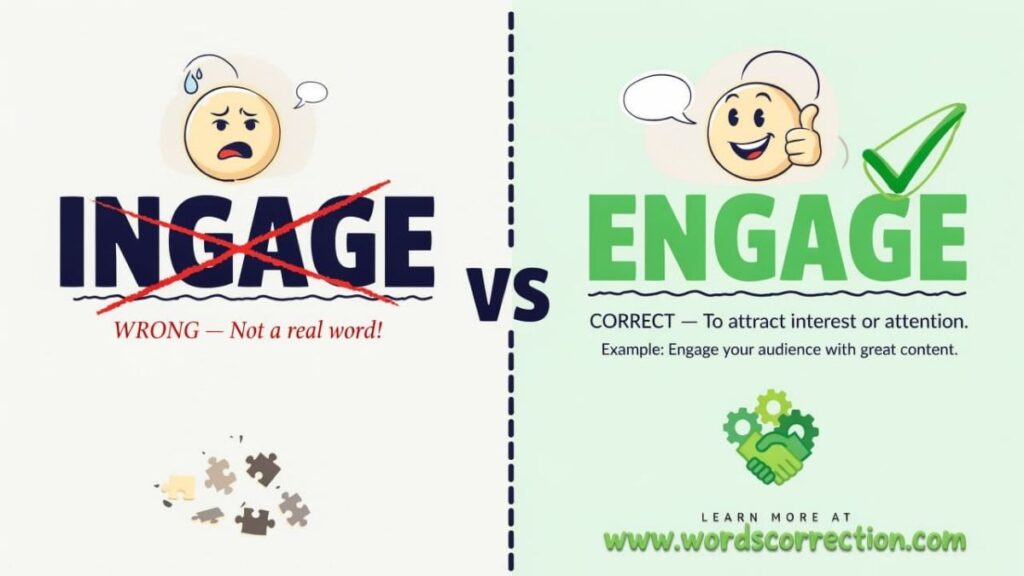
The English language can be confusing, especially when two words look and sound so similar. Ingage vs engage is a common example of this confusion. While both spellings may look correct at first, only engage is accepted in modern standard English. Using the wrong spelling can make your emails, essays and professional documents look less polished. The good news is that the difference is simple to understand. In this guide, you’ll learn the meanings spelling differences, history and correct usage of both words, along with easy examples to help you avoid this common mistake and write with confidence.
Ingage vs Engage Quick Answer
Engage is the correct spelling in modern standard English. Ingage is an obsolete spelling that appeared in historical English but isn’t an accepted alternative in contemporary writing.
Here’s a quick comparison
| Feature | Ingage | Engage |
|---|---|---|
| Modern standard spelling | No | Yes |
| Historical usage | Yes | Yes |
| Modern dictionary status | Obsolete form | Standard English word |
| Part of speech | Historical verb form | Verb |
| Modern meaning | No separate standard meaning | To involve, attract, employ, or participate |
| American English | Nonstandard | Correct |
| British English | Nonstandard | Correct |
| Professional writing | Avoid | Recommended |
| Academic writing | Avoid | Recommended |
Consider these examples
- Correct: The teacher wants to engage students in meaningful discussions.
- Incorrect in modern standard English: The teacher wants to ingage students in meaningful discussions.
The distinction is straightforward. When you want to describe participation, involvement, interaction, or attraction, use engage.
You may encounter ingage in an old book or historical document. In that situation, the spelling reflects the language conventions of its time rather than a modern spelling preference.
What Does Engage Mean?
The word engage is a versatile verb with several meanings. Its exact definition depends on the context in which someone uses it.
In general, engage means to involve yourself in something, involve another person, attract attention, establish an active connection, or employ someone for a particular purpose.
Consider these examples
- She likes to engage in meaningful conversations.
- The speaker knows how to engage an audience.
- The company plans to engage a marketing consultant.
- Children learn better when teachers engage them in activities.
Each sentence uses the same verb, but the context changes its meaning.
Engage Meaning in Everyday English
In everyday English, engage often means participating in something or becoming involved in an activity.
For example, when someone engages in a discussion, they actively contribute rather than simply listen. Similarly, engaging with another person means interacting, communicating, or responding to them.
Here are some common examples
- I enjoy engaging in conversations about history.
- She encouraged her children to engage in outdoor activities.
- Try to engage with people who have different opinions.
- The book is interesting enough to engage young readers.
The word can also describe something that captures attention and keeps someone interested.
For instance, an engaging story makes readers want to continue reading. An engaging teacher makes lessons interesting and encourages students to participate.
Learn the difference between commonly confused more words in English
Eying or Eyeing Which Spelling Is Correct?
Engage Meaning in Relationships
The meaning of engage in relationships depends on the situation.
In everyday communication, engaging with someone means interacting with them, listening to their thoughts, sharing ideas, and building a connection.
For example
- Healthy couples engage in honest conversations.
- Partners should engage with each other’s feelings and concerns.
- Spending quality time together helps couples remain engaged in their relationship.
However, engage has another important meaning in romantic relationships.
When someone says, “They got engaged,” it usually means two people have formally agreed to marry each other.
Consider these sentences
- Sarah and James got engaged last summer.
- They announced their engagement to their families.
- He gave her an engagement ring.
The difference between engage and get engaged depends on the context. Engage can describe involvement or interaction, while get engaged commonly refers to a promise to marry.
Engage Meaning in Professional and Business Contexts
Businesses frequently use engage when discussing relationships with customers, employees, clients, and business partners.
Customer engagement describes how a business interacts with its customers across different channels. These interactions may happen through social media, email, customer support, websites, or face-to-face communication.
Similarly, employee engagement refers to how involved, motivated, and committed employees feel toward their work and organization.
Common business expressions include
- Engage customers through helpful content.
- Engage employees in decision-making.
- Engage a professional consultant.
- Engage with business partners.
- Improve customer engagement through better communication.
For example, a clothing company might engage customers by responding to questions on social media, sharing product updates, and asking for feedback.
The goal isn’t simply to attract attention. It’s to encourage meaningful interaction and build lasting relationships.
Engage Meaning in Academic and Educational Contexts
Teachers and educators use engage to describe activities that encourage students to participate actively in learning.
An engaged student doesn’t simply sit in a classroom and listen. They ask questions, explore ideas, complete activities, and contribute to discussions.
Examples include
- Teachers should engage students through interactive lessons.
- Students need to engage in critical thinking.
- Group projects encourage learners to engage with different perspectives.
- Reading interesting material can engage a student’s attention.
In academic writing, engage with can also describe examining an idea, theory, argument, or research finding.
For example
“The researcher engages with previous studies to develop a stronger argument.”
Here, engage with means examining and responding to existing academic work.
Learn the difference between more words people mix up
A Unique or An Unique Which Is Correct?
What Does Ingage Mean?
Ingage is an obsolete spelling of engage. It appeared in older English writing but isn’t used as a standard spelling in contemporary English.
Historical records contain examples of ingage in texts from earlier centuries. Its existence reflects the spelling variations that occurred before English spelling conventions became more standardized.
This historical connection matters because it explains why ingage sometimes appears in historical dictionaries and older publications.
However, its historical existence doesn’t make it an appropriate substitute for engage in modern writing.
Is Ingage a Word?
The answer depends on what you mean by the word.
Historically, yes. Ingage existed as an English spelling variant of engage. However, it isn’t a standard modern spelling.
If you’re writing an email, preparing a school assignment, publishing an article, or creating a business report, use engage.
There are also situations in which Ingage may appear as a proper name. A company, product, or organization can intentionally choose that spelling for its identity.
That doesn’t change the standard spelling of the ordinary English verb.
Learn the difference between everyday English mistakes
Heros or Heroes which spelling is correct?
Key Differences Between Ingage vs Engage
Although the two forms have a historical connection, they don’t have the same status in modern English.
Understanding their differences makes it easier to choose the correct spelling.
Correctness and Standard Spelling
The biggest difference between ingage vs engage is their correctness in contemporary writing.
Engage is the accepted modern spelling. It appears in established English dictionaries and follows current spelling conventions.
Ingage, on the other hand, is an obsolete spelling.
For example
- Correct: We need to engage more customers.
- Incorrect: We need to ingage more customers.
The first sentence follows standard English spelling. The second uses an outdated form.
Dictionary Recognition
Established dictionaries recognize engage as a standard English verb.
Modern dictionary entries provide its definitions, grammatical patterns, pronunciation, and word history. Historical references also identify ingage as an earlier spelling of engage.
This distinction is important because historical dictionary recognition doesn’t mean both spellings are equally acceptable today.
Instead, it shows how English spelling developed over time.
Meaning and Definition
The modern meaning of engage includes several related ideas
- To participate in an activity.
- To become involved in something.
- To attract and hold attention.
- To communicate or interact with someone.
- To employ someone for a particular purpose.
- To promise to marry someone.
The obsolete form ingage doesn’t have a separate established meaning in contemporary standard English. Historically, it carried the same meaning as engage.
Therefore, you shouldn’t use the two spellings interchangeably in modern writing.
Pronunciation
Pronunciation is one reason people confuse these words.
The standard pronunciation of engage is commonly represented as
ingage
The main stress falls on the second syllable.
Depending on the speaker’s accent, the first vowel may sound closer to the vowel in in or en. This can make the spelling less obvious when someone hears the word.
However, spelling and pronunciation don’t always match perfectly in English.
Consider these words
- Enough
- Enforce
- Enjoy
- Engage
The letters at the beginning of these words don’t always produce the sounds a learner might expect.
The important point is that similar pronunciation doesn’t make ingage the correct modern spelling.
Professional and Academic Writing
In professional and academic settings, spelling accuracy helps you communicate clearly and maintain credibility.
Imagine submitting a business proposal that repeatedly uses ingage instead of engage. Readers may interpret the spelling as a proofreading mistake or a lack of attention to detail.
The same issue can occur in
- Business emails
- Research papers
- School assignments
- Marketing materials
- News articles
- Company reports
- Professional presentations
Using engage helps your writing follow established English conventions.
American vs British English
American and British English sometimes use different spellings for the same words.
For example
| American English | British English |
|---|---|
| Color | Colour |
| Organize | Organise |
| Center | Centre |
| Traveling | Travelling |
| Defense | Defence |
| Engage | Engage |
As you can see, engage remains the same in both varieties.
There isn’t an American preference for engage and a British preference for ingage.
Both use engage as the standard spelling.
Historical Usage
The history of ingage provides an interesting example of how English spelling changes.
Older English texts sometimes used spellings that look unusual today. Writers didn’t always follow the same standardized conventions that modern publications use.
Historical dictionary references identify ingage as an obsolete form of engage. The word’s origin also helps explain its modern spelling.
This historical development shows why the modern word begins with en rather than in.
Learn the difference between commonly misused words
Thier or Their which is correct?
Ingage vs Engage Comparison Table
Here’s a more detailed comparison of the two spellings.
| Comparison | Ingage | Engage |
|---|---|---|
| Modern spelling | Obsolete | Standard |
| Historical existence | Yes | Yes |
| Modern dictionary use | Historical reference | Current entry |
| Verb meaning | Historical equivalent of engage | Involve, interact, attract, employ |
| Common usage today | Rare historical occurrence | Everyday and professional English |
| Correct in modern essays | No | Yes |
| Correct in business communication | No, unless a proper name | Yes |
| Correct in American English | No | Yes |
| Correct in British English | No | Yes |
| Recommended spelling | No | Yes |
Remember: Ingage belongs to historical spelling discussions, while engage belongs to modern everyday English.
Learn the difference between basic English word mistakes
Benefitting or Benefiting Which Spelling Is Correct?
The Origin and History of Engage
The word engage has a long history that dates back several centuries. Understanding its origins also provides useful context for the spelling distinction in ingage vs engage.
The word entered English in the early 15th century through the Old French engager. Its roots can be traced to the expression en gage, meaning “under pledge” or “as security.” This expression combines en, meaning “in,” with gage, meaning “pledge” or “security.”
Originally, engage referred to making a promise, giving a pledge, or entering into a commitment. Over time, its meaning developed to include participation, involvement, and interaction. Today, engage is the accepted standard spelling in modern English, while ingage is considered an obsolete variant. This historical distinction helps clarify the difference between ingage vs engage.
How Did Engage Develop Its Modern Meaning?
The word gradually developed meanings connected to commitment and participation.
For example
- Pledging or promising: To commit yourself to an obligation.
- Employment: To hire someone for a particular job or service.
- Participation: To become involved in an activity.
- Attention: To attract and hold someone’s interest.
- Relationships: To promise to marry someone.
- Conflict: To enter into a fight or military encounter.
These meanings may seem different at first, but they share an underlying idea: becoming involved or committed to something.
The word also developed its modern noun form, engagement, and related forms such as engaged and engaging.
The historical spelling ingage reflects an earlier period when spelling conventions differed from those used today.
Learn the difference between often confused words
Freshman or Freshmen what’s the Difference?
Why Do People Confuse Ingage vs Engage?
Even though engage is the accepted spelling, people still search for ingage vs engage. Several factors explain this confusion.
Similar Pronunciation
English spelling can be unpredictable. Some words contain sounds that don’t clearly reveal their written forms.
When someone hears engage, they may interpret the first sound as an in sound and write ingage.
This is especially common among English learners who rely on pronunciation rather than familiar spelling patterns.
Typing Errors
Typing quickly can also produce mistakes.
Someone might accidentally type ingage while writing a message or preparing a document. If the software doesn’t flag the error, the incorrect spelling may remain.
Autocorrect and Spell-Checking Limitations
Spell-checking tools don’t always catch every error.
Some unusual spellings may appear in databases, dictionaries, or brand-name lists. As a result, a tool might not flag a word in every situation.
For important documents, consult a reliable dictionary rather than relying entirely on automatic correction.
Brand Names and Business Names
Another source of confusion is branding.
A company may intentionally use Ingage as its name because it wants a distinctive identity.
Proper names don’t always follow standard dictionary spelling.
However, that doesn’t mean you should use ingage when writing the ordinary verb engage.
Learn the difference between confusing word pairs
Requestor or Requester Which Spelling Is Correct?
Common Expressions and Phrases Using Engage
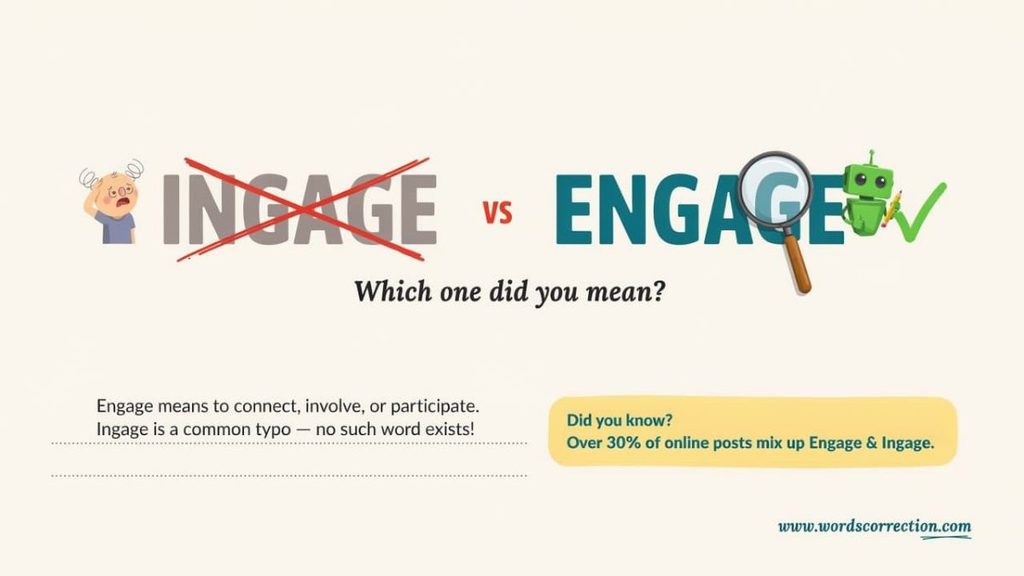
The word engage appears in many common English expressions. Understanding these phrases will help you use it naturally.
Engage In
The expression engage in means to participate in or become involved in an activity.
Examples
- Children should engage in physical activities.
- She likes to engage in meaningful conversations.
- Employees regularly engage in team discussions.
- The students engage in group projects.
Use engage in when describing participation in an activity, process, or experience.
Engage With
The expression engage with describes interacting, communicating, or responding to someone or something.
Examples
- Businesses should engage with their customers.
- Teachers need to engage with their students.
- Readers often engage with content that addresses their interests.
- The organization wants to engage with local communities.
The focus is on interaction rather than simply participating in an activity.
Engage Someone’s Attention
This expression means to attract and hold someone’s interest.
Examples
- The opening scene immediately engaged the audience’s attention.
- A good headline can engage readers.
- The teacher used a short story to engage the students’ attention.
You can also say that something engages an audience without using the word attention.
Get Engaged
Get engaged commonly refers to agreeing to marry someone.
Examples
- They got engaged during their vacation.
- My sister recently got engaged.
- The couple announced their engagement yesterday.
In this context, engaged describes a romantic commitment rather than ordinary participation.
Engage the Services Of
This expression means to hire or obtain someone’s professional services.
Examples
- The company decided to engage the services of a financial consultant.
- We need to engage an experienced attorney.
- The organization engaged a professional designer.
This expression is common in formal and business writing.
Learn the difference between tricky grammar more words
Traveler or Traveller Which Spelling Is Correct?
Engage In vs Engage With What’s the Difference?
These expressions are closely related, but they don’t always mean the same thing.
| Expression | Meaning | Example |
|---|---|---|
| Engage in | Participate in an activity | She engages in regular exercise. |
| Engage with | Interact or communicate with someone or something | She engages with her colleagues. |
| Engage someone | Involve another person | The teacher engaged students in the lesson. |
| Engage someone’s attention | Attract someone’s interest | The story engaged my attention. |
Here’s an easy way to remember the distinction
- Use engage in when describing participation.
- Use engage with when describing interaction.
- Use engage someone when involving another person.
- Use engage someone’s attention when describing interest or attraction.
For example, a student can engage in a classroom activity and engage with the teacher during a discussion.
Both expressions are correct because they describe different types of involvement.
Different Forms of Engage and Their Correct Spelling
Understanding the word family helps you avoid other English spelling mistakes.
Engage is the base form of the verb. It changes depending on tense, sentence structure, and grammatical function.
| Word | Grammatical Form | Meaning |
|---|---|---|
| Engage | Base verb | To involve or participate |
| Engages | Third-person singular present | Used with he, she, or it |
| Engaged | Past tense | Participated or became involved |
| Engaged | Past participle | Used with helping verbs |
| Engaging | Present participle or gerund | Participating or involving |
| Engagement | Noun | Involvement, commitment, or an agreement to marry |
| Re-engage | Verb | To become involved again |
| Re-engaged | Past tense or past participle | Became involved again |
| Re-engaging | Present participle | Becoming involved again |
| Disengage | Verb | To withdraw or separate |
| Disengaged | Past tense or adjective | Withdrawn or no longer involved |
| Disengagement | Noun | Withdrawal or lack of involvement |
Engage
This is the base form of the verb.
Example: “We need to engage more people in the discussion.”
Engages
Use this form with a singular third-person subject in the present tense.
Example: “The teacher engages students through practical exercises.”
Engaged
This form serves as the past tense and past participle.
Examples
- She engaged in the discussion yesterday.
- They have engaged a professional consultant.
It can also function as an adjective.
Example: “The employees are highly engaged.”
Engaging
This form can act as a present participle, gerund, or adjective.
Examples
- The company is engaging new customers.
- Engaging in exercise can improve overall fitness.
- The speaker delivered an engaging presentation.
Engagement
Engagement is the noun form of engage.
It can refer to participation, involvement, commitment, or a promise to marry.
Examples
- Customer engagement is important for businesses.
- Employee engagement can influence workplace performance.
- Their engagement surprised everyone.
The regular plural form is engagements.
For example “The organization announced several new business engagements.”
Everyday Examples of Engage in Sentences
The best way to understand a word is to see how people use it in different situations.
Here are practical examples from everyday and professional communication.
Engage in Casual Conversations
- I enjoy engaging in conversations about different cultures.
- She knows how to engage people in interesting discussions.
- Try to engage with your neighbors more often.
in Professional Communication
- Our company wants to engage with more potential clients.
- The manager encouraged employees to engage in the meeting.
- We hired a consultant to engage with business partners.
Engage in Academic Writing
- Students should engage in independent research.
- Researchers must engage with existing academic literature.
- The assignment encourages learners to engage in critical thinking.
For Social Media and Marketing
- Brands use social media to engage their audiences.
- Interactive posts help businesses improve audience engagement.
- The marketing team wants to engage with followers regularly.
- Useful videos can keep viewers engaged.
Engage in Formal Writing
- The organization aims to engage local communities.
- The committee will engage an independent consultant.
- The report examines how businesses engage with their customers.
These examples demonstrate how flexible engage can be without changing its spelling.
Learn the difference between confusing more English words
Whoa or Woah Which Spelling Is Correct?
Incorrect Spelling of Engage Common Mistakes to Avoid
The most obvious mistake is writing ingage instead of engage. However, other errors can occur when people use different forms of the word.
Consider these examples
| Incorrect or Nonstandard | Correct | Explanation |
|---|---|---|
| Ingage | Engage | Obsolete spelling |
| Ingaged | Engaged | Incorrect modern word form |
| Ingaging | Engaging | Incorrect modern word form |
| Engagment | Engagement | Missing letter e |
| Reingage | Re-engage | Nonstandard spelling in this usage |
| Disengagment | Disengagement | Incorrect noun spelling |
A few simple proofreading habits can prevent these mistakes
- Check spelling before submitting important documents.
- Learn the correct forms of common verbs.
- Use a trusted dictionary when uncertain.
- Don’t rely entirely on pronunciation.
- Pay attention to related words such as engaged, engaging, and engagement.
Is Ingage Ever Acceptable?
Although ingage isn’t suitable for ordinary modern English writing, a few situations justify its appearance.
Historical documents: If you’re quoting an old book, letter, or manuscript, preserve the original spelling. Changing it could affect the accuracy of the quotation.
Academic research: Researchers studying historical English may discuss ingage when examining spelling variations and language development.
Brand names: A business may intentionally choose Ingage as its name. In that situation, follow the official spelling of the brand.
Product names and titles: A product, publication, or creative work may use Ingage as part of its official title.
These exceptions don’t change the general rule.
If you mean to involve someone, participate in an activity, or attract attention, write engage.
Learn the difference between tricky words and use them correctly
How to Remember the Correct Spelling of Engage
Remembering the correct spelling becomes easier when you connect it to the word’s history and familiar expressions.
Use the EN-GAGE Memory Trick
Think of the word as
EN + GAGE = ENGAGE
The word comes through French from an expression associated with being under pledge.
This historical connection provides a useful reminder that the standard spelling begins with en, not in.
Remember Common Word Combinations
Practice the word in familiar expressions
- Engage in conversation.
- Engage with customers.
- Engage the audience.
- Become engaged.
- Improve employee engagement.
Repeated exposure to these expressions makes the correct spelling easier to remember.
Learn the Entire Word Family
Don’t memorize only the base word. Learn its related forms
- Engage
- Engages
- Engaged
- Engaging
- Engagement
- Re-engage
- Disengage
Once you recognize the spelling pattern, you’ll be less likely to make mistakes when using different grammatical forms.
A Practical Case Study Choosing Between Ingage vs Engage
Consider a small business preparing a marketing campaign.
The marketing manager wants to write a sentence explaining the company’s goal.
A: “Our goal is to ingage customers through helpful social media content.”
B: “Our goal is to engage customers through helpful social media content.”
Version B is correct because engage is the standard modern spelling.
Now consider another situation.
A history student discovers an old manuscript containing the sentence:
“Her words did ingage the attention of the entire audience.”
The student may preserve ingage when quoting the original manuscript. However, if the student paraphrases the sentence in modern English, the correct version would be:
“Her words engaged the attention of the entire audience.”
These examples highlight an important distinction: historical accuracy may require preserving an obsolete spelling, while modern writing requires following current conventions.
Practice Session about Ingage vs Engage
Instructions: Choose the correct word or form to complete each sentence. Test your understanding of engage, engaged, engaging, and engagement.
1. The teacher tried to ______ the students in the lesson.
2. The correct spelling is ______, not ingage.
3. The speaker used interesting stories to ______ the audience.
4. The students ______ in a lively classroom discussion yesterday.
5. The company wants to improve customer ______.
6. Good teachers know how to keep their students ______.
7. We should ______ with others to exchange ideas.
8. The manager encouraged employees to ______ in teamwork activities.
9. The presentation was so ______ that everyone paid attention.
10. The organization plans to ______ more volunteers.
11. She enjoys ______ with people from different backgrounds.
12. The instructor ______ the participants in a group activity.
13. Active participation helps increase student ______.
14. The company is looking for new ways to ______ its customers.
15. They regularly ______ in community development projects.
16. The teacher is ______ the children with creative activities.
17. The correct past tense of engage is ______.
18. The noun form of engage is ______.
19. Please ______ in the discussion and share your ideas.
20. The documentary was highly ______ and informative.
21. Employees should actively ______ with their colleagues.
22. The workshop encouraged greater student ______.
23. The manager wants to ______ the team in decision-making.
24. The audience remained ______ throughout the presentation.
25. Remember, ______ is the standard modern English spelling.
Answers
- Engage
- Engage
- Engage
- Engaged
- Engagement
- Engaged
- Engage
- Engage
- Engaging
- Engage
- Engaging
- Engaged
- Engagement
- Engage
- Engage
- Engaging
- Engaged
- Engagement
- Engage
- Engaging
- Engage
- Engagement
- Engage
- Engaged
- Engage
Here’s a trusted source for clear word meanings:
Cambridge Dictionary
FAQ’s
What is the meaning of Engage?
Engage means to become involved in an activity, participate in a discussion, interact with someone, or attract another person’s attention. It is commonly used in everyday communication, education, and professional settings.
Which is correct Engaged or Engage?
Both spellings are correct, but they serve different grammatical purposes. Engage is the base form of the verb, while engaged is its past tense and past participle.
When should you use Engage?
Use engage when referring to participation, interaction, involvement, or attracting attention. For example, “Teachers use interactive activities to engage their students.”
What is an example of Engage in a sentence?
“The speaker used real-life examples to engage the audience.” Here, engage means to capture the audience’s interest and encourage their attention.
What is a better word for Engage?
Depending on the context, suitable alternatives include involve, interact, participate, connect, attract, interest, and communicate. Each synonym expresses a slightly different aspect of engagement.
How do you use Engage in a sentence?
Use engage to describe someone’s involvement or interaction with an activity, person, or subject. For example, “Students should engage in meaningful classroom discussions.”
What can I say instead of Engage?
You can use alternatives such as involve, interact, participate, connect, communicate, or interest. The most appropriate replacement depends on the intended meaning of your sentence.
What does Engage in something mean?
Engage in something means to participate in or become actively involved in an activity. For example, “The employees engage in professional development programs.”
What does Please Engage mean?
Please engage is a polite request encouraging someone to participate, interact, or become involved in a particular activity, conversation, or discussion.
What does it mean to Engage someone?
To engage someone means to attract their attention, involve them in an activity, or encourage them to participate in a conversation. For example, “The presenter tried to engage the audience with interesting questions.”
What does it mean to Engage someone in something?
It means to involve another person in a specific activity, conversation, or discussion. For example, “The instructor engaged the students in a group activity.”
What does Let’s Engage mean?
Let’s engage is an expression that invites people to participate, interact, or collaborate. Its precise meaning depends on the situation in which it is used.
Is Engage a verb or a noun?
Engage is primarily a verb. Its related noun form is engagement, which refers to participation, involvement, interaction, or a formal commitment.
What is the past tense of Engage?
The past tense of engage is engaged. For example, “The company engaged a professional consultant to improve its marketing strategy.”
What is the present participle of Engage?
The present participle of engage is engaging. It is used in continuous verb forms and can also function as an adjective. For example, “The teacher is engaging students in an interesting lesson.”
What is the noun form of Engage?
The noun form of engage is engagement. It describes involvement, participation, interaction, or a formal agreement to marry.
What does Engage with someone mean?
Engage with someone means to communicate, interact, or establish a connection with another person. For example, “The manager regularly engages with employees to understand their concerns.”
What does Engage mean in a relationship?
In a relationship, engage can refer to communicating, interacting, or becoming involved with another person. In a marriage context, getting engaged means formally agreeing to marry.
What is the opposite of Engage?
The opposite of engage is generally disengage. Depending on the context, other alternatives include withdraw, avoid, ignore, and detach.
Is Engage spelled the same way in British and American English?
Yes, engage is the standard spelling in both British and American English. There is no spelling difference between the two varieties, and ingage is not accepted as the standard modern spelling.
Can Engage mean attracting someone’s attention?
Yes, engage can mean capturing and maintaining someone’s attention or interest. For example, “The creative presentation engaged the audience throughout the session.”
What is the difference between Engage and Engagement?
Engage is a verb that describes an action, while engagement is a noun that refers to involvement, participation, or commitment. For example, “The teacher wants to engage students and improve classroom engagement.”
Can Engage be used in a professional context?
Yes, engage is widely used in professional communication to describe interaction, collaboration, and participation. For example, “The company aims to engage customers through better communication.”
What does Engage actively mean?
“Engage actively” means to participate with interest, attention, and genuine involvement rather than simply observing. For example, “Students are encouraged to engage actively in classroom discussions.” It emphasizes meaningful participation, communication, and interaction.
Why is Engage often confused with Ingage?
Engage and ingage are often confused because they sound similar when pronounced. However, engage is the correct standard spelling in modern English, while ingage is an obsolete historical variant and a common spelling error. Understanding ingage vs engage helps writers avoid confusion and maintain accuracy in both professional and everyday communication.
Learn the difference between similar English words the easy way
Hierarchical vs Hierarchal Which Word Should You Use?
Conclusion
Understanding the difference between ingage vs engage helps you avoid common spelling mistakes and communicate more effectively. Although the two spellings may sound similar, engage is the correct spelling in modern English, whereas ingage is an obsolete historical variant. Knowing the distinction between ingage vs engage ensures your writing remains clear, accurate, and professional. Whether you’re preparing an assignment, writing an email, or creating business content, always choose engage. Remember, mastering ingage vs engage is a small but valuable step toward better writing. Keep the correct spelling in mind, avoid unnecessary errors, and use your words to engage readers with confidence.

Stella AJS is an experienced blogger and dedicated English language writer at Words Correction. She turns confusing grammar, word meanings, spelling, and usage into clear, practical insights that readers can easily understand and apply. With a passion for precise and engaging writing, Stella helps readers avoid common language mistakes, strengthen their vocabulary, and communicate with greater clarity and confidence.




