
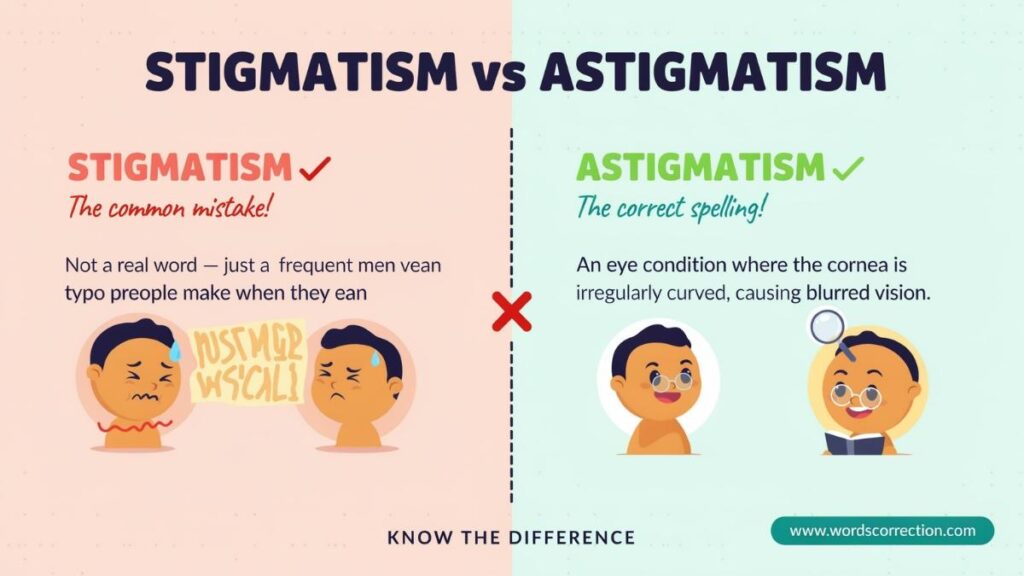
The confusion between Stigmatism vs Astigmatism often begins with one small spelling difference. Although these terms look and sound similar only one is the correct medical term for a common vision condition. Understanding Stigmatism vs Astigmatism makes it easier to distinguish the correct spelling from the common mistake. Astigmatism is a refractive error that affects how the eye focuses light, often causing blurred or distorted vision. Stigmatism, meanwhile, is generally a misspelling rather than a recognized eye condition. One extra syllable makes all the difference. Let’s explore Stigmatism vs Astigmatism understand the correct term, and clear up this common spelling confusion once and for all.
Quick Answer Stigmatism vs Astigmatism?
Astigmatism is the correct medical term for the eye condition that causes blurred or distorted vision because of uneven curvature in the cornea or natural lens. Stigmatism is not the standard medical name for this condition. People commonly use it as a shortened or mistaken version of astigmatism.
Here’s a quick comparison
| Term | Meaning | Correct medical usage |
|---|---|---|
| Astigmatism | A refractive error caused by uneven curvature of the cornea or lens | Correct |
| Stigmatism | An informal or mistaken form when referring to the eye condition | Not standard |
For example
- Correct: My optometrist diagnosed me with astigmatism.
- Incorrect in this medical context: My optometrist diagnosed me with stigmatism.
Remember this simple rule: If you’re discussing an eye condition that affects how light focuses inside the eye, use astigmatism.
What Is Astigmatism?
Astigmatism is a common vision condition in which the cornea or the eye’s natural lens has an uneven curvature. This irregular shape prevents light from focusing at a single point on the retina, which can result in blurred or distorted vision. Understanding Stigmatism vs Astigmatism also helps clarify the correct medical term and distinguish this condition from a common spelling mistake.
To understand the condition, it helps to know how your eyes work.
The cornea is the clear, dome-shaped front surface of the eye. It helps bend incoming light toward the retina, a light-sensitive layer at the back of the eye. The natural lens also changes the direction of light to help you focus on objects at different distances.
In an eye without significant astigmatism, the cornea and lens generally focus incoming light properly. However, when one or both have an uneven curve, light may focus at different points rather than forming one clear image.
Think of the difference between a basketball and a football. A basketball has a relatively round surface, while a football has a more oval shape. An eye with astigmatism often has a corneal curvature that resembles the football’s shape rather than a perfectly rounded surface.
This comparison makes the condition easier to understand, although actual corneal shapes are more complex.
Astigmatism can affect the cornea or the natural lens. It can also occur alongside other refractive errors, such as nearsightedness and farsightedness.
How Does Astigmatism Affect Vision?
Your eyes need to bend incoming light accurately to produce a clear image. Astigmatism changes this process because the eye’s curvature isn’t uniform.
Instead of focusing light evenly, different parts of the cornea or lens bend light differently. As a result, the image reaching the retina may appear stretched, blurred, or distorted.
This can affect your ability to
- Read small text on a phone or computer.
- Recognize distant objects and road signs.
- See fine details clearly.
- Focus comfortably while reading.
- Drive at night when headlights and streetlights appear distorted.
Some people experience blurred vision at all distances. Others notice more difficulty with particular tasks, depending on the type and degree of astigmatism.
Types of Astigmatism
Astigmatism can develop in different parts of the eye. Eye care professionals commonly distinguish between corneal and lenticular astigmatism.
Corneal astigmatism: This occurs when the cornea has different curvatures in different directions. For example, its vertical curve may be steeper than its horizontal curve.
Lenticular astigmatism: This develops when the natural lens inside the eye has an uneven curvature.
Eye professionals also describe astigmatism according to its curvature pattern.
- Regular astigmatism: The eye has different curvatures along two main directions that are usually perpendicular to each other.
- Irregular astigmatism: The curvature varies unevenly across the cornea or lens. This type can occur with corneal scarring, injury, or conditions such as keratoconus.
These distinctions matter because the type and severity of astigmatism can influence the most appropriate vision correction method.
What Does Stigmatism Mean?
When people search for stigmatism meaning or stigmatism eye meaning, they usually want to understand whether the word describes a real eye condition.
The important distinction is that stigmatism is not the standard medical term for the refractive error known as astigmatism.
People often drop the initial “a” when saying or writing the longer word. This may happen because astigmatism is relatively long and unfamiliar, especially to someone who has only heard it in conversation.
However, removing that letter changes the spelling. It doesn’t create an accepted alternative name for the medical condition.
Is Stigmatism a Word?
Yes, stigmatism can appear as a word in specialized or historical contexts. However, it isn’t the accepted medical term for the common vision condition.
This distinction is important. A word can exist without being appropriate for every context.
For example, affect and effect are both real English words, but they don’t mean the same thing. Similarly, the existence of stigmatism doesn’t make it an alternative spelling of astigmatism.
If you’re writing a medical article, describing an eye examination, or discussing a vision prescription, use astigmatism.
What Does Stigmatism of the Eye Mean?
The phrase stigmatism of the eye usually refers to astigmatism when someone uses the wrong or shortened term.
For example, a person might say, “I have stigmatism in my left eye.” They probably mean that an eye care professional diagnosed them with astigmatism.
The correct medical statement would be
“I have astigmatism in my left eye.”
Using the proper term helps prevent confusion when communicating with an optometrist, ophthalmologist, or other eye care professional.
Learn the difference between confusing more English words
Freshman or Freshmen what’s the Difference?
Stigmatism vs Astigmatism Key Differences
The difference between stigmatism vs astigmatism is mainly a matter of correct terminology. They aren’t two separate refractive errors with different symptoms or treatments.
Here’s how they compare in practical situations.
| Comparison | Astigmatism | Stigmatism |
|---|---|---|
| Correct medical term | Yes | No |
| Refers to a common refractive error | Yes | Not as a standard medical term |
| Used in eye prescriptions | Yes | No |
| Standard spelling in medical resources | Yes | No |
| Appropriate for medical writing | Yes | No |
| Refers to uneven corneal or lens curvature | Yes | Only when someone mistakenly intends astigmatism |
| Recommended in everyday conversation | Yes | Use astigmatism instead |
Correctness
Astigmatism is the correct spelling when referring to the eye condition. It is the term used by eye care professionals and established medical organizations.
Stigmatism is not an accepted substitute in this context. Although people may understand what someone means, using the correct spelling is better in formal and medical communication.
Medical Usage
Medical professionals use astigmatism to describe a refractive error involving uneven curvature of the cornea or natural lens.
You’ll find the term in
- Eye examination reports.
- Prescription eyeglasses records.
- Contact lens prescriptions.
- Ophthalmology textbooks.
- Medical research.
- Patient education materials.
The word stigmatism doesn’t serve as the standard diagnosis for this condition.
Dictionary and Medical Recognition
Astigmatism is an established medical term found in standard English dictionaries and medical references.
It has a specific meaning related to the eye’s ability to focus light. Medical organizations consistently use astigmatism when discussing this refractive error.
Pronunciation
The two spellings may sound similar when people speak quickly. However, the standard medical term includes the initial unstressed vowel sound.
Correct pronunciation and spelling help people recognize the term when discussing their vision with an eye care professional.
Everyday and Formal Usage
In casual conversation, someone might say stigmatism because they’ve heard others use it that way.
However, formal writing requires the accepted spelling.
For example
- Everyday conversation: “I think I have astigmatism.”
- Medical writing: “The patient has moderate corneal astigmatism.”
- Incorrect medical usage: “The patient has stigmatism.”
Eye Care Industry and Educational Materials
Eye care organizations, optometrists, ophthalmologists, and vision researchers use astigmatism in their educational and professional materials.
If you’re searching for information about symptoms, treatment, or diagnosis, using the correct spelling will also help you find more relevant medical resources.
Learn the difference between commonly mixed-up more words
Requestor or Requester Which Spelling Is Correct?
Astigmatism vs Stigmatism Pronunciation Guide
Spelling isn’t the only reason people confuse these terms. Pronunciation can also make astigmatism difficult to recognize, especially when someone hears it for the first time.
How to Pronounce Astigmatism
The standard American English pronunciation of astigmatism is
as-TIG-muh-tiz-um
- IPA: /əˈstɪɡ.məˌtɪz.əm/
- Syllables: as-tig-ma-tism
- Primary stress: The second syllable.
The first vowel is unstressed, so speakers often pronounce it quickly. This can make the word sound unfamiliar or cause listeners to remember an incomplete version.
How to Pronounce Stigmatism
Stigmatism is commonly pronounced
STIG-muh-tiz-um
However, pronouncing the shortened form doesn’t make it the correct medical name for the eye condition.
If you’re speaking with an eye doctor, use astigmatism to avoid confusion about the condition you’re describing.
Learn the difference between tricky grammar more words
Traveler or Traveller Which Spelling Is Correct?
Common Symptoms of Astigmatism
Astigmatism doesn’t affect everyone in exactly the same way. Some people experience noticeable blurred vision, while others have only mild symptoms.
The degree of astigmatism, the presence of other refractive errors, and individual visual needs can all influence how the condition feels.
Common astigmatism symptoms include blurry vision, headaches, eyestrain, squinting, and difficulty seeing at night. People with mild astigmatism may not notice any symptoms.
Here are the symptoms worth recognizing.
Blurred or distorted vision: Objects may look unclear, stretched, or slightly distorted. You might struggle to read small letters or recognize distant details.
Difficulty seeing at different distances: Unlike some other refractive errors, astigmatism can affect both near and distant vision.
Frequent headaches: Your eyes may work harder to focus when your vision isn’t clear. This can contribute to headaches, particularly after prolonged reading or screen use.
Eye strain and fatigue: You may experience tired or uncomfortable eyes after reading, driving, or working on a computer.
Squinting: People sometimes squint to make objects appear clearer. However, squinting doesn’t correct the underlying refractive error.
Difficulty seeing at night: Dim lighting and bright headlights may make existing vision problems more noticeable.
Why Do Lights Look Streaky or Blurry With Astigmatism?
One of the most common concerns associated with astigmatism is the appearance of lights at night.
You may notice that headlights, streetlights, and illuminated signs look stretched, blurred, or surrounded by glare. Some people describe these visual effects as starbursts or halos.
Why does this happen?
The uneven curvature of the cornea or lens changes how light enters and focuses inside the eye. Instead of producing a sharp image, the optical system may create a distorted image of bright objects.
For example, imagine driving along a dark road. A car approaches with its headlights on. Instead of seeing two clearly defined lights, you may notice streaks or glare around them.
This explains why searches for stigmatism vs astigmatism lights often relate to nighttime vision problems.
However, halos and glare aren’t exclusive to astigmatism. Cataracts, dry eyes, and other eye conditions can also cause similar symptoms.
If you notice new or worsening light disturbances, arrange an eye examination rather than assuming astigmatism is responsible.
Can You Have Astigmatism Without Symptoms?
Yes. Mild astigmatism may cause no noticeable vision problems.
You might read, use a computer, and perform everyday activities without realizing that your cornea or lens has an uneven curvature.
This is one reason regular eye examinations matter. An eye care professional can identify refractive errors even when you don’t experience obvious symptoms.
Children especially need appropriate vision screening because they may not realize that their eyesight differs from normal vision.
Learn the difference between confusing word pairs
Whoa or Woah Which Spelling Is Correct?
What Causes Astigmatism?
The main cause of astigmatism is an uneven curvature of the cornea or natural lens. However, several factors can influence how the condition develops.
Some people have astigmatism from birth, while others develop it during childhood, adulthood, or after an eye injury or surgery.
Several factors can contribute to astigmatism, including genetics, eye injuries, corneal scarring, keratoconus, and certain eye surgeries.
Genetics and Family History
Astigmatism often runs in families. If your parents or close relatives have the condition, you may have a greater chance of developing it.
Researchers don’t fully understand why the cornea and lens develop particular shapes. However, inherited characteristics can influence the structure of the eye.
Naturally Uneven Corneal Curvature
Some people are born with an irregularly shaped cornea.
Rather than having equal curvature in different directions, the cornea may be steeper along one axis than another. This creates a refractive error that affects how light focuses.
Eye Injuries and Corneal Scarring
An injury that damages the cornea can change its surface and create irregular curvature.
For example, a serious scratch, trauma, or other corneal damage may leave scar tissue. Depending on the location and severity, this can affect how light enters the eye.
Previous Eye Surgery
Certain eye procedures can change the shape of the cornea.
Some people develop astigmatism after surgery because healing or surgical changes affect the corneal surface. The amount of change depends on the procedure and individual eye characteristics.
Keratoconus
Keratoconus is an eye condition in which the cornea gradually becomes thinner and bulges outward into a cone-like shape.
This structural change can produce irregular astigmatism and increasingly distorted vision.
An important distinction: Ordinary astigmatism doesn’t automatically mean someone has keratoconus. However, unusual or progressive astigmatism may lead an eye doctor to investigate the cornea more closely.
Does Screen Time Cause Astigmatism?
No. Spending hours looking at a computer, phone, or television doesn’t directly cause the cornea to develop astigmatism.
However, prolonged screen use can contribute to digital eye strain. You may experience tired eyes, temporary blurred vision, headaches, or dryness.
These symptoms can feel similar to some astigmatism symptoms, but they have different causes.
Similarly, reading in dim light doesn’t cause astigmatism. It may make reading uncomfortable or contribute to temporary eye fatigue, but it doesn’t create an irregular corneal curvature.
Learn the difference between often confused words
How Is Astigmatism Diagnosed?
You can’t reliably diagnose astigmatism by looking at your eyes or comparing your symptoms with pictures online.
An optometrist or ophthalmologist can identify the condition through a comprehensive eye examination. The tests measure how clearly you see and how your eyes focus incoming light.
An astigmatism eye test is generally simple and painless.
Visual Acuity Test
A visual acuity test measures how clearly you can see letters, numbers, or symbols at a specific distance.
You may be asked to read a chart with progressively smaller letters while covering one eye at a time.
In the United States, results commonly use the 20/20 vision measurement system.
For example, someone with 20/40 vision can see at 20 feet what a person with standard 20/20 vision can see at 40 feet.
This test helps identify reduced visual clarity, although it doesn’t determine the exact cause by itself.
Refraction Test
A refraction test helps an eye care professional determine the prescription needed to correct your vision.
You may look through a phoropter, a device containing different lenses. The examiner changes the lenses and asks which option makes the letters appear clearer.
This process helps measure nearsightedness, farsightedness, and astigmatism.
Keratometry Test
Keratometry measures the curvature of the cornea.
The instrument assesses how steep or flat different areas of the corneal surface are. These measurements help identify corneal astigmatism and determine appropriate contact lens options.
Corneal Topography
Corneal topography creates a detailed map of the corneal surface.
It helps eye care professionals identify areas with different curvatures and detect unusual patterns that a basic examination might not fully explain.
This test can be particularly useful when an eye doctor suspects irregular astigmatism or keratoconus.
Important: An eye examination can also help identify other conditions that cause blurred vision. Don’t assume every vision problem comes from astigmatism.
Learn the difference between basic English word mistakes
Hierarchical vs Hierarchal Which Word Should You Use?
Astigmatism vs Other Eye Conditions
One of several refractive errors and eye conditions that can affect vision. However, its causes and effects differ from those of nearsightedness, farsightedness, keratoconus, and cataracts.
Understanding these differences helps explain why two people with blurry vision may need completely different treatments.
Astigmatism vs Nearsightedness (Myopia)
Astigmatism and nearsightedness both cause blurred vision, but they affect the eye’s focusing system differently.
Nearsightedness, also called myopia, usually occurs when the eyeball is too long or the cornea has excessive curvature. Light focuses in front of the retina rather than directly on it, making distant objects appear blurry.
Astigmatism happens when the cornea or lens has an uneven curvature. It can distort vision at both near and far distances.
| Feature | Astigmatism | Nearsightedness |
|---|---|---|
| Medical name | Astigmatism | Myopia |
| Main cause | Uneven curvature of cornea or lens | Eye length or excessive optical power |
| Common vision problem | Blurred or distorted vision | Blurry distant vision |
| Near vision | May also be affected | Often clearer |
| Far vision | May be affected | Commonly blurry |
| Correction | Cylindrical or specialized lenses | Minus-powered lenses |
Can you have both conditions? Absolutely.
Many people have astigmatism alongside myopia. Their eyeglass prescriptions account for both problems.
Astigmatism vs Farsightedness (Hyperopia)
Farsightedness, or hyperopia, makes nearby objects harder to focus on. It usually occurs when the eyeball is too short or the eye’s optical power is insufficient.
Astigmatism, by contrast, involves unequal curvature that affects how light focuses.
Both conditions can occur in the same eye.
For example, someone may need prescription lenses to correct farsightedness and additional cylindrical correction to address astigmatism.
Astigmatism vs Presbyopia
Presbyopia is an age-related focusing problem.
As people grow older, the natural lens inside the eye becomes less flexible. This makes it harder to focus on nearby objects, such as books, menus, and phone screens.
Astigmatism has a different cause uneven curvature of the cornea or lens.
| Feature | Astigmatism | Presbyopia |
|---|---|---|
| Main cause | Uneven curvature | Reduced lens flexibility |
| Typical development | Often present from birth or develops earlier | Usually begins in middle age |
| Main difficulty | Blurred or distorted vision | Difficulty focusing up close |
| Treatment | Glasses, contacts, or surgery | Reading glasses, contacts, or selected procedures |
A person can develop both conditions. For example, someone with astigmatism may eventually need reading glasses as age-related changes affect near vision.
Astigmatism vs Keratoconus
Keratoconus is more than an ordinary refractive error. It is a progressive corneal condition in which the cornea becomes thinner and gradually bulges outward.
Astigmatism can occur because of uneven corneal curvature. Keratoconus can create severe irregular astigmatism as the cornea changes shape.
The key differences include
- Astigmatism: Often involves relatively regular differences in corneal or lens curvature.
- Keratoconus: Involves progressive thinning and structural changes in the cornea.
- Vision: Both can cause blurred and distorted vision, but keratoconus may cause increasingly irregular distortion.
- Diagnosis: Keratoconus often requires corneal imaging, such as corneal topography or tomography.
- Treatment: Ordinary astigmatism may need corrective lenses, while keratoconus may require specialized contact lenses or corneal cross-linking to slow progression.
Corneal cross-linking is particularly important because it aims to strengthen corneal tissue and slow or stop the progression of keratoconus. It isn’t simply another way to correct ordinary astigmatism.
Astigmatism vs Cataracts
Astigmatism and cataracts can both cause blurry vision, but they affect different aspects of the eye.
It involves uneven curvature of the cornea or natural lens. Cataracts develop when the natural lens becomes cloudy, reducing the amount and quality of light that reaches the retina.
| Feature | Astigmatism | Cataracts |
|---|---|---|
| Main problem | Uneven optical curvature | Clouding of the natural lens |
| Vision changes | Blurred or distorted images | Cloudy, hazy, or faded vision |
| Common symptoms | Eye strain, headaches, distorted vision | Glare, faded colors, poor night vision |
| Typical treatment | Glasses, contact lenses, or refractive surgery | Cataract surgery when needed |
Cataracts become more common with age. Astigmatism, however, can affect children and adults.
It’s also possible to have both conditions. Cataract surgery may sometimes change a person’s astigmatism, and surgeons can use specific techniques or lens options to address it.
Learn the difference between commonly misused words
Eying or Eyeing Which Spelling Is Correct?
How Is Astigmatism Treated?
The good news is that most people with astigmatism can improve their vision with corrective lenses. The appropriate treatment depends on the degree of astigmatism, the shape of the cornea, overall eye health, and personal needs.
Some people with mild astigmatism don’t need treatment if it doesn’t interfere with their daily activities. Others benefit from prescription glasses, contact lenses, or refractive surgery.
Prescription Glasses for Astigmatism
Prescription glasses are one of the simplest and most common ways to correct astigmatism.
Unlike ordinary lenses that mainly correct nearsightedness or farsightedness, astigmatism glasses often include cylindrical power. This helps compensate for the eye’s uneven curvature.
An astigmatism prescription generally includes three important measurements
- Sphere (SPH): Measures the correction needed for nearsightedness or farsightedness.
- Cylinder (CYL): Measures the amount of astigmatism correction required.
- Axis: Indicates the orientation of the cylindrical correction, measured from 0 to 180 degrees.
For example, a prescription might include a cylinder measurement of -1.50 and an axis of 90 degrees. These numbers tell the lens manufacturer how to position the corrective power.
The exact prescription depends on your eye examination. You shouldn’t use another person’s glasses because their measurements may not match your vision needs.
Toric Contact Lenses for Astigmatism
Toric contact lenses are specially designed to correct astigmatism.
Unlike standard spherical contact lenses, toric lenses have different optical powers in different directions. Their design helps compensate for uneven corneal or lenticular curvature.
Some toric lenses contain features that help them stay properly oriented on the eye.
Common options include
- Soft toric contact lenses.
- Rigid gas-permeable lenses.
- Specialty contact lenses for irregular astigmatism.
Rigid gas-permeable lenses can sometimes provide clearer vision for people with irregular corneal surfaces because their firm optical surface helps create a more regular focusing surface.
However, not every lens suits every patient. Proper fitting, cleaning, and regular replacement are essential for contact lens safety.
Orthokeratology (Ortho-K)
Orthokeratology uses specially designed rigid contact lenses worn overnight to temporarily reshape the cornea.
After removing the lenses in the morning, some people can see more clearly during the day without glasses or contact lenses.
However, the effect is temporary. The cornea gradually returns toward its original shape when someone stops wearing the lenses.
Ortho-K isn’t appropriate for everyone with astigmatism. An eye care professional must evaluate the cornea and determine whether the treatment is suitable.
LASIK Eye Surgery
LASIK is a refractive surgery that uses a laser to reshape the cornea and improve how light focuses on the retina.
It can correct certain cases of astigmatism, nearsightedness, and farsightedness.
During the procedure, a surgeon creates a thin corneal flap and uses a laser to reshape the underlying tissue. The flap is then repositioned.
LASIK may reduce or eliminate the need for prescription glasses, but results vary.
Potential risks include
- Dry eyes.
- Glare and halos.
- Under-correction or over-correction.
- Changes in night vision.
- Corneal complications.
A comprehensive eye examination helps determine whether your corneal thickness, prescription stability, and general eye health make you a suitable candidate.
PRK Surgery
Photorefractive keratectomy (PRK) is another laser procedure used to correct certain refractive errors, including astigmatism.
Unlike LASIK, PRK doesn’t create a corneal flap. Instead, the surgeon removes the thin outer layer of the cornea and uses a laser to reshape the underlying tissue.
The surface layer then grows back during healing.
PRK may be considered for people who aren’t suitable candidates for LASIK because of particular corneal characteristics. However, recovery usually takes longer, and patients may experience discomfort during the initial healing period.
LASIK and PRK aren’t suitable for everyone. An ophthalmologist must assess your eyes, discuss potential risks, and explain realistic treatment outcomes before recommending surgery.
Learn the difference between everyday English mistakes
Passtime or Pastime Which Spelling Is Correct?
Can Astigmatism Get Worse Over Time?
Yes, astigmatism can change over time. However, it doesn’t necessarily become worse for everyone.
Some people have relatively stable astigmatism for many years. Others experience gradual changes as their eyes grow, age, or develop other conditions.
Astigmatism can increase, decrease, or remain stable over time.
Several factors can influence these changes
- Natural changes in the cornea or lens.
- Eye growth during childhood.
- Age-related changes in the natural lens.
- Eye injuries or corneal scarring.
- Conditions such as keratoconus.
- Changes following certain eye surgeries.
If your vision becomes blurry even when wearing your usual glasses, you may need an updated prescription or further examination.
Does Astigmatism Go Away on Its Own?
Astigmatism doesn’t usually disappear simply because you wait.
Some children experience changes in astigmatism as their eyes develop. Adults may also experience changes in their measurements over time.
However, there is no reliable home remedy that can reshape the cornea and permanently eliminate astigmatism.
Prescription lenses can correct the resulting vision problems, while suitable surgical procedures may reduce the refractive error.
Can Astigmatism Improve Naturally?
Astigmatism measurements can change naturally, but that doesn’t mean eye exercises, supplements, or special diets can cure the condition.
Healthy habits support overall eye health. They don’t correct an uneven corneal curvature.
Be cautious of products that promise to reverse astigmatism without an eye examination or medically supported treatment.
Can Astigmatism Cause Blindness?
Ordinary astigmatism doesn’t typically cause blindness. It is a refractive error that affects visual clarity rather than directly damaging the retina or optic nerve.
However, significant uncorrected astigmatism during childhood can interfere with normal visual development and contribute to amblyopia, commonly called lazy eye.
Also, some conditions associated with irregular astigmatism, such as advanced keratoconus, can seriously affect vision.
If your eyesight changes suddenly or you experience severe eye pain, seek prompt medical attention. Don’t automatically blame these symptoms on astigmatism.
Learn the difference between more words people mix up
Ingage vs Engage Which Word Is Correct?
Astigmatism in Children and Adults
It can affect people at different stages of life. Some children are born with it, while others develop it as their eyes grow. Adults can also experience changes in corneal or lens curvature.
The main concern isn’t simply whether someone has astigmatism. It’s whether the condition affects their vision and whether they need correction.
Astigmatism in Children
Children may not realize that their vision is blurry because they assume everyone sees the same way.
A child with uncorrected astigmatism might
- Squint when looking at a classroom board.
- Hold books unusually close to the face.
- Struggle to recognize distant objects.
- Complain about headaches.
- Avoid reading or other activities that require clear vision.
- Have difficulty concentrating on visual tasks.
Significant uncorrected astigmatism can contribute to amblyopia during visual development, especially when the two eyes have different refractive errors.
Early eye examinations help identify problems before they interfere with normal visual development.
Prescription glasses are often the first treatment for children who need correction. An eye care professional can recommend an appropriate prescription and monitor changes as the child grows.
Astigmatism in Adults
Adults may notice blurred vision, headaches, eye strain, and difficulty seeing clearly at night.
Some people discover the condition during routine eye examinations rather than because of noticeable symptoms.
Others experience changes in their prescription over time.
If you suddenly struggle to read road signs, notice distorted images, or experience persistent headaches while reading, an eye examination can help determine whether astigmatism or another vision problem is responsible.
Learn the difference between tricky English words with easy explanations
Implicit vs Complicit what’s the Differences?
Common Myths and Misconceptions About Astigmatism
Astigmatism is a familiar vision condition, but several myths surround its causes and treatment.
Let’s separate common misconceptions from medical facts.
Myth Astigmatism Means You Have Poor Eyesight
Fact: Having astigmatism doesn’t automatically mean you have severe vision problems.
Mild astigmatism may cause little or no noticeable discomfort. Many people achieve clear vision with ordinary prescription glasses or contact lenses.
The impact depends on the amount and type of astigmatism.
Myth Reading in Dim Light Causes Astigmatism
Fact: Reading in poor lighting doesn’t create an irregular corneal curvature.
It may make reading uncomfortable or contribute to temporary eye fatigue, but it doesn’t cause astigmatism.
Myth: Wearing Glasses Makes Astigmatism Worse
Fact: Prescription glasses don’t weaken your eyes or increase astigmatism.
They simply compensate for the way your eyes focus light. If your vision changes while wearing glasses, your prescription may need updating.
Myth Everyone With Astigmatism Sees Streaky Lights
Fact: Some people notice halos, glare, or streaks around lights, particularly at night. Others experience ordinary blurred vision without noticeable light distortion.
Symptoms vary according to the severity and type of astigmatism.
Myth Astigmatism Always Requires Surgery
Fact: Most people can manage their vision with prescription glasses or contact lenses.
Surgery is an option for selected patients, not a requirement for everyone with the condition.
Myth Astigmatism and Nearsightedness Are the Same
Fact: They are different refractive errors.
Myopia primarily affects distance vision, while astigmatism results from uneven optical curvature and can affect vision at different distances.
However, both conditions can occur together.
Stigmatism vs Astigmatism Common Spelling and Usage Mistakes
Because astigmatism is a relatively long word, people sometimes misspell it or shorten it when speaking and writing.
The most common mistake is leaving out the first letter.
Here are a few examples
| Incorrect usage | Correct usage |
|---|---|
| I have stigmatism. | I have astigmatism. |
| Stigmatism affects my vision. | Astigmatism affects my vision. |
| My doctor checked my stigmatism. | My doctor checked my astigmatism. |
| I need glasses for stigmatism. | I need glasses for astigmatism. |
| What causes stigmatism of the eye? | What causes astigmatism of the eye? |
Is Stigmatism Another Name for Astigmatism?
No. Astigmatism is the established medical term. Stigmatism isn’t a recognized alternative diagnosis for the same condition.
People may use both spellings when talking casually, but that doesn’t make them interchangeable in medical writing.
Can You Say Stigmatism Instead of Astigmatism?
You might hear people use stigmatism in everyday conversation. Most listeners will probably understand what they mean if the context involves blurry vision or an eye prescription.
However, using the correct term is still the better choice.
For example, if you visit an optometrist, ask about an astigmatism prescription rather than a stigmatism prescription.
How Do You Spell Astigmatism Correctly?
The correct spelling is
A-S-T-I-G-M-A-T-I-S-M
A useful way to remember it is to focus on the first three letters: AST.
Don’t remove the initial “a.” That small letter separates the accepted medical term from the common spelling mistake.
Learn the difference between confusing more English words step by step
Xenodochial vs Xenodochium Which Word Should You Use?
Correct Usage Examples Astigmatism in Everyday Sentences
Understanding the correct spelling is easier when you see how the word works in different situations.
Here are examples of how to use astigmatism naturally.
Examples Everyday Conversation
- “I have astigmatism, so I wear prescription glasses when driving.”
- “My sister was diagnosed with astigmatism during a routine eye examination.”
- “Bright headlights bother me because my astigmatism affects my night vision.”
- “I need new glasses because my astigmatism prescription has changed.”
Examples in Medical Communication
- “The patient has moderate astigmatism in both eyes.”
- “The eye examination revealed irregular corneal curvature.”
- “The optometrist recommended toric contact lenses to correct the patient’s astigmatism.”
- “Corneal topography was performed to evaluate possible irregular astigmatism.”
in Formal Writing
- “Astigmatism is a common refractive error that affects the focusing ability of the eye.”
- “The condition may occur alongside nearsightedness or farsightedness.”
- “Prescription lenses can improve visual clarity in patients with astigmatism.”
- “Regular eye examinations help identify changes in refractive errors.”
Examples of Common Spelling Errors
Incorrect: “My doctor says I have stigmatism.”
Correct: “My doctor says I have astigmatism.”
Incorrect: “Can stigmatism affect night vision?”
Correct: “Can astigmatism affect night vision?”
Incorrect: “I need special glasses for stigmatism.”
Correct: “I need special glasses for astigmatism.”
British vs American English Is Astigmatism Spelled Differently?
Some English words have different spellings in American and British English. For example, Americans write color, while British writers usually write colour.
However, astigmatism has the same standard spelling in both varieties of English.
| Language variety | Correct spelling | Incorrect alternative |
|---|---|---|
| American English | Astigmatism | Stigmatism |
| British English | Astigmatism | Stigmatism |
| Australian English | Astigmatism | Stigmatism |
| Canadian English | Astigmatism | Stigmatism |
Pronunciation may vary slightly between speakers and regions, but the spelling doesn’t change.
Whether you’re writing a medical report in the United States or discussing an eye examination in the United Kingdom, astigmatism remains the correct term.
Why the Difference Between Stigmatism vs Astigmatism Matters
At first glance, leaving out one letter might seem like a harmless mistake. After all, people often understand what someone means when they say stigmatism.
However, correct terminology matters when discussing medical conditions.
Consider someone searching online for information about an eye problem. If they search for the wrong term, they may encounter irrelevant results or miss useful information about symptoms, diagnosis, and treatment.
Using astigmatism helps you
- Find reliable medical information.
- Understand an eye prescription.
- Communicate accurately with an optometrist.
- Read medical reports without confusion.
- Recognize the correct name of the condition.
- Search for appropriate vision correction options.
The distinction also matters in educational and professional writing. Medical terminology should be consistent because even small spelling differences can affect clarity.
When Should You See an Eye Doctor?
Occasional blurry vision doesn’t always indicate a serious eye problem. However, persistent changes in eyesight deserve attention.
Schedule an eye examination if you experience
- Frequent blurred or distorted vision.
- Regular headaches after reading.
- Difficulty focusing on distant or nearby objects.
- Persistent eye strain or fatigue.
- Difficulty driving at night.
- Increasing glare or halos around lights.
- Frequent squinting to see clearly.
An optometrist can perform an eye examination and determine whether astigmatism, myopia, or another condition explains your symptoms.
Seek urgent medical attention if you experience sudden vision loss, sudden major changes in vision, severe eye pain, or new flashes and floaters. These symptoms shouldn’t be assumed to result from astigmatism.
Practice Session Stigmatism vs Astigmatism
Fill in the blanks with the correct words to test your understanding of astigmatism, its symptoms, causes, and treatment.
- The correct medical term is __________.
- Stigmatism is a common __________ of astigmatism.
- Astigmatism affects the shape of the __________.
- Astigmatism is a type of __________ error.
- Uneven corneal curvature causes __________ vision.
- Astigmatism can affect one or __________ eyes.
- Blurred vision is a common __________ of astigmatism.
- Astigmatism can cause eye strain and __________.
- People with astigmatism may experience glare around __________.
- Astigmatism can make night __________ difficult.
- The three main types include myopic, hyperopic, and __________ astigmatism.
- Astigmatism can be passed down through __________.
- An eye specialist uses an eye __________ to diagnose astigmatism.
- __________ lenses can help correct astigmatism.
- Prescription glasses may contain __________ correction.
- LASIK is a type of refractive __________.
- The __________ receives focused light inside the eye.
- Keratoconus can change the shape of the __________.
- An optometrist can recommend suitable __________ lenses.
- Mild astigmatism may not cause noticeable __________.
- Astigmatism can develop during __________ or adulthood.
- The __________ measures the curvature of the cornea.
- Astigmatism may cause blurred vision at different __________.
- Not wearing glasses does not generally make astigmatism __________.
- Regular eye __________ help monitor changes in vision.
Answers
- Astigmatism
- Misspelling
- Cornea
- Refractive
- Blurred
- Both
- Symptom
- Headaches
- Lights
- Driving
- Mixed
- Genetics
- Examination
- Toric
- Cylindrical
- Surgery
- Retina
- Cornea
- Contact
- Symptoms
- Childhood
- Keratometer
- Distances
- Worse
- Examinations
Here’s a trusted source for clear word meanings:
FAQ’s
Can stigmatism be corrected?
Yes. Astigmatism can be corrected with prescription eyeglasses, specialized contact lenses, or refractive surgery, depending on its severity and individual eye health.
Do I need glasses if I have astigmatism?
Not everyone with astigmatism needs glasses. However, corrective lenses may be recommended when the condition causes blurred vision, eye strain, or difficulty performing everyday activities.
What are the three types of astigmatism?
The three main types are myopic astigmatism, hyperopic astigmatism, and mixed astigmatism. Each type describes how light focuses in relation to the retina.
What causes astigmatism to get worse?
Changes in corneal curvature, certain eye conditions, injuries, and progressive conditions such as keratoconus can cause astigmatism to worsen over time.
At what age does astigmatism worsen?
Astigmatism can change at any age. Although it often remains relatively stable during adulthood, changes in the cornea or lens may affect its severity as a person gets older.
Which parent passes down astigmatism?
Astigmatism can be inherited from either parent. Genetic factors from both sides of the family may influence the development of this vision condition.
Do you inherit eyes from mom or dad?
You inherit eye characteristics from both parents. Their genes contribute to features such as eye color, shape, and certain vision-related conditions, including astigmatism.
Is astigmatism a trait of autism?
No. Astigmatism is not a defining characteristic of autism. It is a common refractive error caused by an irregular curvature of the cornea or lens.
What should you avoid if you have astigmatism?
Avoid ignoring persistent changes in vision or skipping recommended eye examinations. Make sure you have adequate lighting when reading or working, and follow your eye specialist’s recommendations.
What do people with astigmatism struggle with?
People with astigmatism may experience blurred or distorted vision, difficulty reading, eye strain, headaches, and increased glare when looking at lights, particularly at night.
What glasses should I wear if I have astigmatism?
People with astigmatism generally need prescription glasses containing cylindrical correction. An optometrist determines the appropriate lens power and axis based on an eye examination.
Is it worth getting glasses just for astigmatism?
Yes, prescription glasses can be beneficial when astigmatism interferes with clear vision or everyday activities. The need for corrective lenses depends on the severity of the condition and associated symptoms.
Does not wearing my glasses make my astigmatism worse?
No. Not wearing prescribed glasses does not generally worsen astigmatism or change the shape of the cornea. However, it can leave vision blurry and make visual activities less comfortable.
What is the root cause of astigmatism?
The primary cause of astigmatism is an uneven curvature of the cornea or the lens inside the eye. This irregular shape prevents light from focusing at a single point on the retina, resulting in distorted vision.
Do I have to wear glasses forever if I have astigmatism?
No. Although many people manage astigmatism with prescription glasses or contact lenses, some may qualify for refractive procedures such as LASIK or PRK. Treatment options depend on individual eye health and eligibility.
Can astigmatism affect both eyes?
Yes. Astigmatism can develop in one or both eyes. Its severity may vary between the eyes, meaning one eye may require a different prescription from the other.
Can astigmatism cause double vision?
Astigmatism can cause blurred or distorted vision, including ghosting or shadow-like images around objects. These symptoms may sometimes resemble double vision.
Does astigmatism make reading difficult?
Yes. Astigmatism can make letters and words appear blurred or distorted, affecting reading comfort. Some people also experience headaches or eye strain during prolonged reading.
Can astigmatism cause blurry vision in the morning?
Astigmatism can cause blurred vision throughout the day rather than exclusively in the morning. However, temporary morning blurriness may also result from dry eyes or other eye-related conditions.
Can astigmatism cause dizziness?
Uncorrected astigmatism may contribute to visual discomfort, headaches, and difficulty focusing. Some people also report dizziness, although persistent dizziness can have other underlying causes.
Can astigmatism develop later in life?
Yes. Although astigmatism commonly develops during childhood, it can also appear or change during adulthood because of changes in the cornea, eye lens, or other eye conditions.
Is mild astigmatism a problem?
Mild astigmatism does not always cause noticeable symptoms or require treatment. However, an eye examination can determine whether corrective lenses or monitoring are necessary.
Can astigmatism go away naturally?
Stigmatism vs Astigmatism is a common spelling confusion, but astigmatism does not usually disappear naturally because it involves the physical curvature of the cornea or lens. When comparing Stigmatism vs Astigmatism, it is important to understand that the condition may change in severity over time, but corrective treatment may be necessary to improve vision.
How often should someone with astigmatism get an eye test?
Understanding Stigmatism vs Astigmatism can help you find accurate information about this vision condition. The recommended frequency of eye examinations depends on age, vision changes, prescription stability, and overall eye health. An optometrist can recommend an appropriate examination schedule to monitor astigmatism and maintain good vision.
Can astigmatism affect driving at night?
Yes. Astigmatism can cause headlights and streetlights to appear blurry, stretched, or surrounded by glare and halos. These visual disturbances may make night driving more challengingn.
Conclusion
Understanding the difference between Stigmatism vs Astigmatism helps you avoid a common spelling mistake and use the correct medical terminology. Astigmatism is the proper term for a common refractive error that affects how the eye focuses light, often causing blurred or distorted vision. Stigmatism, on the other hand, is generally a misspelling rather than a recognized eye condition.
Although Stigmatism vs Astigmatism may seem like a minor spelling distinction, using the correct term is important when discussing eye health or searching for reliable medical information. Knowing the difference between Stigmatism vs Astigmatism also helps you understand the condition and recognize its correct terminology.
If you are researching Stigmatism vs Astigmatism because of persistent blurred vision, eye strain, or difficulty focusing, consult an eye care professional for an accurate diagnosis. Learning about Stigmatism vs Astigmatism can also help you find relevant information about symptoms, causes, and treatment options. Ultimately, Stigmatism vs Astigmatism highlights how a small spelling difference can create confusion, but using the correct term makes communication clearer and more accurate.

Stella AJS is an experienced blogger and dedicated English language writer at Words Correction. She turns confusing grammar, word meanings, spelling, and usage into clear, practical insights that readers can easily understand and apply. With a passion for precise and engaging writing, Stella helps readers avoid common language mistakes, strengthen their vocabulary, and communicate with greater clarity and confidence.




