
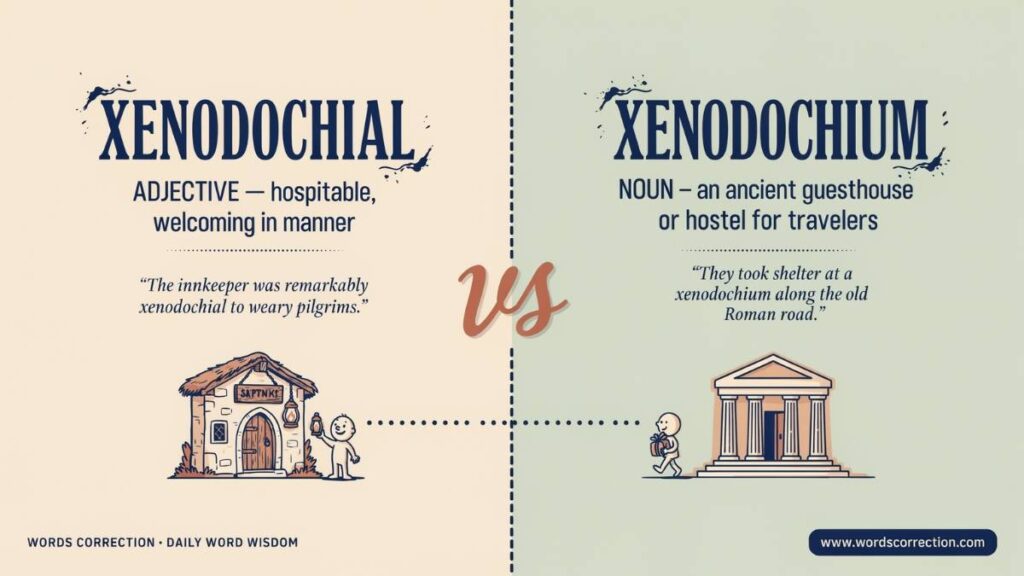
English can be confusing especially when two unusual words look and sound similar. Xenodochial vs Xenodochium is a good example. Both words are connected to hospitality and welcoming strangers but they have different meanings and uses. One describes a person’s friendly attitude toward strangers while the other refers to a place that provides shelter for travelers and guests. Mixing them up can easily lead to a vocabulary mistake. In this article you’ll learn what each word means how they differ where they come from and how to use them correctly in everyday writing.
Xenodochial vs Xenodochium Quick Difference
The easiest way to understand these words is to examine what each one describes. Although they share a connection with hospitality, their grammatical functions are different.
| Feature | Xenodochial | Xenodochium |
|---|---|---|
| Part of speech | Adjective | Noun |
| Basic meaning | Friendly toward strangers | A guesthouse for strangers |
| Describes | A person’s attitude or behavior | A place or institution |
| Main association | Hospitality and friendliness | Accommodation and shelter |
| Historical connection | Receiving strangers | Guesthouses and religious institutions |
| Modern usage | Rare adjective | Rare historical noun |
| Example | The host was xenodochial. | The monastery maintained a xenodochium. |
Remember this simple distinction
- Xenodochial describes how someone treats strangers.
- Xenodochium identifies a place where strangers receive hospitality.
For example, imagine a medieval monastery with a separate building for visiting pilgrims. The building could be described as a xenodochium. The monks who welcomed those visitors could be described as xenodochial.
Both words belong to the vocabulary of hospitality, but they perform different grammatical functions.
What Does Xenodochial Mean?
The word xenodochial means friendly, welcoming, or hospitable toward strangers. It describes someone who receives unfamiliar people with kindness rather than suspicion or hostility.
If a person makes visitors feel comfortable, offers help to newcomers, and treats unfamiliar guests with respect, their behavior could be described as xenodochial.
The xenodochial meaning goes beyond ordinary politeness. It emphasizes openness toward people who aren’t already part of someone’s family, community, or social circle.
For example, imagine a homeowner who welcomes travelers into their house, offers them a meal, and helps them find a safe place to stay. Their actions demonstrate a friendly and hospitable nature.
However, xenodochial is an uncommon word in modern English. Although it has a clear meaning, writers generally prefer more familiar alternatives such as welcoming, hospitable, and friendly.
Xenodochial Definition and Grammatical Function
The xenodochial definition identifies it as an adjective. An adjective describes a noun or pronoun by providing information about its qualities or characteristics.
In this case, xenodochial describes a welcoming attitude toward strangers.
Consider these examples
- A xenodochial host welcomes unfamiliar visitors.
- The community maintained a xenodochial attitude toward travelers.
- Her xenodochial nature made international guests feel comfortable.
- The organization encouraged xenodochial behavior among its volunteers.
In each example, the adjective describes a person, group, attitude, or type of behavior.
The word can also appear in formal and historical discussions of hospitality. However, it isn’t a common choice in everyday conversation.
Grammar tip: Xenodochial is not a noun for a guesthouse or accommodation facility. It describes a quality or characteristic.
What Does Xenodochial Mean in Simple Words?
In simple words, xenodochial means friendly toward people you don’t know.
Think about two different situations
- A visitor enters a room, but everyone ignores them.
- A visitor enters another room, and someone welcomes them, offers assistance, and makes them feel included.
The second situation demonstrates xenodochial behavior.
You don’t need an elaborate gesture to show this quality. Small actions can communicate hospitality, including:
- Greeting unfamiliar visitors warmly.
- Offering directions to someone who looks lost.
- Helping a newcomer feel included.
- Providing food or shelter to a traveler.
- Treating foreign guests with kindness and respect.
These examples capture the central idea behind the xenodochial word meaning: a willingness to welcome strangers.
Xenodochial Synonym and Antonym
Understanding related words can make xenodochial easier to use.
Possible synonyms include
- Hospitable
- Welcoming
- Friendly
- Cordial
- Amiable
- Generous
- Warm
- Neighborly
These words aren’t perfect replacements in every context. For instance, amiable generally describes a pleasant personality, while xenodochial specifically emphasizes friendliness toward strangers.
Possible antonyms include
- Xenophobic
- Unwelcoming
- Hostile
- Inhospitable
- Unfriendly
- Antagonistic
The most closely related opposite is xenophobic, which describes fear, dislike, or prejudice toward foreigners or strangers.
A xenodochial person welcomes unfamiliar visitors. A xenophobic person may distrust or reject them because they are outsiders.
Learn the difference between more words people mix up
Benefitting or Benefiting Which Spelling Is Correct?
What Does Xenodochium Mean?
A xenodochium is a guesthouse or place established to receive strangers, travelers, and pilgrims. Historically, the term referred particularly to accommodation connected with religious institutions, including monasteries.
Unlike xenodochial, which describes a personal quality, xenodochium identifies a physical place or institution.
These establishments served an important purpose when traveling was difficult. Roads could be dangerous, accommodation was limited, and many travelers had few reliable places to rest.
Religious communities sometimes provided shelter, meals, and other forms of assistance to people passing through their areas. A xenodochium could offer temporary accommodation to pilgrims, poor travelers, and other visitors who needed help.
Historically, the term referred to guesthouses that received strangers in ancient times and to facilities associated with medieval monasteries that accommodated pilgrims, visitors, and people in need.
Xenodochium Definition and Grammatical Function
The xenodochium definition identifies it as a noun. A noun names a person, place, thing, or idea.
Here, it names a place that provides hospitality to strangers.
For example
- The monastery established a xenodochium for visiting pilgrims.
- Travelers found shelter in the ancient xenodochium.
- Historical records mention a xenodochium near the church.
- The religious community maintained its xenodochium for people in need.
Notice that each sentence uses xenodochium to identify a location or institution.
The word is particularly useful in historical, religious, and academic writing. It can describe an old guesthouse without requiring a lengthy explanation every time.
What Does Xenodochium Mean in History?
Historically, a xenodochium was more than a simple place to sleep. It represented an organized form of hospitality toward people who needed temporary accommodation.
In ancient and medieval societies, travelers included
- Religious pilgrims visiting sacred places.
- Merchants traveling between towns.
- Foreign visitors and messengers.
- Poor people seeking temporary assistance.
- Travelers who became ill or needed care.
Religious communities played an important role in this tradition. Monasteries could maintain guest facilities within their larger premises, allowing them to receive visitors while continuing their religious activities.
Historical accounts describe monasteries that provided daily support to poor people and welcomed travelers seeking assistance. These examples show that a xenodochium could serve a wider charitable purpose than accommodation alone.
Xenodochium Plural Form Is It Xenodochiums or Xenodochia?
The traditional Latin-style plural of xenodochium is xenodochia.
This follows the pattern of certain Latin neuter nouns ending in -ium, which form their plurals by changing the ending to -ia.
| Form | Word |
|---|---|
| Singular | Xenodochium |
| Traditional plural | Xenodochia |
For example
- Singular: The monastery maintained a xenodochium.
- Plural: Several monasteries maintained xenodochia for visiting pilgrims.
The xenodochia plural is especially useful in historical and academic writing.
You may also encounter the English plural xenodochiums. However, xenodochia is the traditional form.
Learn the difference between everyday English mistakes
Freshman or Freshmen what’s the Difference?
Xenodochial vs Xenodochium Meaning and Usage
Although these words share a connection with welcoming strangers, their meanings become clearer when you examine how they function in actual sentences.
The easiest way to distinguish them is to ask one question:
Are you describing someone’s behavior or naming a place?
If you’re describing a welcoming personality, xenodochial is the appropriate choice. If you’re referring to a historical guesthouse, xenodochium is the correct word.
Consider the following situations:
| Situation | Correct word | Reason |
|---|---|---|
| A host welcomes foreign visitors warmly. | Xenodochial | Describes the host’s attitude. |
| A monastery provides shelter to pilgrims. | Xenodochium | Names the guesthouse. |
| A person treats strangers kindly. | Xenodochial | Describes personal behavior. |
| A historical institution accommodates travelers. | Xenodochium | Identifies a place. |
| A community welcomes newcomers. | Xenodochial | Describes the community’s attitude. |
Understanding the Difference Through a Practical Example
Imagine a monastery situated along a popular pilgrimage route during the Middle Ages.
The monastery has a separate guesthouse where travelers can rest, eat, and receive basic assistance. The monks welcome visitors regardless of where they come from.
In this situation
- The guesthouse is a xenodochium.
- The monks’ welcoming attitude is xenodochial.
- The hospitality they provide reflects kindness toward strangers.
This example demonstrates how both words can appear in the same discussion without having interchangeable meanings.
Xenodochial vs Xenodochium Examples
Here are additional examples to help you recognize the difference.
Xenodochial examples
- The xenodochial family welcomed travelers who needed a place to rest.
- Her xenodochial personality helped international students feel at home.
- The village became known for its xenodochial treatment of visitors.
- The organization promoted xenodochial values among its volunteers.
- His xenodochial nature made unfamiliar guests feel comfortable.
- The monks displayed a xenodochial attitude toward passing pilgrims.
Xenodochium examples
- The monastery built a xenodochium to accommodate visiting pilgrims.
- Historical documents describe a xenodochium that sheltered poor travelers.
- The ancient xenodochium provided temporary lodging for strangers.
- Researchers discovered references to several xenodochia in historical records.
- The religious institution maintained a xenodochium near its main church.
- Travelers could receive food and shelter at the monastery’s xenodochium.
The distinction remains consistent: one word describes hospitality as a quality, while the other names an institution associated with providing it.
Learn the difference between commonly misused words
Requestor or Requester Which Spelling Is Correct?
Xenodochial vs Xenial What’s the Difference?
The words xenodochial and xenial share a connection with hospitality, but they don’t have exactly the same meaning.
Xenial describes something related to hospitality or the relationship between a host and a guest. It can also describe a warm, welcoming, and hospitable attitude.
Xenodochial has a narrower emphasis it describes friendliness toward strangers.
Both adjectives have connections to Greek hospitality-related vocabulary. However, their meanings and historical development differ.
Xenial Meaning
The word xenial refers to hospitality, particularly the relationship between a host and a guest. It has roots in the Ancient Greek concept of xenia, which involved welcoming and respecting guests.
In ancient Greek culture, hospitality was an important social obligation. A host was expected to receive guests appropriately, offer protection, and provide food or shelter when necessary.
For example
- The hotel staff maintained a xenial atmosphere throughout the visit.
- The ancient Greeks valued xenial relationships between hosts and guests.
- Their xenial customs encouraged kindness toward visitors from distant lands.
Xenial also appears in specialized botanical contexts. In botany, it can describe effects associated with pollen on plant structures other than the embryo. Therefore, its meaning depends on the subject being discussed.
Xenodochial vs Xenial Comparison
| Feature | Xenodochial | Xenial |
|---|---|---|
| Part of speech | Adjective | Adjective |
| Main meaning | Friendly toward strangers | Related to hospitality between hosts and guests |
| Main focus | Welcoming unfamiliar people | Guest-host relationships |
| Historical connection | Reception of strangers | Ancient Greek hospitality |
| Modern usage | Very rare | Rare and specialized |
| Example | The host was xenodochial. | Their relationship reflected xenial customs. |
Which word should you choose?
Use xenodochial when you want to emphasize friendliness toward strangers. Choose xenial when discussing hospitality or the relationship between guests and hosts.
In ordinary writing, hospitable and welcoming are usually clearer alternatives to both words.
Learn the difference between basic English word mistakes
Traveler or Traveller Which Spelling Is Correct?
Xenodoch vs Xenodochial vs Xenodochium
Another word worth understanding is xenodoch. It belongs to the same family of hospitality-related vocabulary, although it isn’t interchangeable with xenodochial vs xenodochium.
The three words have different grammatical functions and meanings.
| Word | Meaning | Grammatical role |
|---|---|---|
| Xenodoch | A host or person who receives strangers | Noun |
| Xenodochial | Friendly or hospitable toward strangers | Adjective |
| Xenodochium | A guesthouse or institution for strangers | Noun |
The distinction becomes easier when you think about three different parts of hospitality
- The host: The person receiving visitors.
- The attitude: The friendliness shown toward visitors.
- The place: The accommodation where visitors stay.
Xenodoch, xenodochial, and xenodochium relate to these different aspects of receiving strangers.
A related historical term is xenodochy, which refers to the reception or entertainment of strangers. It describes hospitality itself rather than a particular person’s attitude or a specific building.
How Do You Pronounce Xenodoch?
The word xenodoch is another uncommon term, so pronunciation references may be harder to find than those for familiar English words.
Its spelling follows the same Greek-derived word family as xenodochial vs xenodochium. When discussing it, avoid assuming that every related word has an identical ending or stress pattern.
For practical writing, the more important distinction is its meaning and grammatical function.
Learn the difference between often confused words
Whoa or Woah Which Spelling Is Correct?
How to Pronounce Xenodochial vs Xenodochium
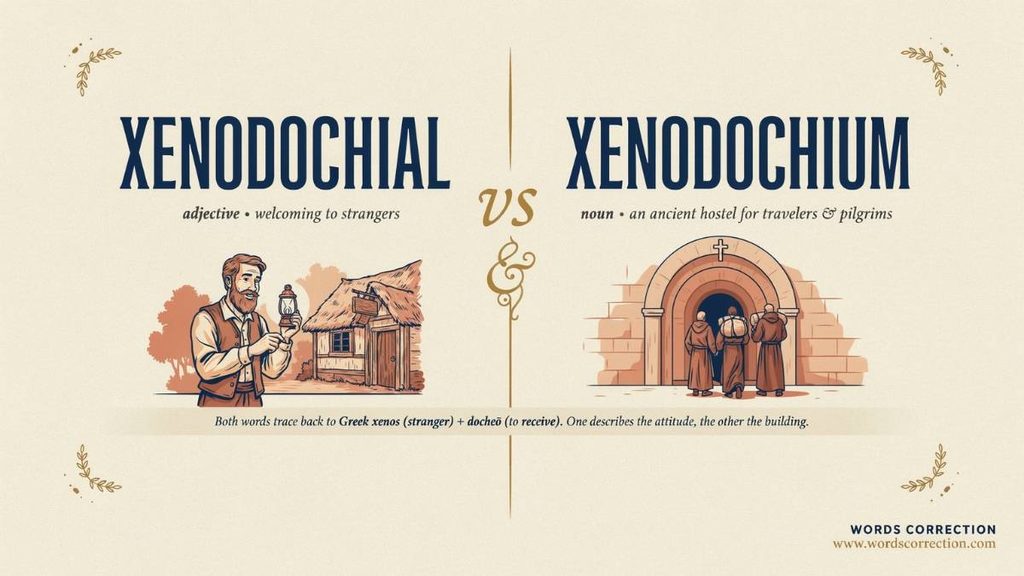
Both words look complicated, especially if you haven’t encountered them before. Fortunately, breaking them into smaller sound groups makes them easier to pronounce.
The xenodochial pronunciation and xenodochium pronunciation differ mainly in their endings and syllable patterns.
Xenodochial Pronunciation
The word xenodochial has two commonly listed American English pronunciations:
- /ˌzɛnəˈdoʊkiəl/
- /ˌziːnəˈdoʊkiəl/
A simple pronunciation guide is
ZEN-uh-DOH-kee-uhl
The main stress falls on the DOH portion.
You may also hear a slightly different opening vowel depending on the speaker. Both listed forms appear in pronunciation references.
To practice
- Start with the opening sound, similar to the beginning of zebra.
- Move smoothly through the middle syllables.
- Give the DOH portion the strongest emphasis.
- Finish with the softer ending.
Xenodochium Pronunciation
The word xenodochium is pronounced differently from xenodochial.
Commonly listed American English pronunciations include
- /ˌzɛn.oʊˈdoʊ.ki.əm/
- /ˌzɛn.əˈdoʊ.ki.əm/
A helpful pronunciation guide is
ZEN-oh-DOH-kee-um
The strongest stress falls on DOH. Some pronunciation references also list alternative forms with slight differences in the unstressed opening sounds.
Pronunciation Comparison Table
| Word | American English IPA | Easy pronunciation guide |
|---|---|---|
| Xenodochial | /ˌzɛnəˈdoʊkiəl/ | ZEN-uh-DOH-kee-uhl |
| Xenodochium | /ˌzɛn.oʊˈdoʊ.ki.əm/ | ZEN-oh-DOH-kee-um |
Pronunciation tip: Don’t rush through the middle of either word. Giving the stressed syllable enough emphasis makes both terms easier to recognize and pronounce.
Learn the difference between confusing word pairs
Examples of Xenodochial in Sentences
Understanding a definition is helpful, but seeing a word in context makes its meaning much easier to remember.
The following examples demonstrate xenodochial usage in different situations.
Xenodochial Examples in Everyday Contexts
- The xenodochial shopkeeper welcomed travelers who stopped in the village.
- Her xenodochial nature made visitors feel comfortable during their stay.
- The family showed a xenodochial attitude toward people from other countries.
- His xenodochial behavior helped newcomers feel accepted in the community.
- The village was remembered for its xenodochial treatment of strangers.
Xenodochial Examples in Formal Writing
- The historical account praised the monks for their xenodochial hospitality.
- The organization encouraged xenodochial values among its international volunteers.
- The community’s xenodochial approach helped visiting families feel welcome.
- The author described the leader as xenodochial because of his kindness toward unfamiliar visitors.
Examples in Academic Writing
- The study examined historical attitudes toward xenodochial hospitality in religious communities.
- The monastery’s xenodochial practices reflected a broader tradition of welcoming strangers.
- Medieval accounts sometimes emphasized the importance of receiving foreign travelers with kindness.
These examples illustrate how the adjective can describe a person, a community, an attitude, or a particular form of behavior.
One important point: because xenodochial is rare and historically marked, these sentences demonstrate its meaning rather than suggesting that it is a common choice in contemporary writing.
Learn the difference between tricky grammar more words
Hierarchical vs Hierarchal Which Word Should You Use?
Examples of Xenodochium in Sentences
The word xenodochium appears most naturally in historical discussions of accommodation, religious institutions, and charitable hospitality.
Unlike xenodochial, it names a place rather than describing someone’s personality.
Xenodochium Examples in Historical Contexts
- The monastery maintained a xenodochium for pilgrims traveling through the region.
- Historical records mention a xenodochium that provided shelter to poor travelers.
- The ancient city established a xenodochium to receive visiting strangers.
- The religious community operated a xenodochium near its main church.
- The historical building served as a xenodochium for people seeking temporary accommodation.
Xenodochium Examples in Academic Writing
- Researchers examined the role of the xenodochium in medieval charitable institutions.
- The manuscript described a xenodochium that accommodated pilgrims and foreign visitors.
- The monastery’s xenodochium provided an organized system of hospitality.
- Several historical sources mention xenodochia associated with Christian communities.
Examples in Context
Consider these two sentences:
Correct: The monastery established a xenodochium to shelter pilgrims.
Incorrect: The monastery established a xenodochial to shelter pilgrims.
The second sentence uses an adjective where a noun is required. The building needs a noun to identify it. Xenodochium supplies that meaning.
Similarly
Correct: The monks displayed xenodochial behavior toward strangers.
Incorrect: The monks displayed xenodochium behavior toward strangers.
The second example incorrectly uses the name of a guesthouse to describe an attitude.
These examples show why understanding parts of speech matters just as much as memorizing definitions.
Learn the difference between commonly mixed-up more words
Eying or Eyeing Which Spelling Is Correct?
Origin and History of Xenodochial vs Xenodochium
The connection between xenodochial vs xenodochium becomes clearer when you examine their Greek roots. Both belong to a family of words associated with strangers, guests, and hospitality.
However, they developed along different paths and eventually acquired different grammatical roles in English.
Etymology of Xenodochial
The etymology of xenodochial traces back to Ancient Greek hospitality-related vocabulary.
The word is historically connected with Greek xenodochia, meaning the reception of strangers or hospitality. Its English formation combines this historical root with the adjective-forming suffix -al.
The suffix -al helps turn a noun or related word into an adjective. For example
- Culture → Cultural
- Nature → Natural
- Institution → Institutional
- Xenodochy → Xenodochial
Historical dictionary records document xenodochial as a word describing someone who receives strangers hospitably. Its recorded English use dates to 1716.
This history explains why xenodochial describes a quality rather than a building. Its grammatical form makes it suitable for describing behavior associated with welcoming visitors.
Etymology of Xenodochium
The word xenodochium has a more direct connection to a physical place.
It entered English through Late Latin xenodochium, which developed from Late Greek xenodocheion (ξενοδοχεῖον), meaning a place for receiving strangers or an inn.
Its Greek roots include
- Xenos (ξένος): A stranger, guest, or foreigner.
- Dechomai (δέχομαι): To receive, accept, or welcome.
Together, these elements express the idea of a place that receives strangers.
The term eventually became associated with guesthouses, hostels, and religious institutions that provided accommodation to people traveling away from home.
Historical Development of Xenodochium
The xenodochium became particularly important in discussions of ancient and medieval hospitality.
In earlier societies, traveling could involve long distances, uncertain conditions, and limited access to accommodation. A traveler who arrived in an unfamiliar settlement might struggle to find food, shelter, or medical assistance.
Religious and charitable institutions helped address these needs.
Some establishments offered temporary lodging, while others also supported poor people, sick visitors, and pilgrims. The precise services depended on the institution and historical period.
In Christian communities, the practice of receiving strangers developed into an organized form of charitable hospitality.
Historical references provide several examples
- A xenodochium established near Porto by the Roman senator Pammachius.
- Guest facilities associated with medieval monasteries.
- Institutions that provided relief to poor travelers and pilgrims.
- Guesthouses connected with religious centers and places of pilgrimage.
Some historical accounts also describe monastery facilities where poor people received regular support and travelers could seek assistance. These examples demonstrate that a xenodochium could serve a wider charitable purpose than accommodation alone.
A Historical Case Study The Xenodochium of Pammachius
One useful historical example comes from Pammachius, a Roman senator and Christian benefactor.
Historical accounts associate him with the establishment of a xenodochium at Porto, near the important port area of ancient Rome.
The institution provided lodging and assistance to travelers arriving in or departing from the port. Its purpose reflected the Christian tradition of caring for strangers and people in need.
This example illustrates an important distinction: a xenodochium wasn’t simply a commercial inn where visitors paid for a room. Some establishments also served a charitable purpose by helping people who lacked the resources to arrange their own accommodation.
The example also shows why the term remains useful in historical writing. Calling such an institution a modern hotel would overlook its religious and charitable role.
The Role of Monasteries in Historical Hospitality
Monasteries played an important role in the history of organized hospitality.
Many religious communities followed traditions that encouraged them to receive travelers and provide assistance to people in need. A monastery guesthouse offered a practical way to welcome visitors without disrupting the community’s regular activities.
Depending on the institution, a xenodochium could provide
- Temporary accommodation for pilgrims.
- Meals and drinking water for travelers.
- A place to rest after a long journey.
- Basic assistance for poor visitors.
- Care or support for sick and vulnerable people.
- Shelter for strangers who had nowhere else to stay.
Not every xenodochium provided all these services. Its facilities and responsibilities varied according to its location, resources, and religious or charitable purpose.
Nevertheless, the central idea remained the same: strangers deserved a place where they could receive hospitality and assistance.
This historical background explains why xenodochium has a stronger connection to religious guesthouses and charitable accommodation than to ordinary modern hotels.
Learn the difference between confusing more English words
Passtime or Pastime Which Spelling Is Correct?
Common Mistakes When Using Xenodochial vs Xenodochium
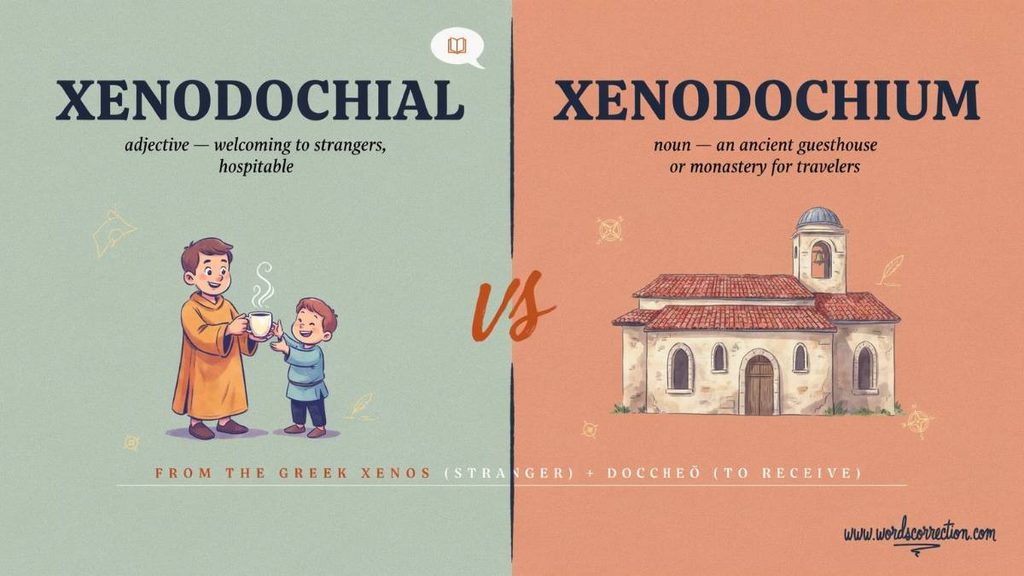
Even though these words have distinct meanings, their similar spelling makes them easy to confuse.
Most errors occur when writers overlook their parts of speech or assume that both terms refer to the same aspect of hospitality.
Here are the mistakes worth avoiding.
Using Xenodochial as a Noun
Xenodochial is an adjective, not the name of a building or accommodation facility.
Incorrect: The monastery built a xenodochial for visiting pilgrims.
Correct: The monastery built a xenodochium for visiting pilgrims.
The correct sentence uses a noun to identify the guesthouse.
Using Xenodochium as an Adjective
Xenodochium names a place. It doesn’t describe someone’s personality.
Incorrect: The host was xenodochium toward foreign visitors.
Correct: The host was xenodochial toward foreign visitors.
The adjective xenodochial describes the host’s welcoming behavior.
Assuming Both Words Have the Same Meaning
The two words share a connection with hospitality, but that doesn’t make them interchangeable.
For example:
- Xenodochial hospitality describes a welcoming attitude toward strangers.
- A xenodochium provides accommodation or shelter to strangers.
One describes a quality. The other names an institution.
Confusing Xenodochial With Xenial
Although both adjectives relate to hospitality, their emphasis differs.
Xenodochial focuses on friendliness toward strangers. Xenial relates more broadly to hospitality and the host-guest relationship.
Using them interchangeably can make a sentence less precise.
Making Spelling Mistakes
Both words contain several syllables and unusual letter combinations. Writers sometimes replace or omit letters because they aren’t familiar with the terms.
The correct spellings are:
- Xenodochial
- Xenodochium
A useful way to remember them is to associate their endings with their grammatical roles
- -ial appears in the adjective xenodochial.
- -ium appears in the noun xenodochium.
Using Rare Words When Simpler Words Work Better
Another common mistake is choosing an uncommon word simply because it sounds impressive.
For example
Unnecessarily complicated: The xenodochial proprietor demonstrated considerable hospitality toward unfamiliar guests.
Clearer: The hospitable owner welcomed strangers warmly.
Both sentences communicate a similar idea. However, the second version is easier for most readers to understand.
Use xenodochial when its specific meaning adds value, especially in historical, linguistic, or specialized writing. Otherwise, hospitable or welcoming will usually work better.
Learn the difference between tricky words and use them correctly
Ingage vs Engage Which Word Is Correct?
Xenodochial vs Xenodochium Quick Reference and Usage Comparison
The following table brings the main differences together so you can check them quickly.
| Comparison | Xenodochial | Xenodochium |
|---|---|---|
| Definition | Friendly toward strangers | A place that receives strangers |
| Part of speech | Adjective | Noun |
| Refers to | Attitude or behavior | Building or institution |
| Main subject | Hospitality | Accommodation |
| Greek connection | Reception of strangers | A place for receiving strangers |
| Historical association | Welcoming behavior | Ancient and medieval guesthouses |
| Common context | Describing people or communities | Historical and religious writing |
| Singular form | Xenodochial | Xenodochium |
| Traditional plural | Not applicable | Xenodochia |
| Common alternative | Hospitable, welcoming | Guesthouse, hostel, inn |
A simple memory trick makes the distinction easier
Xenodochial = a welcoming attitude.
Xenodochium = a welcoming place.
Keep that difference in mind and you’ll rarely confuse the two.
Practice Exercise Fill in the Blanks
Complete each sentence with the correct word: Xenodochial, Xenodochium, Xenodochia, Xenial, or Xenagogue.
- A welcoming person is __________.
- A historical guesthouse is a __________.
- The plural of xenodochium is __________.
- Hospitality toward strangers is __________.
- A guide for strangers is a __________.
- The monks showed a __________ attitude.
- Travelers stayed at the __________.
- Ancient guesthouses were called __________.
- Xenodochial is an __________.
- Xenodochium is a __________.
- A friendly host is __________.
- Pilgrims received shelter in a __________.
- Several historical shelters were __________.
- Xenial relates to __________.
- The guide was a __________.
- Her __________ nature impressed visitors.
- The monastery maintained a __________.
- The travelers visited several __________.
- A hospitable attitude is __________.
- The old __________ provided food and shelter.
- Xenodochial describes a person’s __________.
- The __________ welcomed unfamiliar guests.
- The charity operated several __________.
- A person guiding visitors is a __________.
- Xenodochium refers to a historical __________.
Answers
- Xenodochial
- Xenodochium
- Xenodochia
- Xenial
- Xenagogue
- Xenodochial
- Xenodochium
- Xenodochia
- Adjective
- Noun
- Xenodochial
- Xenodochium
- Xenodochia
- Hospitality
- Xenagogue
- Xenodochial
- Xenodochium
- Xenodochia
- Xenial
- Xenodochium
- Personality
- Xenodochial person
- Xenodochia
- Xenagogue
- Guesthouse
Here’s a trusted source for clear word meanings:
Cambridge Dictionary
FAQ’s
What does xenodochium mean?
Xenodochium is a noun that refers to a historical guesthouse or charitable shelter where travelers, pilgrims, and people in need could receive accommodation, food, and care.
What does xenodochial mean in English?
Xenodochial is an adjective meaning friendly, welcoming, and hospitable toward strangers, visitors, or foreigners.
What is a xenagogue?
A xenagogue is a guide who leads or assists strangers and visitors, particularly those exploring an unfamiliar place.
What is the difference between xenodochial and xenial?
Xenodochial describes a welcoming attitude toward strangers, whereas xenial relates to hospitality and the friendly relationship between a host and a guest.
Is xenodochial a positive word?
Yes, xenodochial has a positive meaning. It describes someone who treats strangers with kindness, warmth, openness, and genuine hospitality.
What is the opposite of xenodochial?
The opposite of xenodochial includes words such as hostile, unfriendly, unwelcoming, and inhospitable, depending on the context.
What is a synonym for xenodochial?
Hospitable, welcoming, cordial, friendly, and accommodating are suitable synonyms for xenodochial because they describe kindness and warmth toward others.
Is xenodochium a valid English word?
Yes, xenodochium is a recognized English noun. It describes a historical institution that offered temporary accommodation and charitable assistance to travelers, pilgrims, and disadvantaged people.
What is the plural of xenodochium?
The plural of xenodochium is xenodochia. This form refers to multiple historical guesthouses or charitable institutions.
How do xenodochium and xenodochia differ?
Xenodochium is the singular form used for one historical guesthouse or shelter, while xenodochia is the plural form used for two or more such establishments.
What is the origin of xenodochial?
Xenodochial has Greek-derived roots associated with strangers and hospitality. Its origins reflect the concept of welcoming unfamiliar people and treating them with kindness.
What is the origin of xenodochium?
Xenodochium comes from Greek, with linguistic elements associated with strangers and receiving guests. It developed as a term for institutions that provided shelter and hospitality.
Is xenodochial a noun or an adjective?
Xenodochial is an adjective. It modifies nouns by describing a person’s welcoming personality, friendly behavior, or hospitable attitude toward strangers.
Is xenodochium a noun or an adjective?
Xenodochium is a noun because it identifies a particular type of historical building or institution established to provide accommodation and assistance.
How do you use xenodochial in a sentence?
Xenodochial describes someone who welcomes strangers warmly. For example: “The manager’s xenodochial attitude made every visitor feel comfortable and appreciated.”
Can xenodochial describe someone’s personality?
Yes, xenodochial can describe a person’s personality when they are naturally welcoming, approachable, and considerate toward strangers, visitors, and foreigners.
Can xenodochial describe a place or environment?
Yes, xenodochial can describe a place, organization, or environment that demonstrates hospitality and creates a welcoming atmosphere for unfamiliar visitors.
How is xenodochial different from hospitable?
Both words express hospitality, but xenodochial specifically emphasizes friendliness toward strangers and foreigners. Hospitable has a broader meaning that includes welcoming guests and providing them with comfort.
What is the difference between xenodochial and friendly?
Friendly describes a generally kind and approachable attitude toward others, whereas xenodochial specifically emphasizes warmth and hospitality toward strangers or foreigners.
What was the main purpose of a xenodochium?
The main purpose of a xenodochium was to provide temporary shelter, food, and care for travelers, pilgrims, poor individuals, and sick people. These establishments often served charitable and religious purposes.
Were xenodochia historically connected to monasteries?
Yes, many xenodochia were associated with monasteries and churches. Religious communities established these institutions to accommodate travelers, support pilgrims, and assist people who needed shelter or care.
How does a xenodochium differ from a modern hotel?
A xenodochium was primarily a charitable institution that provided shelter and assistance to travelers and disadvantaged individuals. A modern hotel generally operates as a commercial establishment offering paid accommodation and guest services.
Why is xenodochial rarely used in everyday English?
Xenodochial is an uncommon adjective because simpler words such as welcoming, hospitable, and friendly communicate similar ideas. It is more frequently found in advanced vocabulary, literary discussions, and specialized writing.
What does xenodoch mean?
Xenodoch is a rare related word associated with a stranger or guest. It shares Greek-derived linguistic roots with xenodochial vs xenodochium.
Can xenodochial vs xenodochium be used in the same sentence?
Yes, both words can appear in the same sentence when discussing hospitality and historical accommodation. For example: “The xenodochial monks welcomed travelers to the nearby xenodochium.”
Learn the difference between similar English words the easy way
Implicit vs Complicit what’s the Differences?
Conclusion
Understanding xenodochial vs xenodochium becomes simple when you know the meaning and purpose of each word. Xenodochial is an adjective that describes a friendly and welcoming attitude toward strangers. In contrast, xenodochium is a noun that refers to a place that offers shelter and hospitality to travelers or guests. Although both words share a connection to hospitality, they have different meanings and grammatical uses.
The easiest way to remember the difference is this xenodochial describes an attitude, while xenodochium refers to a place. Keep this distinction in mind, and you’ll avoid mixing up these uncommon words in your writing. Even unusual English vocabulary becomes easier when you understand how each word works.

Stella AJS is an experienced blogger and dedicated English language writer at Words Correction. She turns confusing grammar, word meanings, spelling, and usage into clear, practical insights that readers can easily understand and apply. With a passion for precise and engaging writing, Stella helps readers avoid common language mistakes, strengthen their vocabulary, and communicate with greater clarity and confidence.




