
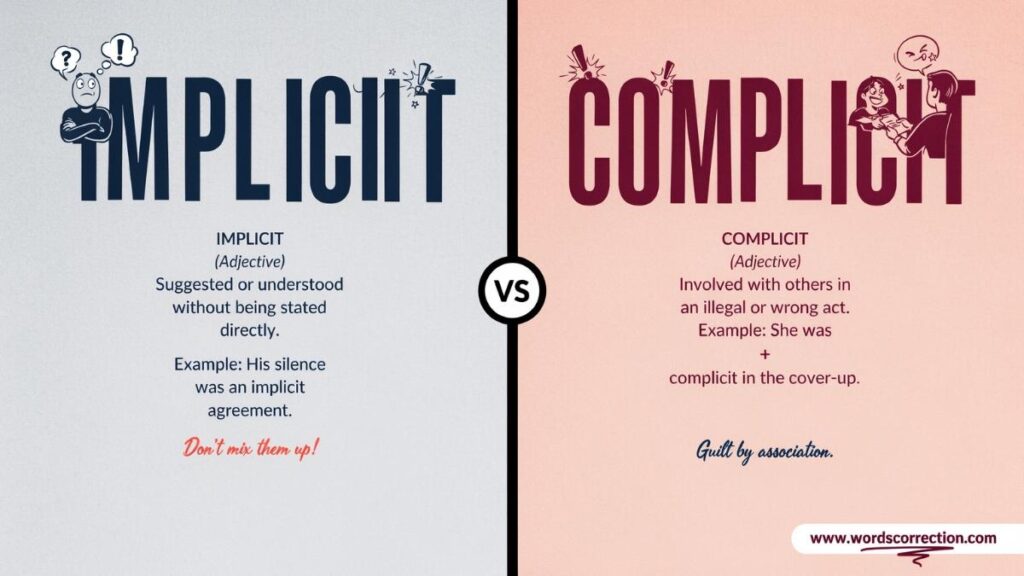
English can make even simple words confusing. Implicit vs complicit is a good example. These two words look and sound similar, but they have very different meanings. Implicit describes something that is suggested or understood without being said directly. Complicit, on the other hand, describes someone who knowingly takes part in something wrong. Confusing these words can change the meaning of your sentence completely. For example, you might want to describe an unspoken agreement but accidentally suggest that someone helped with a crime. Learning the difference between implicit vs complicit will help you use both words correctly and write with confidence.
Implicit vs Complicit Quick Answer
The simplest way to understand implicit vs complicit meaning is to remember that implicit relates to indirect communication, while complicit relates to involvement in wrongdoing.
- Implicit (adjective): Suggested, understood, or communicated indirectly without being stated openly.
- Complicit (adjective): Knowingly involved in or helping someone commit wrongdoing.
Consider these examples
- Implicit: Her manager’s silence carried an implicit message that the team should finish the project before Friday.
- Complicit: The employee became complicit in the fraud when he knowingly helped hide the false financial records.
In the first sentence, the manager communicates an expectation without expressing it directly. In the second the employee knowingly assists with dishonest activity.
| Word | Meaning | Example |
|---|---|---|
| Implicit | Indirectly expressed or understood | The agreement was implicit. |
| Complicit | Knowingly involved in wrongdoing | She was complicit in the cover-up. |
Quick memory tip: Implicit means implied. Complicit means involved in wrongdoing.
What Does Implicit Mean?
Part of speech: Adjective
The word implicit describes something that people suggest, communicate, or understand without stating it directly. Its meaning exists beneath the surface of a statement, action, agreement, or situation.
When someone communicates implicitly, they don’t always use direct words. Instead, they rely on context, shared knowledge, behavior, or indirect signals to express an idea.
For example, imagine a teacher tells a student, “Students who review their notes regularly usually perform better on exams.” The teacher hasn’t directly instructed the student to study every day. However, the underlying message suggests that regular revision is expected and beneficial.
This is an example of implicit communication.
The implicit definition also covers ideas that people accept or assume without formally discussing them. An implicit expectation, for instance, can influence how people behave even when nobody has written down a specific rule.
Implicit Definition and Meaning
According to its standard English meaning, implicit refers to something that is
- Implied rather than directly stated.
- Understood from context or circumstances.
- Accepted or assumed without being formally expressed.
- Present as an underlying meaning or suggestion.
In simple words, implicit means something is understood even though nobody says it openly.
Consider these common expressions
- Implicit agreement: An understanding that exists without a formal or direct statement.
- Implicit trust: Complete or unquestioning trust that someone places in another person.
- Implicit understanding: Shared knowledge or agreement that people don’t need to explain.
- Implicit assumption: A belief that someone accepts without directly questioning or stating it.
- Implicit message: An indirect idea communicated through words, actions, or circumstances.
These expressions demonstrate how implicit works in everyday English.
How to Use Implicit in a Sentence
The word implicit usually appears before a noun because it functions as an adjective. It describes the nature of an idea, expectation, message, or relationship.
Here are some common grammatical patterns
| Grammatical pattern | Example |
|---|---|
| Implicit + agreement | They reached an implicit agreement. |
| Implicit + understanding | We have an implicit understanding. |
| Implicit + assumption | The argument contains an implicit assumption. |
| Implicit + message | His response carried an implicit message. |
| Implicit + trust | The relationship depends on implicit trust. |
| Implicit + bias | Researchers examined implicit bias. |
You can also use implicit with the preposition in
- The expectation was implicit in her instructions.
- Several assumptions were implicit in the proposal.
- A warning was implicit in his response.
One important point: implicit doesn’t automatically mean secret, hidden, or intentionally concealed. Something can be implicit simply because the speaker and listener share enough information to understand it without spelling everything out.
Examples of Implicit in Everyday English
The following examples show how implicit works in different situations.
Everyday communication
- Her smile contained an implicit message of approval.
- His silence suggested an implicit disagreement.
- Their conversation revealed an implicit understanding.
Workplace
- The job description included an implicit expectation of flexibility.
- Employees understood the implicit rule about arriving on time.
- The manager’s comments carried an implicit warning about missed deadlines.
Education
- The assignment contained an implicit instruction to provide evidence.
- The teacher’s feedback included an implicit suggestion to improve the introduction.
- Students developed an implicit understanding of classroom expectations.
Relationships
- Their friendship involved implicit trust.
- An implicit agreement existed between the two business partners.
- His actions communicated an implicit promise to support her.
Business
- The contract contained an implicit assumption about delivery schedules.
- The company’s policy reflected an implicit commitment to customer satisfaction.
- Their negotiations revealed an implicit understanding about future cooperation.
Learn the difference between confusing more English words
Heros or Heroes which spelling is correct?
Implicit in Different Contexts
The meaning of implicit remains consistent across different subjects, although its practical application changes with context.
Implicit Communication
In communication, implicit refers to messages that people express indirectly. Speakers may rely on tone, gestures, facial expressions, or shared experiences instead of stating everything explicitly.
For example
“Your desk looks different today.”
Depending on the situation, this simple observation might carry an implicit suggestion that someone should organize their workspace.
However, context matters. The statement doesn’t necessarily contain criticism. The listener must interpret its intended meaning using the surrounding conversation.
This type of indirect communication appears frequently in personal relationships, professional conversations, and everyday social interactions.
Implicit Agreement
The implicit agreement meaning refers to an understanding that people establish through their actions or circumstances rather than through a formal spoken or written agreement.
For example, two coworkers might regularly divide their responsibilities without discussing the arrangement each morning. Over time, their repeated behavior establishes an implicit agreement about who handles each task.
An implicit agreement isn’t automatically a legally binding contract. Whether an agreement has legal effect depends on the relevant law and the facts of the situation.
Implicit Understanding
An implicit understanding develops when people share knowledge or expectations that don’t require constant explanation.
For instance, experienced members of a sports team may understand when to change positions without receiving verbal instructions.
Their shared experience allows them to communicate through familiar signals and actions.
Implicit Bias in Psychology
In psychology, implicit bias refers to automatic associations or attitudes that can influence judgments and behavior without a person’s conscious awareness.
For example, a hiring manager might unintentionally associate certain educational backgrounds with greater competence. That automatic association could affect how the manager evaluates applicants.
Implicit bias doesn’t necessarily reflect someone’s openly stated beliefs or deliberate intentions. Researchers study these automatic associations to understand how they may influence decisions.
Implicit Language and Literature
Writers often use implicit language to communicate ideas without explaining every detail.
For example
“Mark checked the clock for the fifth time while waiting for the interview.”
The writer doesn’t directly say Mark feels nervous. However, his repeated actions suggest impatience or anxiety.
This technique gives readers room to interpret an underlying message rather than receiving every detail directly.
Synonyms and Antonyms of Implicit
The best implicit synonym depends on the sentence and the intended meaning.
| Synonyms | Antonyms |
|---|---|
| Implied | Explicit |
| Indirect | Direct |
| Unspoken | Stated |
| Unstated | Expressed |
| Inferred | Clearly communicated |
| Tacit | Overt |
| Understood | Unambiguous |
| Suggested | Declared |
Example
- Original: The manager gave an implicit warning.
- Alternative: The manager gave an indirect warning.
Both sentences communicate a similar idea.
However, these alternatives aren’t always interchangeable. For example, implicit trust has a slightly different meaning from suggested trust. Always consider the context before replacing one word with another.
Learn the difference between commonly mixed-up more words
Thier or Their which is correct?
What Does Complicit Mean?
Part of speech: Adjective
Unlike implicit, the word complicit describes a person’s involvement in wrongdoing. Someone is complicit when they knowingly participate in, assist, encourage, or help conceal an improper or harmful act.
A person doesn’t always have to commit the wrongdoing personally to become complicit. Providing deliberate assistance or helping someone cover up misconduct can also demonstrate complicity.
For example, imagine an employee discovers that a colleague has been stealing company money. Instead of reporting the theft, the employee knowingly changes financial records to hide it. The employee hasn’t stolen the money personally, but the deliberate assistance makes them complicit in the fraud.
This distinction matters because complicit involvement often raises questions about moral responsibility, ethical accountability, and sometimes criminal responsibility.
Complicit Definition and Meaning
The complicit definition is straightforward: knowingly involved in or associated with another person’s wrongdoing.
In simple words, complicit means helping someone do something wrong or knowingly taking part in it.
Here are some important expressions
- Complicit behavior: Actions that help, support, or enable wrongdoing.
- Complicit involvement: Knowing participation in an improper or harmful activity.
- Complicit responsibility: Responsibility associated with knowingly assisting or contributing to wrongdoing.
- Complicit in wrongdoing: Being involved in an unethical, dishonest, or illegal act.
- Moral complicity: Sharing moral responsibility for wrongdoing through participation or assistance.
Awareness and involvement are important parts of the word’s meaning. Simply knowing that something wrong has happened doesn’t automatically make someone complicit.
For example, an employee who discovers financial fraud but has no involvement in it isn’t necessarily complicit. However, an employee who knowingly destroys evidence to protect the person responsible may be.
How to Use Complicit in a Sentence
Complicit usually functions as an adjective and commonly appears with the preposition in.
The construction complicit in something identifies the wrongdoing or activity in which someone participates.
Examples include
- She was complicit in the financial fraud.
- Several officials were complicit in the cover-up.
- The company became complicit in unethical business practices.
- He refused to become complicit in the dishonest scheme.
- Their silence made them appear complicit in the misconduct.
You can also use complicit with linking verbs such as be, become, remain, and seem.
| Grammatical pattern | Example |
|---|---|
| Be complicit in | He was complicit in the fraud. |
| Become complicit in | She became complicit in the cover-up. |
| Remain complicit in | They remained complicit in the misconduct. |
| Seem complicit in | The manager seemed complicit in the scheme. |
| Refuse to be complicit in | She refused to be complicit in the deception. |
Grammar tip: Use complicit in when identifying the wrongdoing or activity. For example, “complicit in corruption” is the natural construction.
Examples of Complicit in Everyday English
These examples demonstrate how the word applies to different situations.
Workplace misconduct
- The accountant was complicit in the company’s financial fraud.
- Several employees became complicit in the manager’s cover-up.
- The supervisor was complicit in falsifying performance records.
Dishonesty
- He was complicit in hiding the truth from his business partners.
- The assistant knowingly helped destroy evidence and became complicit in the deception.
- Their actions made them complicit in the dishonest arrangement.
Politics and public responsibility
- The officials were accused of being complicit in the corruption scandal.
- Critics argued that the institution was complicit in concealing misconduct.
- The investigation examined whether senior leaders were complicit in the cover-up.
Social situations
- Anyone who knowingly helps a bully target another student may become complicit in the harassment.
- The group was complicit in spreading a false story.
- She refused to remain complicit in the unfair treatment of her coworkers.
Business ethics
- The company faced criticism for being complicit in unethical supplier practices.
- Managers were accused of being complicit in misleading customers.
- The organization investigated whether employees had been complicit in the misconduct.
Learn the difference between tricky grammar more words
Benefitting or Benefiting Which Spelling Is Correct?
Complicit in Different Contexts
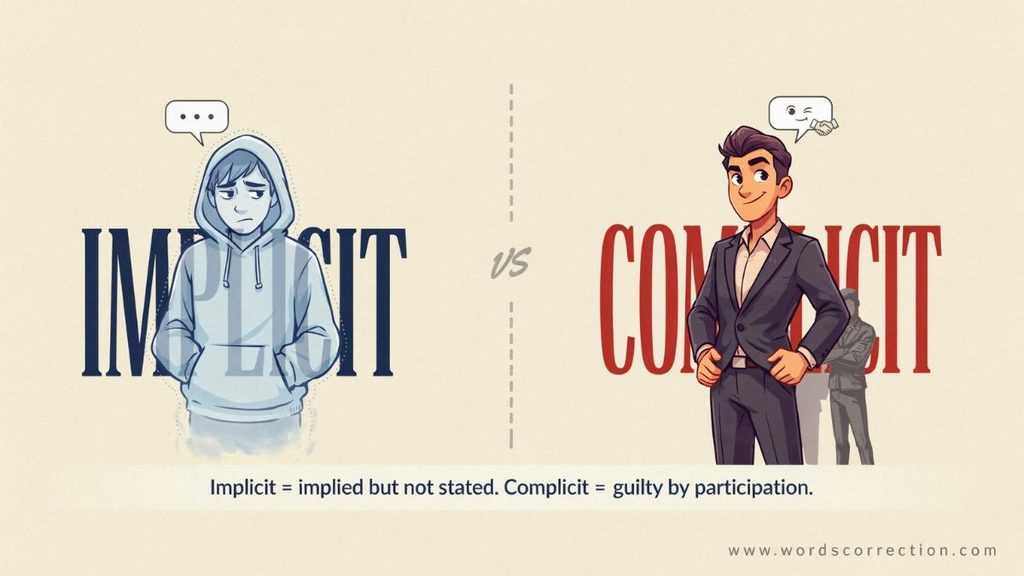
The word complicit appears in discussions about law, business, politics, and personal behavior. Its central meaning remains the same, but the type of responsibility can vary.
Complicit in Law and Criminal Activity
In legal discussions, complicit describes involvement in criminal wrongdoing. However, the word itself doesn’t establish that someone has committed a crime.
Legal systems distinguish between different forms of participation, such as assisting, encouraging, facilitating, or conspiring to commit an offense. The requirements for criminal liability depend on the jurisdiction and the specific offense.
For example, someone who knowingly provides assistance to another person committing a crime may face legal consequences if the relevant legal requirements are satisfied.
This is where the distinction between ordinary involvement and legal complicity becomes important.
Remember: Being described as complicit in everyday language doesn’t automatically mean someone is legally guilty.
Complicit in Workplace Misconduct
Workplace complicity can occur when employees knowingly help conceal harassment, discrimination, financial misconduct, or other unethical behavior.
Consider a manager who discovers that an employee has falsified customer records. Instead of investigating the issue, the manager deliberately changes reports to protect the employee.
The manager may be described as complicit in the misconduct because the manager knowingly helps conceal it.
Complicit in Politics
Political discussions frequently use complicit when describing individuals or institutions that knowingly support or enable harmful actions.
For instance, critics might describe an organization as complicit in corruption if its leaders knowingly help conceal improper financial activities.
The word often communicates a strong accusation of shared responsibility.
Complicit in Social Behavior
Complicity doesn’t always involve major crimes or financial scandals.
A person may also contribute to harmful behavior by deliberately encouraging harassment, spreading damaging lies, or helping someone avoid accountability.
For example, a student who knowingly helps a group bully another student by spreading humiliating messages may be complicit in the harassment.
However, simply witnessing an incident doesn’t automatically establish complicity. The person’s actions, knowledge, and circumstances matter.
Synonyms and Antonyms of Complicit
The best complicit synonym depends on how someone participates in wrongdoing.
| Synonyms or related terms | Antonyms or contrasting terms |
|---|---|
| Involved | Innocent |
| Implicated | Uninvolved |
| Assisting | Opposing |
| Participating | Preventing |
| Abetting | Resisting |
| Colluding | Independent |
| Conspiring | Blameless |
| Aiding | Disassociated |
Some related words have narrower meanings
- Accomplice: A person who helps another person commit a crime.
- Abettor: Someone who encourages or assists wrongdoing.
- Conspirator: Someone who participates in a plan to commit an unlawful act.
- Collaborator: Someone who works with another person, although the word isn’t necessarily negative.
- Accessory: A person who assists or contributes to a crime, depending on the legal context.
These words overlap with complicit, but they aren’t exact substitutes in every situation.
For example, involved can describe participation in a completely harmless activity. Complicit specifically suggests involvement in wrongdoing.
Learn the difference between confusing word pairs
Freshman or Freshmen what’s the Difference?
Implicit vs Complicit Key Differences Explained
Although implicit vs complicit look similar, their meanings, applications, and connotations differ significantly.
Understanding the difference between implicit vs complicit requires looking beyond their spelling. The real distinction lies in what each word describes.
Difference in Meaning
Implicit describes an idea, message, or understanding that someone communicates indirectly.
Complicit describes someone who knowingly participates in or helps with wrongdoing.
Compare these sentences
- The manager’s instructions contained an implicit warning.
- The manager was complicit in the financial misconduct.
The first sentence describes an indirect message. The second describes involvement in unethical activity.
That’s the central implicit vs complicit difference.
Difference in Usage
Implicit commonly describes abstract ideas, expectations, assumptions, and messages.
Common expressions include
- Implicit agreement
- Implicit understanding
- Implicit trust
- Implicit assumption
- Implicit meaning
- Implicit bias
Complicit usually describes people, organizations, or groups that knowingly participate in wrongdoing.
Common expressions include
- Complicit in fraud
- Complicit in corruption
- Complicit in misconduct
- Complicit in a cover-up
- Complicit in discrimination
The difference becomes easier to recognize when you examine the noun each adjective modifies.
Difference in Connotation
Another important distinction involves the emotional tone of each word.
Implicit can be positive, neutral, or negative.
For example:
- Positive: She has implicit trust in her closest friend.
- Neutral: The agreement contained an implicit condition.
- Negative: His argument relied on an implicit assumption about other people.
The word itself doesn’t automatically express approval or criticism.
Complicit generally has a negative connotation.
It connects someone with wrongdoing, misconduct, or unethical behavior.
For example:
- The director was complicit in the financial deception.
- Several employees were complicit in concealing the incident.
Both sentences suggest involvement in something improper.
Learn the difference between often confused words
Requestor or Requester Which Spelling Is Correct?
Difference in Grammatical Structure
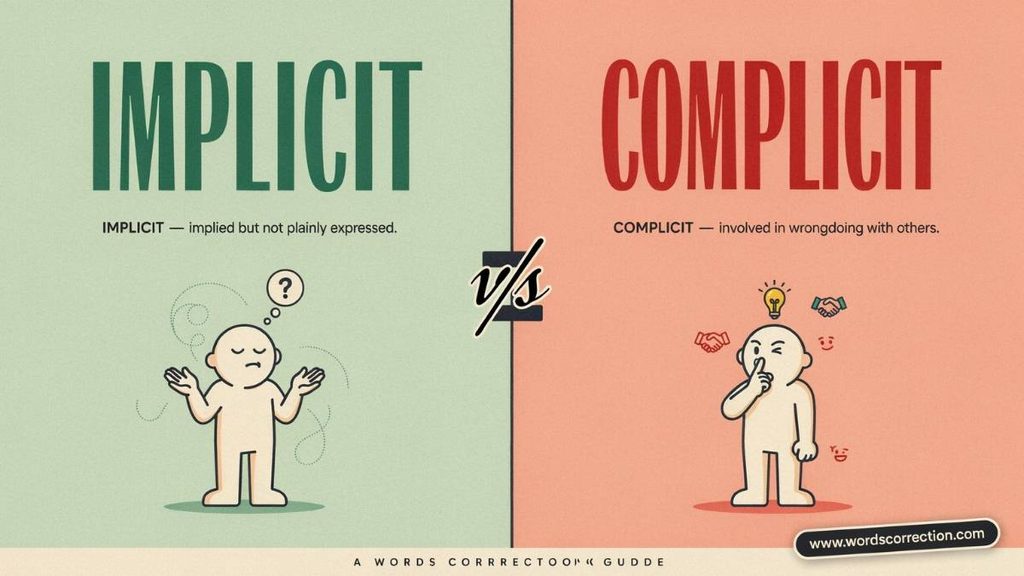
Implicit vs complicit follow different common grammatical patterns.
| Feature | Implicit | Complicit |
|---|---|---|
| Part of speech | Adjective | Adjective |
| Main meaning | Implied or indirectly understood | Knowingly involved in wrongdoing |
| Common subjects | Messages, agreements, assumptions, ideas | People, groups, organizations |
| Common structure | Implicit + noun | Complicit in + wrongdoing |
| Connotation | Positive, neutral, or negative | Generally negative |
| Related noun | Implicitness | Complicity |
| Opposite | Explicit | Innocent or uninvolved |
Example of implicit: The agreement included an implicit understanding about payment.
Example of complicit: The accountant was complicit in hiding the missing funds.
Implicit vs Complicit Comparison Table
Here is another practical comparison to help you remember the distinction.
| Example | Correct word | Reason |
|---|---|---|
| An unstated agreement | Implicit | The agreement isn’t directly expressed. |
| Someone helping conceal fraud | Complicit | The person knowingly assists wrongdoing. |
| An indirect warning | Implicit | The warning is suggested rather than stated. |
| An employee assisting corruption | Complicit | The employee participates in misconduct. |
| An unspoken expectation | Implicit | The expectation is understood from context. |
| A person helping cover up a crime | Complicit | The person knowingly helps conceal wrongdoing. |
Learn the difference between basic English word mistakes
Traveler or Traveller Which Spelling Is Correct?
Implicit vs Explicit vs Complicit
One reason people search for implicit vs. complicit is that they may also confuse these words with explicit.
Although all three words are adjectives, they describe different things.
Implicit vs Explicit What’s the Difference?
The difference between implicit and explicit meaning is straightforward.
- Implicit: Communicated indirectly or understood without being directly stated.
- Explicit: Communicated clearly and directly, leaving little room for uncertainty.
For example
Implicit instruction: “People who arrive early usually get their preferred seats.”
Explicit instruction: “Please arrive by 8:00 a.m. to get your preferred seat.”
The first statement suggests an expectation. The second communicates it directly.
Here are more examples
| Implicit | Explicit |
|---|---|
| Her silence suggested disagreement. | She directly disagreed. |
| The manager hinted at a deadline. | The manager announced the deadline. |
| Their actions suggested an agreement. | They formally agreed. |
| His expression suggested disappointment. | He openly expressed disappointment. |
The distinction is useful in writing, communication, education, and everyday conversations.
How Is Complicit Different From Both?
Complicit doesn’t describe whether someone communicates directly or indirectly.
Instead, it describes involvement in wrongdoing.
Consider these three examples
- Implicit: The manager’s response contained an indirect warning.
- Explicit: The manager directly warned the employee.
- Complicit: The manager knowingly helped the employee falsify records.
The first two words describe how information is expressed. The third describes someone’s involvement in improper behavior.
Implicit, Explicit, and Complicit Comparison Table
| Word | Definition | Example |
|---|---|---|
| Implicit | Indirectly suggested or understood | The message contained an implicit warning. |
| Explicit | Clearly and directly stated | The manager gave an explicit warning. |
| Complicit | Knowingly involved in wrongdoing | The manager was complicit in the fraud. |
A useful way to remember all three is to connect each word with its main purpose
- Implicit = Implied meaning.
- Explicit = Directly expressed meaning.
- Complicit = Involvement in wrongdoing.
Learn the difference between commonly misused words
Whoa or Woah Which Spelling Is Correct?
Implicit vs Complicit Examples in Similar Situations
Sometimes, the easiest way to understand two confusing words is to see how they work in similar situations.
The following examples show how changing one word can completely change a sentence.
Workplace Examples
Implicit
“The company’s new policy included an implicit expectation that employees would respond to urgent emails after working hours.”
The expectation isn’t directly stated, but employees may understand it from the company’s behavior and workplace culture.
Complicit
“The supervisor was complicit in the company’s attempt to hide unpaid overtime.”
The supervisor knowingly helped conceal improper workplace practices.
School Examples
Implicit:
“The teacher’s comments contained an implicit suggestion that students should revise their essays.”
The teacher communicates an idea indirectly.
Complicit:
“The students who knowingly helped hide the bullying incident were complicit in the harassment.”
Their actions helped conceal harmful behavior.
Business Examples
Implicit:
“The business partners had an implicit agreement to share important decisions.”
They understood their responsibilities without formally discussing every detail.
Complicit
“The financial officer was complicit in falsifying the company’s accounts.”
The officer knowingly participated in dishonest financial activity.
Social Media Examples
Implicit
“Her post carried an implicit message about the importance of online privacy.”
The message was suggested rather than directly expressed.
Complicit
“The users who knowingly helped spread the fraudulent advertisement were complicit in the deception.”
They deliberately helped promote misleading information.
Learn the difference between everyday English mistakes
A Practical Case Study Implicit Expectations vs Complicit Behavior
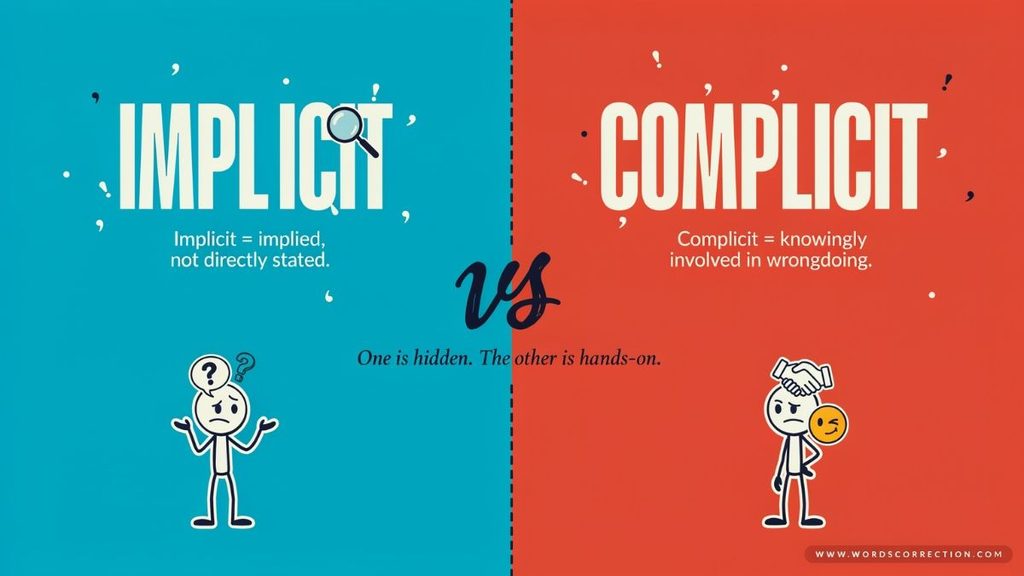
Imagine a company where employees notice that their manager regularly ignores complaints about misleading sales practices.
Two employees respond differently.
Employee A: She understands that management expects employees to avoid discussing the complaints openly. Nobody has directly communicated this instruction, but the workplace culture suggests it.
This is an example of an implicit expectation.
Employee B: He knows that the sales team is deliberately misleading customers. He also helps alter customer records to hide the problem.
This is an example of complicit behavior.
The difference is important
- Employee A recognizes an unspoken workplace expectation.
- Employee B knowingly assists with dishonest conduct.
However, Employee A’s situation could also involve ethical concerns depending on her actions and the circumstances. An implicit expectation doesn’t automatically establish innocence or complicity.
The case study demonstrates that implicit describes an indirect understanding, while complicit describes knowing involvement in wrongdoing.
Learn the difference between more words people mix up
Hierarchical vs Hierarchal Which Word Should You Use?
Complicit vs Complacent What’s the Difference?
Another common vocabulary mistake involves complicit vs. complacent. These words look similar, but they describe different attitudes and behaviors.
Complacent means overly satisfied or unconcerned, often because someone doesn’t recognize or respond to a potential problem.
Complicit means knowingly involved in or helping with wrongdoing.
Consider these examples
- Complacent: The manager became complacent and ignored the company’s declining customer satisfaction.
- Complicit: The manager was complicit in hiding customer complaints to protect the company’s reputation.
In the first sentence, the manager shows a lack of concern or urgency. In the second, the manager knowingly helps conceal information.
| Word | Meaning | Example |
|---|---|---|
| Implicit | Indirectly expressed or understood | An implicit warning |
| Complicit | Knowingly involved in wrongdoing | Complicit in fraud |
| Complacent | Overly satisfied or unconcerned | Complacent about declining performance |
Memory tip: Complacent means careless or unconcerned. Complicit means involved in wrongdoing.
Common Mistakes When Using Implicit vs Complicit
Even confident English speakers sometimes confuse words that share similar spellings. However, a few simple rules can prevent mistakes when choosing between implicit vs complicit.
Using Complicit When You Mean Implicit
This mistake happens when someone wants to describe an indirect message but chooses complicit instead.
Incorrect: The manager gave a complicit warning about the upcoming changes.
Correct: The manager gave an implicit warning about the upcoming changes.
Why? The warning is indirectly expressed. Nobody is being described as participating in wrongdoing.
Using Implicit When You Mean Complicit
This mistake reverses the problem. It happens when someone wants to describe involvement in misconduct but chooses implicit.
Incorrect: The accountant was implicit in the financial fraud.
Correct: The accountant was complicit in the financial fraud.
Why? The sentence describes the accountant’s involvement in dishonest activity, not an indirect message or unstated idea.
Assuming Implicit Always Has a Negative Meaning
Implicit isn’t automatically a negative word.
It can describe positive relationships, neutral agreements, or negative assumptions.
For example
- Positive: The children have implicit trust in their parents.
- Neutral: The agreement contained an implicit condition.
- Negative: The decision reflected an implicit bias.
The surrounding context determines the tone.
Assuming Complicit Means Direct Participation Only
A person doesn’t always need to carry out the harmful action personally to be described as complicit.
Knowing assistance, encouragement, or deliberate concealment may also demonstrate complicity.
For example, someone who knowingly destroys evidence to protect a person responsible for financial fraud may be complicit even if they never handled the stolen money.
However, awareness alone isn’t enough. The person’s actions, knowledge, and circumstances matter.
Confusing Complicit With Associated or Involved
Being associated with someone who commits wrongdoing doesn’t automatically make a person complicit.
For example
“She worked in the same department as the employee responsible for fraud.”
This statement establishes an association, not complicity.
However
“She knowingly changed the financial records to help conceal the fraud.”
This statement describes deliberate assistance and may support an accusation of complicity.
The difference between association and knowing participation is essential.
Learn the difference between tricky English words with easy explanations
Eying or Eyeing Which Spelling Is Correct?
Special Usage and Grammar Rules for Implicit vs Complicit
Correct definitions are important, but understanding grammatical patterns makes your writing more accurate.
Why Is Complicit Usually Followed by “In”?
The most common grammatical construction is complicit in + noun or gerund.
Examples
- Complicit in fraud.
- Complicit in corruption.
- Complicit in concealing evidence.
- Complicit in covering up misconduct.
- Complicit in spreading misinformation.
The preposition in identifies the wrongdoing or activity in which someone participates.
For example:
“The director was complicit in the cover-up.”
Here, in the cover-up explains the director’s involvement.
You may occasionally encounter other constructions depending on the sentence, but complicit in is the standard pattern to remember.
Can Implicit Describe a Person?
Yes, but its meaning depends on the expression.
Implicit usually describes a person’s trust, assumptions, beliefs, or understanding rather than describing the person as indirectly involved in wrongdoing.
For example
- She has implicit trust in her business partner.
- His implicit assumptions influenced the decision.
- They developed an implicit understanding over time.
However, saying “She is implicit in the fraud” doesn’t communicate the intended meaning of participation. If you mean that she knowingly helped with the fraud, use complicit.
Can Complicit Describe an Organization?
Yes. Complicit can describe individuals, companies, institutions, governments, and groups.
For example
- The organization was complicit in concealing the misconduct.
- Several officials were accused of being complicit in corruption.
- The company faced criticism for being complicit in unethical business practices.
The important factor is the alleged knowing involvement in wrongdoing, not whether the subject is an individual or an organization.
Is There a Noun Form of Implicit vs Complicit?
Yes. Both adjectives have related noun forms.
| Adjective | Noun | Meaning |
|---|---|---|
| Implicit | Implicitness | The quality or state of being implicit |
| Complicit | Complicity | Involvement in wrongdoing |
Examples of implicitness
- The implicitness of the instructions confused several employees.
- The writer used implicitness to leave room for interpretation.
Examples of complicity
- The investigation examined the manager’s complicity in the fraud.
- The report raised questions about institutional complicity.
One useful distinction: complicity is much more common in everyday and formal discussions than implicitness.
Can You Use Implicit vs Complicit as Verbs?
No. Both words function as adjectives, not standard English verbs.
For example
- Correct: The agreement was implicit.
- Incorrect: They implicit the agreement.
- Correct: He was complicit in the fraud.
- Incorrect: He complicit the fraud.
Use verbs such as imply, suggest, or indicate when describing indirect communication.
Use expressions such as participate in, assist with, or help conceal when describing involvement in wrongdoing.
Word Origins Where Do Implicit vs Complicit Come From?
Although implicit vs complicit have similar spellings, their historical development follows different paths.
Origin and History of Implicit
The word implicit comes from Latin implicitus, the past participle of implicare, meaning to involve, entangle, or fold into.
The underlying idea of something being folded or contained within something else helps explain its modern meaning.
An implicit message contains an idea without expressing it openly. The meaning exists within the statement or situation rather than appearing directly on the surface.
Over time, English developed the modern sense of something being implied, understood, or indirectly expressed.
Origin and History of Complicit
The word complicit entered English through French complice and is connected to Latin complicare, meaning to fold or entangle together.
Its modern meaning developed around the idea of being involved with another person in wrongdoing.
The related noun complicity describes involvement in an improper or unlawful act.
Although the two words share historical connections to Latin roots involving entanglement, their modern English meanings are quite different.
Learn the difference between confusing more English words step by step
Passtime or Pastime Which Spelling Is Correct?
How to Remember the Difference Between Implicit and Complicit
Remembering the difference doesn’t require memorizing complicated dictionary definitions. A simple connection between each word and its meaning will do the job.
Easy Memory Trick for Implicit
Connect implicit with implied.
Both words relate to something that isn’t directly expressed.
Remember
- Implicit = Implied.
- Implicit message = Indirect message.
- Implicit agreement = Unspoken agreement.
- Implicit understanding = Something understood without saying it.
Example: Their actions suggested an implicit agreement to work together.
Easy Memory Trick for Complicit
Connect complicit with complicity and involvement in wrongdoing.
Remember
- Complicit = Knowingly involved.
- Complicit behavior = Helping wrongdoing happen.
- Complicit in fraud = Knowingly assisting fraud.
- Complicit in a cover-up = Helping conceal misconduct.
Example: The accountant was complicit in hiding the financial records.
Quick Test to Choose the Correct Word
Before choosing between implicit and complicit, ask yourself one simple question:
Am I describing an indirect meaning or someone’s involvement in wrongdoing?
- If you’re describing something implied or understood indirectly, choose implicit.
- If you’re describing someone’s knowing involvement in wrongdoing, choose complicit.
Practice Exercise Implicit vs Complicit
Instructions: Fill in each blank with the correct word: Implicit or Complicit.
- Her silence showed __________ agreement.
- He was __________ in the fraud.
- The message contained an __________ warning.
- They were __________ in the crime.
- She made an __________ suggestion.
- The manager was __________ in the misconduct.
- His words carried an __________ meaning.
- The employee became __________ in the scheme.
- It was an __________ understanding.
- Nobody wanted to be __________.
- The statement included an __________ message.
- They were __________ in the wrongdoing.
- Her response showed __________ approval.
- The officials were __________ in corruption.
- He made an __________ assumption.
- She refused to become __________.
- The instructions contained an __________ warning.
- The assistant was __________ in the fraud.
- His criticism was __________.
- They were knowingly __________ in the scheme.
- The agreement involved an __________ promise.
- The director was __________ in the scandal.
- Her words suggested an __________ meaning.
- The employees were __________ in the misconduct.
- The message conveyed an __________ idea.
Answers
- Implicit
- Complicit
- Implicit
- Complicit
- Implicit
- Complicit
- Implicit
- Complicit
- Implicit
- Complicit
- Implicit
- Complicit
- Implicit
- Complicit
- Implicit
- Complicit
- Implicit
- Complicit
- Implicit
- Complicit
- Implicit
- Complicit
- Implicit
- Complicit
- Implicit
Here’s a trusted source for clear word meanings:
Cambridge Dictionary
fAQ’s
What does it mean to be complicit in something?
Being complicit means knowingly participating in, supporting, or enabling another person’s wrongdoing, even without directly carrying out the action.
What does implicit mean in simple terms?
Implicit means suggested or understood without being directly stated. It describes an idea or message communicated indirectly through words, actions, or context.
How does implicit meaning differ from hidden meaning?
Implicit meaning refers to an idea suggested indirectly, while hidden meaning refers to information that may be deliberately concealed or not immediately apparent.
Can an implicit statement be misunderstood?
Yes, an implicit statement can be misunderstood because its meaning depends on context, tone, and the listener’s interpretation.
What is the difference between implicit and implied?
Implicit describes something understood without direct expression, while implied refers to an idea suggested through words, actions, or circumstances.
What does implicit agreement mean?
An implicit agreement is an understanding between two or more people that exists without being formally discussed or directly expressed.
What is an example of implicit communication?
When someone closes a window after another person mentions feeling cold, the action may reflect an implicit understanding of their discomfort.
Does implicit always have a positive meaning?
No, implicit is a neutral adjective. It can describe positive, negative, or neutral ideas depending on the context in which it is used.
What does implicit bias mean in psychology?
Implicit bias refers to unconscious attitudes, beliefs, or associations that can influence a person’s judgments, decisions, and interactions with others.
How does implicit knowledge differ from explicit knowledge?
Implicit knowledge develops through experience and may be difficult to explain, whereas explicit knowledge can be clearly expressed, documented, and communicated.
Can someone be complicit without directly participating in wrongdoing?
Yes, someone may be complicit by knowingly assisting, encouraging, or enabling wrongdoing without personally performing the action. The legal implications depend on the circumstances and applicable law.
What is passive complicity?
Passive complicity refers to knowingly allowing or enabling wrongdoing through inaction, particularly when someone has a responsibility or duty to intervene.
What is the difference between complicity and conspiracy?
Complicity involves assisting or participating in wrongdoing, whereas conspiracy generally involves an agreement between two or more people to commit an unlawful act.
Can someone be morally complicit without breaking the law?
Yes, someone can be morally complicit by knowingly supporting or enabling unethical behavior, even when their actions do not amount to a criminal offense.
What does complicity by omission mean?
Complicity by omission refers to enabling wrongdoing through a failure to act when a person has a relevant responsibility or legal duty to intervene.
What is the difference between complicity and being an accomplice?
An accomplice is a person who assists another individual in committing wrongdoing, while complicity describes the involvement or shared responsibility associated with that assistance.
Can an organization be complicit in unethical behavior?
Yes, an organization can be considered complicit when its policies, decisions, or actions knowingly support, encourage, or enable unethical practices.
What does institutional complicity mean?
Institutional complicity describes an organization’s involvement in harmful or unethical practices through its policies, leadership decisions, established procedures, or organizational actions.
Is silence always considered complicity?
No, silence does not automatically indicate complicity. Its significance depends on a person’s knowledge, intentions, circumstances, and responsibility to take action.
What is the difference between complicity and accountability?
Complicity refers to involvement in or assistance with wrongdoing, whereas accountability means accepting responsibility for one’s actions and their consequences.
How does complicity differ from complacency?
Complicity means knowingly participating in or enabling wrongdoing, while complacency describes excessive satisfaction or a lack of concern about a situation that may require attention.
Can someone be complicit in harmful behavior within a relationship?
Yes, someone may be considered complicit if they knowingly encourage, support, or enable harmful behavior within a relationship.
What is the difference between implicit and explicit communication?
Implicit communication conveys information indirectly through suggestions or context, whereas explicit communication expresses ideas clearly, directly, and unambiguously.
Can implicit meanings change depending on context?
Yes, implicit meanings can vary according to the speaker’s tone, surrounding words, cultural background, and the circumstances of the conversation.
Why is it important to understand the difference between implicit and complicit?
Understanding the distinction helps prevent vocabulary and word-choice errors. Implicit describes something suggested or understood indirectly, while complicit describes knowingly participating in or enabling wrongdoing.
CConclusion
Understanding the difference between implicit and complicit becomes simple once you know what each word means. Although they look and sound similar, they serve very different purposes. Implicit describes something suggested or understood without being directly stated, while complicit refers to knowingly taking part in wrongdoing. Confusing these words can change the meaning of a sentence and create an entirely different message.
To remember the difference, use implicit when referring to an unspoken idea, understanding, or agreement. Choose complicit when describing someone’s knowing involvement in something wrong. With this distinction in mind, you can use both words accurately, avoid common grammar mistakes, and express your ideas more clearly and confidently.

Stella AJS is an experienced blogger and dedicated English language writer at Words Correction. She turns confusing grammar, word meanings, spelling, and usage into clear, practical insights that readers can easily understand and apply. With a passion for precise and engaging writing, Stella helps readers avoid common language mistakes, strengthen their vocabulary, and communicate with greater clarity and confidence.




