
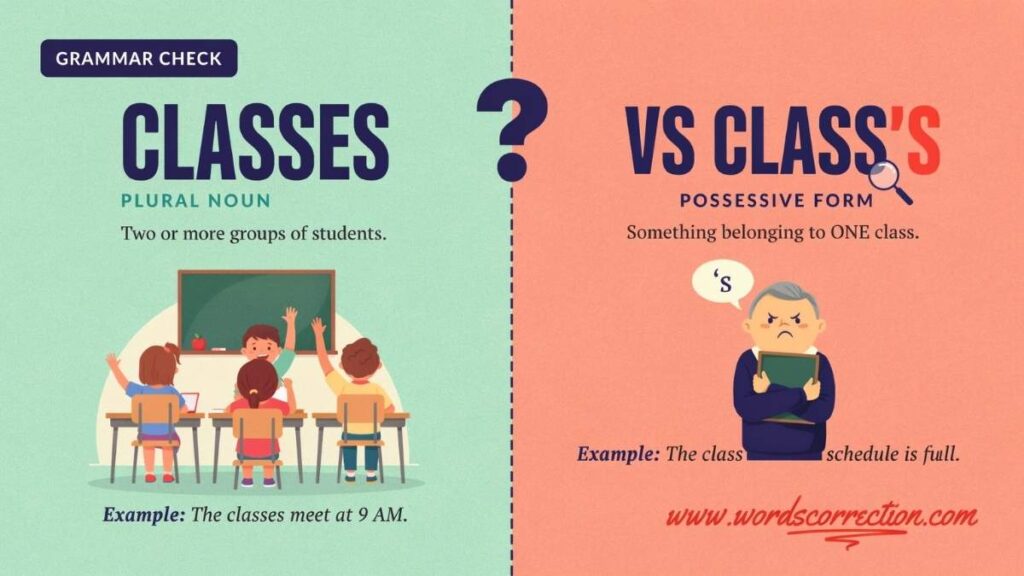
The difference between classes or class’s may look like a tiny grammar detail, but that small apostrophe can completely change the meaning. Classes refers to more than one class, while class’s shows possession or a relationship involving one class. Because the two forms look so similar, writers often confuse them and place the apostrophe where it doesn’t belong. Fortunately, the rule is straightforward once you understand what each form does. In this guide, you’ll learn the difference between classes and class’s, discover when to use each form, and avoid common grammar mistakes that can make otherwise clear writing unnecessarily confusing or inaccurate.
Classes or Class’s Quick Answer
The simplest rule is:
- Class = one class.
- Classes = more than one class.
- Class’s = something belonging to or associated with one class.
- Classes’ = something belonging to or associated with multiple classes.
| Form | Grammar | Meaning | Example |
| class | Singular noun | One class | The class starts at nine. |
| classes | Plural noun | More than one class | The classes start at nine. |
| class’s | Singular possessive | Belonging to one class | The class’s project is finished. |
| classes’ | Plural possessive | Belonging to multiple classes | The classes’ projects are finished. |
Simple Examples
Consider these four sentences:
The class is preparing for an exam.
Only one class appears in the sentence, so class is the correct singular noun.
The classes are preparing for exams.
This sentence refers to multiple groups or lessons. Therefore, classes is the plural form.
The class’s exam is tomorrow.
The exam belongs to or is associated with one class. That makes class’s the singular possessive.
The classes’ exams are tomorrow.
Now several classes have their own exams. The plural possessive classes’ fits.
Quick Rule
When deciding between class’s or classes, ask yourself:
How many classes are you talking about?
the answer is more than one, use classes when you simply need the plural.
If the answer is one, use class’s when you need the possessive.
answer is more than one and you need to show possession, use classes’.
The pattern is simple:
Plural: class → classes
Singular possessive: class → class’s
Plural possessive: classes → classes’
This distinction resolves most questions involving the possessive noun classes or class’s.
Learn the difference between tricky words and use them correctly
Bosses or Boss’s Which Is Correct? Meaning and Usage
Classes vs Class’s What Is the Difference?
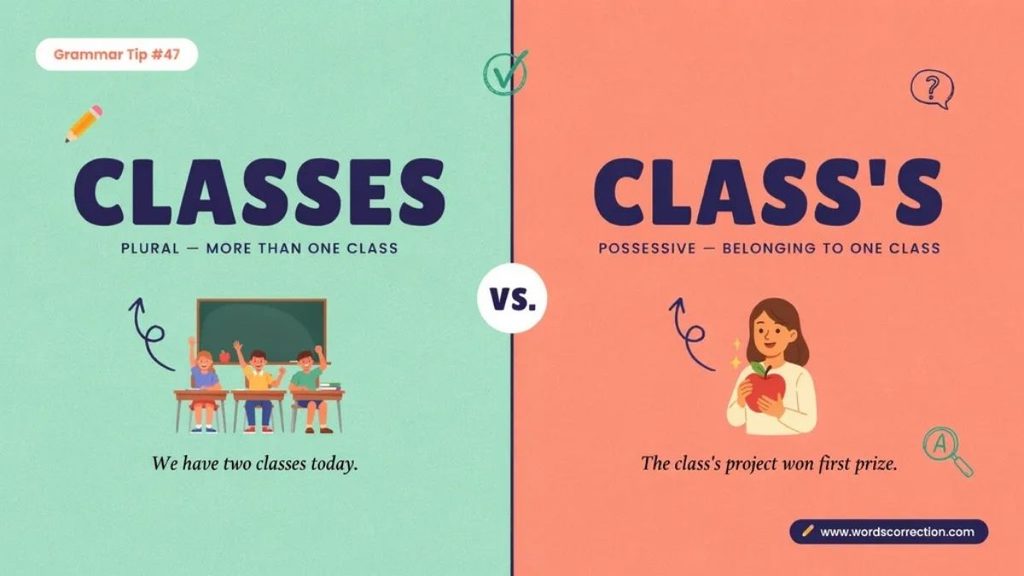
The main difference between classes vs class’s involves grammatical number and possession.
Classes is a plural noun. It tells readers that you mean multiple classes.
Class’s is a singular possessive noun form. It tells readers that one class has, owns, contains, produces, or relates to something.
The apostrophe isn’t decorative. It carries grammatical information.
Classes Is the Plural of Class
The plural of class is classes.
English often forms regular plurals by adding -s, but nouns ending in certain sounds take -es. The word class follows this pattern.
The formation is:
class → classes
This is the standard class plural form.
For example:
- one class
- two classes
- one English class
- three English classes
- one training class
- several training classes
The apostrophe has no role in forming this ordinary plural.
Therefore:
The school offers several classes.
is correct.
But:
The school offers several class’s.
is incorrect when the intended meaning is simply “several classes.”
The apostrophe changes the grammatical function of the word rather than making it plural.
Class’s Is the Singular Possessive Form
Now the grammar changes.
Class’s is the singular possessive of class. It normally means that something belongs to, comes from, or relates to one class.
For example:
The class’s teacher assigned a project.
There is one class, and the teacher is associated with that class.
Another example:
The class’s average score improved.
Again, the sentence refers to one particular class.
This is a singular possessive noun construction:
singular noun + ’s
Possession doesn’t always mean literal ownership. A class cannot physically own a teacher or an average score. Instead, class’s can express a relationship or association.
Learn the difference between similar English words the easy way
Personalise or Personalize Difference,Meaning and Usage
Classes’ Is the Plural Possessive Form
This is where the distinction becomes especially important.
If several classes have something, use classes’.
For example:
The classes’ schedules overlap.
This means the schedules belong to or are associated with multiple classes.
Compare:
The class’s schedule is posted online.
This refers to one class.
The classes’ schedules are posted online.
This refers to multiple classes.
The apostrophe moves because the grammatical number changes.
Class Is Neither Plural Nor Possessive
Sometimes you don’t need classes or class’s. You simply need class.
For example:
The class starts at 10 a.m.
Here, class functions as a singular noun. It doesn’t indicate possession.
Compare these sentences:
- The class starts at 10. → one class
- The classes start at 10. → multiple classes
- The class’s schedule changed. → one class + possession
- The classes’ schedules changed. → multiple classes + possession
This gives you the basic class or classes distinction.
Classes Meaning and Usage
The word classes has several meanings depending on context. Its most common use is simply the plural of class.
Classes as Multiple Lessons or Groups
You might say:
I have three classes today.
The sentence refers to three instructional periods or groups.
Other examples include:
- The university offers evening classes.
- She takes online classes every weekend.
- The students attend science classes twice a week.
- Several classes are using the new laboratory.
- The school canceled all afternoon classes.
These are straightforward examples of classes grammar because no possessive relationship exists.
Learn the difference between commonly confused more words in English
Unvoluntary or Involuntary Which One Is Correct?
Classes as Groups or Categories
The word class can also describe a category, group, rank, or division.
Therefore, classes can refer to several categories or groups.
For example:
Scientists use different classes to organize the organisms.
Or:
The software supports several classes of users.
The exact meaning depends on the subject, but the grammatical rule remains the same.
Classes in Common Expressions
You’ll frequently see classes in phrases such as:
- take classes
- attend classes
- online classes
- evening classes
- college classes
- language classes
- fitness classes
- advanced classes
- different classes
None of these requires an apostrophe simply because the word ends in -s.
For example:
She takes two English classes.
Not:
She takes two English class’s.
The first sentence uses a regular plural noun.
Class’s Meaning and Usage
The class’s meaning changes when the apostrophe appears.
Here, the word doesn’t simply tell you that there are several classes. Instead, it connects one class with another noun.
Class’s as a Possessive Noun
Consider:
The class’s teacher is absent.
The teacher is connected with one class.
Now compare:
The classes’ teachers are absent.
The second sentence refers to teachers connected with multiple classes.
This is why understanding class’s possessive is more useful than simply memorizing an apostrophe rule.
The apostrophe shows the relationship between nouns.
Class’s With Singular Subjects
The basic pattern looks like this:
one class + ’s + related noun
Examples include:
- the class’s teacher
- the class’s project
- the class’s schedule
- the class’s room
- the class’s performance
- the class’s average
- the class’s decision
These examples demonstrate the possessive form of class.
Learn the difference between confusing more English words step by step
Incurable or Uncurable? Meaning, Difference and Usage
Class’s in Everyday Sentences
Here are several natural examples of class’s:
The class’s final project is due Friday.
class’s performance impressed the principal.
The class’s schedule changed after the holiday.
class’s average score increased.
The class’s discussion continued for another hour.
Notice that the possessive relationship doesn’t have to involve ownership in the everyday sense.
A class doesn’t “own” an average score like someone owns a bicycle. The possessive construction simply identifies the score as belonging to or being associated with that class.
How to Form the Possessive of Class
If you’re searching for how to make class possessive, the rule is straightforward.
Start with the singular noun:
class
Then add ’s:
class’s
So the possessive form of class is normally class’s.
Singular Possessive Class’s
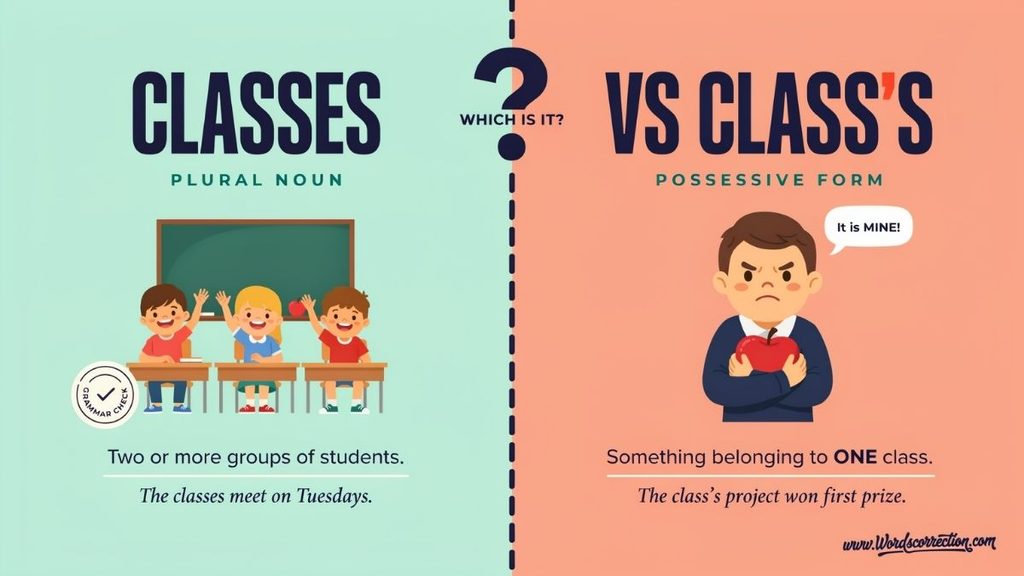
Use class’s when one class has a relationship with another noun.
| Singular noun | Singular possessive | Example |
| class | class’s | The class’s teacher arrived. |
| class | class’s | The class’s project won. |
| class | class’s | The class’s room changed. |
This is the standard singular possessive of class.
Plural Possessive Classes’
First make the plural:
class → classes
Then add the apostrophe:
classes → classes’
For example:
The classes’ schedules were updated.
The phrase refers to multiple classes and their schedules.
This is the plural possessive of class.
Why Class’s and Classes’ Are Not Interchangeable
The difference comes down to number.
Class’s = one class.
Classes’ = multiple classes.
Compare:
The class’s students completed the assignment.
This identifies one class.
The classes’ students completed the assignment.
This identifies students from multiple classes.
The difference is subtle visually, but the grammatical meaning changes.
The Origin of Classes and Class’s
The history of class helps explain why the word appears in so many different contexts today.
The English noun class dates to around 1600 in the sense of a group of students. It entered English through French from Latin and developed broader meanings involving groups, ranks, categories, and educational instruction.
The educational sense developed from the idea of a group of learners receiving instruction. Over time, the word expanded to describe categories, social groups, classifications, and other organized divisions.
Learn the difference between tricky English words with easy explanations
Vain or Vein Key Difference, Meaning, Grammar and Usage
How Classes Developed as the Plural Form
Modern English forms the plural as:
class → classes
The -es ending reflects the sound at the end of class. English commonly adds -es to nouns ending in sounds such as /s/, /z/, /sh/, /ch/, and similar sounds.
That gives us familiar patterns such as:
- bus → buses
- glass → glasses
- box → boxes
- class → classes
So if you’re wondering how to pluralize class, the answer is classes.
How Class’s Developed as a Possessive Form
The apostrophe in class’s belongs to the possessive system of English rather than the plural system.
English uses ’s after many singular nouns to mark possession or a close relationship.
That’s why:
class + ’s = class’s
The same general pattern appears in:
- teacher → teacher’s
- student → student’s
- school → school’s
- class → class’s
The spelling may look unusual because class already ends in s, but the grammar remains straightforward.
Classes, Class’s, and Classes’ A Grammar Comparison
The easiest way to understand the three forms is to separate number from possession.
Number vs Possession
Classes answers:
How many?
Class’s answers:
Whose or associated with which one?
Classes’ answers:
Whose or associated with which multiple ones?
Here’s the pattern:
CLASS
|
+——–+——–+
| |
Number Possession
| |
+—–+—–+ +—+—+
| | | |
class classes class’s classes’
one several one several
This simple structure captures the central distinction.
Apostrophes Do Not Usually Make Nouns Plural
One of the most important apostrophe rules in English is that apostrophes generally do not form ordinary plural nouns.
Therefore:
classes ✓
class’s ✗ when you mean multiple classes
However:
class’s ✓ when you mean something belonging to one class
The apostrophe isn’t the problem. The intended meaning determines whether you need it.
A Simple Test for Choosing the Correct Form
Try these three questions:
Are you talking about more than one class?
Use classes.
Does one class have or relate to something?
Use class’s.
Do multiple classes have or relate to something?
Use classes’.
This test works in most everyday situations.
British English vs American English Spelling
The basic forms class, classes, class’s, and classes’ work across standard American and British English.
The important distinction isn’t a US-versus-UK spelling issue. It’s a question of number and possession.
What Stays the Same
Both varieties use:
- class for one
- classes for more than one
- class’s for singular possession
- classes’ for plural possession
The basic apostrophe rules remain the same.
Learn the difference between more words people mix up
Congrats or Congratulations Which One Is Correct?
What Sometimes Confuses Writers
Some writers become uncertain because singular nouns that end in s can look unusual when they receive ’s.
For example:
the class’s teacher
The repeated s can look strange at first. Still, the form clearly distinguishes singular possession from plural possession.
The plural possessive looks different:
the classes’ teachers
Here, the plural already ends in s, so the apostrophe follows the final s.
Comparison Table British vs American Usage
| Form | American English | British English | Function |
| class | Correct | Correct | Singular |
| classes | Correct | Correct | Plural |
| class’s | Correct | Correct | Singular possessive |
| classes’ | Correct | Correct | Plural possessive |
So don’t look for a regional spelling difference where the real issue is grammatical number.
Class’s or Classes Which One Should You Use?
If you’re asking is it classes or class’s, focus on the meaning rather than the appearance of the word.
Use Classes If:
Use classes when:
- you mean more than one class
- you’re forming the ordinary plural
- no possessive relationship exists
- you’re describing multiple lessons or groups
- the noun functions as a plural subject or object
Examples:
The school offers evening classes.
Several classes joined the event.
The classes finish at noon.
She attends three classes each week.
These demonstrate how to use classes correctly.
Use Class’s If:
Use class’s when:
- you mean one specific class
- something belongs to that class
- something is associated with that class
- you need a singular possessive construction
Examples:
The class’s teacher is new.
class’s project received an award.
The class’s schedule has changed.
These demonstrate when to use class’s.
Use Classes’ If:
Use classes’ when:
- you’re referring to multiple classes
- those classes have a possessive relationship with another noun
- you need the plural possessive
Examples:
classes’ schedules overlap.
The classes’ teachers attended a meeting.
The classes’ projects were displayed in the hall.
These demonstrate how to use classes’.
A Fast Substitution Test
When you’re unsure, replace the noun with one or multiple.
If you can say:
one class
then a possessive version would normally be:
one class’s
If you can say:
multiple classes
then a possessive version would normally be:
multiple classes’
If you simply need the plural:
multiple classes
No apostrophe is needed.
Learn the difference between everyday English mistakes
Synched or Synced Correct Spelling, Meaning and Usage
Common Mistakes With Classes or Class’s

Mistake 1: Using Class’s as the Plural
Incorrect:
The university offers several class’s.
Correct:
The university offers several classes.
The first sentence incorrectly treats the apostrophe as a plural marker.
Mistake 2: Assuming Every Class Relationship Requires an Apostrophe
Consider:
The class schedule changed.
This can be perfectly correct because class can function as a noun modifier in a compound noun.
Now compare:
The class’s schedule changed.
This explicitly presents the schedule as belonging to or being associated with one particular class.
Both constructions can be grammatical, but they can emphasize the relationship differently.
This distinction matters because writers sometimes assume that every noun-to-noun relationship requires a possessive apostrophe. It doesn’t.
Mistake 3: Confusing Class’s With Classes’
Incorrect when referring to several classes:
The class’s schedules were different.
If several classes have separate schedules, write:
The classes’ schedules were different.
If only one class has a schedule, write:
The class’s schedule was different.
Mistake 4: Adding an Apostrophe Before the S
Incorrect:
The school has five class’s.
Correct:
The school has five classes.
The apostrophe in class’s changes the grammatical function. It doesn’t simply make the word “more plural.”
Mistake 5: Treating Classes’ as Another Plural
Classes’ isn’t simply another spelling of classes.
Compare:
The classes are full.
There is no possessive relationship.
Now:
The classes’ rooms are full.
The rooms are associated with multiple classes.
The apostrophe after classes changes the grammatical meaning.
Learn the difference between commonly misused words
Directer or Director Correct Spelling and Usage
Class’s or Class’ Which Possessive Form Is Correct?
A common question is whether the possessive should be class’ or class’s.
For standard American English, class’s is the normal singular possessive form.
So:
the class’s teacher
is the standard choice.
Class’ may appear in certain editorial systems or house styles, but it isn’t the usual form for standard American English writing.
The key point is that class is singular even though it ends in s. Therefore, the standard singular possessive construction is:
class + ’s → class’s
By contrast, classes is already plural:
classes + ’ → classes’
This gives you the two main possessive forms:
- class’s = one class
- classes’ = multiple classes
Learn the difference between basic English word mistakes
Attendance or Attendence Correct Spelling and Usage
Class’s and Classes in Real-World Examples
Grammar becomes easier when you see it working in practical situations.
Education and School Writing
The class begins at 8 a.m.
The school offers six classes each morning.
The class’s final assignment is due Friday.
The classes’ assignments are due Friday.
Each form communicates something different.
Academic Writing
Academic writing often requires precise distinctions because a small grammatical change can alter the scope of a statement.
Consider:
The class’s results were analyzed.
This refers to one class.
Now:
The classes’ results were analyzed.
This refers to results from multiple classes.
And:
The classes were analyzed.
This means the classes themselves were the objects of analysis.
The difference isn’t merely punctuation. It affects what the sentence actually communicates.
Workplace and Training
The same rules apply outside traditional classrooms.
The company offers several training classes.
The class’s instructor arrived early.
The classes’ instructors attended a meeting.
The grammatical distinction remains the same whether you’re discussing schools, professional training, workshops, or other instructional settings.
Emails and Everyday Messages
Imagine an administrator writing:
The evening classes have moved online.
No apostrophe is needed.
Now imagine:
The evening class’s meeting link has changed.
One class has a changed link.
Or:
The evening classes’ meeting links have changed.
Multiple classes have changed links.
The difference becomes clear once you identify the number of classes involved.
Social Media and Informal Writing
Informal writing doesn’t cancel grammar rules.
You might see:
Our weekend classes are almost full!
That is correct.
If you’re talking about one class:
The Saturday class’s final session is next week.
That is also correct.
Even in a short social post, the apostrophe carries meaning.
Learn the difference between often confused words
Many or Meny What’s the Right English Word?
A Practical Case Study One Class, Several Classes
Suppose a school has three groups: Class A, Class B, and Class C.
If you refer to all three groups, write:
The classes are preparing for the competition.
Now suppose Class A has a specific project:
Class A’s project is ready.
Using the general noun instead:
The class’s project is ready.
That’s singular possession.
Finally, suppose all three groups have projects:
The classes’ projects are ready.
Here’s the complete progression:
| Situation | Correct form | Example |
| One group | class | The class is ready. |
| Several groups | classes | The classes are ready. |
| One group’s project | class’s | The class’s project is ready. |
| Several groups’ projects | classes’ | The classes’ projects are ready. |
Once you identify one versus multiple, the apostrophe decision becomes much easier.
Learn the difference between confusing word pairs
Finalise or Finalize Meaning, Difference and Usage
Classes vs Class’s Side-by-Side Sentence Examples
The fastest way to master this distinction is to compare sentences.
| Form | Example | Meaning |
| class | The class is ready. | One class |
| classes | The classes are ready. | Multiple classes |
| class’s | The class’s project is ready. | Project associated with one class |
| classes’ | The classes’ projects are ready. | Projects associated with multiple classes |
More Examples With Context
Plural:
The school added two new classes.
Singular possessive:
The class’s new textbook arrived today.
Plural possessive:
The classes’ textbooks arrived today.
Singular:
The class meets in Room 204.
Plural:
The classes meet in different rooms.
Singular possessive:
The class’s room has new computers.
Plural possessive:
The classes’ rooms have new computers.
These class plural possessive examples and class singular possessive examples reveal the pattern without requiring complicated terminology.
Practice Session Classes or Class’s
Complete each sentence by choosing the correct form: class, classes, class’s, or classes’.
Fill in the Blanks
- I have three ________ today.
- The ________ teacher gave us a new assignment.
- The school offers several different ________.
- The ________ schedule was changed because of the holiday.
- All the ________ schedules were posted on the notice board.
- One ________ is starting at 9 a.m.
- The students attended their morning ________.
- The ________ project received excellent feedback from the teacher.
- The two ________ projects were displayed in the hallway.
- Our ________ is scheduled for Monday morning.
- The school added two new ________ this semester.
- The ________ representative spoke to the principal.
- The ________ representatives met to discuss the event.
- She has a ________ at 10 a.m.
- The teacher announced that the ________ assignment was due Friday.
- The different ________ have separate examination schedules.
- The ________ performance impressed everyone.
- The ________ performances were held in different rooms.
- I have another ________ after lunch.
- The ________ students worked together on the project.
- The ________ activities were planned by their teachers.
- The school changed the ________ timetable.
- The school changed the ________ timetables for the different groups.
- One ________ has been moved to another room.
- Several ________ have been moved to the afternoon.
Answer Session
- Classes
- Class’s
- Classes
- Class’s
- Classes’
- Class
- Classes
- Class’s
- Classes’
- Class
- Classes
- Class’s
- Classes’
- Class
- Class’s
- Classes
- Class’s
- Classes’
- Class
- Class’s
- Classes’
- Class’s
- Classes’
- Class
- Classes
Quick Review
- Class = one class
- Classes = more than one class
- Class’s = possession by one class
- Classes’ = possession by multiple classes
Here’s a trusted source for clear more words Comparison:
Grammar Update
Frequently Asked Questions Classes or Class’s
Is it correct to say class’s?
Yes. “Class’s” is correct when it is used as the singular possessive form of “class.” It indicates that something belongs to or is associated with one class.
Example: The class’s project was completed on time.
What is the plural possessive of class?
The plural possessive form of “class” is “classes’.” It is used when something belongs to or is associated with more than one class.
Example: The classes’ schedules were updated.
Is it correct to say classes?
Yes. “Classes” is the plural form of “class” and refers to more than one class.
Example: I have three classes today.
What is the difference between class’s and classes?
“Class’s” is the singular possessive form, while “classes” is the plural form.
Example: The class’s teacher arrived early.
Example: The students attended several classes.
What is the difference between classes and classe’s?
“Classes” is the plural form of “class,” while “classes’” is the plural possessive form.
Example: The school offers several classes.
Example: The classes’ schedules were different.
What is the singular possessive form of class?
The singular possessive form of “class” is “class’s.” It is used to show that one class owns or is associated with something.
Example: The class’s room was decorated for the event.
Is classe’s grammatically correct?
Yes. “Classes’” is grammatically correct when referring to possession or association involving multiple classes.
Example: The classes’ projects were displayed in the hallway.
Should I write class’s or classes?
Use “class’s” when referring to one class and “classes’” when referring to two or more classes.
Example: The class’s assignment was submitted.
Example: The classes’ assignments were submitted.
Is class singular or plural?
“Class” is a singular noun. Its standard plural form is “classes.”
Example: The class is ready.
Example: The classes are ready.
Is classes are or classes is correct?
“Classes are” is correct because “classes” is a plural noun and takes the plural verb “are.”
Example: The classes are scheduled for Monday.
For one class, use “class is.”
Example: The class is scheduled for Monday.
Can I say I have class?
Yes. “I have class” is a common and grammatically correct expression used to indicate that someone is attending a lesson or class.
Example: I have class at 10 a.m.
When should I use classes?
Use “classes” when referring to more than one class.
Example: She takes four classes at university.
When should I use class’s?
Use “class’s” when one class possesses or is associated with something.
Example: The class’s performance was excellent.
When should I use classes’?
Use “classes’” when multiple classes possess or are associated with something.
Example: The classes’ examination schedules were published.
What is the plural of class?
The plural of “class” is “classes.”
Example: One class → two classes.
Why does class become classes in the plural?
“Class” ends in “-ss,” so its plural is formed by adding “-es,” resulting in “classes.”
Example: class → classes.
Does class’s mean more than one class?
No. “Class’s” normally indicates possession by one class. When referring to possession by multiple classes, use “classes’.”
Example: The class’s teacher = one class.
Example: The classes’ teachers = multiple classes.
Is classes’s correct?
No. “Classes’s” is not the standard possessive form. When referring to possession by multiple classes, use “classes’.”
Correct: The classes’ schedules were updated.
Is class’ correct?
In standard modern English, “class’s” is generally used as the singular possessive form.
Example: The class’s teacher spoke to the students.
How do you make class possessive?
To make “class” possessive, add an apostrophe followed by “s,” forming “class’s.”
Example: The class’s decision was unanimous.
How do you make classes possessive?
Because “classes” is already a plural noun ending in “s,” form its possessive by adding only an apostrophe.
Example: The classes’ rooms were cleaned.
Which is correct class’s schedule or classes’ schedule”?
Both can be correct, depending on the intended meaning. “Class’s schedule” refers to one class, while “classes’ schedule” refers to multiple classes.
Example: The class’s schedule changed.
Example: The classes’ schedules changed.
What does the apostrophe in class’s indicate?
The apostrophe in “class’s” indicates possession or association. It shows that something belongs to or is connected with one class.
Example: The class’s project was impressive.
What does the apostrophe in classes’ indicate?
The apostrophe in “classes’” indicates possession or association involving multiple classes.
Example: The classes’ projects were displayed.
What are the correct forms of class in English?
The four main forms are “class,” “classes,” “class’s,” and “classes’.”
- Class — singular
- Classes — plural
- Class’s — singular possessive
- Classes’ — plural possessive
Classes vs Class’s Final Comparison Table
| Feature | Class | Classes | Class’s | Classes’ |
| Number | Singular | Plural | Singular | Plural |
| Possessive | No | No | Yes | Yes |
| Apostrophe | No | No | Yes | Yes |
| Meaning | One class | More than one class | Belonging to one class | Belonging to multiple classes |
| Example | The class meets today. | The classes meet today. | The class’s room is open. | The classes’ rooms are open. |
Conclusion
The confusion between classes or class’s often comes down to one small punctuation mark: the apostrophe. However, understanding its purpose makes the distinction much easier. Classes is the plural form of class and refers to more than one class. Class’s is the singular possessive form and shows that something belongs to or is associated with one class. When something belongs to or is associated with multiple classes, use classes’.
The simplest rule is easy to remember: classes = plural, class’s = singular possessive, and classes’ = plural possessive. Once you understand whether you’re expressing number or possession, choosing the correct form becomes straightforward. A tiny apostrophe may cause confusion, but it doesn’t have to cause a grammar crisis. Use the form that matches your meaning, and your writing will remain clear, accurate, and professional.

Stella AJS is an experienced blogger and dedicated English language writer at Words Correction. She turns confusing grammar, word meanings, spelling, and usage into clear, practical insights that readers can easily understand and apply. With a passion for precise and engaging writing, Stella helps readers avoid common language mistakes, strengthen their vocabulary, and communicate with greater clarity and confidence.




