

English spelling can turn a simple word into a surprisingly tricky decision. If you’ve ever paused before typing finalise or finalize, wondering whether one is incorrect, you’re certainly not alone. This common confusion often arises when writers move between British and American English. Fortunately, there’s no grammar disaster here: both spellings are correct, but they follow different regional conventions. In this guide, you’ll discover the meaning, difference, pronunciation, and proper usage of finalise and finalize, along with clear examples to help you avoid common mistakes. By the end, you’ll know exactly which spelling to use and why, without second guessing every sentence.
Finalise or Finalize Quick Answer
Both finalise and finalize are correct spellings of the same verb.
They mean to:
- Complete the final details of something
- Make a plan or decision definite
- Bring a process to its final stage
- Settle an agreement or arrangement
- Make something officially final
The main difference is spelling:
| Spelling | Common usage |
| finalize | American English and also accepted in British English |
| finalise | British English and other varieties that commonly use the -ise spelling |
For example:
- We need to finalize the contract today.
- We need to finalise the contract today.
Both sentences mean exactly the same thing.
Finalise or Finalize Examples
Here are some common examples:
- We need to finalize the plans before Friday.
- The team will finalise the arrangements tomorrow.
- Please finalize the report before sending it to the client.
- The company has finalised the agreement with its supplier.
- They are working to finalize the project details.
- The committee will finalise its decision next week.
The spelling changes, but the meaning does not.
What Does Finalise or Finalize Mean?
Finalise and finalize are verbs that describe the act of completing the last details of something or making something definite.
In simple terms, when you finalize something, you stop making major changes and consider it complete or officially settled.
For example:
We need to finalize the schedule before the meeting.
This means the schedule still needs a few final decisions before everyone can treat it as settled.
You can use the verb with plans, arrangements, contracts, documents, decisions, projects, agreements, and many other things.
Learn the difference between more words people mix up
Months or Monthes Which Spelling Is Correct?
Finalise Meaning in English
The meaning of finalise is:
To complete the final details of something or make something final and definite.
For example:
The manager will finalise the schedule tomorrow.
The manager will make the remaining decisions and complete the schedule.
Finalize Meaning in English
The meaning of finalize is the same:
To complete the last part of something or make a final decision about it.
For example:
The company plans to finalize the agreement this week.
The company intends to settle the remaining details and make the agreement final.
Finalise vs Finalize What Is the Difference?
The difference between finalise and finalize is primarily a matter of spelling.
Both words:
- Have the same meaning
- Function as verbs
- Have the same basic pronunciation
- Take the same grammatical forms
- Can be used in formal and informal writing
- Describe the completion or settlement of something
The main distinction is regional spelling preference.
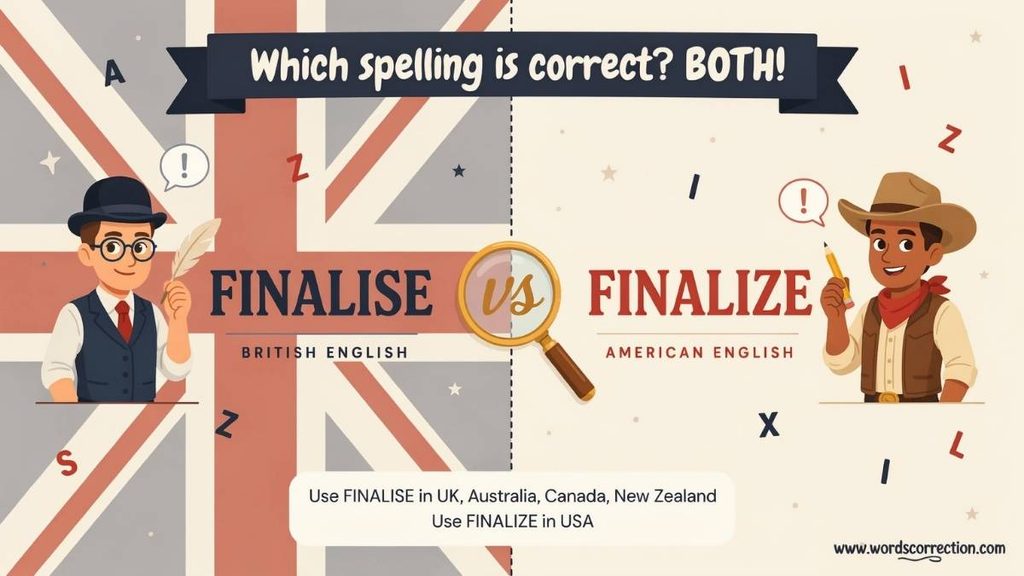
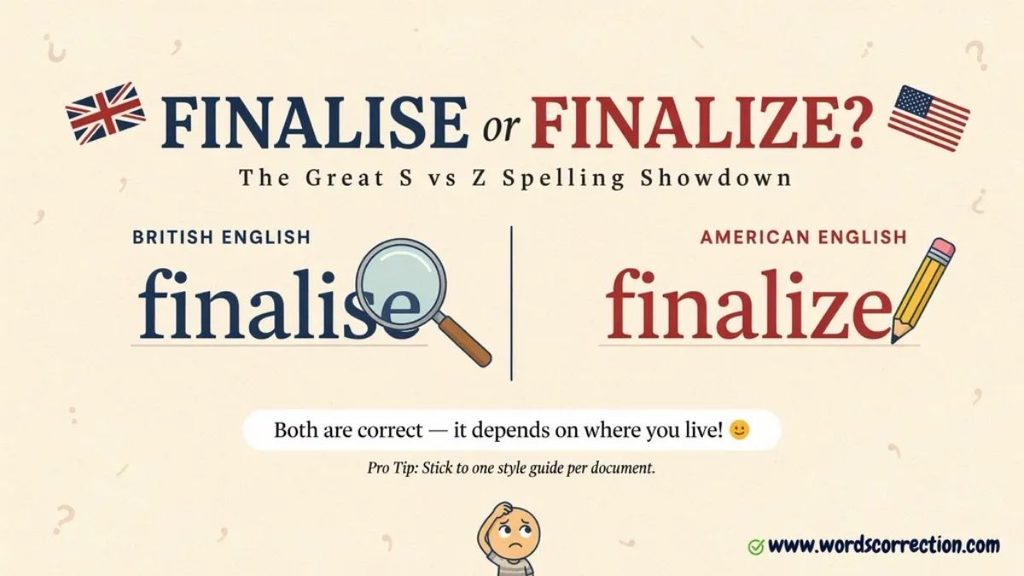
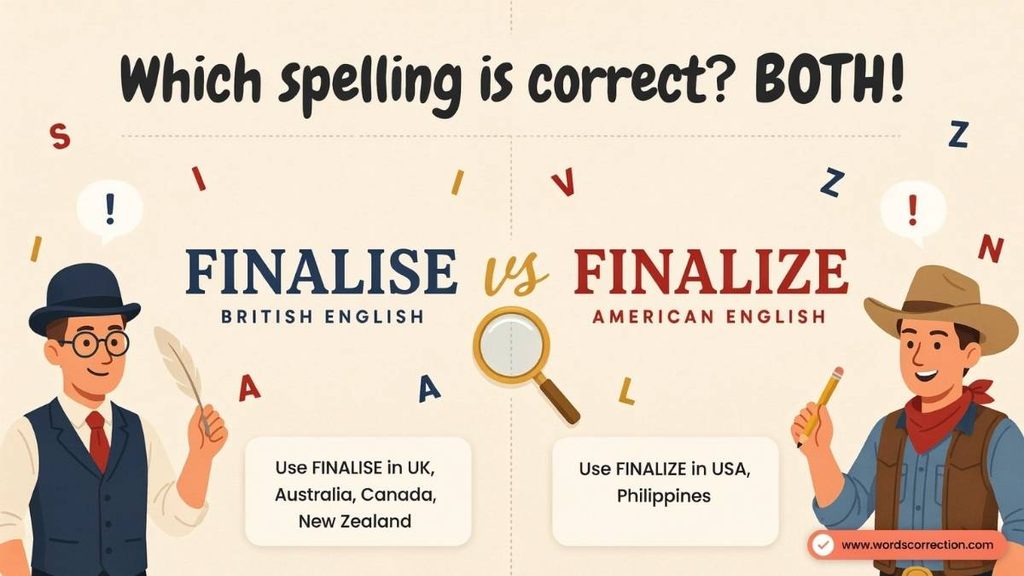
American English generally uses finalize. British English commonly uses finalise, although finalize is also a legitimate British English spelling.
Is It Finalise or Finalize?
The correct choice depends on the variety of English you are using.
If you are writing primarily for an American audience, finalize is the natural choice.
If you are following a British English style that uses the -ise convention, finalise is appropriate.
The important point is consistency. If you choose one spelling convention, avoid switching unnecessarily between forms throughout the same document.
Finalise and Finalize Pronunciation
The pronunciation of finalise and finalize is generally the same.
Both are commonly pronounced approximately as:
FY-nuh-lyze
The spelling changes from -ise to -ize, but the final syllable has the same sound.
This makes the difference easy to miss in conversation. You may hear the word hundreds of times without knowing which spelling the speaker would use in writing.
That is one reason this question appears so often in written English.
Learn the difference between everyday English mistakes
Bosses or Boss’s Which Is Correct? Meaning and Usage
Grammar and Word Forms
Both spellings follow the same grammatical pattern.
| Form | Finalise | Finalize |
| Base verb | finalise | finalize |
| Third-person singular | finalises | finalizes |
| Past tense | finalised | finalized |
| Present participle | finalising | finalizing |
| Noun | finalisation | finalization |
For example:
- She will finalise the document.
- She finalises the document every Friday.
- She finalised the document yesterday.
- She is finalising the document now.
- The finalisation of the agreement took several days.
With the American spelling:
- She will finalize the document.
- She finalizes the document every Friday.
- She finalized the document yesterday.
- She is finalizing the document now.
- The finalization of the agreement took several days.
The grammar remains the same. Only the spelling convention changes.
The Origin of Finalize and Finalise
The spelling difference comes from the broader history of English verb endings.
The verb is built from final with the suffix -ize. English uses this suffix in many verbs that describe making something become a particular state or carrying out a particular process.
Examples include:
- organize
- modernize
- realize
- centralize
- recognize
- standardize
- finalize
Over time, -ise became a common spelling variant in British English and related varieties of English.
This created pairs such as:
- organize / organise
- recognize / recognise
- realize / realise
- standardize / standardise
- finalize / finalise
However, it is important not to assume that every British writer must use -ise.
The -ize spelling has a long history in British English and remains accepted by many British dictionaries and style guides. Some British publishers and organizations prefer -ise, while others retain -ize.
So the distinction is about spelling conventions, not a simple American-versus-British rule.
Learn the difference between commonly misused words
Personalise or Personalize Difference,Meaning and Usage
British English vs American English Spelling
The most useful way to understand finalise vs finalize is to look at common regional patterns.
Finalise in British English
Finalise is widely used in British English.
For example:
We need to finalise the agreement before the end of the month.
You may also encounter this spelling in writing from countries and regions that commonly follow British spelling conventions.
These include many Commonwealth contexts, although individual countries, organizations, publishers, and style guides may follow different conventions.
Finalize in American English
Finalize is the standard spelling in American English.
For example:
We need to finalize the agreement before the end of the month.
American English generally uses -ize in verbs such as:
- finalize
- organize
- recognize
- realize
- centralize
- standardize
British English Can Also Use Finalize
This is an important detail.
It would be inaccurate to say that finalize is only American English.
British English can use -ize spellings as well. Some British dictionaries and publishing systems recognize both -ize and -ise forms.
Therefore:
finalise = valid
finalize = valid
The preferred form depends on the spelling system and style guide being followed.
The Common -ise and -ize Pattern
The difference between finalise and finalize is part of a much larger spelling pattern.
| -ise spelling | -ize spelling |
| finalise | finalize |
| organise | organize |
| recognise | recognize |
| realise | realize |
| standardise | standardize |
| centralise | centralize |
These pairs generally have the same meanings.
However, English spelling has exceptions and historical complications. You should not assume that every word ending in -ise can automatically be changed to -ize, or vice versa.
That is why dictionary guidance and the relevant style guide remain useful when you are unsure.
Learn the difference between basic English word mistakes
Unvoluntary or Involuntary Which One Is Correct?
Finalise or Finalize in a Sentence

Both forms can be used in exactly the same types of sentences.
Finalise in a Sentence
We need to finalise the plans before booking the venue.
The lawyers are working to finalise the contract.
Please finalise your report by Thursday.
The company has finalised the details of the agreement.
Finalize in a Sentence
We need to finalize the plans before booking the venue.
The lawyers are working to finalize the contract.
Please finalize your report by Thursday.
The company has finalized the details of the agreement.
Notice what stays the same: the sentence structure, meaning, and grammatical function.
Only the spelling changes.
Learn the difference between often confused words
Incurable or Uncurable? Meaning, Difference and Usage
Common Uses of Finalise and Finalize
You will often see these verbs used with words related to planning, decision-making, and completion.
Finalize Plans
The team will finalize the travel plans tomorrow.
This means the team will make the remaining decisions and settle the arrangements.
Finalize an Agreement
Both companies hope to finalize the agreement this week.
This means the companies intend to settle the remaining terms and make the agreement final.
Finalize a Contract
The attorneys are reviewing the document before they finalize the contract.
The word suggests that the final details still require attention.
Finalize a Decision
The committee will finalize its decision after reviewing the evidence.
Here, finalize means to reach and settle the final decision.
Finalize a Document
Please finalize the document before submitting it.
This means the document should be completed and ready for submission.
Finalize a Project
The development team expects to finalize the project by the end of the quarter.
In this context, the verb refers to completing the remaining work and bringing the project to its final stage.
Finalize vs Finish Are They the Same?
Finalize and finish are closely related, but they are not always interchangeable.
Finish is broader. It can describe completing almost any activity.
For example:
I finished my homework.
You would not normally say:
I finalized my homework.
Finalize has a more specific sense. It often suggests that something has reached its final, settled, or official form.
For example:
We finalized the contract.
This suggests that the terms have been settled and the contract is now in its final form.
A useful distinction is:
- Finish = complete an activity or task.
- Finalize = complete the final details and make something settled or official.
That small difference matters in professional writing.
Finalize vs Complete
Complete and finalize can overlap, but they emphasize different ideas.
She completed the report.
This focuses on the report being done.
She finalized the report.
This emphasizes that the final details have been settled and the report is ready in its final form.
In business communication, finalize can therefore sound more precise when you are talking about documents, agreements, plans, or arrangements.
Learn the difference between confusing word pairs
Vain or Vein Key Difference, Meaning, Grammar and Usage
Finalise vs Finalize in Business Writing
Both spellings work in professional communication.
Consider this email sentence:
We will finalize the proposal after receiving your feedback.
A British English version could read:
We will finalise the proposal after receiving your feedback.
Neither version is more professional simply because of the spelling.
The important factors are:
- Correct grammar
- Consistent spelling
- Appropriate tone
- Clear wording
- Consistency with your organization’s style guide
If your company uses American English, choose finalize. If your organization follows a British English style guide that prefers -ise, choose finalise.
Finalise or Finalize in Formal and Legal Writing
Both forms appear in formal writing.
You might see:
The parties will finalize the agreement following the review process.
Or:
The parties will finalise the agreement following the review process.
The choice depends on the applicable regional spelling convention.
In legal and contractual writing, consistency becomes particularly important. A document may contain many related words, so switching between -ise and -ize forms can make the text look poorly edited.
For example, if a document uses:
- finalize
- organize
- recognize
it should generally avoid suddenly switching to:
- finalise
- organise
- recognise
unless there is a specific reason for doing so.
Learn the difference between tricky grammar more words
Congrats or Congratulations Which One Is Correct?
both in Academic Writing
Academic writers should follow the spelling requirements of their institution, publisher, journal, or chosen style guide.
For American English:
Researchers finalized the methodology before collecting the data.
For British English:
Researchers finalised the methodology before collecting the data.
The important thing is not to mix spelling systems without a reason.
Academic writing rewards consistency. A small spelling variation may not change your meaning, but inconsistent regional spelling can make a paper look less carefully edited.
Finalise or Finalize in Emails
The right spelling depends on your audience.
For an American audience:
We have finalized the meeting arrangements.
For a British audience:
We have finalised the meeting arrangements.
In either case, the meaning remains unchanged.
If you communicate internationally, choose a consistent style based on your organization’s preferred English variety rather than changing the spelling from one email to another.
Learn the difference between commonly mixed-up more words
Synched or Synced Correct Spelling, Meaning and Usage
Finalise or Finalize on Social Media
Social media gives writers more flexibility, but standard spelling still matters when you are representing a business, organization, or professional brand.
A US-based company might write:
We’ve finalized the details. More information is coming soon.
A British company might write:
We’ve finalised the details. More information is coming soon.
Both are correct.
Your audience and brand style should guide the choice.
Common Mistakes with Finalise and Finalize
Several misconceptions regularly cause confusion.
Assuming Finalise Is Incorrect
Some writers believe that finalise is a misspelling of finalize.
It is not.
Finalise is a legitimate English spelling.
It is widely used in British English and other varieties influenced by British spelling.
Assuming Finalize Is Only American
This is another common misconception.
While finalize is standard in American English, the -ize spelling also has a place in British English.
Therefore, describing finalize as an exclusively American spelling oversimplifies the issue.
Thinking -ise Is Informal
The -ise spelling is not inherently informal.
You can use finalise in:
- Business reports
- Academic writing
- Professional emails
- Government documents
- Formal correspondence
- Legal documents
The choice depends on the spelling convention, not the level of formality.
Learn the difference between confusing more English words
Directer or Director Correct Spelling and Usage
Mixing Spelling Conventions
A document that moves randomly between finalise and finalize can look inconsistent.
The same problem appears with words such as:
- organize / organise
- recognize / recognise
- realize / realise
Pick a convention and use it consistently.
Believing -ize Is Always American
The -ize ending is strongly associated with American English, but it is not exclusively American.
Some British English publications and dictionaries use or recognize -ize spellings.
The safest rule is simple: follow the style guide that governs your writing.
Finalise and Finalize Synonyms
Several words can replace finalise or finalize, depending on the context.
Complete
Use complete when you mean to finish something.
We completed the report.
Settle
Use settle when you mean to resolve remaining details or disagreements.
We settled the terms of the agreement.
Conclude
Use conclude when you mean to bring a process or discussion to an end.
The committee concluded its review.
Confirm
Use confirm when the main idea involves verifying an arrangement or decision.
Please confirm the meeting time.
Approve
Use approve when someone with authority formally accepts something.
The director approved the proposal.
Resolve
Use resolve when you are dealing with an issue, problem, or disagreement.
The team resolved the remaining issues.
These words are related to finalize, but they are not perfect substitutes in every sentence.
Learn the difference between tricky words and use them correctly
Attendance or Attendence Correct Spelling and Usage
Finalise vs Finalization and Finalize vs Finalisation
The noun forms follow the same spelling distinction.
Finalization is commonly used with the -ize spelling.
Finalisation is commonly used with the -ise spelling.
Both refer to the act or process of making something final.
For example:
The finalization of the contract took several days.
British-style spelling may use:
The finalisation of the contract took several days.
Similarly:
- finalized / finalised
- finalizing / finalising
- finalization / finalisation
These forms follow the same regional spelling pattern.
A Practical Case Study One Document, Two Spelling Systems
Imagine that a company prepares two versions of its customer documentation.
The US version says:
The team will finalize the project details on Monday.
The UK version says:
The team will finalise the project details on Monday.
A writer might assume that one version contains an error. It does not.
The difference reflects the spelling convention used for each audience.
Now imagine that the same UK document contains:
The team will finalise the project. The marketing department will organize the launch, and the manager will recognize the final changes.
This combination may look inconsistent if the publication follows an -ise style consistently.
A more consistent version would be:
The team will finalise the project. The marketing department will organise the launch, and the manager will recognise the final changes.
Alternatively, a style guide that prefers -ize could use:
The team will finalize the project. The marketing department will organize the launch, and the manager will recognize the final changes.
The lesson is straightforward: consistency matters more than choosing one spelling as universally correct.
Learn the difference between commonly confused more words in English
Many or Meny What’s the Right English Word?
Which Spelling Should You Use?
The best choice depends on your audience and the style guide you follow.
Use Finalise If:
Choose finalise when:
- You are following a British English spelling convention.
- Your organization prefers the -ise form.
- Your publication uses British spelling consistently.
- Your audience expects British-style spelling.
- You are matching an existing document that uses -ise forms.
Use Finalize If:
Choose finalize when:
- You are writing in American English.
- Your organization uses American spelling.
- Your publication follows a style guide that prefers -ize.
- Your audience primarily uses American English.
- You are maintaining consistency with other -ize words.
For Global or SEO Content
For international content, there is no universal requirement to choose finalise or finalize.
Instead, identify your primary audience.
If the content targets US readers, finalize will usually fit naturally.
If it targets UK readers, finalise may be more appropriate.
For broader international content, consistency and readability matter more than trying to force one spelling into every market.
Search engines can generally understand spelling variants, so there is no need to awkwardly repeat both forms throughout an article. Write naturally and use the spelling that fits your intended audience.
Finalise or Finalize Comparison Table
| Feature | Finalise | Finalize |
| Part of speech | Verb | Verb |
| Meaning | Make something final | Make something final |
| Pronunciation | Generally the same | Generally the same |
| Common in American English | Less common | Standard |
| Common in British English | Widely used | Also accepted |
| Past tense | finalised | finalized |
| Present participle | finalising | finalizing |
| Noun form | finalisation | finalization |
| Formal usage | Yes | Yes |
| Informal usage | Yes | Yes |
Practice Session
Fill in the Blanks
Choose the correct form of finalise/finalize or its related form to complete each sentence.
- The manager needs to ________ the contract before the meeting.
- We have ________ the schedule for next month’s conference.
- The team is ________ the details of the new project.
- The agreement was ________ after several rounds of discussion.
- Please ________ the report before submitting it to the director.
- The company has ________ its plans for the upcoming year.
- They are working to ________ the arrangements for the event.
- The committee ________ the proposal yesterday.
- We need to ________ the remaining details before publication.
- The documents have been ________ and are ready for approval.
- She is ________ the presentation before sending it to the client.
- The two companies have ________ their partnership agreement.
- The British English spelling of the verb is commonly written as ________.
- The American English spelling is commonly written as ________.
- The noun form commonly associated with “finalize” is ________.
- The British spelling of the noun is commonly written as ________.
- The past participle of “finalize” is ________.
- The past participle of “finalise” is ________.
- The present participle of “finalize” is ________.
- The present participle of “finalise” is ________.
- The director asked the team to ________ the proposal by Friday.
- Once the details are ________, we can publish the announcement.
- The legal department is ________ the terms of the agreement.
- The project cannot proceed until all arrangements are ________.
- Writers should choose the spelling appropriate for their variety of English and use it ________ throughout the document.
Correct Answers
- finalize
- finalized
- finalizing
- finalized
- finalize
- finalized
- finalize
- finalized
- finalize
- finalized
- finalizing
- finalized
- finalise
- finalize
- finalization
- finalisation
- finalized
- finalised
- finalizing
- finalising
- finalize
- finalized
- finalizing
- finalized
- consistently
Here’s a trusted source for clear more words Comparison:
Grammar Update
Frequently Asked Questions
When should I use finalise in a sentence?
Use “finalise” when following British English or another English variety that commonly uses the -ise spelling. It means to complete the remaining details of something or make it definite.
When should I use finalize in a sentence?
Use “finalize” when following American English. It has the same meaning as “finalise” and refers to completing or formally settling something.
Do finalise and finalize have the same meaning?
Yes. “Finalise” and “finalize” are spelling variants of the same verb and generally have the same meaning. The primary difference is their regional spelling preference.
Is finalise primarily a British spelling?
Yes. “Finalise” is commonly associated with British English and is also used in several other varieties of English that follow British spelling conventions.
Is finalize used outside American English?
Yes. “Finalize” is also used internationally, including in contexts where British English is common. However, “finalise” may be preferred in some British and Commonwealth contexts.
What is the noun form of finalize?
The noun form is “finalization.” The corresponding noun associated with “finalise” is commonly spelled “finalisation.”
What are the different forms of finalize?
The main forms are finalize, finalizes, finalized, and finalizing.
What are the different forms of finalise?
The main forms are finalise, finalises, finalised, and finalising.
Is finalizing a correct form?
Yes. “Finalizing” is the present participle and gerund form of “finalize.” It refers to the process of completing the last details of something.
Is finalising a correct British form?
Yes. “Finalising” is the spelling commonly used with the British form “finalise.”
Can finalize be used with documents and agreements?
Yes. “Finalize” can be used with documents, contracts, agreements, reports, and other materials when their remaining details are being completed or formally settled.
Can finalise be used for plans and arrangements?
Yes. “Finalise” can be used when completing the remaining details of plans, schedules, arrangements, or similar matters.
Is finalize appropriate in formal writing?
Yes. “Finalize” is a standard English verb and is appropriate in professional, academic, business, and other formal contexts.
Is finalise suitable for professional writing?
Yes. “Finalise” is perfectly appropriate in professional writing when using British English or another variety that follows the -ise spelling convention.
What is the past participle of finalize?
The past participle of “finalize” is “finalized.” For example: “The agreement has been finalized.”
What is the past participle of finalise?
The past participle of “finalise” is “finalised.” For example: “The agreement has been finalised.”
Can finalize be used as a transitive verb?
Yes. “Finalize” is normally used as a transitive verb, meaning it can take a direct object. For example, you can finalize a contract, proposal, schedule, or decision.
What words commonly follow finalize?
Common combinations include finalize a plan, finalize an agreement, finalize a contract, finalize a document, finalize the details, finalize a schedule, and finalize a decision.
Can finalize be used in the passive voice?
Yes. For example, “The contract was finalized yesterday” uses “finalized” in the passive voice.
What is the difference between final and finalize?
“Final” is generally an adjective, meaning last or definitive, while “finalize” is a verb meaning to complete the final details or make something definite.
What is the difference between finalize and complete?
Both words can refer to finishing something. However, “finalize” often emphasizes completing the last details or formal steps, while “complete” has a broader meaning of bringing something to an end.
Can finalize be used with the word decision?
Yes. “Finalize a decision” means to make a decision definite, settled, or officially determined.
Can finalize be used to describe a person?
Generally, no. “Finalize” normally refers to an action, decision, document, agreement, plan, or other matter, rather than describing a person.
Does the spelling change when finalize becomes finalizing?
Yes. The final e is removed before adding -ing, giving “finalizing.” Likewise, “finalise” becomes “finalising.”
Which spelling should I use consistently in my writing?
Choose the spelling that matches the variety of English you are using and remain consistent throughout your writing. “Finalize” is widely associated with American English, while “finalise” is widely associated with British English and related spelling conventions.
Conclusion
The choice between finalise or finalize doesn’t need to become a final test of your English skills. Both spellings are correct and carry the same meaning: to complete the final details of something and make it definite. The primary difference is regional spelling convention. Finalize is the standard form in American English, while finalise is widely used in British English. However, British English also accepts finalize, so treating one spelling as universally incorrect can create unnecessary confusion.
The key is consistency. Choose the spelling that suits your audience, follow the relevant style guide, and use it consistently throughout your writing. Once you understand the distinction, this common spelling dilemma becomes much easier to handle.

Stella AJS is an experienced blogger and dedicated English language writer at Words Correction. She turns confusing grammar, word meanings, spelling, and usage into clear, practical insights that readers can easily understand and apply. With a passion for precise and engaging writing, Stella helps readers avoid common language mistakes, strengthen their vocabulary, and communicate with greater clarity and confidence.




