

One tiny spelling mistake can make your sentence take a completely different turn. That’s exactly what happens when you’re stuck wondering about insight or insite. They look almost identical, sound similar, and can easily confuse even careful writers. However, when you mean a deep understanding, clear perception, or valuable awareness, there’s only one correct choice: insight. “Insite” is generally a spelling mistake in this context. The good news? You don’t need to wrestle with this word every time you write it. This guide breaks down the difference, clears up common grammar mistakes, and shows you exactly how to use insight correctly and confidently.
Insight or Insite Quick Answer
Insight is the correct English word when you mean a clear, deep, or useful understanding of a person, problem, situation, or subject.
Insite is generally incorrect when used as a replacement for insight. It is usually a spelling mistake caused by confusion with words such as site and sight.
| Word | Correct? | Meaning | Example |
| Insight | Yes | A deep or clear understanding | Her insight helped us solve the problem. |
| Insite | Usually no | Common misspelling of insight | Incorrect: He gave me useful insite. |
| Incite | Yes | To encourage or provoke an action | The speech could incite anger. |
| Sight | Yes | The ability to see or something seen | The mountain was an amazing sight. |
| Site | Yes | A place or location | The company selected a new construction site. |
So, if you’re asking “insight or insite?”, the answer is simple:
Insight is correct when you mean understanding or awareness.
What Does Insight Mean?
Insight is a noun that refers to a clear, deep, or valuable understanding of something.
It can describe an understanding that helps you recognize why something happens, how something works, or what a person may be thinking or feeling.
For example:
Her insight into customer behavior helped the company improve its services.
Here, insight means a deeper understanding of customer behavior.
Another example is:
The therapist provided valuable insight into the patient’s concerns.
The word refers to an understanding that goes beyond simply knowing basic facts.
Learn the difference between confusing more English words
Presence or Presense Which Spelling Is Correct?
Insight Meaning in Simple English
In simple terms, insight means understanding something deeply or seeing something clearly.
Think of it this way:
Information tells you what happened. Insight helps you understand why it happened.
For example:
- Information: Sales dropped by 20%.
- Insight: Customers stopped buying because the new prices were too high.
The first statement gives you a fact. The second gives you an explanation or deeper understanding.
That difference is what makes insight such a useful word in everyday, professional, academic, and analytical writing.
What Does Insite Mean?
Insite is generally not the correct spelling when you want to use the noun meaning “deep understanding.”
For example:
Incorrect: The report provides valuable insite into customer behavior.
The correct version is:
Correct: The report provides valuable insight into customer behavior.
The mistake usually happens because English contains several words with similar sounds and spellings, including insight, incite, site, and sight.
These words may look or sound related, but they have completely different meanings.
Learn the difference between commonly mixed-up more words
Gos or Goes Which One Is Right?
Why Do People Write?
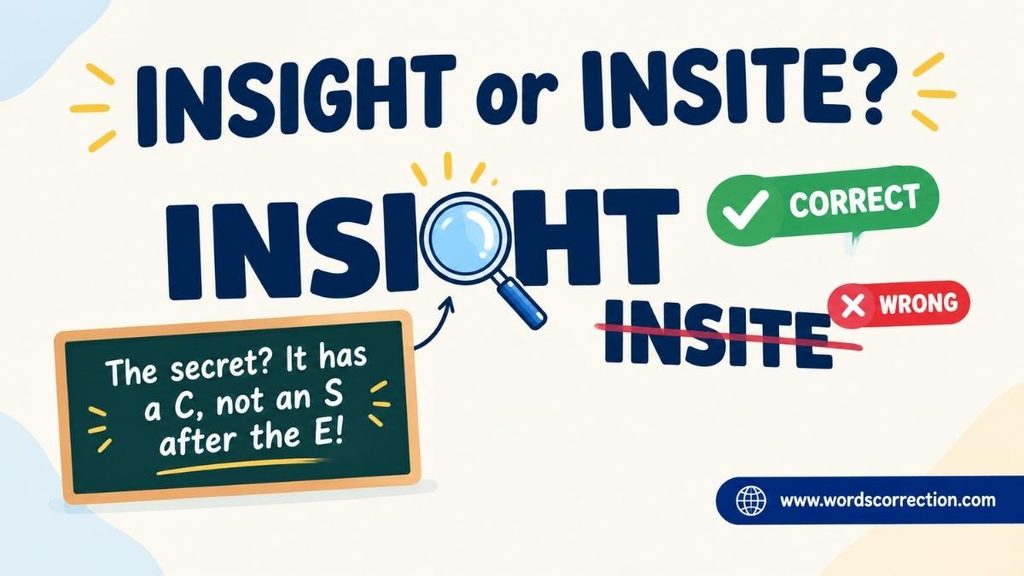
There are several reasons someone might write insite instead of insight.
First, English spelling isn’t always intuitive. The pronunciation of insight can make it easy to forget that the word contains sight.
Second, people may unconsciously connect the word with site, especially because site is a familiar English word.
Third, typing quickly can produce spelling errors. A simple missing letter can turn insight into insite.
The important point is that insite should not normally be used when you mean insight.
Why Is Insight Spelled With “Sight”?
The spelling of insight becomes much easier to remember when you recognize the word’s connection with sight.
The word can be understood historically and conceptually as relating to “seeing into” something. Modern insight, however, doesn’t mean literal eyesight. It refers to mental understanding or perception.
This connection creates a useful memory trick:
Insight = seeing something clearly with your mind.
For example:
The manager gained insight into why employees were leaving.
The manager isn’t literally looking at something with their eyes. Instead, they are developing a deeper understanding of the situation.
That is why the spelling insight, rather than insite, is important.
Learn the difference between tricky grammar more words
To or Too Clear Difference, Meaning and Usage
Insight vs. Incite
One of the most important distinctions is between insight and incite.
They look similar, but their meanings are completely different.
Insight
Insight is a noun meaning deep or clear understanding.
The research offers valuable insight into consumer behavior.
Incite
Incite is a verb meaning to encourage, provoke, or stir someone toward a particular action, especially something negative or aggressive.
The speech could incite violence.
A simple way to remember the difference is:
- Insight = understanding
- Incite = provoke
Consider these two sentences:
The psychologist offered insight into the patient’s behavior.
The inflammatory speech could incite anger.
The first sentence deals with understanding. The second deals with provoking a reaction.
Confusing these words can completely change the meaning of a sentence.
Learn the difference between confusing word pairs
Inact or Enact Which Spelling Is Correct?
Insight vs. Sight
The words insight and sight are related in spelling, but they don’t mean the same thing.
Sight
Sight generally relates to seeing or something that can be seen.
The sunset was a beautiful sight.
It can also refer to the ability to see:
Her eyesight improved after treatment.
Insight
Insight refers to mental understanding.
The discussion gave me new insight into the problem.
A useful distinction is:
Sight involves the eyes. Insight involves understanding.
For example:
I saw the problem with my own eyes.
This concerns sight.
I finally understood why the problem happened.
This concerns insight.
Insight vs. Site
Another common source of confusion is site.
A site is a physical or virtual location.
For example:
The company purchased a new construction site.
The developer launched a new website.
In contrast, insight refers to understanding.
The consultant provided valuable insight into the company’s problems.
So remember:
- Site = place
- Sight = seeing
- Insight = understanding
These three words may look similar, but their meanings are worlds apart.
How to Use Insight in a Sentence
The word insight appears frequently in professional, academic, business, and everyday English.
Here are some natural examples.
The interview gave us valuable insight into her experience.
His research provides important insight into climate behavior.
The manager offered insight into the company’s future plans.
Reading the book gave me new insight into human psychology.
Her personal experience gave her insight into the challenges faced by new employees.
The survey provides useful insight into customer preferences.
In each example, insight refers to a deeper understanding.
Learn the difference between often confused words
Maxxed or Maxed: Which Spelling Is Correct?
Common Expressions With Insight
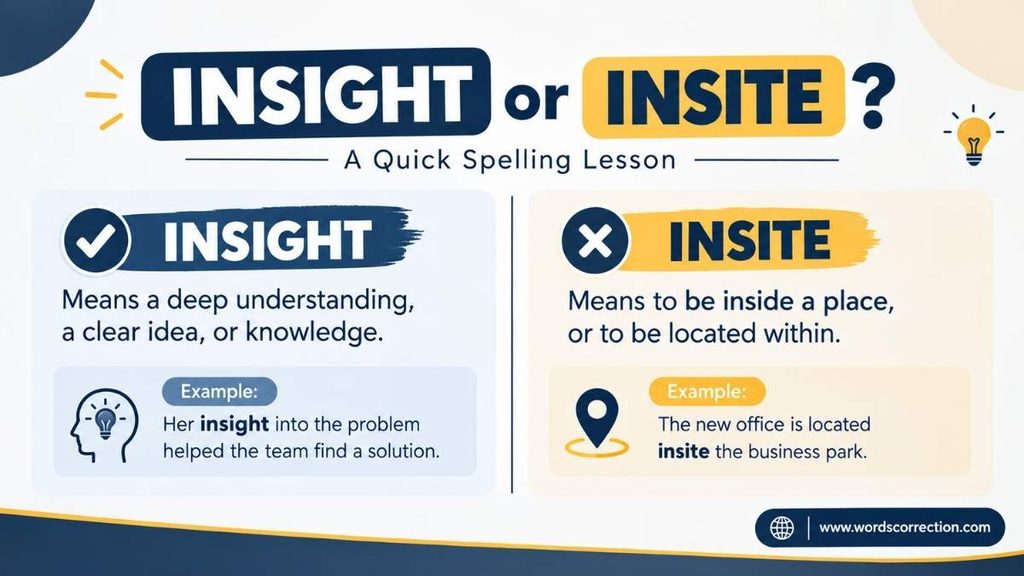
Several expressions commonly appear with insight.
Insight into
This is one of the most common constructions.
The study provides insight into how people make decisions.
The interview offered insight into the artist’s creative process.
Gain insight
This means to develop a deeper understanding.
Students can gain insight by studying real-world examples.
Provide insight
This means to give someone useful understanding or information.
The report provides insight into recent market trends.
Offer insight
This has a similar meaning to provide insight.
The expert offered valuable insight into the issue.
Have insight into
This means to possess a deeper understanding of something.
She has considerable insight into consumer psychology.
Learn the difference between basic English word mistakes
Unattentive or Inattentive Meaning and Usage
Common Mistakes With Insight
Even though insight is a common word, several mistakes occur frequently.
Mistake 1: Writing “Insite”
Incorrect:
The article provides useful insite into the topic.
Correct:
The article provides useful insight into the topic.
Remember that the correct spelling contains sight.
Mistake 2: Confusing Insight With Incite
Incorrect:
The article incites into the problem.
Correct:
The article provides insight into the problem.
Incite is a verb. Insight is a noun.
Mistake 3: Using “Insight” as a Verb
Because insight sounds like it could describe an action, some writers mistakenly use it as a verb.
Incorrect:
The research insights us into the problem.
Correct:
The research gives us insight into the problem.
You can also use insightful as an adjective:
Her comments were insightful.
Mistake 4: Using the Wrong Preposition
A common structure is insight into.
For example:
The report provides insight into customer behavior.
Although other constructions may appear depending on the sentence, insight into is especially common and natural.
Insight Synonyms
Depending on the context, several words can have meanings similar to insight.
Common synonyms include:
- Understanding
- Awareness
- Perception
- Knowledge
- Comprehension
- Discernment
- Perspective
- Recognition
- Intuition
- Awareness
However, these words aren’t always interchangeable.
For example, knowledge often refers to information you possess, while insight suggests a deeper understanding of what that information means.
Consider:
She has extensive knowledge of marketing.
This tells us that she knows a lot about marketing.
Compare that with:
She has valuable insight into consumer behavior.
This suggests that she understands consumer behavior at a deeper level.
Learn the difference between commonly misused words
Handle or Handel Correct Spelling, Meaning, and Usage
in Everyday English
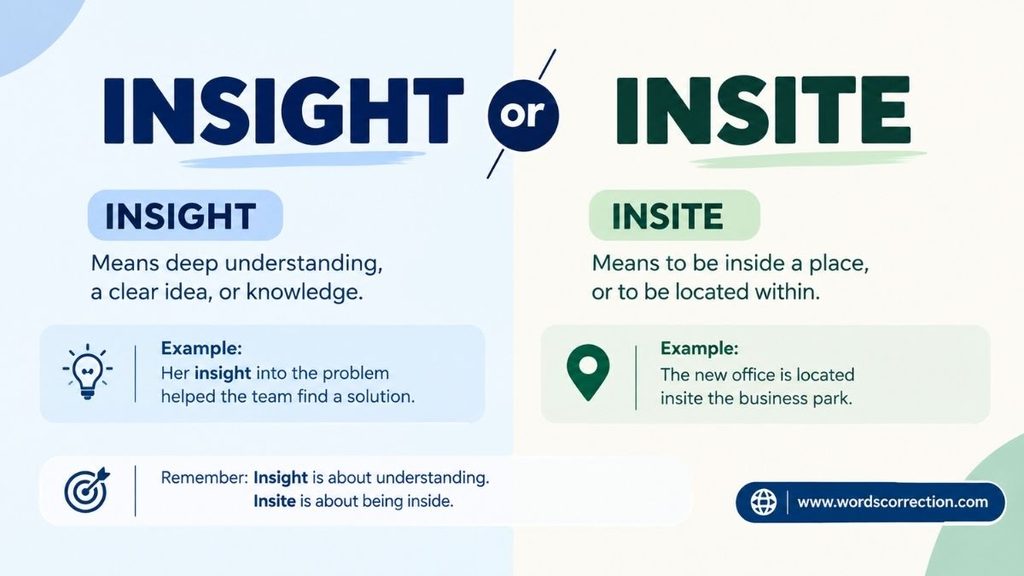
You don’t need to be writing a research paper to use insight.
The word works naturally in everyday conversations.
For example:
That conversation gave me some insight into what he was thinking.
Her advice gave me insight into how I should approach the situation.
The documentary offered fascinating insight into life in the region.
In these sentences, insight adds the idea of discovering something beneath the surface.
Instead of simply knowing a fact, you understand the situation better.
Insight in Business and Marketing
Insight is particularly common in business and marketing.
Companies collect huge amounts of data, but raw numbers aren’t always useful on their own.
For example, a business may discover that:
- Website traffic increased by 30%.
- Most visitors were between 25 and 34.
- Customers abandoned their shopping carts at checkout.
- Mobile users converted less frequently than desktop users.
These are facts.
The insight comes from interpreting those facts:
Customers may be abandoning their carts because the mobile checkout process is difficult to use.
That conclusion can help the business make a practical decision.
This is why expressions such as customer insight, consumer insight, and market insight are common in professional writing.
Learn the difference between everyday English mistakes
Inconsolable or Unconsolable Which Is Correct?
Insight in Academic Writing
Academic writers also use insight when discussing what research reveals.
For example:
The study provides new insight into language development.
The findings offer insight into the causes of the problem.
The research gives researchers greater insight into human behavior.
In academic contexts, insight often refers to an important understanding gained through research, analysis, observation, or evidence.
However, it should not simply be used as a fancy replacement for information. The word works best when the information leads to a deeper interpretation.
Insight in Psychology
Psychology provides another useful context for understanding the word.
A person may have insight into their own behavior when they recognize why they think, feel, or act in certain ways.
For example:
Therapy helped him gain insight into the reasons behind his anxiety.
Here, insight describes a deeper understanding of personal behavior and emotional patterns.
The word can also describe a professional’s understanding:
The psychologist offered insight into the patient’s behavior.
Again, the focus is on understanding what lies beneath the surface.
A Practical Case Study: Data vs. Insight
Imagine that a coffee shop notices something unusual in its sales data.
The owner discovers that weekday afternoon sales have fallen by 15%.
The sales figures are information.
After reviewing customer feedback, the owner discovers that many regular customers are leaving work earlier and no longer visit during the old afternoon rush.
That discovery is an insight.
The owner can now respond by introducing an early evening promotion.
This example shows the difference clearly:
Data: Afternoon sales decreased.
Observation: Fewer customers visit after work.
Insight: Changes in customers’ schedules are affecting the timing of purchases.
Action: Adjust promotions and staffing for the new customer pattern.
Insight becomes valuable because it helps turn information into understanding and, ultimately, better decisions.
Learn the difference between more words people mix up
Where or When Difference and correct usage
Correct and Incorrect Examples
Here are several examples that make the distinction easier to remember.
| Incorrect | Correct |
| The report provides useful insite. | The report provides useful insight. |
| She gave me some insite into the issue. | She gave me some insight into the issue. |
| His research offers new insite into the topic. | His research offers new insight into the topic. |
| The manager has valuable insite into customer behavior. | The manager has valuable insight into customer behavior. |
| The article gives readers better insite. | The article gives readers better insight. |
The pattern is simple: when the meaning is deep understanding, use insight.
Is Insight Countable or Uncountable?
One interesting feature of insight is that it can function as both a countable and uncountable noun.
For example:
The research provides insight into the problem.
Here, insight is used in an uncountable sense.
But you can also say:
The interview provided several valuable insights.
Here, insights refers to individual observations or understandings.
Both forms are correct.
Singular
The report provides valuable insight into consumer behavior.
Plural
The report provides several valuable insights into consumer behavior.
The plural form is especially common when discussing multiple findings, observations, or conclusions.
Insightful: The Adjective Form
The adjective related to insight is insightful.
It describes something that demonstrates or provides deep understanding.
For example:
She made an insightful observation.
The book contains several insightful discussions.
His comments were thoughtful and insightful.
Notice the difference:
- Insight = noun
- Insightful = adjective
You can say:
Her insight was valuable.
Or:
Her comments were insightful.
Both sentences are correct, but they use the words differently.
How to Remember Insight vs. Insite
If you frequently confuse insight or insite, use this simple memory trick:
Think “Sight”
The correct word is:
In + sight = insight
When you mean understanding, think of seeing into something clearly.
You don’t need to memorize a complicated spelling rule. Just remember that insight contains “sight.”
So:
Insight = understanding
Not:
Insite = understanding
That small spelling reminder can prevent a surprisingly common mistake.
Learn the difference between similar English words the easy way
Doggie or Doggy Which Spelling Is Correct?
Insight, Incite, Sight, and Site: Easy Comparison

These four words are especially easy to mix up.
| Word | Part of Speech | Meaning | Example |
| Insight | Noun | Deep understanding | She gained insight into the problem. |
| Incite | Verb | Encourage or provoke | The speech could incite anger. |
| Sight | Noun | Ability to see or something seen | The waterfall was an impressive sight. |
| Site | Noun | Place or location | The company chose a new site. |
A quick memory system can make the differences easier:
Insight = understand
Incite = provoke
Sight = see
Site = place
Once you connect each word with its core meaning, the spelling becomes much easier to remember.
Practice Session
Fill in the Blanks
Choose the correct word to complete each sentence: insight or insite.
- The research provided valuable ______ into customer preferences.
- Her experience gave her deep ______ into the challenges facing the organization.
- The counselor offered useful ______ that helped him understand his emotions.
- We gained important ______ into how the new system works.
- The teacher’s explanation gave students greater ______ into the difficult topic.
- His personal experiences provided valuable ______ into the importance of patience.
- The report offers useful ______ into current market trends.
- Reading different perspectives can give you greater ______ into other people’s opinions.
- The manager’s ______ helped the team identify the cause of the problem.
- The documentary gave viewers fascinating ______ into life in remote communities.
- Her observations provided an interesting ______ into the reasons behind the decision.
- The workshop helped participants develop greater ______ into their strengths and weaknesses.
- The scientist’s discovery gave researchers new ______ into the behavior of the species.
- His comments demonstrated remarkable ______ into the complex situation.
- The survey provides valuable ______ into what customers really want.
- Self-reflection can help individuals gain ______ into their personal goals.
- The expert shared his professional ______ during the discussion.
- The book offers readers meaningful ______ into human nature.
- The analysis revealed important ______ into the company’s future direction.
- Her advice showed considerable ______ into the difficulties faced by new employees.
- The training session gave us practical ______ into improving workplace communication.
- The interview provided fresh ______ into the candidate’s qualifications.
- His ability to understand hidden problems demonstrated exceptional ______.
- The article offers readers valuable ______ into effective decision-making.
- Experience often gives people greater ______ into handling difficult situations.
Answer Key
| No. | Answer |
| 1 | Insight |
| 2 | Insight |
| 3 | Insight |
| 4 | Insight |
| 5 | Insight |
| 6 | Insight |
| 7 | Insight |
| 8 | Insight |
| 9 | Insight |
| 10 | Insight |
| 11 | Insight |
| 12 | Insight |
| 13 | Insight |
| 14 | Insight |
| 15 | Insight |
| 16 | Insight |
| 17 | Insight |
| 18 | Insight |
| 19 | Insight |
| 20 | Insight |
| 21 | Insight |
| 22 | Insight |
| 23 | Insight |
| 24 | Insight |
| 25 | Insight |
Here’s a trusted source for clear more words Comparison:
Grammar Update
Frequently Asked Questions About Insight or Insite
Is It Insight or Insite?
Insight is the correct standard English spelling. It refers to a deep understanding or clear perception of something. “Insite” is generally a misspelling unless it is used as part of a proper name.
What Does Insight Mean?
Insight is the ability to understand something deeply and recognize important ideas, meanings, or truths that may not be immediately obvious.
Is Insite a Correct English Word?
No, “insite” is not generally recognized as a standard English word. In most contexts, it is an incorrect spelling of “insight.”
How Do You Spell Insight Correctly?
The correct spelling is insight, written as one word with the letters I-N-S-I-G-H-T.
What Is the Difference Between Insight and Insite?
Insight is a standard English noun meaning deep understanding or perception. Insite is generally a misspelling and does not have the same meaning in standard English.
How Do You Use Insight in a Sentence?
Insight is used as a noun when describing knowledge, understanding, or perception.
Example: The manager’s experience gave her valuable insight into the company’s challenges.
What Is an Example of Insight?
An example of insight is recognizing the underlying cause of a problem and understanding how to solve it effectively.
What Are Common Synonyms for Insight?
Common synonyms for insight include understanding, perception, awareness, knowledge, wisdom, realization, and comprehension.
Is “Insight Into” Grammatically Correct?
Yes, “insight into” is a grammatically correct and commonly used phrase.
Example: The report provided valuable insight into customer behavior.
Can Insight Be Used in a Professional Context?
Yes, insight is frequently used in business, education, psychology, research, and professional communication to describe valuable understanding or knowledge.
What Does It Mean to Gain Insight?
To gain insight means to develop a deeper understanding of a situation, subject, person, or problem through experience, observation, or analysis.
What Is the Opposite of Insight?
Depending on the context, the opposite of insight may be ignorance, misunderstanding, confusion, or a lack of awareness.
What Is Another Word for Deep Insight?
Alternative words for deep insight include profound understanding, wisdom, perception, awareness, intuition, and clarity.
How Is Insight Pronounced?
Insight is pronounced IN-site, with emphasis on the first syllable. It sounds like the words “in” and “sight” combined.
Is Insight a Noun or a Verb?
Insight is a noun. It describes the ability to understand something deeply or the understanding gained from observation and experience.
What Does It Mean to Have Insight Into Something?
Having insight into something means possessing a clear and detailed understanding of its nature, causes, meaning, or implications.
Can Insight Be Used in a Sentence About Personal Growth?
Yes, insight is commonly used when discussing self-awareness and personal development.
Example: Self-reflection helped her gain valuable insight into her strengths and weaknesses.
What Is the Difference Between Insight and Understanding?
Understanding refers to knowing or comprehending something, while insight often suggests a deeper level of awareness that reveals hidden meanings, connections, or important perspectives.
Why Do People Confuse Insight With Insite?
People often confuse the two spellings because they sound identical when pronounced. However, insight is the correct standard English word, while insite is generally considered a spelling mistake.
Can “Insite” Be Used in a Brand or Company Name?
Yes, “Insite” may appear as part of a company name, software platform, product, or organization. In such cases, it functions as a proper name rather than standard English vocabulary.
Conclusion
The insight or insite confusion may seem like a tiny spelling issue, but that one missing letter can quietly derail an otherwise polished sentence. When you mean deep understanding, clear perception, or valuable awareness, the correct word is insight. “Insite” is generally a misspelling in this context.
The easiest way to remember the difference is to connect each word with its meaning: insight means understanding, sight relates to seeing, site means a place, and incite means to provoke. Once these distinctions are clear, the confusion becomes much easier to avoid. So, the next time you hesitate, give insite a polite goodbye and choose insight. Your spelling and your reader will thank you.

Stella AJS is an experienced blogger and dedicated English language writer at Words Correction. She turns confusing grammar, word meanings, spelling, and usage into clear, practical insights that readers can easily understand and apply. With a passion for precise and engaging writing, Stella helps readers avoid common language mistakes, strengthen their vocabulary, and communicate with greater clarity and confidence.




