
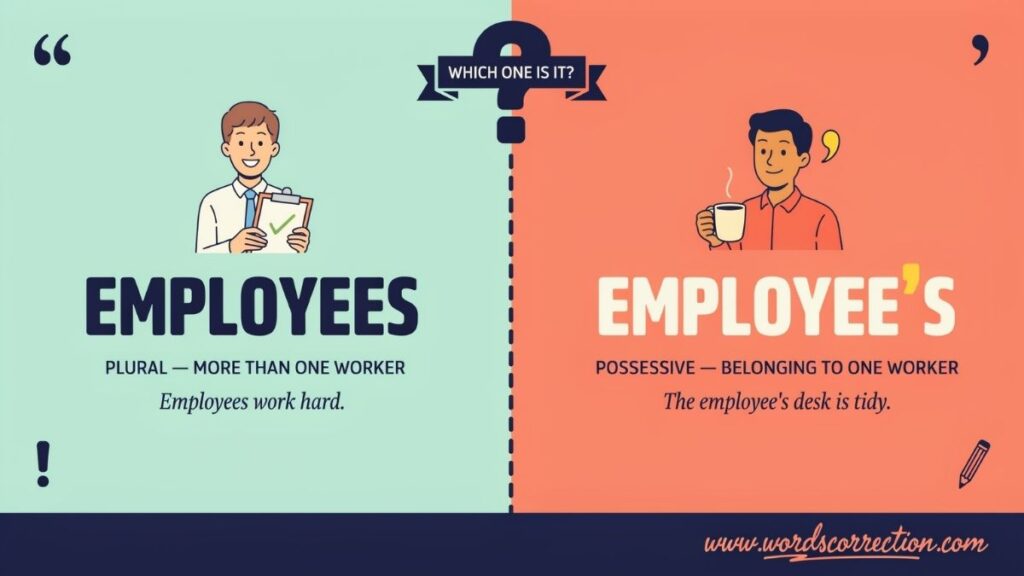
The phrase Employees or employee’s looks deceptively simple, yet one tiny apostrophe can completely change what your sentence means. That little mark has a surprisingly big job. Are you talking about several workers? Use employees. Are you referring to something belonging to one worker? That’s employee’s. And if something belongs to several workers, employees’ is the form you need. No wonder these words cause confusion in emails, reports, workplace policies, and everyday writing. The good news? The rules are easier than they appear. Let’s clear up these common grammar mistakes, break down the differences, and make employee apostrophe rules simple enough to remember.
Employees or Employee’s Quick Answer
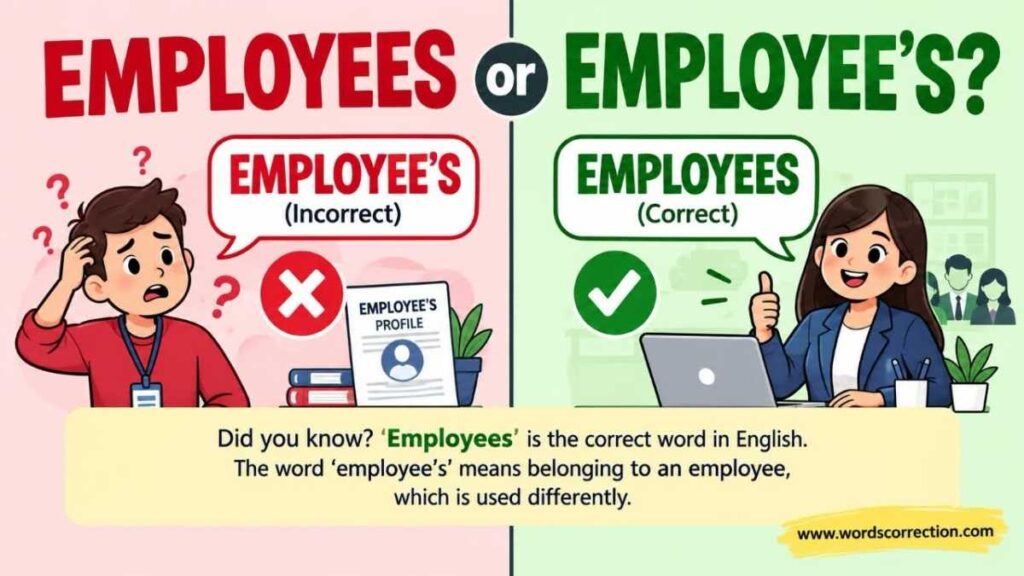
The simplest answer is that employees and employee’s are not alternative spellings of the same word.
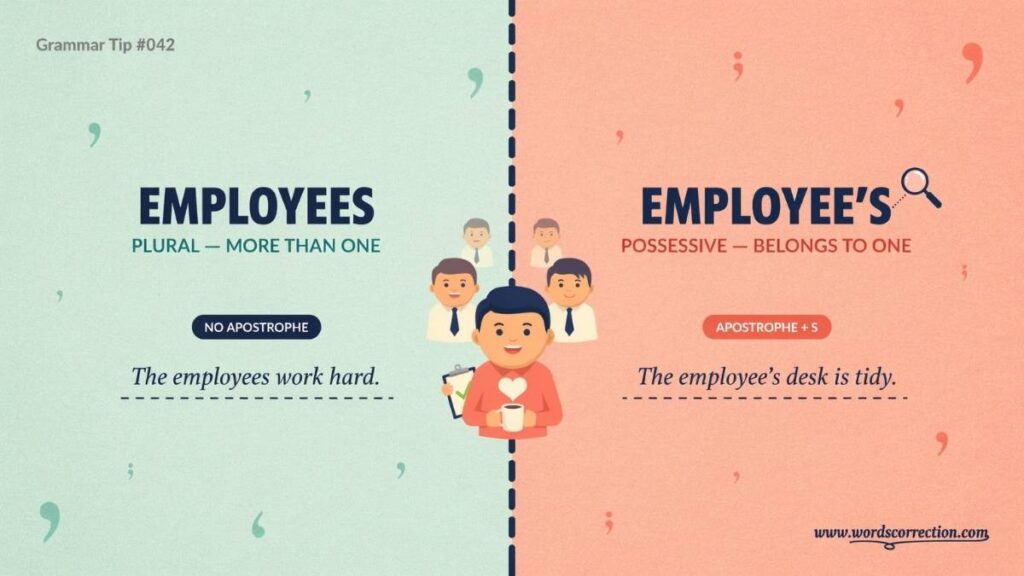
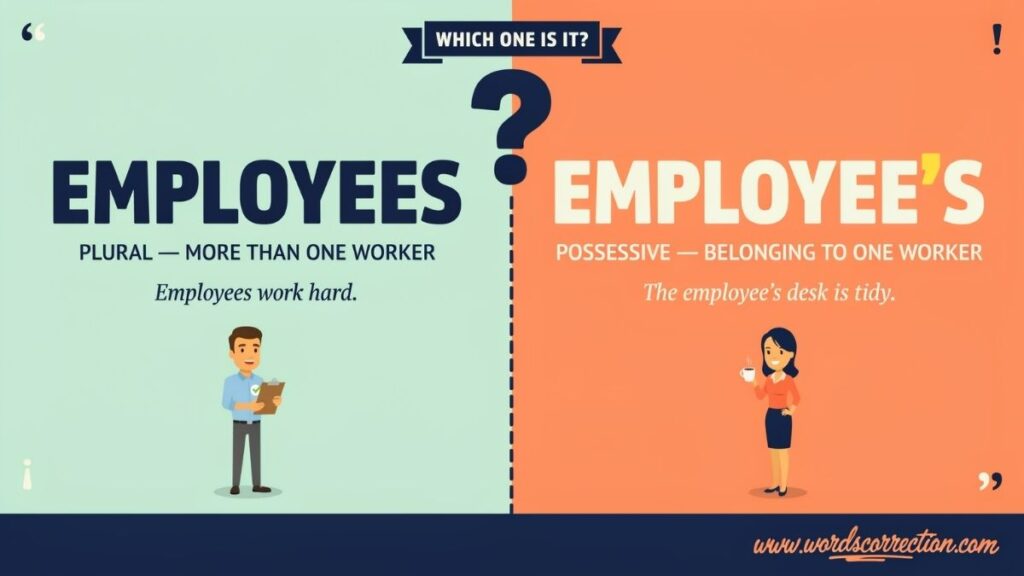
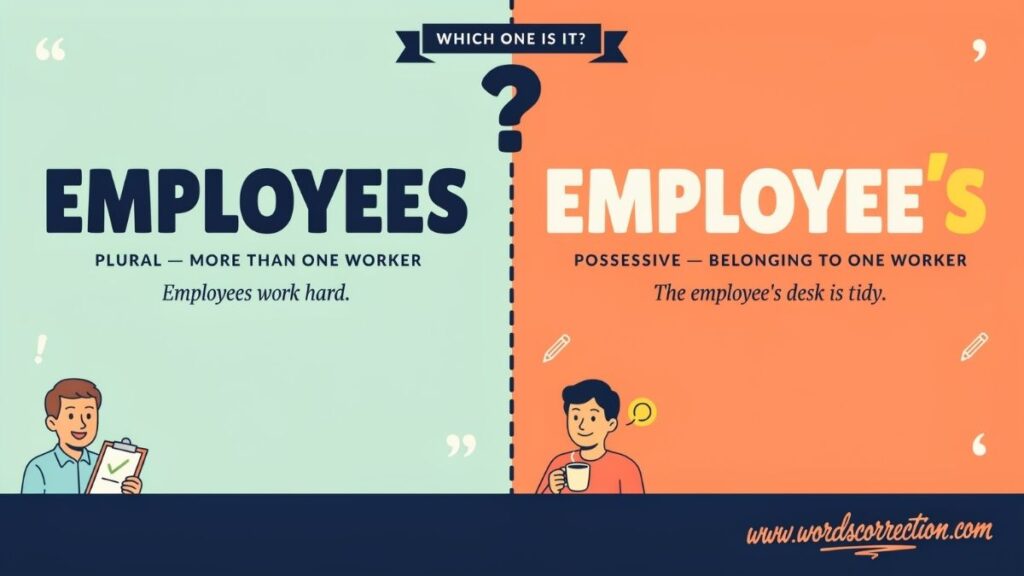
Employees is the plural form of employee. It refers to more than one employee.
Employee’s is the singular possessive form. It shows that something belongs to, relates to, or is associated with one employee.
There is also employees’, which is the plural possessive form. It indicates that something belongs to or relates to multiple employees.
| Form | Meaning | Grammar | Example |
| employee | One worker | Singular noun | The employee arrived early. |
| employees | More than one worker | Plural noun | The employees arrived early. |
| employee’s | Something belonging to one worker | Singular possessive noun | The employee’s desk is clean. |
| employees’ | Something belonging to multiple workers | Plural possessive noun | The employees’ desks are clean. |
The apostrophe is doing real grammatical work here. It isn’t simply decorative punctuation.
Examples
Consider these four sentences:
- The employee completed the report.
- The employees completed the report.
- The employee’s report was submitted yesterday.
- The employees’ reports were submitted yesterday.
Notice how the meaning changes.
In the first sentence, you have one employee. In the second, you have multiple employees. The third sentence refers to a report belonging to one employee. The fourth refers to reports belonging to several employees.
That small apostrophe changes the relationship between the words.
Simple Rule for Employees
Use employees when you simply mean more than one employee.
For example:
The company hired five new employees.
You aren’t showing possession. You’re simply talking about five workers. Therefore, no apostrophe belongs in the word.
This is one of the most important employees grammar rules to remember.
Learn the difference between more words people mix up
Emerse or Immerse Correct Spelling and Use
Employees Meaning and Correct Usage
What Does Employees Mean?
The employees meaning is straightforward: employees is the plural form of employee.
An employee is a person who works for an organization or another person in exchange for compensation. When you refer to two or more such people, you use employees.
For example:
- The employee works in accounting.
- The employees work in accounting.
- One employee requested additional training.
- Several employees requested additional training.
The word employees doesn’t indicate ownership. It simply tells the reader that the noun refers to more than one worker.
This answers the common question, “Is employees plural or possessive?”
Employees is plural, not possessive.
Employees Plural Form
The employees plural form follows the standard English pattern for forming the plural of a noun.
For example:
- employee → employees
- manager → managers
- worker → workers
- customer → customers
- teacher → teachers
Although employee already ends in e, forming its plural is straightforward. Add s to create employees.
Examples of Employees in a Sentence
Here are several practical employees grammar examples:
- The employees attended the annual meeting.
- All employees must complete the training.
- The company provides health benefits to its employees.
- Several employees submitted suggestions.
- The employees worked together to solve the problem.
- New employees receive an orientation on their first day.
- The manager thanked the employees for their hard work.
None of these examples needs an apostrophe because the word simply identifies multiple workers.
Is Employees Correct Spelling?
Yes. Employees is the correct spelling when you mean more than one employee.
A common error occurs when writers see the ending s and assume they need an apostrophe. They don’t.
Compare:
- Correct: The employees attended the meeting.
- Incorrect: The employee’s attended the meeting.
The second version treats an apostrophe as if it creates a plural. It doesn’t.
English normally uses apostrophes to show possession and certain contractions. It doesn’t use an apostrophe simply to make an ordinary noun plural.
Learn the difference between everyday English mistakes
Presence or Presense Which Spelling Is Correct?
Employee’s: Meaning and Correct Usage
What Does Employee’s Mean?
The employee’s meaning depends on context, but when employee’s functions as a possessive noun, it means belonging to one employee or associated with one employee.
The apostrophe comes before the s:
employee’s
That placement matters.
For example:
The employee’s computer needs an update.
This means the computer belongs to or is assigned to one employee.
Now compare it with:
The employees’ computers need an update.
The meaning has changed. The second sentence refers to computers belonging to or assigned to multiple employees.
Employee’s Possessive Form
The employee’s possessive form follows the standard rule for singular nouns.
For a singular noun, add ’s to show possession:
- employee → employee’s
- manager → manager’s
- worker → worker’s
- customer → customer’s
- teacher → teacher’s
The possessive doesn’t always mean literal ownership. It can also indicate a relationship, responsibility, association, or connection.
For example:
- an employee’s responsibility
- an employee’s opinion
- an employee’s schedule
- an employee’s salary
- an employee’s performance
- an employee’s workplace
An employee doesn’t necessarily own a responsibility or performance. The possessive construction simply connects that concept with the individual employee.
Examples of Employee’s in a Sentence
Here are several useful examples of employee’s in a sentence:
- The employee’s desk was moved to another office.
- The manager reviewed the employee’s performance.
- The employee’s request was approved.
- The company addressed the employee’s concerns.
- The supervisor praised the employee’s work.
- The employee’s schedule changed this week.
- The manager discussed the employee’s responsibilities.
In every case, the sentence refers to one employee.
Simple Rule for Employee’s
Use employee’s when you mean something belonging to or associated with one employee.
Try replacing the phrase with “of one employee.”
For example:
The employee’s computer
can become:
The computer of one employee
The second version sounds less natural in everyday English, but it reveals the grammatical relationship.
This simple test can help you identify the correct use of employee’s.
Learn the difference between commonly misused words
Gos or Goes Which One Is Right?
The Form That Causes Another Common Confusion
If employee’s means something connected to one employee, what happens when several employees share that relationship?
That’s where employees’ comes in.
What Does Employees’ Mean?
Employees’ is the plural possessive form of employee.
It indicates something belonging to, associated with, or connected to multiple employees.
The apostrophe comes after the s:
employees’
This distinction is crucial:
- employee’s = one employee possesses or is associated with something
- employees’ = multiple employees possess or are associated with something
For example:
The employee’s locker was damaged.
One employee has a locker.
The employees’ lockers were damaged.
Multiple employees have lockers.
Employees’ Possessive Form
The employees’ possessive form follows the standard rule for regular plural nouns that already end in s.
First make the noun plural:
employee → employees
Then add an apostrophe:
employees → employees’
You don’t add another s after the apostrophe.
So:
- one employee → employee’s
- several employees → employees’
This is the standard plural possessive employees’ pattern.
Examples of Employees’ in a Sentence
- The employees’ opinions influenced the decision.
- The company responded to the employees’ concerns.
- The manager reviewed the employees’ schedules.
- The organization protects its employees’ rights.
- The meeting addressed the employees’ needs.
- The company improved the employees’ working conditions.
In each sentence, the possessive relationship involves multiple employees.
Learn the difference between basic English word mistakes
To or Too Clear Difference, Meaning and Usage
Employees vs Employee’s: Grammar Comparison
Understanding these three forms becomes much easier when you put them next to each other.
| Word | Number | Function | Meaning | Example |
| employee | Singular | Noun | One worker | The employee called. |
| employees | Plural | Noun | More than one worker | The employees called. |
| employee’s | Singular | Possessive noun | Something connected to one employee | The employee’s phone rang. |
| employees’ | Plural | Possessive noun | Something connected to multiple employees | The employees’ phones rang. |
This table captures the main employees or employee’s difference.
The apostrophe doesn’t tell you whether the noun is singular or plural by itself. You need to look at both the noun and the apostrophe’s position.
Employee’s vs Employees’
This is where many otherwise careful writers stumble.
Compare:
The employee’s benefits were explained.
This refers to the benefits of one employee.
Now compare:
The employees’ benefits were explained.
This refers to the benefits of multiple employees.
The only visible difference is the position of the apostrophe. Yet the number of people changes.
Learn the difference between often confused words
Inact or Enact Which Spelling Is Correct?
How to Know Which Form to Use
Use Employees When…
Use employees when you’re talking about two or more workers without expressing possession.
Examples:
- The employees arrived at 9 a.m.
- Several employees joined the meeting.
- The company hired ten new employees.
- The employees completed their training.
A useful question is:
Am I simply talking about more than one employee?
If yes, use employees.
Use Employee’s When…
Use employee’s when one employee has something or is connected to something.
Examples:
- The employee’s contract expires next month.
- The employee’s manager approved the request.
- The employee’s performance improved.
- The employee’s badge was missing.
Ask:
Does this belong to or relate to one employee?
If yes, employee’s is usually the correct form.
Use Employees’ When…
Use employees’ when something belongs to or relates to multiple employees.
Examples:
- The employees’ contracts expire next month.
- The employees’ managers attended the conference.
- The employees’ performance reviews are scheduled.
- The employees’ badges were updated.
Ask:
Does this belong to or relate to several employees?
If yes, use employees’.
A Three-Question Test
When you’re unsure, run through these questions:
1:- Am I talking about one employee or more than one?
2:- Am I showing possession or simply referring to multiple people?
3:- If I’m showing possession, does it involve one employee or several?
The result is simple:
- More than one employee, no possession → employees
- One employee + possession → employee’s
- Multiple employees + possession → employees’
That is the heart of the employee apostrophe rules.
Learn the difference between confusing word pairs
Maxxed or Maxed: Which Spelling Is Correct?
Common Mistakes With Employees and Employee’s
Mistake 1: Using Employee’s as the Plural
Incorrect:
The employee’s attended the meeting.
Correct:
The employees attended the meeting.
Why? Because employee’s doesn’t mean “more than one employee.” The apostrophe creates a possessive form.
This is one of the most common employees apostrophe rules mistakes.
Mistake 2: Missing the Apostrophe in Singular Possession
Incorrect:
The employees desk was messy.
Correct:
The employee’s desk was messy.
Without the apostrophe, employees means multiple workers. That doesn’t fit the intended meaning if only one employee has a desk in question.
Mistake 3: Confusing Singular and Plural Possession
Compare:
The employee’s locker was repaired.
One employee.
The employees’ lockers were repaired.
Multiple employees.
The difference isn’t cosmetic. It tells your reader how many people the possessive phrase involves.
Mistake 4: Adding an Apostrophe to Every Plural
Incorrect:
The company hired three employee’s.
Correct:
The company hired three employees.
This mistake appears with many ordinary plural nouns, not just employee. Writers sometimes treat the apostrophe as a visual signal for “more than one.” English doesn’t work that way.
Mistake 5: Confusing Employees With Employee’s in Headings
Workplace headings can make this especially noticeable:
- Employees Benefits — Incorrect when possession is intended
- Employee’s Benefits — Incorrect if the heading refers to employees generally
- Employees’ Benefits — Correct when the benefits belong to multiple employees
- Employee Benefits — Correct when employee works as a noun modifier
That last example introduces an important point.
Learn the difference between tricky grammar more words
Unattentive or Inattentive Meaning and Usage
Employee vs Employees in Compound Expressions
Not every phrase that refers to workers needs a possessive apostrophe.
For example:
Employee benefits
is perfectly correct.
Why doesn’t employee need an apostrophe?
Because employee is functioning as a noun modifier rather than a possessive noun. It describes the type of benefits being discussed.
Compare:
- employee benefits = benefits provided for employees
- the employee’s benefits = benefits belonging to one specific employee
- the employees’ benefits = benefits belonging to multiple employees
This distinction becomes especially useful in business English and professional writing.
Other examples include:
- employee handbook
- employee training
- employee records
- employee satisfaction
- employee relations
- employee development
These phrases don’t automatically require an apostrophe.
Learn the difference between commonly mixed-up more words
Handle or Handel Correct Spelling, Meaning, and Usage
Employees or Employee’s in Real-World Writing
Grammar becomes much easier when you see how these forms work outside isolated examples.
In Workplace Emails
Consider this sentence:
The employees have completed their training.
Here, employees is simply the plural noun.
Now consider:
Please review the employee’s training record.
The sentence refers to one person’s record.
And:
Please review the employees’ training records.
Now the records belong to multiple employees.
A single apostrophe can change the scope of the entire sentence.
In Company Policies and Documents
Formal workplace writing frequently uses all three forms.
For example:
Employees must follow the company’s safety procedures.
Here, employees is plural.
Now:
Each employee must follow the company’s safety procedures.
Here, employee is singular.
Finally:
The employees’ safety concerns were discussed during the meeting.
Here, employees’ is plural possessive.
These distinctions make professional writing more precise.
In Reports and Business Writing
Business reports often discuss workers collectively:
Employees reported higher levels of job satisfaction.
But a report might also focus on an individual:
The employee’s performance improved significantly during the second quarter.
Or a group:
The employees’ feedback helped shape the revised policy.
The grammatical choice follows the meaning, not the style of the document.
Employees or Employee’s: Case Study
Imagine a company has 50 workers. Its HR department is preparing a report about workplace feedback.
The writer wants to say that the opinions of the workers influenced a new policy.
The sentence should read:
The employees’ opinions influenced the new policy.
Why?
There are multiple employees, and the sentence expresses possession or association. Therefore, employees’ is the correct plural possessive form.
Now imagine the report focuses on one particular worker:
The employee’s opinion influenced the new policy.
Here, only one employee’s opinion matters.
Finally, suppose the writer simply wants to describe the people who work at the company:
The employees participated in the survey.
No possession exists. Therefore, employees is correct.
Learn the difference between confusing more English words
Inconsolable or Unconsolable Which Is Correct?
What This Case Study Shows
The decision doesn’t depend on the word employee itself. It depends on number and grammatical function.
| Intended Meaning | Correct Form |
| One worker | employee |
| Several workers | employees |
| Something connected to one worker | employee’s |
| Something connected to several workers | employees’ |
British English vs American English: Employees and Employee’s
The basic apostrophe rules for employees, employee’s, and employees’ are the same in American and British English.
In both varieties:
- employees = plural
- employee’s = singular possessive
- employees’ = plural possessive
For example:
The employees attended the meeting.
works in both American and British English.
Likewise:
The employee’s desk was moved.
and:
The employees’ desks were moved.
The grammar doesn’t change simply because the variety of English changes.
Learn the difference between similar English words the easy way
Where or When Difference and correct usage
Grammar Comparison Table
| Meaning | American English | British English |
| One worker | employee | employee |
| Multiple workers | employees | employees |
| Possession by one employee | employee’s | employee’s |
| Possession by multiple employees | employees’ | employees’ |
Some punctuation and style conventions can vary between American and British English in other areas. However, this particular distinction remains consistent.
Employees or Employee’s: Examples Side by Side
Seeing the forms together is one of the quickest ways to understand them.
| Incorrect or Confusing Form | Correct Form | Why |
| The employee’s arrived. | The employees arrived. | Plural noun, no possession |
| The employees desk is clean. | The employee’s desk is clean. | One employee’s desk |
| The employees desks are clean. | The employees’ desks are clean. | Multiple employees’ desks |
| Five employee’s joined. | Five employees joined. | Plural noun |
| The employee’s are waiting. | The employees are waiting. | Plural noun |
| The employees’ request was approved. | The employee’s request was approved. | One employee’s request |
These employee grammar examples show why context matters more than the visual appearance of the word.
Learn the difference between tricky words and use them correctly
Doggie or Doggy Which Spelling Is Correct?
Employees Grammar: Subject-Verb Agreement
There’s another useful point worth remembering: employees is plural, so it normally takes a plural verb.
Correct:
The employees are ready.
Incorrect:
The employees is ready.
Compare that with singular employee:
The employee is ready.
This is a basic part of employees grammar and subject-verb agreement.
The same pattern appears throughout English:
- employee is
- employees are
- employee works
- employees work
- employee has
- employees have
Understanding number helps you choose both the noun and the verb correctly.
Employee’s Grammar and Apostrophe Placement
The basic employee’s grammar rule is equally straightforward.
For one employee showing possession:
employee’s
For multiple employees showing possession:
employees’
Think of the apostrophe as marking the possessive relationship.
Apostrophe Before S
employee’s
The apostrophe comes before the s because the noun is singular.
Example:
The employee’s computer stopped working.
Apostrophe After S
employees’
The apostrophe comes after the s because the noun is already plural.
Example:
The employees’ computers stopped working.
This is the essential distinction in apostrophe usage.
Employee’s Plural or Possessive?
One of the most common questions is whether employee’s is plural or possessive.
The answer is:
Employee’s is possessive when used as the standard possessive form. It is not the plural of employee.
The plural is:
employees
The singular possessive is:
employee’s
The plural possessive is:
employees’
So if someone asks for the employee’s plural, the answer isn’t employee’s. The plural is employees.
Likewise, if someone asks about employees plural or possessive, remember that employees without an apostrophe is plural.
Employees or Employees: A Common Search Confusion
You may also encounter the phrase employees or employees in searches or drafts. These two forms are identical, so there is no grammatical distinction between them.
The meaningful comparisons are:
- employee vs employees
- employees vs employee’s
- employee’s vs employees’
- employees vs employees’
If the question is really about whether the word needs an apostrophe, determine whether you’re expressing possession.
That approach works better than trying to memorize isolated spellings.
Is Employee’s Correct Grammar?
Yes, employee’s is grammatically correct when you use it as the singular possessive form.
For example:
The employee’s schedule changed.
It would be incorrect to use employee’s simply to mean several employees.
Incorrect:
The employee’s attended the training.
Correct:
The employees attended the training.
So the answer to “Is employee’s correct grammar?” is yes, but only when its grammatical function calls for the singular possessive form.
Is Employees Correct Grammar?
Yes. Employees is correct grammar when you’re referring to more than one employee.
Examples:
The employees are working remotely.
Several employees requested additional training.
The company hired new employees.
It doesn’t need an apostrophe unless you’re changing it into the plural possessive form:
The employees’ requests were reviewed.
What Is the Difference Between Employees and Employee’s?
The difference between employees and employee’s comes down to two things: number and possession.
Employees means more than one employee.
Employee’s means something belonging to or associated with one employee.
For example:
The employees completed the survey.
Multiple workers completed it.
The employee’s survey was incomplete.
One employee’s survey was incomplete.
They aren’t interchangeable.
When to Use Employees vs Employee’s
Here’s the quickest practical guide.
Use Employees When:
- You mean more than one employee.
- You aren’t expressing possession.
- The word functions as a plural noun.
Example:
The employees attended the meeting.
Use Employee’s When:
- You mean one employee.
- You are showing possession, association, responsibility, or connection.
Example:
The employee’s manager approved the request.
Use Employees’ When:
- You mean multiple employees.
- You are showing possession, association, responsibility, or connection.
Example:
The employees’ managers attended the meeting.
Quick Reference: Employee Apostrophe Rules
Keep these employee apostrophe rules handy:
| If You Mean… | Use… | Example |
| One worker | employee | The employee called. |
| More than one worker | employees | The employees called. |
| One worker’s possession | employee’s | The employee’s phone rang. |
| Several workers’ possession | employees’ | The employees’ phones rang. |
Apostrophes don’t create ordinary plurals.
That’s the key rule.
Practice Exercises: Employees, Employee’s, and Employees’
Fill in the Blank
- The company hired five new ________ this month.
- The ________ desk was moved to another department.
- All ________ must attend the annual training session.
- The ________ lounge is available to everyone in the company.
- The manager praised the ________ for their outstanding performance.
- The ________ responsibilities include managing customer accounts.
- Several ________ requested additional vacation days.
- The ________ meeting will take place tomorrow morning.
- Every ________ is required to follow company policies.
- The company values its ________ contributions.
- The ________ performance review was completed yesterday.
- The ________ benefits package was recently updated.
- All ________ should submit their reports by Friday.
- The manager discussed the ________ concerns during the meeting.
- Each ________ receives a company identification card.
- The ________ opinions were considered before the final decision was made.
- The company organized a professional development workshop for its ________.
- The ________ personal belongings were left in the office.
- Several ________ attended the leadership conference.
- The ________ feedback helped improve workplace policies.
- One ________ was selected to lead the project.
- The ________ salaries were reviewed by the HR department.
- All ________ are entitled to workplace benefits according to company policy.
- The manager spoke with the ________ about the issue.
- The company appreciates its ________ dedication and hard work.
Answer Session
| No. | Answer |
| 1 | Employees |
| 2 | Employee’s |
| 3 | Employees |
| 4 | Employees’ |
| 5 | Employees |
| 6 | Employee’s |
| 7 | Employees |
| 8 | Employees’ |
| 9 | Employee |
| 10 | Employees’ |
| 11 | Employee’s |
| 12 | Employee’s |
| 13 | Employees |
| 14 | Employees’ |
| 15 | Employee |
| 16 | Employees’ |
| 17 | Employees |
| 18 | Employee’s |
| 19 | Employees |
| 20 | Employees’ |
| 21 | Employee |
| 22 | Employees’ |
| 23 | Employees |
| 24 | Employee |
| 25 | Employees’ |
Here’s a trusted source for clear more words Comparison:
Grammar Update
FAQ’s
What is the difference between “employees” and “employee’s”?
“Employees” is the plural form of “employee,” referring to two or more workers. “Employee’s” is the singular possessive form, indicating that something belongs to one employee.
When should you use “employees'” instead of “employee’s”?
Use “employees'” when referring to something that belongs to or is associated with multiple employees. For example, “The employees’ meeting will begin at 9 a.m.”
Is “employee’s” a possessive form?
Yes. “Employee’s” is the singular possessive form of “employee.” The apostrophe before the “s” indicates ownership or association with one employee.
Can “employees” be used as a possessive noun?
No. “Employees” without an apostrophe is simply the plural form of “employee.” To indicate possession by multiple employees, use “employees'” with an apostrophe after the “s.”
What is the difference between “employee”or”employee’s?
“Employee” refers to one worker, “employees” refers to multiple workers, and “employee’s” indicates possession or association with one employee.
What is the difference between “employees” and “employees'”?
“Employees” is the plural form of the noun, while “employees'” is the plural possessive form. The apostrophe in “employees'” indicates that something belongs to or is associated with multiple employees.
Where should the apostrophe be placed in “employees'”?
The apostrophe should be placed after the final “s” in “employees’.” This form indicates possession by two or more employees.
Why are “employees” and “employee’s” commonly confused?
These words are often confused because they sound similar in spoken English. However, “employees” indicates plurality, while “employee’s” indicates possession by a single employee.
How can you remember the difference between “employees” and “employee’s”?
Use “employees” when referring to more than one worker. Use “employee’s” when referring to something belonging to one employee. The apostrophe signals possession.
Is “employees'” grammatically correct?
Yes. “Employees'” is grammatically correct when describing something belonging to or associated with multiple employees.
Should an apostrophe be used to make “employee” plural?
No. The correct plural form is “employees,” without an apostrophe. Apostrophes are generally not used to form standard English plurals.
What does the apostrophe in “employee’s” indicate?
The apostrophe indicates possession or ownership. It shows that something belongs to or is associated with one specific employee.
What does the apostrophe in “employees'” indicate?
The apostrophe indicates plural possession. It shows that something belongs to or is associated with multiple employees.
Can “employee’s” and “employees'” be used interchangeably?
No. “Employee’s” refers to possession by one employee, whereas “employees'” refers to possession by multiple employees. They have different grammatical meanings.
How should “employees” be used in a sentence?
Use “employees” when referring to two or more workers. For example: “The employees attended the company training session.”
How should “employee’s” be used in a sentence?
Use “employee’s” when describing something belonging to one employee. For example: “The employee’s performance exceeded expectations.”
How should “employees'” be used in a sentence?
Use “employees'” when describing something belonging to multiple employees. For example: “The employees’ suggestions improved workplace efficiency.”
What is the singular possessive form of “employee”?
The singular possessive form is “employee’s.” It is used when one employee owns or is associated with something.
What is the plural possessive form of “employee”?
The plural possessive form is “employees’.” It is used when something belongs to two or more employees.
Is “employee’s” singular or plural?
“Employee’s” is singular possessive. It refers to one employee and indicates ownership or association.
Is “employees” singular or plural?
“Employees” is plural. It refers to two or more people who work for an organization, business, or employer.
Which is correct: “employee responsibility” or “employee’s responsibility”?
Both forms can be correct depending on the context. “Employee responsibility” refers generally to responsibilities associated with employees, while “employee’s responsibility” refers to the responsibility of one specific employee.
Which is correct: “employee rights” or “employees’ rights”?
Both expressions can be correct. “Employee rights” is commonly used as a general term, while “employees’ rights” emphasizes rights belonging to multiple employees.
How can you distinguish between “employee’s” and “employees'” in writing?
Determine whether the possession belongs to one employee or multiple employees. Use “employee’s” for singular possession and “employees'” for plural possession.
What is the easiest way to avoid mistakes with “employees” and “employee’s”?
Identify whether you are referring to one employee, multiple employees, or possession. Use “employee” for one person, “employees” for multiple people, “employee’s” for singular possession, and “employees'” for plural possession.
Conclusion
The difference between employees or employee’s may seem like a small grammatical detail, but that tiny apostrophe can make a big difference in meaning. Fortunately, once you understand the role of each form, the confusion disappears.
Use employees when you mean more than one worker. Use employee’s when something belongs to or is associated with one employee. When something belongs to or is associated with multiple employees, use employees’. The apostrophe isn’t decorative punctuation; it tells your reader how the words are connected.
The easiest way to remember the rule is simple: employee = one, employees = many, employee’s = one employee’s, employees’ = several employees’. Keep this pattern in mind, and you’ll avoid a common workplace grammar mistake while making your emails, reports, and professional writing clearer and more precise. A tiny apostrophe may be small, but in English grammar, it can certainly pull its weight.

Stella AJS is an experienced blogger and dedicated English language writer at Words Correction. She turns confusing grammar, word meanings, spelling, and usage into clear, practical insights that readers can easily understand and apply. With a passion for precise and engaging writing, Stella helps readers avoid common language mistakes, strengthen their vocabulary, and communicate with greater clarity and confidence.




