
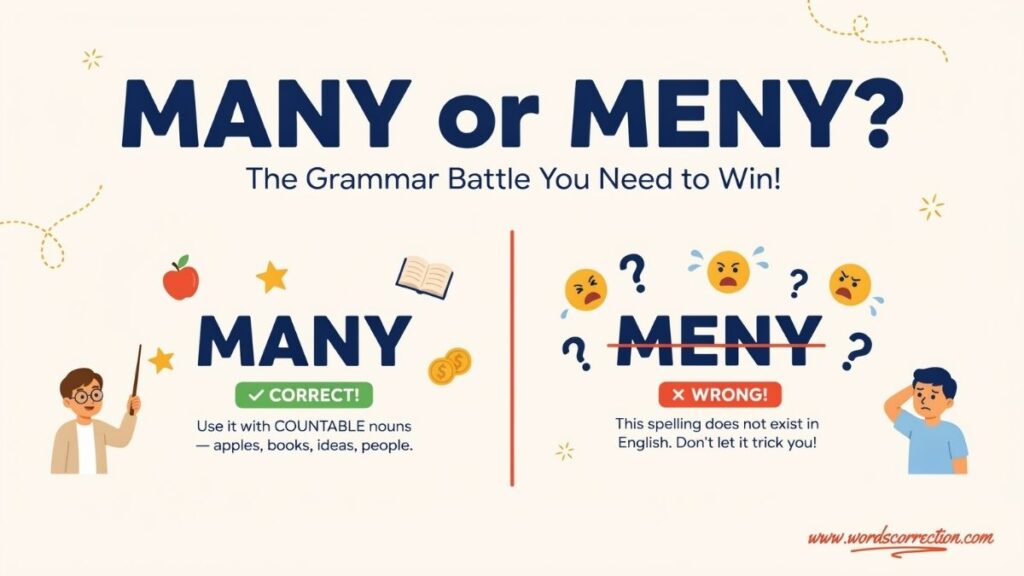
English spelling has a talent for turning simple words into surprisingly tricky questions. You write a sentence, read it again, and suddenly wonder whether you have spelled the word correctly. That’s exactly what can happen with many or meny. Because many sounds somewhat like “meny,” the incorrect spelling can seem perfectly reasonable at first glance. However, English pronunciation doesn’t always provide a reliable spelling guide. The answer is straightforward: many is the correct spelling, while meny is a common spelling mistake. In this guide, you’ll learn the meaning, grammar, pronunciation, and proper usage of many, with practical examples to help you avoid this confusion.
Many or Meny Quick Answer
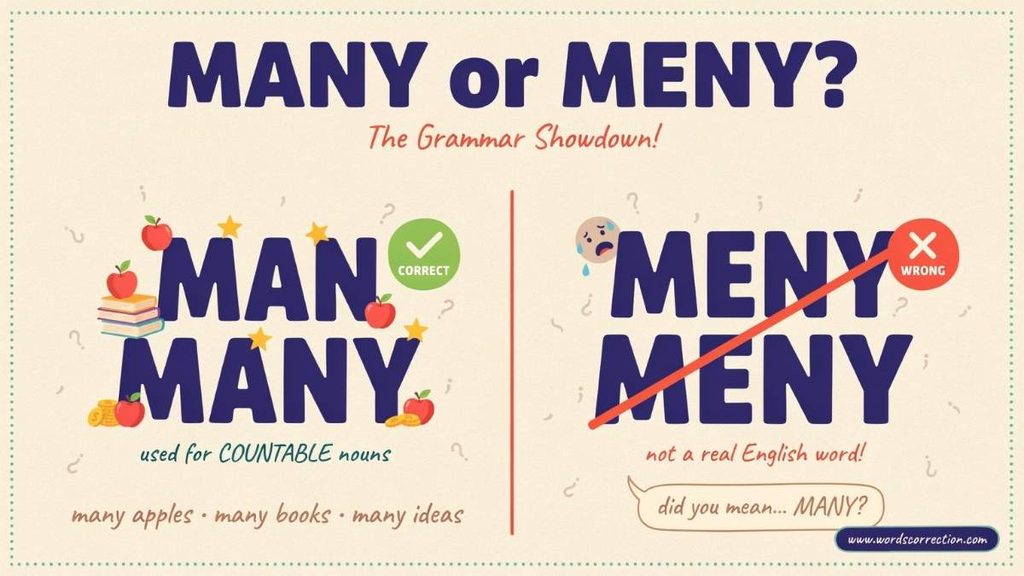
Many is the correct English spelling.
Meny is not the standard spelling when you mean “a large number.”
For example:
- Correct: Many students attended the class.
- Incorrect: Meny students attended the class.
The word many is widely used in standard English, including both American and British English.
Many vs Meny at a Glance
| Word | Correct? | Meaning | Example |
| Many | Yes | A large number | Many people attended. |
| Meny | No, for this meaning | Usually a spelling mistake for many | Meny people attended. |
If you are searching for “is many or meny correct?”, the answer is many.
If you’re wondering “which is correct, many or meny?”, choose many.
Examples of Many
Here are a few examples:
- Many people enjoy reading.
- She has many friends.
- We received many questions.
- There are many books on the shelf.
- Many students completed the assignment.
- How many tickets do you need?
- I don’t have many options.
- They visited many places during their trip.
In each example, many refers to a large number of countable people, objects, or things.
Learn the difference between confusing more English words
Grayscale or Greyscale Which Is Correct?
What Does Many Mean?
The many meaning is “a large number of people or things.”
The word describes quantity or number. It usually comes before a plural countable noun.
For example:
- many books = a large number of books
- many students = a large number of students
- many questions = a large number of questions
- many opportunities = a large number of opportunities
The key idea is number.
Compare these two sentences:
Many books were sold.
Much information was shared.
Books are countable, so we use many. Information is generally treated as an uncountable noun, so much is appropriate.
Many Word Meaning in Simple English
The simplest definition is:
Many means a large number of people or things.
For example:
Many people attended the event.
This tells us that a large number of people attended, although it doesn’t tell us the exact number.
The word can also appear without a noun when the meaning is already clear:
Many were invited, but only a few attended.
Here, many means many people.
Is Many or Meny Correct?
If you’re asking “is many or meny correct?”, the answer is many.
Use many when you want to express a large number.
For example:
Many employees joined the meeting.
Not:
Meny employees joined the meeting.
Many vs Meny Spelling Difference
There is no standard spelling difference between British and American English here. Both varieties use many.
| Feature | Many | Meny |
| Standard English spelling | Yes | No |
| Means a large number | Yes | No |
| Used with plural countable nouns | Yes | No |
| Suitable for formal writing | Yes | No |
| Suitable for academic writing | Yes | No |
| Common spelling mistake | No | Yes |
The important point is simple: meny is not an alternative spelling of many in standard English.
Is Meny a Word?
The question “is meny a word?” requires a little context.
If you mean the standard English quantity word meaning “a large number,” then meny is not the correct word.
When someone writes meny in a sentence such as:
Meny people attended the event.
they almost certainly intended to write:
Many people attended the event.
Of course, a sequence of letters can appear as a name, username, brand, or word in another language. That does not make meny a standard English alternative to many.
Therefore, for ordinary English writing, use many.
What Does Meny Mean?
The meny meaning is not a standard English equivalent of many.
If your intended meaning is “a large number,” the correct English word is many.
This distinction matters because a misspelling can sometimes look convincing enough to be mistaken for a legitimate variation.
How to Spell Many Correctly
If you’re wondering how to spell many, remember these four letters:
M-A-N-Y
The correct spelling is:
many
Not:
meny
A Simple Memory Trick
Remember the phrase:
Many people
Then focus on the first four letters of the phrase’s key word:
M-A-N-Y
You can also remember:
Many has A, not E.
That small reminder can help prevent the common meny spelling mistake.
Why Do People Spell Many as Meny?
The most common reason is pronunciation.
Many is pronounced approximately as MEN-ee. Because the first sound resembles the vowel sound represented by e in words such as “men,” some writers naturally assume the word should be spelled meny.
English spelling, however, doesn’t always match pronunciation perfectly.
Consider words such as:
- said
- friend
- bread
- head
- again
Their pronunciations don’t always tell you exactly how to spell them.
The same principle applies to many.
Learn the difference between commonly mixed-up more words
Months or Monthes Which Spelling Is Correct?
Pronunciation Does Not Always Reveal Spelling
When you hear many, the first sound can make the spelling meny seem logical.
But English spelling often preserves historical patterns rather than following pronunciation exactly.
Therefore:
Pronunciation: sounds similar to “men-ee”
Spelling: many
This is why relying entirely on sound can create spelling mistakes.
The Origin of Many
The word many has a long history in the English language.
It developed from older forms of English, including Old English forms such as monig and manig. Related forms appeared in Middle English before the modern spelling gradually became established.
The word also has connections with related Germanic languages. This shows that many is not a recently developed English word. It has been part of the language for centuries.
The modern spelling may look simple, but its history is much older than modern American or British English.
That also explains why there is no special American or British spelling of the word. Both varieties use many.
Learn the difference between tricky grammar more words
Bosses or Boss’s Which Is Correct? Meaning and Usage
British English vs American English Spelling
Some English words have different spellings in British and American English.
For example:
- colour / color
- centre / center
- organise / organize
However, many isn’t one of those words.
Both British English and American English use:
many
Many in British English
Examples include:
Many people live in London.
There aren’t many seats available.
How many students are in your class?
Many in American English
Examples include:
Many people live in New York.
I don’t have many questions.
How many tickets do you need?
The spelling remains the same.
Important Fact
Meny is not the British spelling of many
It isn’t the American spelling either.
If you’re writing for an international audience, many is the standard spelling when you mean “a large number.”
What Type of Word Is Many?
A common grammar question is:
What type of word is many?
In modern English grammar, many can function as a determiner or pronoun. It is also commonly described as a quantifier because it expresses quantity.
For example:
Many students passed the exam.
Here, many comes before the noun students and tells us about their number.
Now consider:
Many passed the exam.
Here, the noun has been omitted because the meaning is already understood.
Learn the difference between confusing word pairs
Personalise or Personalize Difference,Meaning and Usage
Is Many a Noun or an Adjective?
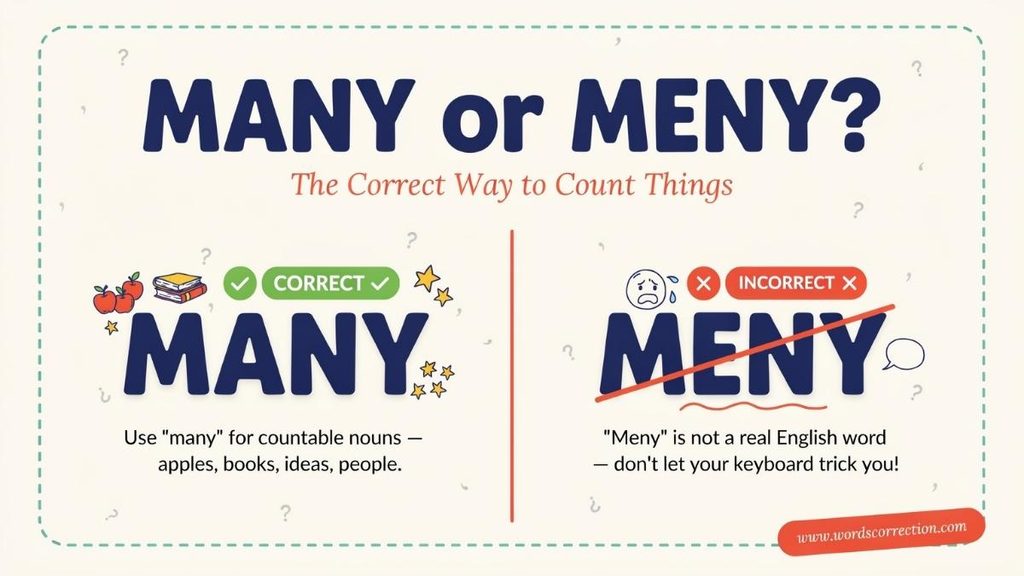
You may occasionally see traditional grammar descriptions that classify words like many differently. Modern grammar generally treats many as a determiner when it comes before a noun and a pronoun when it stands alone.
For everyday writing, the most important point is its function:
Many expresses the quantity of countable people or things.
Is Many a Quantifier?
Yes.
Many is a quantifier because it expresses number or quantity.
Other common quantifiers include:
- few
- several
- enough
- more
- most
- much
- some
- any
- plenty of
These words help us communicate how much or how many of something we mean.
Learn the difference between often confused words
Unvoluntary or Involuntary Which One Is Correct?
Many Grammar How to Use Many Correctly
Understanding many grammar is essential if you want to use the word correctly.
The basic rule is:
Use many with plural countable nouns
For example:
- many books
- many students
- many questions
- many houses
- many people
- many ideas
Many With Countable Nouns
Countable nouns refer to things that can be counted individually.
For example:
- one book, two books, three books
- one student, two students, three students
- one question, two questions, three questions
Therefore, these sentences are correct:
I have many books.
She has many friends.
We received many questions.
Many With Plural Nouns
Because many refers to multiple individual items, the noun following it is generally plural.
Correct:
Many students attended.
Incorrect:
Many student attended.
The plural form students is required because many refers to more than one student
Learn the difference between basic English word mistakes
Incurable or Uncurable? Meaning, Difference and Usage
Many vs Much What’s the Difference?
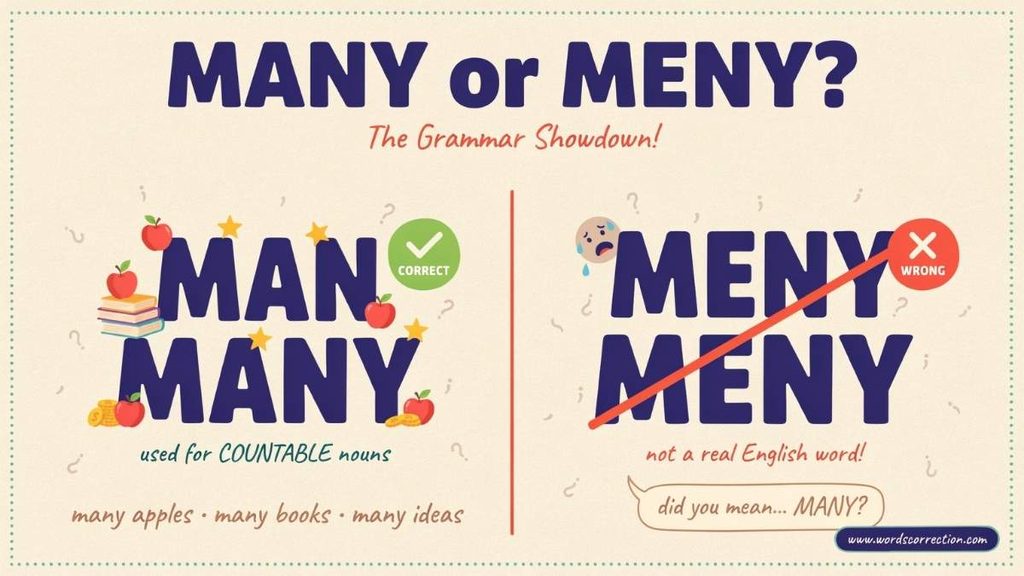
One of the most important grammar distinctions is many vs. much.
The basic rule is:
- Many is used with plural countable nouns.
- Much is used with singular uncountable nouns.
Compare:
How many books did you buy?
How much information did you find?
Books can be counted individually. Information is generally treated as uncountable.
Many People or Much People?
The correct expression is:
Many people
Not:
Much people
People can refer to individual human beings, so many is appropriate.
Many Things or Much Things?
Use:
Many things
Not:
Much things
Things are countable and plural.
Many Books or Much Books?
Use:
Many books
Not:
Much books
Many Friends or Much Friends?
Use:
Many friends
Not:
Much friends
Many Questions or Much Questions?
Use:
Many questions
Not:
Much questions
Many Times or Much Time?
This pair can be confusing because both expressions are correct, but their meanings differ.
I called her many times.
Here, times refers to separate occasions, so it is countable.
I don’t have much time.
Here, time refers to an amount or duration, so it is uncountable.
This small distinction can completely change the grammar of a sentence.
Learn the difference between commonly misused words
Vain or Vein Key Difference, Meaning, Grammar and Usage
Many in a Sentence Examples and Usage
Learning many in a sentence becomes easier when you see it in different structures.
Affirmative Sentences
students enjoy online learning.
Many companies use digital communication.
the people prefer flexible working arrangements.
Many is completely correct in affirmative sentences. However, everyday English often uses a lot of or lots of instead.
For example:
A lot of people attended the event.
This may sound more conversational than:
Many people attended the event.
Both can be correct. The choice depends on tone and context.
Negative Sentences
Many is especially common in negative sentences:
I don’t have many books.
She doesn’t have many options.
We don’t have many days left.
There aren’t many seats available.
Questions
Many frequently appears in questions:
many people are coming?
How many pages does the report have?
how many students passed?
many questions are left?
Too Many
Use too many when the number is greater than necessary or desirable:
There are too many people in this room.
I made too many mistakes in the report.
We have too many meetings this week.
So Many
Use so many to emphasize a large or surprising number:
There are so many choices that I can’t decide.
She has so many books.
As Many As
The expression as many as can emphasize a surprisingly large number:
As many as 5,000 people attended the event.
This structure draws attention to the size of the number.
A Great Many
great many means a large number and often sounds more formal:
many people attended the conference.
It is more common in formal or literary contexts than in casual conversation.
Learn the difference between everyday English mistakes
Congrats or Congratulations Which One Is Correct?
Many in Everyday and Formal Writing
The correct use of many depends partly on the context and tone.
Professional Emails
Many customers have requested this feature.
I don’t have many updates at the moment.
Academic Writing
Many studies have examined the effects of sleep on learning.
the participants reported similar experiences.
Many works particularly well in formal and academic writing because it is concise and neutral.
Business Writing
Many customers prefer digital payment options.
The company received many applications for the position.
News Writing
Many residents expressed concern about the proposed changes.
Informal Writing
So many great memories from this trip!
The tone may change, but the spelling does not. Many remains correct in formal and informal English.
Learn the difference between more words people mix up
Synched or Synced Correct Spelling, Meaning and Usage
Common Many or Meny Mistakes
Understanding common errors can make them easier to avoid.
Using Meny Instead of Many
This is the most obvious mistake.
Incorrect:
Meny people attended the meeting.
Correct:
Many people attended the meeting.
Confusing Pronunciation With Spelling
The pronunciation of many can make meny look logical.
However, English spelling often doesn’t follow pronunciation perfectly.
The safest approach is to learn the standard spelling:
Many
Assuming Meny Is a Regional Spelling
Some English words have different British and American spellings. Many doesn’t.
Many is used in both varieties.
Meny is not a British or American spelling variant.
Using Meny in Professional Writing
A spelling error can make otherwise polished writing look careless.
Instead of:
Meny customers contacted us.
write:
Many customers contacted us.
Learn the difference between tricky English words with easy explanations
Directer or Director Correct Spelling and Usage
Depending Entirely on Spell-Check
Spell-checking tools are helpful, but they shouldn’t replace careful proofreading.
Learning the correct spelling yourself makes your writing more accurate and helps you recognize the error immediately.
Many vs Several vs Numerous vs A Lot Of
it isn’t the only word that expresses quantity.
Many
generally means a large number:
Many people attended the event.
Several
usually means more than two but doesn’t necessarily suggest a very large number:
Several people called this morning.
Numerous
it means many and often sounds more formal:
Numerous studies have examined the issue.
A Lot Of
it extremely common in everyday English:
A lot of people use this service.
Plenty Of
Plenty of suggests more than enough:
We have plenty of time.
These expressions can overlap, but they aren’t always interchangeable. Choosing the right word helps communicate the intended quantity more precisely.
Many or Meny Comparison Table
| Question | Correct Answer |
| What is the correct spelling of many? | Many |
| Is many or meny correct? | Many |
| Is meny a standard English word meaning “a large number”? | No |
| What does many mean? | A large number of people or things |
| Can many be used with countable nouns? | Yes |
| Can many be used with plural nouns? | Yes |
| Is many used in British English? | Yes |
| Is many used in American English? | Yes |
| Is meny a British spelling of many? | No |
| Is many a quantifier? | Yes |
| Should you write many people? | Yes |
| Should you write much people? | No |
| Should you write many books? | Yes |
| Should you write much books? | No |
How to Remember the Correct Spelling of Many
When you’re unsure about the many spelling, don’t overcomplicate it.
Remember:
M-A-N-Y = many
Then connect it to a familiar phrase:
Many people
You can also use this simple memory trick:
Many has A, not E.
That small reminder can help you avoid writing meny.
Many Of An Important Grammar Pattern
The expression many of deserves special attention.
Use many of when a determiner or pronoun follows it.
For example:
the many students passed.
many of my friends live nearby.
Many of these books are useful.
Compare:
Many students passed.
with:
Many of the students passed.
Both sentences are grammatical, but the second refers to a particular group.
Many in Real-World Context
Consider this sentence:
Many employees completed the training
The sentence tells us that a large number of employees completed the training, but it doesn’t provide an exact figure.
Now compare it with:
Several employees completed the training
This suggests a smaller number.
Then consider:
Most employees completed the training
Most has a more specific meaning. It indicates more than half of the relevant group.
Finally:
Meny employees completed the training
The intended meaning may be obvious, but the spelling is incorrect.
This example shows why both spelling and word choice matter. A spelling error can distract readers, while choosing the wrong quantity word can change the meaning of the sentence
Learn the difference between confusing more English words step by step
Attendance or Attendence Correct Spelling and Usage
Many Grammar Rules and Examples
For quick reference, keep these rules in mind:
- Use many with plural countable nouns.
- Use many when asking about a number.
- Use many in negative statements about quantity.
- Use too many when there is an excessive number.
- Use so many for emphasis.
- Use how many when asking about quantity.
- Use many of before expressions such as the, these, those, my, and your.
- Use much with singular uncountable nouns.
- Don’t use meny as an alternative spelling of many.
Examples of Using Many in a Sentence
| Grammar Pattern | Example |
| Many + plural noun | Many students attended. |
| How many + plural noun | How many books do you have? |
| Too many + plural noun | There are too many cars outside. |
| So many + plural noun | She has so many ideas. |
| Many of + determiner | Many of the students passed. |
| Many without a noun | Many were invited. |
| Not many + plural noun | Not many people knew. |
| As many as + number | As many as 500 people attended. |
Practice Session Many or Meny
Fill in each blank with the correct word or phrase.
- The correct spelling is ________, not “meny.”
- There are ________ students in the classroom.
- How ________ books have you read this year?
- She has ________ friends at school.
- We received ________ applications for the position.
- There are ________ reasons to learn English.
- ________ people attended the conference.
- He has visited ________ countries.
- How ________ questions are on the test?
- I have ________ ideas for the new project.
- ________ of the students completed the assignment.
- There are ________ opportunities available to qualified candidates.
- The company has ________ employees working remotely.
- She made ________ useful suggestions during the meeting.
- ________ people believe that practice improves language skills.
- The library contains ________ interesting books.
- We have ________ tasks to complete before Friday.
- How ________ participants joined the program?
- He has written ________ articles about English grammar.
- There are ________ ways to improve your vocabulary.
- ________ of the answers were correct.
- The word “many” is generally used with ________ countable nouns.
- The correct spelling is “many,” while “meny” is a ________ spelling.
- For uncountable nouns, English generally uses “much” rather than ________.
- Remember to spell the word as ________ when referring to a large number of people or things.
Answers
- many
- many
- many
- many
- many
- many
- Many
- many
- many
- many
- Many
- many
- many
- many
- Many
- many
- many
- many
- many
- many
- Many
- plural
- incorrect
- many
- many
Here’s a trusted source for clear more words Comparison:
Grammar Update
Frequently Asked Questions
How can I remember the correct spelling of many?
The correct spelling is many, not “meny.” A useful way to remember it is that “many” contains a after the first consonant: m-a-n-y.
Why is meny commonly misspelled instead of many?
“Meny” is a common spelling mistake because the vowel sound in many can make the spelling less intuitive for English learners and writers.
Is meny ever acceptable in standard English writing?
No. Meny is not the standard English spelling of the word. In ordinary English writing, the correct form is many.
How do you pronounce the word many?
“Many” is generally pronounced /ˈmen.i/, with two syllables. It sounds approximately like “MEN-ee.”
What part of speech is the word many?
Many is commonly used as a determiner, quantifier, or pronoun. It indicates a large number of people or things.
Can many be used as a pronoun?
Yes. “Many” can function as a pronoun when the noun is understood from context. For example: “Many attended the meeting.”
Can many be used as a determiner?
Yes. Many can come before a plural countable noun to indicate a large number, as in “Many students participated.”
Can many be used before singular nouns?
Generally, no. Many normally modifies plural countable nouns, such as many books, many students, and many questions.
Can many be used with uncountable nouns?
No. Many is normally used with plural countable nouns. For uncountable nouns, much is generally used instead, such as much water or much time.
What noun forms normally follow many?
Many is normally followed by a plural countable noun, such as many people, many houses, many ideas, or many opportunities.
Can many be used in negative sentences?
Yes. For example: “I do not have many opportunities to travel.” The word “many” can describe a limited or large number depending on the context.
Can many be used in questions?
Yes. Many is frequently used in questions about quantity. For example: “How many books do you have?”
Can many be used in affirmative sentences?
Yes. For example: “Many people enjoy reading.” It is grammatically correct to use “many” in affirmative statements.
What is the comparative form associated with many?
The comparative form associated with many is more. For example: “She has more books than I do.”
What is the superlative form of many?
The superlative form is most. For example: “He received the most votes.”
How is many used with numbers?
Answer: Many can describe a large quantity without specifying an exact number. For example: “Many people attended the event.”
Can many be used with of?
Yes. Many of is followed by a determiner or pronoun and then a noun phrase. For example: “Many of the students passed the examination.”
What is the difference between many and several?
Both refer to more than one, but many generally indicates a larger or unspecified number, while several usually refers to more than two but not a particularly large number.
What is the difference between many and numerous?
Both indicate a large number. Many is more common in everyday English, while numerous is often more formal and emphasizes that there are a large number of something.
What is the difference between many and a lot of?
Both can express a large quantity. Many is normally used with plural countable nouns, while a lot of can be used with both countable and uncountable nouns.
Is many formal or informal English?
Many is a standard English word that can be used in both formal and informal contexts.
Can many be used in formal writing?
Yes. Many is completely appropriate in formal writing, including academic, professional, and business contexts.
How is many used in academic writing?
In academic writing, many can describe a large but unspecified number of people, studies, factors, examples, or other countable items. For example: “Many studies have examined this issue.”
What are common mistakes when using many?
Common mistakes include spelling many as “meny,” using many with an uncountable noun, and using a singular noun after many. The standard pattern is many + plural countable noun.
How can I use many correctly in everyday English?
Use many before plural countable nouns when referring to a large or unspecified number. For example: “There are many reasons to learn English.”
Conclusion
When it comes to many or meny, there’s no need to let one little vowel cause a full spelling crisis. Many is the correct English spelling, while meny is a common spelling mistake when you mean “a large number.” The confusion usually comes from pronunciation, since many sounds somewhat like “meny.” However, English spelling doesn’t always follow the way a word sounds. Remember the simple formula: M-A-N-Y = many. Use many with plural countable nouns, such as people, books, questions, and students. Once you remember the correct spelling and grammar, you can leave “meny” behind and write with confidence.

Stella AJS is an experienced blogger and dedicated English language writer at Words Correction. She turns confusing grammar, word meanings, spelling, and usage into clear, practical insights that readers can easily understand and apply. With a passion for precise and engaging writing, Stella helps readers avoid common language mistakes, strengthen their vocabulary, and communicate with greater clarity and confidence.




