
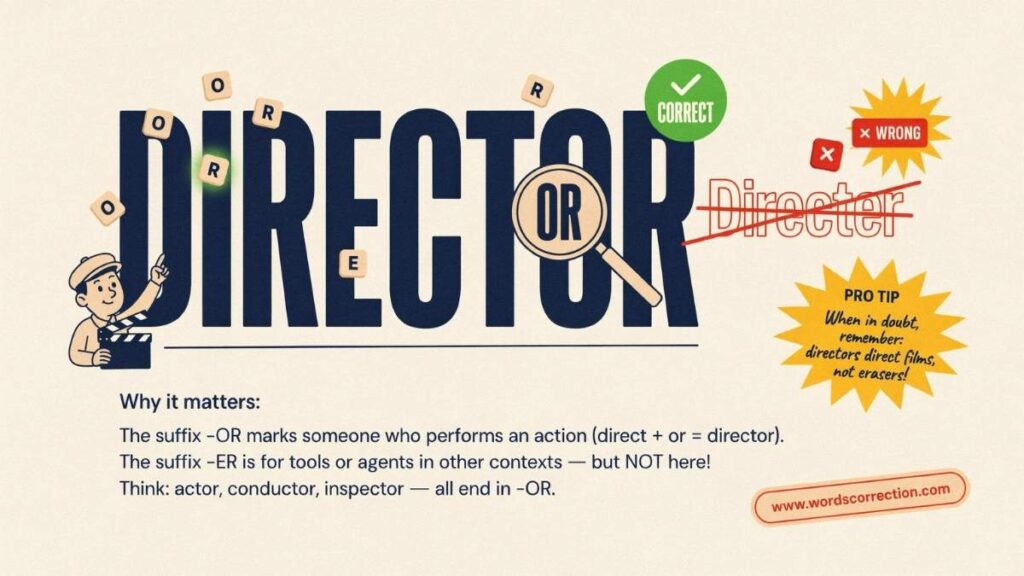
The confusion between directer or director is easy to understand. At first glance, “directer” seems perfectly logical, especially when words like “teacher” and “writer” follow the familiar -er pattern. English, however, doesn’t always follow such straightforward spelling rules. In modern standard English, director is the correct noun for a person who directs a film, company, project, or organization. The word “directer” does exist, but it has limited historical and grammatical uses that can cause further confusion. This article clears up the difference, explains the meaning and history of both forms, and shows you exactly when to use director correctly.
Directer or Director Quick Answer
Director is the standard spelling when you mean a person who directs, manages, or leads an organization, production, department, project, or activity.
Directer is not normally used as the modern noun for this meaning. It is documented in historical English as an archaic noun meaning “director.” It can also function as the comparative form of direct, meaning “more direct.”
| Word | Modern standard use | Meaning |
| Director | Yes | A person who directs, manages, or leads |
| Directer | Limited | An archaic noun or comparative form of direct |
| Direct | Yes | To guide, control, or manage |
Examples of Director in Sentences
- The director approved the company’s new strategy.
- The film director worked closely with the actors.
- She became the marketing director last year.
- The school director announced several changes.
- The theater director rehearsed the cast before opening night.
In each example, director is the natural modern spelling.
What Does Director Mean?
The word director is a noun. It generally refers to a person who directs, controls, manages or supervises something.
The exact meaning changes slightly depending on the context.
Director as a Person Who Directs
At its broadest, a director is a person who directs something.
To direct means to guide an action, activity, group, or process toward a particular goal. A director may therefore be responsible for making decisions, coordinating people, or controlling how something is carried out.
For example:
The director gave the team clear instructions before the project began.
Here, the director is the person responsible for guiding the team.
Director in Film and Television
In film and television, a director is the person responsible for guiding the creative and practical execution of a production.
A film director may work with actors, cinematographers, editors, designers, and other members of the production team. The precise division of responsibilities varies from one production to another.
Examples include:
- film director
- movie director
- television director
- theater director
- commercial director
For example:
The film director explained how the final scene should be performed.
The word director remains the same whether the production is a film, television program, or stage performance.
Learn the difference between more words people mix up
Boxes or Boxs Correct Spelling and Usage
Director in Business and Organizations
In business, a director usually refers to someone who holds a senior management or governance position.
Common job titles include:
- Managing Director
- Executive Director
- Finance Director
- Marketing Director
- Operations Director
- Sales Director
- Human Resources Director
- Creative Director
- Technical Director
A company director may have responsibilities involving organizational leadership, strategic decisions, oversight, or governance. Specific legal responsibilities depend on the country, company structure, and applicable laws.
For example:
The managing director presented the company’s annual strategy.
Director in Other Contexts
The word appears in many other settings.
You might encounter:
- school director
- program director
- research director
- athletic director
- music director
- education director
- project director
- theater director
- artistic director
Although these positions have different responsibilities, the underlying idea remains similar: a director provides leadership, direction, management, or oversight.
Why Is It Director and Not Directer?
The question “why is director spelled with or?” has an interesting answer.
English contains many nouns formed with suffixes such as -er and -or. That makes the spelling seem unpredictable at times.
For example:
- teach → teacher
- write → writer
- manage → manager
- act → actor
- inspect → inspector
- edit → editor
- direct → director
Because direct ends in a consonant sound and describes an action, it is easy to assume that the person performing that action should be a “directer.”
English does not always work that way.
Word Formation Behind Director
The modern word director has a historical connection to Latin and Anglo-French rather than simply being a modern combination of direct + -or.
The word can be traced through Anglo-French and French forms to the Late Latin director, connected with the Latin verb dirigere, meaning to guide, arrange, or set straight.
This history helps explain why director became established as the standard noun.
Why Directer Looks Correct at First
The spelling directer looks perfectly logical if you apply a common English pattern.
Consider:
- drive → driver
- teach → teacher
- write → writer
- paint → painter
It is reasonable to think:
direct → directer
However, established English vocabulary does not always follow one simple spelling formula. Director became the standard noun, and that is the form modern English speakers normally use.
Direct vs Director
These words have different grammatical roles.
Direct can function as a verb, adjective, or adverb.
Examples:
- Please direct the visitors to the main entrance.
- We took a direct route.
- The manager spoke directly to the employees.
Director is a noun.
Examples:
- The director spoke to the employees.
- The film director approved the scene.
- The company appointed a new director.
A simple way to remember the distinction is:
Direct describes the action. Director names the person who directs.
Learn the difference between everyday English mistakes
Trialled or Trialed Meaning, Difference and Usage
Origin and History of Director
Understanding the history of director makes the spelling easier to remember.
Latin Roots of Director
The word ultimately traces back to the Latin verb dirigere, associated with guiding, arranging, or setting something straight.
From this linguistic family came forms that eventually developed into words associated with direction and leadership.
The English noun director entered the language through French and Anglo-French influences.
How Director Entered English
Historical dictionaries trace director to the late Middle English period.
Its earliest meanings were connected with the idea of a guide or someone who provides direction.
Over time, the word developed broader meanings.
It came to describe people who:
- guide others
- manage organizations
- supervise activities
- lead productions
- control or oversee particular operations
The corporate meaning developed later, while its theatrical meaning also became established over time.
Why Historical Origin Matters for Spelling
English spelling often preserves forms that developed through older languages.
That is why you cannot always determine the correct spelling simply by adding a familiar suffix.
Director is a good example. Its spelling reflects its historical development rather than a straightforward modern rule such as “verb + -er.”
Learn the difference between commonly misused words
Grayscale or Greyscale Which Is Correct?
British English vs American English Spelling
Is Director Spelled Differently in British and American English?
No.
The standard spelling is director in both British and American English.
| Variety | Standard spelling |
| British English | director |
| American English | director |
| Canadian English | director |
| Australian English | director |
The spelling does not change when you move between these varieties.
Differences You May Notice Around the Word Director
Although the spelling remains the same, pronunciation can vary.
English dictionaries commonly give more than one accepted pronunciation for director, particularly in British and American English.
The first vowel may sound different depending on the speaker, accent, and region.
This can sometimes make learners think the spelling should also change. It does not.
Director in Other English Varieties
Across major varieties of English, director remains the standard modern spelling.
Whether you are writing a résumé, business report, academic paper, film review, or professional email, director is the form you should normally use.
Learn the difference between basic English word mistakes
Months or Monthes Which Spelling Is Correct?
Director vs Directer Comparison Table
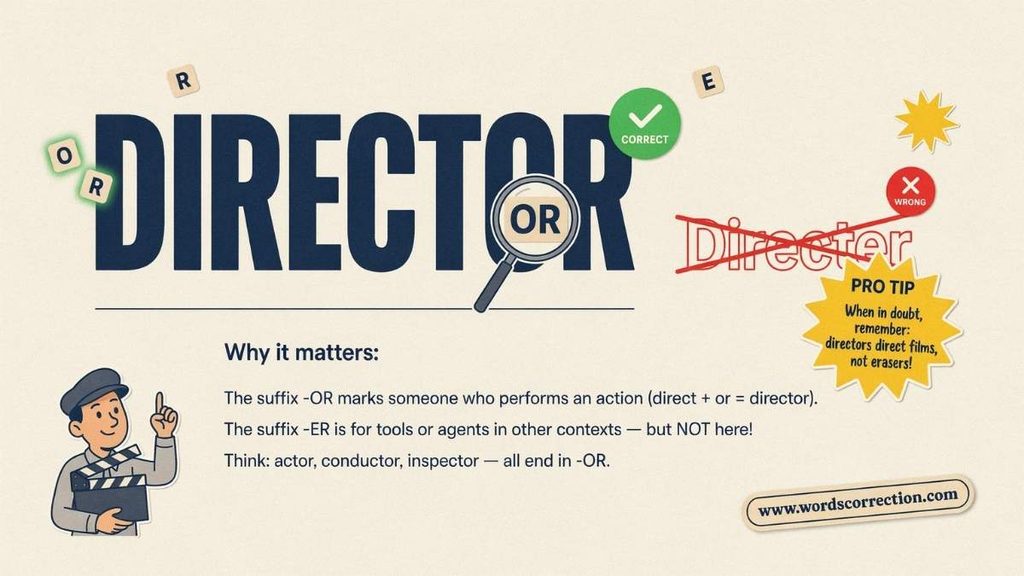
The difference between directer vs director becomes much clearer when you look at their grammatical functions.
| Feature | Director | Directer |
| Common modern noun | Yes | No |
| Person who directs | Yes | Historically |
| Professional job title | Yes | No |
| Film professional | Yes | No |
| Company position | Yes | No |
| Comparative adjective | No | Yes |
| Meaning “more direct” | No | Yes |
| Historical noun | Yes | Yes |
The important point is that directer is not simply an alternative modern spelling of director.
It has separate, limited uses.
Common Mistakes With Director or Directer
Adding -er by Habit
One of the most common mistakes occurs when writers automatically add -er to the verb direct.
They may reason:
Someone who teaches is a teacher, so someone who directs must be a directer.
That reasoning seems logical, but English vocabulary contains many established exceptions and historical forms.
The standard modern noun is director.
Spellcheck Dependence
Spellcheck tools can help identify obvious spelling errors, but they cannot always explain why a word is correct.
A dictionary or reliable language reference provides more useful information when two forms have different historical or grammatical functions.
Resume and Job Title Mistakes
Professional documents require particular care.
If your official job title is Director of Marketing, Operations Director, or Executive Director, changing the spelling to Directer can make the title look incorrect or unprofessional.
For example:
Correct:
Director of Operations
Incorrect in standard modern usage:
Directer of Operations
Learn the difference between often confused words
Bosses or Boss’s Which Is Correct? Meaning and Usage
Non-Native English Confusion
English learners often struggle with -er and -or endings because there is no single rule that works for every word.
The best approach is to learn common professional nouns as complete vocabulary items.
For example:
- actor
- editor
- director
- administrator
- supervisor
- coordinator
Learning the standard form prevents repeated spelling mistakes.
Correct Form Reminder
If you mean a person who directs, remember:
Director is the standard modern noun.
That one sentence solves most director or directer spelling questions.
Director in Everyday and Professional Writing
The word director appears frequently in formal and professional English.
Emails
Use director when referring to someone in a leadership or management position.
I will discuss the proposal with the director tomorrow.
Resumes and Job Applications
Use the exact standard spelling when describing your experience.
Served as Marketing Director for three years.
Promoted to Director of Operations in 2025.
Business Documents
The word frequently appears in reports, policies, organizational charts, and company communications.
Examples include:
- board of directors
- director of finance
- director of operations
- managing director
- executive director
Academic Writing
Academic institutions also use director as a formal title.
Examples include:
- Director of Research
- Program Director
- Director of Admissions
- Director of Graduate Studies
Social Media and Informal Writing
Even in informal writing, director remains the normal spelling.
For example:
Excited to announce that I am now the creative director of the project!
Informality can change your tone, but it does not usually change the spelling.
Director vs Related Words
Understanding related words can make director spelling easier to remember.
Direct vs Director
Direct refers to the act of guiding or controlling something.
Director refers to the person who performs that role.
The manager will direct the project.
The manager is the project director.
Learn the difference between confusing word pairs
Personalise or Personalize Difference,Meaning and Usage
Direction vs Director
it refers to guidance, orientation, or the act of directing.
Director refers to a person.
The team needs clear direction.
The director provided clear instructions.
Directing vs Director
Directing is the activity or process of directing.
Director is the person who directs.
She enjoys directing films.
She is a film director.
Directorate vs Director
A director is generally an individual.
A directorate can refer to an organizational department, office, or group associated with directors, depending on the context.
These words are related, but they are not interchangeable.
Learn the difference between tricky grammar more words
Unvoluntary or Involuntary Which One Is Correct?
How to Remember the Correct Spelling of Director
If you frequently confuse directer or director, a few memory tricks can help.
Use the -or Reminder
Think of other familiar professional nouns ending in -or:
- actor
- editor
- instructor
- administrator
- supervisor
- director
The pattern is not a universal spelling rule, but the association can help you remember the standard form.
Learn the difference between confusing more English words step by step
Synched or Synced Correct Spelling, Meaning and Usage
Connect Director With Actor and Editor
Both actor and editor describe people who perform particular roles.
Add director to the same mental group:
Actor → Editor → Director
This simple word family can make the spelling easier to recall.
Remember the Job-Title Rule
When director describes someone’s professional position, use the standard spelling director.
For example:
- Film Director
- Managing Director
- Executive Director
- Creative Director
- Sales Director
If you are writing a job title, director is almost certainly the form you need.
Director Example Sentences
Seeing the word in context is one of the easiest ways to learn correct usage.
Film and Television Examples
The director asked the actors to repeat the scene.
The movie director discussed the project’s visual style.
The television director coordinated the production team.
Business Examples
The company appointed a new finance director.
The managing director addressed the employees.
The director presented the annual business plan.
Education Examples
The program director welcomed the new students.
The school director announced the updated policy.
The research director approved the proposal.
General Examples
The director gave clear instructions to the team.
She accepted the position of executive director.
The board appointed him as a director.
Learn the difference between commonly mixed-up more words
Incurable or Uncurable? Meaning, Difference and Usage
When Should You Use Director?

Use Director When You Mean a Person Who Directs
If you are naming a person who leads, manages, guides, or supervises an activity or organization, director is normally the appropriate noun.
For example:
The director oversees the department.
Use Director in Formal and Professional Writing
Use director in:
- business writing
- resumes
- cover letters
- academic writing
- job descriptions
- company documents
- professional emails
- organizational charts
- film reviews
It is the standard form across these contexts.
Learn the difference between confusing more English words
Vain or Vein Key Difference, Meaning, Grammar and Usage
Don’t Replace Director With Directer
Although directer has historical and grammatical uses, it should not normally replace director in modern professional English.
Writing:
She is the company’s directer.
is likely to be interpreted as a spelling mistake.
Writing:
She is the company’s director.
uses the established modern form.
Director Pronunciation
The pronunciation of director varies somewhat between English accents.
Common dictionary pronunciations include versions beginning with either a “dye” or “di” sound, depending on the speaker and variety of English.
The important point is that pronunciation differences do not create different standard spellings.
Whether you pronounce the word one way or another, the spelling remains:
director
Director Synonyms
The best synonym for director depends on the context.
Possible alternatives include:
- leader
- manager
- supervisor
- administrator
- head
- chief
- coordinator
- conductor
However, these words are not always exact substitutes.
For example, a film director should not automatically be called a “manager,” because directing a film involves a particular creative and production role.
Likewise, a company director may have responsibilities that differ substantially from those of a supervisor.
Therefore, choose a synonym according to the specific role you are describing.
Learn the difference between tricky English words with easy explanations
Congrats or Congratulations Which One Is Correct?
Director Meaning in Hindi and Spanish
The word director also appears in other languages, although pronunciation and grammatical forms can differ.
In Hindi, the English word is commonly translated according to context, with terms relating to a person who directs or leads.
In Spanish, director is also a common word. The feminine form is generally directora.
These translations show why context matters. The exact translation can change depending on whether you are talking about a company, film, school, organization, or another setting.
Is Directer a Word?
This is one of the most important questions in the directer vs director debate.
Yes, directer is documented as a word, but that does not make it the standard modern noun for a person who directs.
It has at least two notable uses.
First, directer can be the comparative form of the adjective direct, meaning more direct.
For example:
This route is directer than the previous one.
However, this construction is uncommon in modern standard English. Writers generally prefer:
This route is more direct than the previous one.
Second, historical dictionaries record directer as an older noun meaning director.
Therefore, saying that directer is not a word at all would be too absolute.
The more accurate statement is:
Directer exists in English, but director is the standard modern noun for a person who directs.
Is Director a Word?
Yes.
Director is a standard English noun with established meanings in business, entertainment, education, government, organizations, and other fields.
It can refer to a person who:
- directs an activity
- manages an organization
- leads a department
- oversees a project
- directs a film or play
- serves on a company’s board
The word is also used in many professional job titles.
Practice Session
Fill in the Blanks
Test your understanding of director, directer, direct, and related words. Choose the word or phrase that best completes each sentence.
- The film ________ discussed the final scene with the actors.
- She was appointed the new Marketing ________.
- The company’s ________ approved the annual business plan.
- Please ________ the visitors to the conference room.
- The theater ________ organized the rehearsals.
- He accepted the position of Executive ________ last month.
- The ________ gave the production team detailed instructions.
- This route is ________ than the previous one.
- The company appointed three new ________ this year.
- The school ________ announced the new academic policy.
- The manager will ________ the team throughout the project.
- A film ________ works closely with many members of a production team.
- The Finance ________ presented the company’s financial report.
- This road provides a ________ route to the airport.
- The ________ of Operations oversees several departments.
- The Program ________ welcomed the new students.
- The standard modern noun for a person who directs is ________.
- Although “directer” appears in historical usage, ________ is normally used as the modern professional title.
- The company has five ________ on its board.
- The director asked the assistant to ________ the guests to their seats.
- This explanation is ________ and easier to understand.
- The Creative ________ approved the design before production began.
- The board of ________ met to discuss the company’s future.
- The director provided clear ________ before the meeting began.
- If you mean a person who directs a film, the correct term is film ________.
Answer Session
- director
- Director
- director
- direct
- director
- Director
- director
- directer
- directors
- director
- direct
- director
- Director
- direct
- Director
- Director
- director
- director
- directors
- direct
- more direct
- Director
- directors
- direction
- director
Here’s a trusted source for clear more words Comparison:
Grammar Update
Frequently Asked Questions
What is the correct spelling of director?
The correct modern spelling is director. It is the standard noun for a person who directs, manages, or oversees a film, company, organization, project, or activity.
Is it director or directer?
Director is the standard modern spelling when referring to a person who directs. Directer has limited uses in English, including an archaic noun meaning “director” and a comparative form of direct, meaning “more direct.”
Is directer a word?
Yes, directer is a documented English word, but it is uncommon in modern usage. It can function as the comparative form of direct or appear as an archaic noun meaning “director.”
What does directer mean?
Directer can mean “more direct” when used as the comparative form of direct. Historically, it was also used as a noun for a person who directs. In modern standard English, director is preferred for this noun meaning.
What does director mean?
A director is a person who directs, manages, supervises, or leads something. The term can refer to a film director, company director, program director, theater director, or another person in a leadership position.
Is director a noun?
Yes. Director is a noun that refers to a person who directs, manages, or oversees an activity, organization, production, or department.
What is the difference between directer and director?
Director is the standard modern noun for a person who directs. Directer has limited historical and grammatical uses and is not normally used as a modern professional title.
Why do people spell director as directer?
The spelling directer may seem logical because English often forms nouns for people by adding -er, as in “teacher” and “writer.” However, director developed through a different historical path and became the established modern noun.
How do you spell director correctly?
The correct spelling is D-I-R-E-C-T-O-R: director.
Is director spelled differently in American and British English?
No. Director is the standard spelling in both American and British English. The pronunciation may vary by accent, but the spelling remains the same.
What is the plural of director?
The plural of director is directors.
Example: The directors attended the annual meeting.
Is director gender-specific?
No. Director is generally gender-neutral in modern English and can refer to a person of any gender.
How is director pronounced?
Director has more than one accepted pronunciation in English. Pronunciation can vary between British and American English as well as among regional accents.
What does a director do?
A director generally provides leadership, direction, management, or oversight. The specific duties depend on the role. A film director, for example, guides a production, while a company director may have management or governance responsibilities.
What is a film director?
A film director is the person responsible for guiding the creative direction of a movie or film production. The role may involve working with actors and coordinating with various production departments.
What is a company director?
A company director is a person who holds a senior management or governance position within a company. Their specific duties and legal responsibilities depend on the organization’s structure and applicable laws.
What is a managing director?
A managing director is a senior executive who typically has substantial responsibility for managing an organization or its operations. The exact role varies between companies and jurisdictions.
What are some synonyms for director?
Depending on the context, possible alternatives include leader, manager, supervisor, administrator, head, chief, and coordinator. These terms are not always interchangeable because they can describe different responsibilities.
How do you use director in a sentence?
Use director as a noun when referring to someone who directs, manages, or oversees something.
Example: The director approved the company’s new business strategy.
Is directer correct as a job title?
No. Director is the standard form for modern job titles such as Marketing Director, Executive Director, Finance Director, and Managing Director. Although “directer” appears in historical usage, it is not normally used as a modern professional title.
Can directer mean “more direct”?
Yes. Directer can be used as the comparative form of direct, meaning “more direct.” However, modern English generally prefers more direct.
Example: This route is more direct than the previous one.
Why is director spelled with -or instead of -er?
The spelling director reflects the word’s historical development through French from Latin. It did not simply develop by adding the modern English suffix -er to “direct.” Over time, director became the established English noun.
What is the correct form of director in professional writing?
Use director when referring to a person who directs, manages, or oversees something. This includes professional titles such as Director of Operations, Creative Director, Finance Director, Executive Director, and Managing Director.
Conclusion
The directer or director confusion may seem like a small spelling problem, but one extra letter can send your sentence in the wrong direction. While “directer” looks logical because English often uses the -er ending for people who perform an action, director is the standard modern noun for someone who directs, manages, or leads. The word “directer” does have limited historical and grammatical uses, but it isn’t the usual choice for a professional title or everyday writing. So, when you mean a film director, company director, managing director, or project leader, choose director. Remember the spelling, trust the established form, and let your writing stay on the right track.

Stella AJS is an experienced blogger and dedicated English language writer at Words Correction. She turns confusing grammar, word meanings, spelling, and usage into clear, practical insights that readers can easily understand and apply. With a passion for precise and engaging writing, Stella helps readers avoid common language mistakes, strengthen their vocabulary, and communicate with greater clarity and confidence.




