
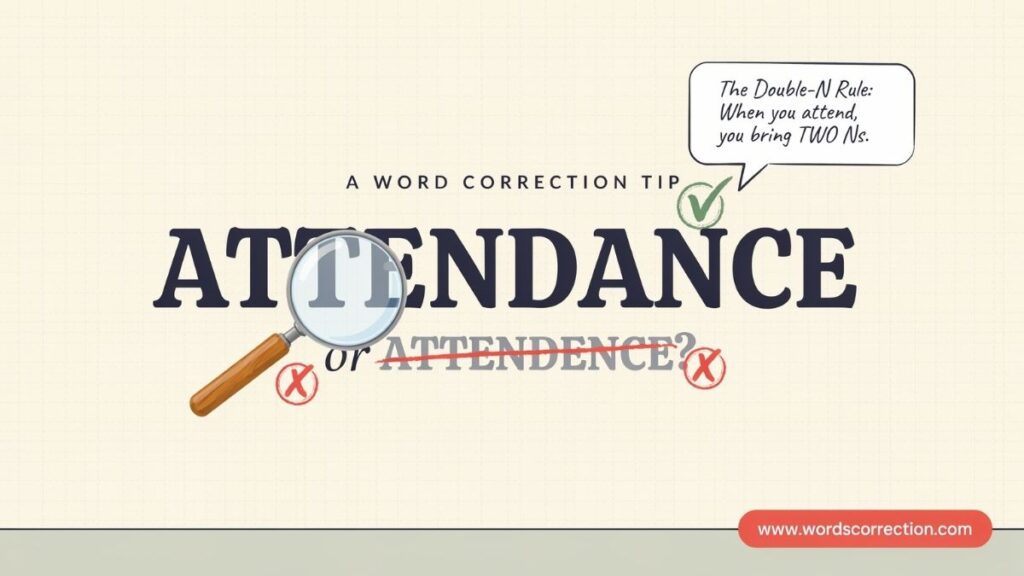
The word attendance looks harmless until one extra letter turns it into “attendence,” a spelling mistake that can sneak into emails, school records, and workplace documents. The confusion is understandable because English spelling doesn’t always behave the way pronunciation suggests. When choosing between attendance or attendence, there’s only one standard spelling: attendance. In this guide, you’ll learn why “attendance” is correct, what it means, how to pronounce it, and how to use it naturally in everyday writing. You’ll also explore common mistakes, related word forms, and practical examples. By the end, this troublesome word should finally stop taking attendance on your spelling list.
So, if you’re asking “is it attendance or attendence?”, remember this:
Attendance is correct Attendence is incorrect
| Spelling | Correct? | Meaning |
| Attendance | Yes | Being present or the number of people present |
| Attendence | No | Common misspelling of attendance |
This distinction matters in everyday writing as well as formal documents. A misplaced letter might seem minor, but spelling errors in school records, business emails, reports, applications, and official forms can undermine otherwise polished writing.
Attendance or Attendence Quick Answer
The correct spelling of attendance is:
A-T-T-E-N-D-A-N-C-E
The spelling attendence is incorrect.
If you’re trying to remember how to spell attendance, connect the noun to the verb attend:
attend → attendance
For example:
- I attend school every day.
- My attendance is excellent.
- The teacher took attendance.
- Regular attendance is required.
The word does not change to attendence simply because the pronunciation may make the ending sound less obvious.
Examples of Correct Usage
Here are some natural examples of the attendance word in everyday English:
- The teacher recorded attendance before the lesson began.
- Her attendance record shows that she rarely misses class.
- The company has a clear attendance policy.
- Attendance at the conference exceeded expectations.
- The school monitors daily attendance.
- The manager reviewed the employee attendance report.
- Students must meet the required attendance percentage.
- Regular attendance is essential for the course.
In every example, attendance is the correct form.
Learn the difference between confusing more English words
Boxes or Boxs Correct Spelling and Usage
What Does Attendance Mean?
The basic attendance meaning is the act or state of being present.
The word can also describe the number of people present at a particular event or location. Context determines which meaning applies.
Consider this sentence:
“Regular attendance is required.”
Here, attendance means the act of being present.
Now consider:
“The concert had an attendance of 15,000.”
In this case, attendance refers to the number of people who were present.
Attendance Definition
A clear attendance definition is:
Attendance is the act or state of being present at a place, event, class, meeting, or other activity. It can also mean the number of people present.
This definition covers the word’s most common uses in education, workplaces, events, and formal records.
Two Common Meanings of Attendance
| Meaning | Explanation | Example |
| Being present | The state or act of being present | “Regular attendance is required.” |
| Number present | The number of people who attend | “Attendance reached 2,000.” |
This distinction explains why you might see attendance in both an individual student’s record and a newspaper report about a large public event.
What Does Attendence Mean?
The spelling attendence often creates confusion because it looks like a reasonable English word.
It isn’t the standard spelling of the noun.
When someone writes attendence, they normally intend to write attendance. Therefore, attendence meaning is not a separate definition you need to learn. It is simply an incorrect spelling of the correct word.
If you’re wondering “is attendence a word?”, the safest answer is no in standard English usage when you mean the noun referring to being present.
The correct form is:
attendance
Not:
attendence
Learn the difference between commonly mixed-up more words
Trialled or Trialed Meaning, Difference and Usage
Why Does This Spelling Mistake Happen?

English has many nouns that end in -ence, including:
- difference
- confidenceimexperience
Because -ence appears so often, writers may naturally assume that attendence follows the same pattern.
That assumption creates the attendence spelling mistake.
The correct noun uses -ance:
attendance
English spelling doesn’t always follow a pattern that you can predict from another word. Sometimes, the best approach is to learn the established spelling and connect it to related words.
Why Is Attendance Spelled With “-ance”?
The easiest way to understand the spelling is to start with the verb attend.
The noun formed from it is:
attend → attendance
The incorrect form changes the ending:
attend → attendence
That extra e doesn’t belong in the standard noun.
A useful memory trick is:
If you attend, your attendance shows that you were present.
This connection makes the spelling easier to recall than trying to memorize individual letters.
Learn the difference between tricky grammar more words
Grayscale or Greyscale Which Is Correct?
The Attendance Word Family
The word attendance belongs to a larger family of words connected with attend.
ATTEND
│
┌─────────────┼─────────────┐
│ │ │
attended attending attends
│
┌──────┴───────────┐
│ │
attendee attendance
│
attendant
These words are related, but they don’t have identical meanings or grammatical roles.
For example:
- Attend is a verb.
- Attended is the past tense of attend.
- Attending is the present participle.
- Attendee means a person who attends.
- Attendant generally means a person who attends to someone or something.
- Attendance is a noun referring to being present or the number of people present.
Knowing the word family helps prevent both spelling and word-choice errors.
The Origin of Attendance and Attendence
The history of attendance traces back to the word attend, which ultimately comes from the Latin attendere, meaning to direct attention toward something.
The word passed into English through French before developing its modern uses.
Over time, attend came to describe being present at something, such as a meeting, class, ceremony, or event. From this verb, attendance developed as the noun describing the act or state of attending.
The spelling attendence does not represent a separate historical form that competes with attendance in modern standard English. Instead, it is a spelling error that likely arises from confusion about the noun ending.
This history also explains why several related words share the same basic attend root.
Learn the difference between confusing word pairs
Months or Monthes Which Spelling Is Correct?
Attendance or Attendence in British and American English
One common question is whether attendance changes spelling between American and British English.
It doesn’t.
Both varieties use:
attendance
Both reject:
attendence
| English Variety | Correct | Incorrect |
| American English | attendance | attendence |
| British English | attendance | attendence |
| Canadian English | attendance | attendence |
| Australian English | attendance | attendence |
English does have many regional spelling differences. For example, American English uses color, while British English generally uses colour.
However, attendance isn’t one of those words.
So whether you’re writing a school report in the United States or an academic document in the United Kingdom, use attendance.
Attendance Pronunciation
Spelling becomes especially tricky when pronunciation doesn’t make every letter obvious.
The pronunciation of attendance can make the unstressed vowel sounds difficult to identify. As a result, some writers spell the word according to how they think it sounds.
That approach often leads to attendence.
A better strategy is to remember the written form:
attendance
You can also connect it to attend:
attend + ance = attendance
Pronunciation helps you recognize a word, but it doesn’t always provide a reliable spelling guide. English contains many words where letters aren’t pronounced exactly as learners might expect.
Learn the difference between often confused words
Bosses or Boss’s Which Is Correct? Meaning and Usage
Attendance in School and Education

Few contexts use attendance more frequently than education.
School attendance refers to a student’s presence at school, in a classroom, or at required educational activities.
Schools often keep detailed attendance records to identify patterns of absence, lateness, and regular participation.
Common terms include:
- student attendance
- school attendance
- class attendance
- daily attendance
- attendance percentage
- attendance rate
- attendance requirement
- attendance record
- attendance register
- attendance sheet
- attendance monitoring
- attendance policy
What Does Attendance Mean in School?
If you’re asking what does attendance mean in school, it generally means being present at school or attending required classes and activities.
For example:
“The school requires students to maintain regular attendance.”
Here, attendance refers to the student’s pattern of being present at school.
Another example:
“Jordan’s attendance percentage increased from 91% to 96%.”
In this sentence, attendance becomes a measurable figure.
Attendance in School Example
Consider:
“The teacher took attendance before beginning the lesson.”
This means the teacher checked which students were present and recorded the result.
Another example is:
“The student’s attendance record shows five absences this semester.”
Here, the record provides a documented history of presence and absence.
Learn the difference between basic English word mistakes
Personalise or Personalize Difference,Meaning and Usage
Attendance in the Workplace
The word attendance also appears frequently in professional settings.
Employee attendance generally concerns whether employees are present when they are expected to work. Organizations may use attendance policies, attendance systems, and attendance tracking tools to maintain accurate records.
Common workplace phrases include:
- employee attendance
- attendance policy
- attendance record
- attendance report
- attendance tracking
- attendance monitoring
- attendance management
- attendance system
- attendance requirement
For example:
“The HR department reviewed the employee attendance report.”
Or:
“All employees must follow the company’s attendance policy.”
The exact rules differ among organizations. The spelling remains the same.
Attendance vs Attending vs Attendant
The similarity between these words can cause confusion, particularly for people learning English.
Although they share the attend root, they perform different grammatical roles.
Attend
Attend is a verb meaning to go to or be present at something.
“I will attend the meeting.”
Attends
Attends is the third-person singular form.
“She attends class every morning.”
Attended
Attended is the past form.
“He attended the conference yesterday.”
Attending
Attending is the present participle.
“They are attending a training session.”
Attendee
An attendee is a person who attends an event or activity.
“Each attendee received a registration badge.”
Attendant
An attendant is generally someone who attends to another person, place, or task.
“The parking attendant directed us to an available space.”
Attendance
Attendance is a noun.
“Conference attendance increased this year.”
| Word | Type | Meaning | Example |
| attend | Verb | Go to or be present | “I attend class.” |
| attends | Verb | Present-tense form | “She attends class.” |
| attended | Verb | Past form | “He attended the meeting.” |
| attending | Verb form | Currently attending | “They are attending.” |
| attendee | Noun | Person who attends | “Every attendee registered.” |
| attendant | Noun | Person who attends to someone or something | “The attendant helped us.” |
| attendance | Noun | Presence or number present | “Attendance was high.” |
This distinction is especially useful when proofreading formal writing.
Learn the difference between commonly misused words
Unvoluntary or Involuntary Which One Is Correct?
Common Mistakes With Attendance or Attendence
Writing “Attendence” From Memory
The most common problem is simply choosing the wrong vowel.
A writer remembers the pronunciation and types attendence without checking the spelling.
The solution is straightforward:
Remember attendance as a complete word rather than spelling it phonetically.
Confusing “-ance” and “-ence”
English uses both endings frequently.
Compare:
- attendance
- importance
- performance
- difference
- confidence
- existence
Because both patterns are common, it’s easy to transfer the wrong ending from one word to another.
Confusing Attendance With Attendant
These words look similar, but they aren’t interchangeable.
“The attendance at the event was impressive.”
“The attendant helped visitors find their seats.”
The first sentence describes the people present or their presence. The second refers to a person who provides assistance or attends to something.
Using Attendance as a Verb
Attendance is a noun. It doesn’t mean “to attend.”
Incorrect:
“I will attendance the meeting.”
Correct:
“I will attend the meeting.”
Or:
“I will be in attendance at the meeting.”
This is a grammar issue rather than a spelling issue, but the two mistakes often appear together.
Entering the Wrong Spelling in Official Documents
The difference between attendance and attendence becomes particularly important in formal writing.
Check carefully when preparing:
- school records
- attendance sheets
- attendance registers
- employee reports
- business emails
- applications
- resumes
- certificates
- official forms
- academic documents
A quick proofreading check can prevent an avoidable error.
Learn the difference between everyday English mistakes
Incurable or Uncurable? Meaning, Difference and Usage
Attendance in Everyday Examples
Once the correct spelling is clear, usage becomes much easier.
Emails
Professional emails often use attendance when discussing meetings or events.
“Please confirm your attendance by Friday.”
“Thank you for your attendance at yesterday’s meeting.”
“Your attendance is requested at the training session.”
School and Education
“The teacher recorded daily attendance.”
“The student’s attendance percentage improved this term.”
“Regular attendance is required for the course.”
Workplace
“The manager reviewed the employee attendance records.”
“The company updated its attendance policy.”
Events
“The conference attracted more than 2,000 attendees.”
“The event had record attendance.”
Formal Writing
“Attendance at the hearing was limited.”
“Participants must meet the attendance requirement.”
The spelling remains attendance in every context.
Attendance vs Attendence Comparison Table
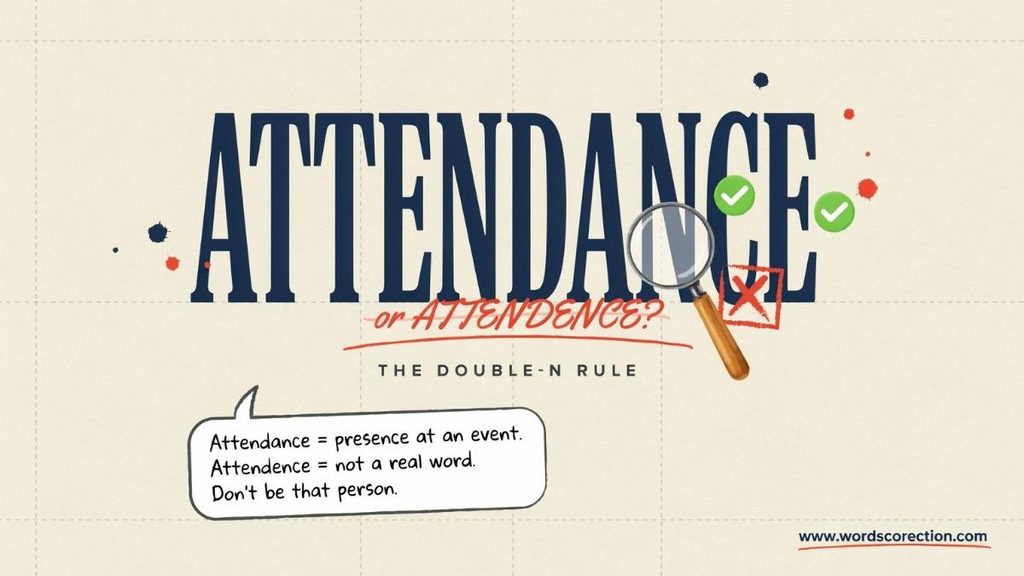
The attendance vs attendence difference is easier to understand when you place the two forms side by side.
| Feature | Attendance | Attendence |
| Standard English word | Yes | No |
| Correct spelling | Yes | No |
| Used in American English | Yes | No |
| Used in British English | Yes | No |
| Part of speech | Noun | Misspelling |
| Refers to being present | Yes | No |
| Refers to number present | Yes | No |
| Used in school records | Yes | No |
| Used in workplace records | Yes | No |
| Appropriate in formal writing | Yes | No |
| Recommended form | Attendance | Avoid |
The difference between attendance and attendence isn’t a difference in meaning. One is the correct English word, while the other is a spelling error.
Learn the difference between more words people mix up
Vain or Vein Key Difference, Meaning, Grammar and Usage
What Is an Attendance Record?
An attendance record is a written or digital record that shows whether someone attended a required place, event, class, or activity.
Schools commonly maintain attendance records for students. Employers may also keep records for employees.
Depending on the setting, an attendance record might include:
- dates
- presence
- absence
- late arrivals
- attendance percentage
- approved absences
- required sessions
- completed sessions
For example:
“The school reviewed the student’s attendance record at the end of the semester.”
An attendance record provides a history rather than a single attendance check.
What Is an Attendance Sheet?
An attendance sheet is a form used to record who is present.
A basic classroom attendance sheet might look like this:
| Student | Monday | Tuesday | Wednesday |
| Alex | Present | Present | Absent |
| Jordan | Present | Late | Present |
| Taylor | Present | Present | Present |
Businesses, training programs, conferences, and other organizations can use similar sheets.
An attendance sheet can exist on paper or in a digital attendance system. Its purpose remains the same: to record attendance accurately.
What Is an Attendance Register?
An attendance register is a formal record used to track attendance and absence.
The term appears frequently in educational settings, particularly in British English.
A teacher may use an attendance register to record which students attended a class and which students were absent.
For example:
“The teacher updated the attendance register at the beginning of the lesson.”
An attendance register may cover a single class, an entire school day, or a longer period depending on the institution’s system.
Attendance, Presence, and Absence
Although attendance and presence overlap, they aren’t always interchangeable.
Presence focuses on the state of being present.
“Her presence was required at the meeting.”
Attendance can refer to presence, the act of attending, a pattern of participation, or the number of people present.
“Her attendance at the meetings was excellent.”
Absence, meanwhile, refers to not being present.
“His absence was recorded.”
| Word | Meaning | Example |
| Attendance | Being present or the number/record of people present | “Attendance was high.” |
| Presence | The state of being present | “Her presence was required.” |
| Absence | The state of not being present | “His absence was noted.” |
Therefore, when someone asks “What is the opposite of attendance?”, absence is generally the appropriate answer when attendance refers to being present.
Case Study: Correcting an Attendance Error
Consider a school administrator preparing a monthly report.
The original sentence reads:
“Student attendence fell to 89% in October.”
The meaning is understandable, but the spelling is wrong.
The corrected version is:
“Student attendance fell to 89% in October.”
Now consider a different sentence:
“The teacher will attendence the class.”
This sentence contains more than a spelling mistake. It uses attendance as though it were a verb.
A natural correction would be:
“The teacher will take attendance in the class.”
Or:
“The teacher will record attendance.”
This example highlights an important point: good proofreading isn’t limited to checking individual letters. You also need to make sure the word fits the sentence grammatically.
Learn the difference between commonly confused more words in English
Congrats or Congratulations Which One Is Correct?
How to Remember the Correct Spelling of Attendance
If how to spell attendance still feels tricky, use a simple word association.
Start with the verb:
attend
Then add the noun ending:
attendance
Think of it as a small chain:
Attend → Attendance → Attendance record
You can reinforce the spelling by learning common phrases:
- attendance sheet
- attendance register
- attendance record
- attendance rate
- attendance percentage
- attendance policy
- attendance report
- regular attendance
- perfect attendance
- poor attendance
Seeing the correct form repeatedly makes it easier to recall naturally.
A Quick Memory Trick
Remember:
If you attend, your attendance is recorded.
The noun ends in -ance, not -ence.
Learn the difference between similar English words the easy way
Synched or Synced Correct Spelling, Meaning and Usage
How to Use Attendance in a Sentence
Because attendance is a noun, it often appears with words such as regular, poor, perfect, high, and low.
Common Patterns
Regular attendance
“Regular attendance helps students keep up with their lessons.”
Poor attendance
“Poor attendance can make it difficult to complete the course.”
Perfect attendance
“She received an award for perfect attendance.”
Attendance rate
“The school’s attendance rate improved this year.”
Attendance requirement
“Students must meet the course’s attendance requirement.”
Attendance policy
“Employees should review the company’s attendance policy.”
These combinations make the word easier to use correctly in both everyday and formal English.
Is “Attendances” a Word?
Yes. Attendances is the plural form of attendance.
However, English speakers don’t use the plural form in every context.
When talking about attendance as a general concept, the singular form is usually appropriate:
“Regular attendance is important.”
When referring to separate attendance figures or separate events, attendances can be appropriate:
“The report compared attendances at several sporting events.”
Attendance vs Attendances
| Form | Typical Use | Example |
| attendance | General concept or a single attendance figure | “Attendance was high.” |
| attendances | Multiple separate attendance figures or occasions | “The report compared attendances.” |
So, “is attendances a word?” Yes. It is a valid plural form.
The key is knowing when the plural makes sense.
Attendance Example Sentences
Here are additional examples showing how native English speakers commonly use the word:
- Attendance at the meeting was lower than expected.
- The school tracks student attendance every day.
- Her attendance record remains excellent.
- The company introduced a new attendance system.
- Please confirm your attendance before Friday.
- The event attracted record attendance.
- Students must meet the minimum attendance requirement.
- The manager reviewed the monthly attendance report.
- Poor attendance can affect academic progress.
- The teacher took attendance before starting the lesson.
Each sentence uses attendance as a noun.
Practice Session
Fill in each blank with the correct word.
- The correct spelling is __________, not “attendence.”
- Regular __________ is required for all students.
- The teacher recorded the students’ __________ before beginning the lesson.
- Please sign the __________ sheet before entering the meeting.
- The company maintains an __________ record for every employee.
- The school monitors student __________ throughout the academic year.
- Employees are expected to __________ the training session.
- Her excellent __________ record demonstrates her consistency.
- The manager checked the staff __________ for the month.
- The meeting had a high level of __________.
- His __________ percentage was 95% this semester.
- Students must __________ all scheduled examinations.
- Poor __________ can affect a student’s academic progress.
- The school has introduced a new __________ policy.
- The receptionist maintains the daily __________ register.
- The attendance __________ shows how many classes each student attended.
- The organization uses a digital __________ system to track employees.
- The teacher asked students to mark their __________ on the register.
- The employee’s consistent __________ was recognized by the manager.
- The event organizers recorded the __________ of every participant.
- “Attend” is a __________, while “attendance” is a noun.
- “Attendance” refers to the act or state of being __________.
- An attendance sheet records whether someone is present or __________.
- A high attendance rate indicates that a person attends scheduled activities __________.
- The word “attendence” is a common spelling __________ of “attendance.”
- attendance
- attendance
- attendance
- attendance
- attendance
- attendance
- attend
- attendance
- attendance
- attendance
- attendance
- attend
- attendance
- attendance
- attendance
- percentage
- attendance
- attendance
- attendance
- attendance
- verb
- present
- absent
- regularly
- mistake
Here’s a trusted source for clear more words Comparison:
Grammar Update
Frequently Asked Questions
Is attendance a countable or uncountable noun?
“Attendance” is generally an uncountable noun when referring to the act or state of being present. For example, “Attendance is required at every meeting.”
What is the verb form of attendance?
The verb related to “attendance” is attend. It means to be present at a place, event, class, meeting, or activity.
What is the difference between attend and attendance?
Attend is a verb that describes the action of being present, while attendance is a noun that refers to the act, state, or record of being present.
What is the difference between attendance and presence?
“Attendance” generally refers to being present at an organized activity or event, while “presence” has a broader meaning and refers to being in a particular place or situation.
What is the difference between attendance and absence?
“Attendance” refers to being present, whereas “absence” refers to not being present at a particular place, event, class, or activity.
Can attendance refer to an event?
Yes. “Attendance” can refer to the act of being present at an event or to the number of people who attend it.
Can attendance refer to both people and events?
Yes. The word can describe people’s presence at classes, meetings, workplaces, events, and other organized activities.
What does attendance record mean?
An attendance record is a documented record showing when a person was present or absent from a school, workplace, class, meeting, or other activity.
What is an attendance register?
An attendance register is an official record used to track whether students, employees, or other participants are present or absent.
What is an attendance sheet used for?
An attendance sheet is used to record the presence or absence of individuals during classes, meetings, work shifts, training sessions, or events.
What is an attendance percentage?
An attendance percentage represents the proportion of scheduled classes, workdays, meetings, or activities that a person attended, usually expressed as a percentage.
How is an attendance percentage calculated?
Attendance percentage is typically calculated by dividing the number of sessions attended by the total number of scheduled sessions and multiplying the result by 100.
What does regular attendance mean?
“Regular attendance” means being present consistently at scheduled classes, workdays, meetings, or activities with relatively few absences.
What does poor attendance mean?
“Poor attendance” refers to frequent or repeated absences from scheduled classes, work, meetings, or other activities.
What does attendance rate mean?
An attendance rate is the percentage or proportion of scheduled sessions, days, or events that a person or group attends.
What is an attendance policy?
An attendance policy is a set of rules that explains expectations and procedures concerning attendance, absences, lateness, and related records.
What does attendance monitoring mean?
Attendance monitoring is the process of recording, tracking, and reviewing whether individuals are present, absent, or late.
What is an attendance system?
An attendance system is a method, process, or digital tool used to record and manage the attendance of individuals.
Why are attendance records important?
Attendance records help schools, workplaces, and organizations monitor participation, maintain accurate records, identify attendance patterns, and apply relevant policies.
Can attendance be used for meetings?
Yes. “Attendance” can describe participation in a meeting by being present. For example “Attendance at the staff meeting was high.”
Can attendance be recorded for online classes?
Yes. Attendance can be recorded for online classes using methods such as participation records, digital check-ins, or attendance-management systems.
What does attendance at an event mean?
“Attendance at an event” refers to being present at the event or, depending on the context, the number of people who were present.
What is voluntary attendance?
Voluntary attendance means being present at an activity, event, or meeting by personal choice rather than because attendance is required.
What is mandatory attendance?
Mandatory attendance means that individuals are required to be present according to a particular rule, policy, agreement, or requirement.
What is the difference between attendance and participation?
Attendance generally means being present, while participation means actively taking part in an activity. A person may attend an event without actively participating in it.
Conclusion
When it comes to attendance or attendence, the answer is straightforward: attendance is the correct spelling. “Attendence” may look plausible, but it is simply a common spelling mistake, not an accepted alternative. Remember the -ance ending, and this frequently confused word becomes much easier to spell correctly.
Understanding the attendance meaning, pronunciation, and proper usage also helps you communicate clearly in school, the workplace, and everyday writing. Whether you’re completing an attendance sheet, maintaining an attendance record, or preparing an attendance report, accuracy matters. After all, attendance may be about being present, but your spelling should show up correctly, too.

Stella AJS is an experienced blogger and dedicated English language writer at Words Correction. She turns confusing grammar, word meanings, spelling, and usage into clear, practical insights that readers can easily understand and apply. With a passion for precise and engaging writing, Stella helps readers avoid common language mistakes, strengthen their vocabulary, and communicate with greater clarity and confidence.




