
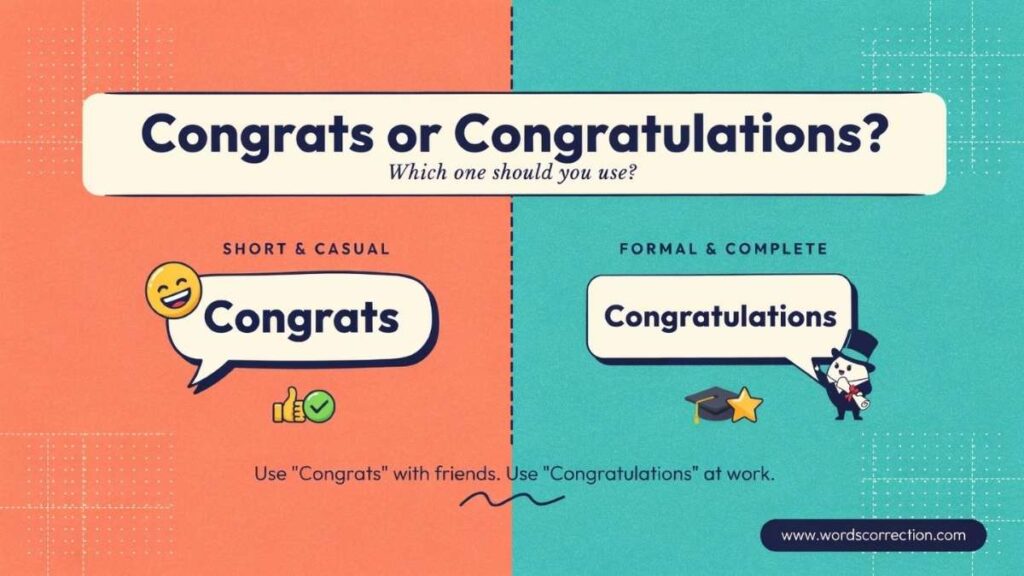
“Congrats!” looks simple enough, but then comes the little grammar question: should you write “Congratulations!” instead? This tiny choice can turn a cheerful message into a surprisingly serious language puzzle. Fortunately, there’s no need to call the grammar police. Both expressions are correct, but they don’t always fit the same situation. “Congrats!” is short, friendly, and casual, while “Congratulations!” sounds more complete and polished. Whether you’re celebrating a promotion, graduation, wedding, or new baby, choosing the right expression helps your message sound natural. Let’s clear up the confusion, uncover the key differences, and discover when each expression works best.
Congrats or Congratulations Quick Answer
Congrats and congratulations are both correct.
The main difference is formality:
- Congratulations is the full, standard form.
- Congrats is an informal shortened form.
- Both expressions communicate happiness, approval, or good wishes about someone’s achievement or good news.
- Congratulations is usually the safer choice for formal and professional writing.
- Congrats works naturally in texts, social media posts, casual conversations, and friendly messages.
| Word | Correct? | Tone | Common Use |
| Congratulations | Yes | Neutral to formal | Professional, academic, and personal situations |
| Congrats | Yes | Informal and friendly | Texts, chats, and social media |
| Congratulation | Yes, in specific noun uses | Formal or less common | Limited noun constructions rather than the usual standalone expression |
In other words, “Congratulations!” and “Congrats!” can celebrate the same achievement. The first sounds more complete and polished, while the second feels quicker and more casual.
Is “Congrats” a Word?
Yes. “Congrats” is an established English word and expression.
If you’ve ever wondered, “Is congrats a word?”, there’s a simple answer: yes. Major English dictionaries recognize it as an informal form connected to congratulations.
That means writing:
Congrats on your new job!
is not a spelling mistake.
The word simply belongs to a more casual register of English.
Think of it as a shortened version designed for everyday communication. English does this frequently. Words such as “info” from “information” and “ad” from “advertisement” follow a similar pattern. Shortening a word doesn’t automatically make it incorrect.
Learn the difference between more words people mix up
Chears or Cheers Difference, Meaning and Usage
Is “Congrats” an Abbreviation?
Congrats is commonly described as a shortened form, clipping, or informal abbreviation of congratulations.
It isn’t a random internet invention. English speakers have used the shortened form for well over a century.
The important point is that informal does not mean incorrect. It simply means the word fits relaxed communication better than highly formal writing.
Congrats Meaning: What Does “Congrats” Mean?
So, what does congrats mean?
Congrats means essentially the same thing as congratulations. It expresses happiness, approval, praise, or good wishes toward someone because of an achievement, success, or positive event.
For example:
- Congrats on passing your exam!
- Congrats on the promotion!
- Congrats to the winners!
- Congrats on your new baby!
- Congrats on getting the job!
The basic meaning remains the same even though the tone becomes more casual.
Congrats Definition in Simple English
A simple congrats definition is:
Congrats means an informal way to say congratulations.
It commonly appears when people celebrate:
- A graduation
- A promotion
- A new job
- A wedding
- A new baby
- An award
- A victory
- An examination result
- A personal accomplishment
- An important milestone
What Does Congrats Mean in a Message?
In a text or social media message, “Congrats!” generally means:
“I’m happy for you and want to acknowledge your success or good news.”
For example:
“I got the promotion!”
“Congrats! You earned it.”
That exchange sounds natural because the situation is personal and conversational.
Learn the difference between everyday English mistakes
Honoured or Honored Meaning, Spelling and Usage
Congratulations Meaning What Does “Congratulations” Mean?
The congratulations meaning is straightforward.
Congratulations is an expression used to show that you are pleased about someone’s success, achievement, good fortune, or happy event.
You might say it when someone:
- Graduates
- Gets a new job
- Receives a promotion
- Wins an award
- Gets married
- Has a baby
- Passes an important exam
- Wins a competition
- Completes a major project
- Reaches an important milestone
What Does Congratulations Mean in Simple Words?
A simple explanation of what does congratulations mean is:
“Congratulations” is something you say to show that you are pleased about someone’s success or good news.
For example:
Congratulations on your graduation!
This doesn’t merely state that someone graduated. It also expresses positive feelings about the achievement.
Congrats vs Congratulations What Is the Difference?
The difference between congrats and congratulations is mainly one of register and tone, not meaning.
Both expressions congratulate someone. The important distinction is how they sound in a particular situation.
Congrats vs Congratulations Comparison
| Feature | Congrats | Congratulations |
| Meaning | Praise or good wishes | Praise or good wishes |
| Form | Shortened form | Full form |
| Tone | Casual | Neutral to formal |
| Formality | Informal | Neutral, formal, or warm |
| Text messages | Very common | Correct |
| Social media | Very common | Very common |
| Professional email | Sometimes appropriate | Usually safer |
| Formal letter | Less suitable | Appropriate |
| Wedding card | Appropriate | Appropriate |
| Academic announcement | Usually casual | Appropriate |
Therefore, if you’re searching for the difference between congrats and congratulations, remember one simple point:
The meaning is essentially the same, while the level of formality is different.
Learn the difference between commonly misused words
Boxes or Boxs Correct Spelling and Usage
Is “Congrats” Formal or Informal?
Congrats is informal.
This distinction matters because correctness and formality aren’t the same thing.
A word can be completely correct English while still being unsuitable for a particular setting.
For example:
Congrats on the new job!
sounds natural when speaking to a friend.
Now consider:
Congratulations on your appointment as Director.
This version sounds more polished and professional.
The first sentence isn’t grammatically wrong. It simply has a more relaxed tone.
When Is “Congrats” Appropriate?
The shortened form works particularly well in:
- Text messages
- Instant messages
- Group chats
- Social media comments
- Friendly emails
- Casual workplace communication
- Conversations with friends
- Family messages
If the relationship is informal and the situation is relaxed, congrats usually sounds perfectly natural.
Is “Congratulations” Formal?
Congratulations can be formal, but it isn’t limited to formal situations.
This distinction is important.
You can use congratulations with:
- Close friends
- Family members
- Colleagues
- Customers
- Managers
- Professors
- Business partners
- Professional organizations
For example:
Congratulations! I’m so happy for you.
This sounds warm and personal rather than stiff.
However:
Please accept my sincere congratulations on your appointment.
has a clearly formal tone.
So, when asking “Is congratulations formal?”, the best answer is that the word works across a broad range of situations. The surrounding wording and context determine how formal the complete message sounds.
Learn the difference between basic English word mistakes
Trialled or Trialed Meaning, Difference and Usage
Congratulation or Congratulations Which Is Correct?
This is one of the most common points of confusion.
If you’re asking about congratulation or congratulations, both forms exist in English, but they don’t serve exactly the same purpose.
the normal form when directly celebrating someone’s achievement:
Congratulations!
on your promotion.
Congratulations on your wedding.
The singular noun congratulation also exists, but it is much less common in everyday conversation.
For example:
She sent him a note of congratulation.
Here, congratulation functions as a noun referring to an expression of praise or the act of congratulating someone.
Is “Congratulation!” Correct?
In ordinary modern English, “Congratulation!” is not the natural standalone expression.
Use:
Congratulations!
rather than:
Congratulation!
The singular noun isn’t incorrect in every context. It simply isn’t the standard form for directly congratulating someone.
Congratulation vs Congratulations Grammar Explained
The congratulation vs congratulations grammar question becomes easier when you separate the noun from the fixed expression.
“Congratulation” as a Noun
The singular noun can appear in specific constructions.
For example:
He sent a formal note of congratulation.
Here, the word functions as a regular noun.
“Congratulations” as an Expression
The plural form commonly appears as the standalone expression:
Congratulations!
It can also appear with on:
Congratulations on your achievement.
This explains why both forms can exist without being interchangeable in every situation.
The grammar isn’t broken. The context simply determines which form sounds natural.
Learn the difference between often confused words
Grayscale or Greyscale Which Is Correct?
The Origin of Congrats and Congratulations
The history behind these words goes back much further than modern texting.
The verb congratulate comes from Latin congratulari, which carried the idea of expressing or sharing joy.
The related English noun congratulation developed from this word family. Over time, congratulations became a common expression used to acknowledge someone’s success or good fortune.
The shorter form congrats developed later as an informal clipping of the longer word.
A Simple Word History
Latin: congratulari
↓
English verb: congratulate
↓
Noun: congratulation
↓
Common expression: congratulations
↓
Informal short form: congrats
The history helps explain why the two modern expressions remain closely connected.
More importantly, it shows that congrats isn’t a careless modern spelling. It developed as a natural shortening of a much longer word.
Congrats vs Congratulations in American and British English
The choice between congrats and congratulations is not primarily an American-versus-British spelling difference.
Both American English and British English use congratulations. Both also recognize congrats as an informal expression.
The more useful distinction is therefore:
Formal vs. informal, rather than American vs. British.
Usage in American English
American English commonly uses congrats in casual communication.
For example:
Congrats on the promotion!
In formal writing, however, congratulations remains a safer choice:
Congratulations on your promotion.
Usage in British English
British English also uses both forms.
For example:
Congrats on the new job!
is natural in casual communication.
Meanwhile:
Congratulations on your appointment.
works well in a more formal setting.
Therefore, neither variety requires a completely different choice.
When to Use Congratulations
If you’re wondering when to use congratulations, use the full form when you want a standard expression that works across formal and informal situations.
It is especially useful for:
- Formal emails
- Business communication
- Academic announcements
- Graduation cards
- Wedding cards
- Professional networking
- Speeches
- Public announcements
- Letters
- Award announcements
Learn the difference between confusing word pairs
Months or Monthes Which Spelling Is Correct?
Congratulations Examples
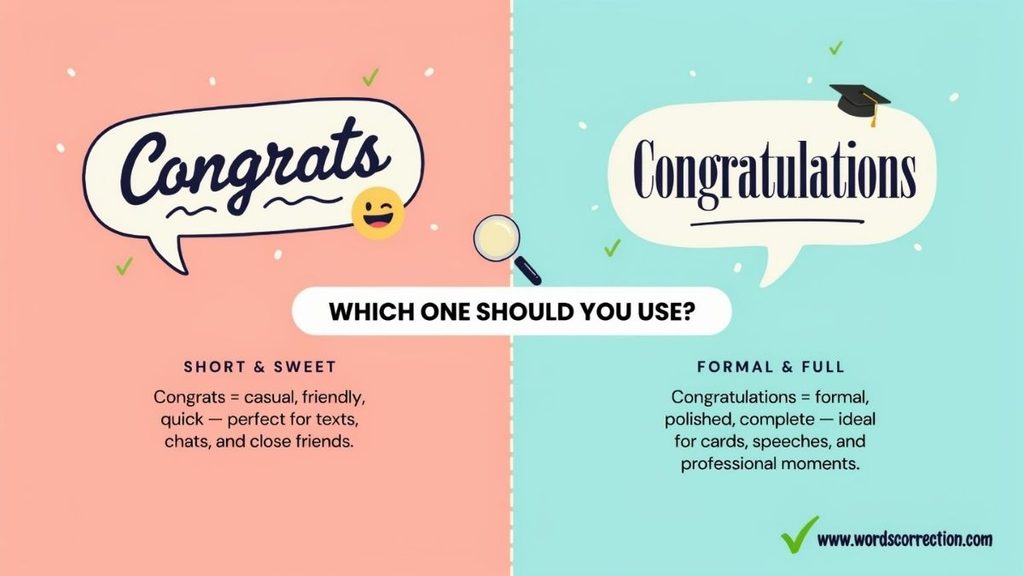
Professional:
Congratulations on your promotion. Your achievement is well deserved.
Academic:
Congratulations on completing your degree.
Personal:
Congratulations on your new home!
Wedding:
Congratulations on your wedding. Wishing you both a wonderful future together.
Achievement:
Congratulations on this outstanding accomplishment.
The full form gives you plenty of room to sound warm, respectful, and polished.
When to Use Congrats
Knowing when to use congrats is equally useful.
Use congrats when the setting is relaxed and the relationship is informal.
Common situations include:
- Text messages
- Group chats
- Social media comments
- Casual emails
- Friendly workplace messages
- Conversations with friends
- Informal celebrations
Learn the difference between tricky grammar more words
Bosses or Boss’s Which Is Correct? Meaning and Usage
Examples
on the promotion!
Congrats on graduating!
Congrats to the whole team!
Huge congrats on the win!
Congrats! You absolutely earned it.
These examples sound natural because the shortened form matches the conversational setting.
Can You Say “Congrats” Instead of “Congratulations”?
Yes. You can say congrats instead of congratulations in informal communication.
The two expressions can often replace each other without changing the basic message.
Compare:
Congratulations on your new job!
with:
Congrats on your new job!
Both communicate happiness about the person’s success.
The difference is stylistic.
The first sounds more complete. The second feels quicker, lighter, and more casual.
So, if you’re asking “Is it correct to say congrats instead of congratulations?”, the answer is yes when the situation allows informal language.
Congrats or Congratulations in Professional Writing
Professional communication requires a little more judgment.
Congratulations is generally the safer choice when writing to someone you don’t know well, addressing a senior colleague, preparing an official announcement, or communicating on behalf of an organization.
For example:
Congratulations on your appointment as department manager.
This sounds professional and respectful.
Compare it with:
Congrats on becoming department manager!
The second version isn’t grammatically wrong. It simply sounds more conversational.
A Useful Workplace Rule
When you’re unsure, choose congratulations.
It rarely sounds too casual. Congrats, however, can sound too relaxed in a highly formal setting.
That makes the full form a useful default for:
- Formal email congratulations
- Executive communication
- Official company announcements
- Academic correspondence
- Customer-facing communication
- Formal letters
Learn the difference between commonly mixed-up more words
Personalise or Personalize Difference,Meaning and Usage
Case Study Choosing the Right Tone at Work

Imagine three people receive the same promotion.
Message to a Close Coworker
Congrats on the promotion! You earned it.
The friendly tone fits the relationship.
Message From a Manager
Congratulations on your promotion. Your hard work and leadership have made a real difference to the team.
The complete form creates a more professional tone.
Company Announcement
Congratulations to Sarah Mitchell on her appointment as Vice President of Operations.
Here, congratulations fits the public and formal nature of the announcement.
The achievement hasn’t changed. Only the communication context has.
That’s the heart of the congrats vs congratulations distinction.
Congratulations for Different Occasions
The expression works with countless achievements and milestones.
Congratulations on Your Graduation
Congratulations on your graduation!
Or casually:
Congrats on graduating!
Both are natural.
Congratulations on Your Wedding
Congratulations on your wedding!
A warmer alternative:
Congratulations to you both!
Casually:
Congrats to the happy couple!
Congratulations on Your Promotion
Congratulations on your promotion.
Casually:
Congrats on the promotion!
Congratulations on Your New Job
Congratulations on your new job!
Casually:
Congrats on the new job!
Congratulations on Your Baby
Congratulations on your new baby!
A warmer personal version:
Congratulations to your growing family!
Casually:
Congrats on the new arrival!
Congratulations on Your Achievement
Congratulations on your achievement. Your hard work really paid off.
Casually:
Congrats! You did it!
Learn the difference between confusing more English words
Unvoluntary or Involuntary Which One Is Correct?
Congratulations On or Congratulations For?
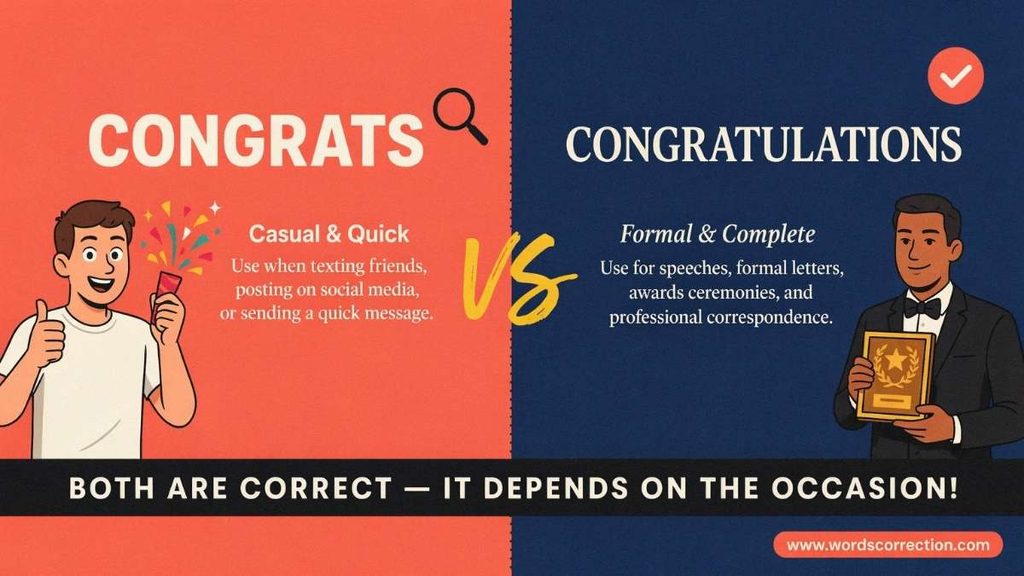
One of the most common grammar questions is whether you should say “congratulations on” or “congratulations for.”
In standard congratulatory expressions, on is the usual choice when identifying the achievement or event.
For example:
- Congratulations on your promotion.
- Congratulations on your graduation.
- Congratulations on winning the award.
- Congratulations on your new job.
- Congratulations on your wedding.
The same pattern works with congrats:
- Congrats on your promotion.
- Congrats on graduating.
- Congrats on winning the competition.
A helpful rule for English learners is simple:
Use “congratulations on” when directly identifying the achievement or event.
This pattern is natural, widely used, and easy to apply.
Proper Use of Congrats
The proper use of congrats depends mainly on register.
Good Uses
Congrats on the new job!
Congrats! That was an amazing achievement.
Congrats to everyone who participated.
Huge congrats on your graduation!
When Another Form Is Better
A highly formal letter might sound better with:
Congratulations on your appointment.
rather than:
Congrats on your appointment.
The casual version isn’t necessarily incorrect. The question is whether it matches the situation.
Learn the difference between tricky words and use them correctly
Incurable or Uncurable? Meaning, Difference and Usage
Proper Use of Congratulations
The proper use of congratulations is remarkably flexible.
You can use it by itself:
Congratulations!
You can follow it with on:
Congratulations on your success!
You can combine it with additional good wishes:
Congratulations on your graduation, and best wishes for the future.
You can also make it more personal:
Congratulations! You worked incredibly hard for this achievement.
This flexibility makes the full form useful in virtually every type of English communication.
Common Mistakes With Congrats and Congratulations
Even a cheerful message can stumble over a tiny grammar mistake. Fortunately, these errors are easy to fix.
Writing “Congratulation!” as a Celebration
Less natural:
Congratulation!
Standard:
Congratulations!
The plural form is the conventional expression when directly congratulating someone.
Assuming “Congrats” Is a Misspelling
Incorrect assumption:
“Congrats isn’t a real word.”
Correct understanding:
“Congrats” is an established informal word and expression.
It is a shortened form of congratulations, not simply a typing error.
Using “Congrats” in Every Situation
Casual:
Congrats on the win!
Formal:
Congratulations on your achievement.
The audience and setting should guide the choice.
Treating the Two Words as Different in Meaning
The core meaning remains essentially the same.
Congrats isn’t a different type of congratulations. It is the shorter, more informal form.
Forgetting “On”
Natural:
Congratulations on your promotion.
Natural:
Congrats on your promotion.
The preposition on commonly introduces the achievement being celebrated.
Learn the difference between similar English words the easy way
Vain or Vein Key Difference, Meaning, Grammar and Usage
Correct Spelling of Congratulations
The correct spelling of congratulations is:
Congratulations
If you’re wondering how to spell congratulations, connect it with the verb congratulate:
congratulate → congratulation → congratulations
A frequent spelling mistake is adding an unnecessary d, producing a form such as congradulations. That spelling is incorrect.
Common Misspellings
| Incorrect | Correct |
| Congradulations | Congratulations |
| Congratualtions | Congratulations |
| Congratulaitons | Congratulations |
| Congradulation | Congratulation |
| Congratulation! | Congratulations! when used as the standard expression |
The word is long enough to invite a typo. Breaking it into related forms can make the spelling easier to remember.
Congrats in a Sentence
If you’re looking for congrats in a sentence, here are natural examples:
- Congrats on your promotion!
- Congrats on passing your exam!
- Congrats to the entire team.
- Congrats on your new job!
- Congrats! You worked hard for this.
- A huge congrats to everyone involved.
These examples generally suit relaxed, conversational settings.
Congratulations in a Sentence
For congratulations in a sentence, the possibilities are broader:
- Congratulations on your graduation!
- Congratulations on your promotion.
- Congratulations to the winners.
- Please accept my congratulations on your achievement.
- Congratulations on your wedding!
- Congratulations on completing such an important project.
The full form works naturally in both personal and professional writing.
Formal and Informal Congratulations
Understanding formal and informal congratulations makes these expressions easier to use.
Formal
Please accept my sincere congratulations on your appointment.
Congratulations on this significant professional achievement.
May I offer my congratulations on your success?
Neutral
Congratulations on your new position.
Congratulations on your graduation!
Informal
Congrats on the new job!
Congrats! You did it!
Huge congrats on the win!
Formality exists on a spectrum. You don’t have to choose between sounding like a legal document and sending a two-word text.
Ways to Say Congratulations
Sometimes “congratulations” feels repetitive. English offers many alternatives.
Warm and Friendly
- Well done!
- You did it!
- Great job!
- I’m so happy for you!
- You should be proud!
- That’s fantastic news!
- What an achievement!
Professional
- Well deserved.
- Excellent work.
- That is a remarkable achievement.
- Best wishes on your continued success.
- Wishing you continued success in your new role.
Very Casual
- Congrats!
- Way to go!
- You nailed it!
- Fantastic!
- Amazing job!
These expressions aren’t exact replacements for congratulations in every sentence. However, they can serve a similar purpose when celebrating success or praising an achievement.
Alternative Words for Congratulations
Depending on the context, possible alternatives include:
- Praise
- Well done
- Kudos
- Cheers
- Acclaim
- Recognition
- Best wishes
- Good wishes
- Well deserved
- Great work
These words don’t always carry precisely the same meaning.
For example, kudos emphasizes praise, while best wishes can focus more on hopes for someone’s future. Congratulations directly marks the person’s achievement or good fortune.
Can “Congrats” Be Used on Social Media?
Absolutely.
Social media favors concise and conversational language, so congrats fits naturally.
Examples include:
Congrats on your graduation!
Huge congrats to the whole team!
Congrats on the new chapter!
Congrats! So happy for you.
In a public post, the shorter form can make the message feel spontaneous and friendly.
Still, congratulations works just as well:
Congratulations on this incredible achievement!
The choice depends on the overall voice of the post.
Can You Use “Congrats” in a Formal Email?
Yes, but context matters.
If you’re writing to a close colleague in a relaxed workplace:
Congrats on the promotion!
may be completely natural.
If you’re writing a formal business email to a client, senior executive, or professional contact:
Congratulations on your new appointment.
is usually a better fit.
A useful rule is:
If you would normally avoid casual abbreviations in the message, use “congratulations.”
That keeps professional communication polished without making every message sound stiff.
A Practical Guide to Choosing the Right Word
When you’re still unsure whether to use congrats or congratulations, consider these three questions.
Who Are You Addressing?
A close friend?
Congrats!
A client or senior executive?
Congratulations!
Where Are You Writing?
A text message?
Congrats!
An official announcement?
Congratulations!
A greeting card?
Either can work, depending on the relationship and desired tone.
What Tone Do You Want?
Relaxed and friendly?
Congrats!
Polished and respectful?
Congratulations!
Warm and personal?
Congratulations! I’m so happy for you.
The choice becomes much easier when you think about the reader rather than treating the two forms as competing spellings.
Comparison: Congrats vs Congratulations
| Question | Congrats | Congratulations |
| Is it correct? | Yes | Yes |
| Is it a word? | Yes | Yes |
| Is it informal? | Yes | Not necessarily |
| Is it a shortened form? | Yes | No |
| Can it stand alone? | Yes | Yes |
| Good for texting? | Yes | Yes |
| Good for social media? | Yes | Yes |
| Good for formal writing? | Less suitable | Yes |
| Good for professional emails? | Depends on context | Usually |
| Works in American English? | Yes | Yes |
| Works in British English? | Yes | Yes |
| Expresses praise or good wishes? | Yes | Yes |
Practice Sessions Congrats or Congratulations
Fill-in-the-Blank
- ______ on successfully completing your graduation!
- “Congrats” is a shortened and informal form of ______.
- We would like to ______ you on your outstanding achievement.
- ______ is generally preferred in formal business communication.
- She received a ______ message from her colleagues after winning the award.
- “Congrats” is commonly used in casual conversations and ______ messages.
- The correct preposition is “Congratulations ______ your promotion.”
- The verb form related to “congratulations” is ______.
- ______ is an appropriate expression for acknowledging someone’s achievement.
- In academic writing, ______ is generally more suitable than “congrats.”
- He expressed his sincere ______ to the newly married couple.
- “Congratulatory” is an adjective derived from the verb ______.
- ______ is commonly used to celebrate a personal milestone.
- You can simply say “Congratulations!” when the achievement is already clear from the ______.
- “Congrats” is considered an informal ______ of “congratulations.”
- The expression “Congratulations on your success” uses the preposition ______.
- A formal letter may begin with the words, “Please accept my sincere ______.”
- “Congratulations” can be addressed to an individual, team, or ______.
- The word “congratulations” expresses happiness, praise, and ______.
- In a friendly text message, “______!” is a natural way to acknowledge someone’s success.
- The adjective form associated with “congratulate” is ______.
- “Congratulations” functions primarily as a noun or an ______.
- You should use “my condolences” rather than “congratulations” when expressing ______.
- “Congrats” and “congratulations” share the same basic meaning but differ in ______.
- A professional congratulatory message should maintain a polite and ______ tone.
Answer Session
- Congratulations
- congratulations
- congratulate
- Congratulations
- congratulatory
- text
- on
- congratulate
- Congratulations
- congratulations
- congratulations
- congratulate
- Congratulations
- context
- abbreviation
- on
- congratulations
- organization
- celebration
- Congrats
- congratulatory
- interjection
- sympathy
- formality
- professional
Here’s a trusted source for clear more words Comparison:
Grammar Update
Frequently Asked Questions (FAQs)
What does “congrats” stand for?
“Congrats” is an informal abbreviation of “congratulations.” It is commonly used in casual conversations, text messages, social media comments, and friendly communication.
Can “congratulations” function as a verb?
No. “Congratulations” is primarily a noun or interjection used to express praise or good wishes. The corresponding verb is “congratulate,” as in, “I congratulate you on your achievement.”
Why is “congratulations” usually written in the plural form?
“Congratulations” is conventionally used in the plural form when expressing praise or good wishes for someone’s success. Although “congratulation” exists as a singular noun in specific contexts, “congratulations” is the standard expression.
Which preposition is commonly used after “congratulations”?
The preposition “on” is generally used when referring to a specific achievement or occasion. For example, “Congratulations on your promotion” and “Congratulations on completing your degree.”
Is “congratulations” appropriate for academic achievements?
Yes. “Congratulations” is appropriate for graduations, scholarships, academic awards, research accomplishments, and other educational milestones.
Can “congrats” be used in a professional email?
Yes, but the choice depends on the level of formality. “Congratulations” is generally more suitable for formal business emails, while “congrats” may be appropriate in informal workplace communication.
Is “congrats” considered slang?
“Congrats” is generally considered an informal abbreviation rather than slang. It is widely recognized and accepted in everyday English.
Can the word “congratulations” be used sarcastically?
Yes. Depending on the speaker’s tone and context, “congratulations” can sometimes be used sarcastically rather than sincerely.
What is the grammatical difference between “congratulate” and “congratulations”?
“Congratulate” is a verb that describes the action of expressing praise. “Congratulations” is a noun or interjection used to express praise or good wishes directly.
Can “congratulations” be addressed to a group?
Yes. “Congratulations” can be used for individuals, teams, families, organizations, or any group that has achieved something noteworthy.
Is “congratulations” suitable for formal written announcements?
Yes. The word is appropriate for formal announcements, greeting cards, award ceremonies, graduation notices, and congratulatory letters.
Is “congrats” pronounced differently from “congratulations”?
Yes. “Congrats” is pronounced as a shortened word, while “congratulations” is pronounced in its complete form.
Is “congratulations” preferred over “congrats” in academic writing?
Generally, yes. “Congratulations” is preferred in academic and formal writing because it maintains a more professional tone.
Is the word “congratulations” used differently in British and American English?
The meaning and spelling of “congratulations” remain the same in both British and American English. However, preferences for formal or informal expressions may vary depending on the context.
Can “congratulations” be used for personal accomplishments?
Yes. The expression can acknowledge personal achievements such as reaching a goal, completing a challenging task, winning a competition, or accomplishing a significant milestone.
What is the adjective form of “congratulate”?
The adjective form is “congratulatory.” For example, “She received a congratulatory message from her colleagues.”
What is the noun form related to the verb “congratulate”?
The noun commonly associated with “congratulate” is “congratulations.” It refers to an expression of praise or good wishes for someone’s achievement.
Can “congratulations” be used without specifying the achievement?
Yes. “Congratulations!” can stand alone when the achievement or occasion is already understood from the context.
Is “congratulations” appropriate when expressing sympathy?
No. “Congratulations” is used to express happiness or approval for an achievement. Expressions of sympathy, such as “my condolences,” are appropriate for difficult or unfortunate situations.
Is “congrats” appropriate for text messages?
Yes. “Congrats” is particularly common in text messages because it is brief, friendly, and suitable for informal communication.
Is “congratulations” considered a polite expression?
Yes. “Congratulations” is a polite and positive expression used to acknowledge someone’s success, achievement, or important milestone.
Can congratulations be expressed on behalf of another person or organization?
Yes. You can offer congratulations on behalf of yourself, a company, a team, a family, or another individual.
What punctuation is commonly used after “congratulations”?
An exclamation mark is commonly used to convey enthusiasm, as in “Congratulations!” However, a period may also be appropriate in formal or complete sentences.
Can “congrats” be used in social media captions?
Yes. “Congrats” is widely used in social media captions, comments, and posts because it is concise, informal, and conversational.
Does “congratulations” express praise, celebration, or both?
“Congratulations” expresses both praise and celebration. It acknowledges someone’s achievement while conveying happiness, recognition, and positive wishes.
Conclusion
The Congrats or Congratulations confusion doesn’t need to become a full-blown grammar emergency. Both expressions are correct, but they suit different situations. “Congratulations” is the complete and more formal choice, making it ideal for professional messages, greeting cards, and important occasions. “Congrats” is its shorter, informal counterpart, which fits naturally in texts, social media posts, and friendly conversations.
The golden rule is simple: match your words to the moment. When you want a polished, professional tone, choose “Congratulations!” When the conversation is relaxed, “Congrats!” works perfectly. Celebrate the achievement, choose your words wisely, and let the grammar police enjoy their coffee in peace!

Stella AJS is an experienced blogger and dedicated English language writer at Words Correction. She turns confusing grammar, word meanings, spelling, and usage into clear, practical insights that readers can easily understand and apply. With a passion for precise and engaging writing, Stella helps readers avoid common language mistakes, strengthen their vocabulary, and communicate with greater clarity and confidence.




