

English has a knack for making simple spelling choices surprisingly confusing, and “incurable or uncurable” is a perfect example. At first glance, both forms seem perfectly logical. If something is curable, why not add “un-” and create uncurable? It sounds reasonable, but English rarely follows neat grammatical formulas. Although uncurable has a genuine history in the English language, incurable is the established form in modern usage. Understanding this distinction can help you avoid an awkward spelling mistake and choose the right word with confidence. In this guide, you’ll explore their meanings, differences, history, grammar, and usage examples, making this confusing word choice much easier to understand.
Incurable or Uncurable: Quick Answer
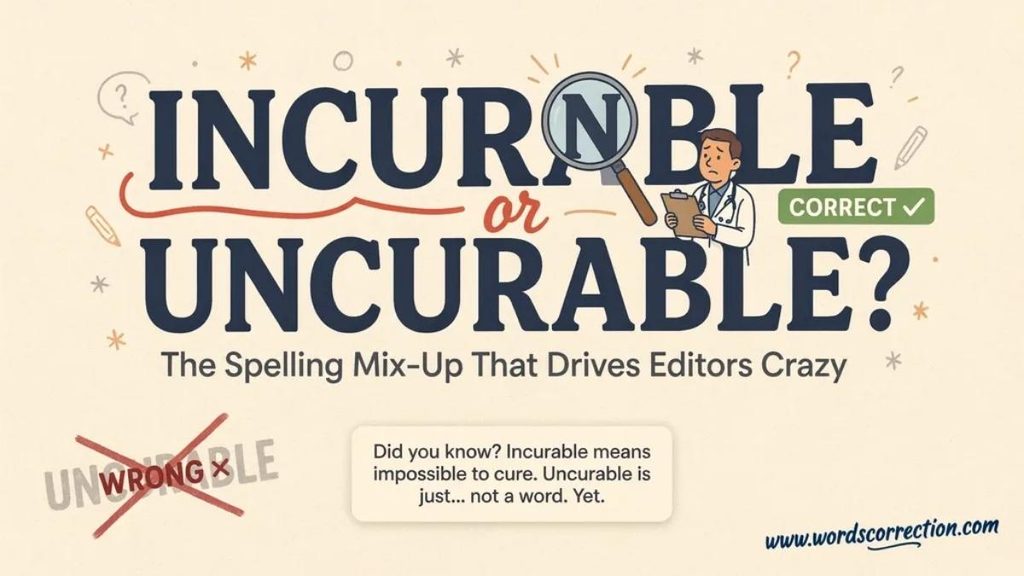
Incurable is the preferred and established spelling in modern English.
It describes something that cannot be cured, healed, or remedied, particularly a disease, illness, or medical condition.
Uncurable is also a documented English word. However, it is uncommon in contemporary writing and is often described by dictionaries as an archaic or obsolete form of incurable.
Correct Examples
- The doctors diagnosed him with an incurable disease.
- Researchers are working to improve treatment for incurable conditions.
- His optimism seemed incurable, even after repeated setbacks.
- The condition is currently considered incurable, although treatment can manage its symptoms.
Examples With Uncurable
- The historical text described the illness as uncurable.
- The writer used uncurable in an older passage.
- The word uncurable appears in historical English sources.
For most modern writing, incurable is the better choice.
What Does Incurable Mean?
Incurable Definition
Incurable is an adjective meaning unable to be cured or permanently remedied.
The word most commonly describes a disease, illness, or medical condition for which no cure currently exists.
For example:
The patient was diagnosed with an incurable condition.
Here, incurable means that the condition cannot currently be cured.
The word does not necessarily mean that nothing can be done. An incurable illness may still be treatable, manageable, or controllable. Treatment might reduce symptoms, slow progression, or improve a person’s quality of life.
That distinction matters.
Incurable as an Adjective
The word incurable functions primarily as an adjective.
It can describe:
- A disease
- An illness
- A medical condition
- A disorder
- A problem
- A habit
- A weakness
- A personality trait
- A situation that cannot be remedied
For example:
- She has an incurable illness.
- The disease was once considered incurable.
- He is an incurable optimist.
- She has an incurable love of books.
The last two examples use the word figuratively rather than medically.
Figurative Uses of Incurable
English often takes medical vocabulary and gives it a figurative life.
When incurable describes a person or behavior, it can mean something that seems impossible to change.
Consider:
- He is an incurable romantic.
- She is an incurable optimist.
- My brother is an incurable procrastinator.
- He has an incurable curiosity about history.
Nobody is suggesting that optimism requires a medical prescription. The word simply emphasizes that the characteristic is deeply rooted and unlikely to disappear.
Learn the difference between confusing more English words
Insight or Insite? What’s the Correct English Word?
Is Uncurable a Word?
Yes, uncurable is a word, but that does not make it equally common or preferred in modern English.
Historical and dictionary evidence shows that uncurable has existed for a long time. Older English writers used it in much the same way that modern writers use incurable.
However, modern English has largely settled on incurable as the standard form.
This creates an important distinction:
Uncurable is documented English, but incurable is the established modern choice.
So, if you’re wondering, “Is uncurable a correct English word?” the answer requires a little more nuance than a simple yes or no.
Why Uncurable Looks Grammatically Reasonable
The confusion makes perfect sense.
English commonly forms negative adjectives with un-:
- happy → unhappy
- clear → unclear
- known → unknown
- certain → uncertain
- fair → unfair
- necessary → unnecessary
Because curable means “able to be cured,” it seems logical to assume:
curable → uncurable
The logic is understandable. English, however, has never been famous for following its own neat little rules.
Many words have developed through historical patterns rather than simple modern word-building rules. Incurable is one of them.
Why Incurable Is the Established Form
Incurable comes from the Latin-based form incurabilis, meaning “not curable.”
It entered English through French and Latin influences, and the form became established in English long before modern spelling conventions developed.
As a result, English inherited incurable rather than creating the word from scratch as uncurable.
This is one reason you should not assume that every negative form must use un-.
Can Uncurable Appear in English?
Yes.
You may encounter uncurable in:
- Historical writing
- Older literature
- Archived texts
- Some dictionaries
- Rare modern usage
- Discussions of English vocabulary
Some usage references have also recognized incurable and uncurable as forms with the same basic meaning.
However, current dictionary treatment is not completely uniform. Some sources recognize uncurable as a variant, while others label it archaic or obsolete.
For contemporary general-purpose writing, incurable remains the safer and more familiar choice.
Learn the difference between commonly mixed-up more words
Chears or Cheers Difference, Meaning and Usage
Incurable vs Uncurable: What’s the Difference?
The basic meaning is very similar.
| Word | Meaning | Modern Usage | Recommended for General Writing |
| Incurable | Cannot be cured | Common and established | Yes |
| Uncurable | Cannot be cured | Rare or historical | Usually no |
The main difference is therefore usage and historical status, not meaning.
If you see uncurable, you can generally understand it as another form of incurable. The important point is that modern English overwhelmingly favors incurable for ordinary communication.
Incurable vs Uncurable Spelling
The spelling difference comes down to the prefix:
- In- + curable = incurable
- Un- + curable = uncurable
Both forms make semantic sense. Only one has become firmly established in contemporary standard usage.
Think of it as two roads leading to the same destination. English simply paved one road much more thoroughly.
The Origin and Etymology of Incurable
Understanding the history of a word often makes its spelling easier to remember.
Latin Roots
Incurable traces back to Latin.
The Latin word incurabilis meant “not curable.” It combined:
- in- meaning “not”
- curabilis meaning “curable”
The root ultimately connects with the Latin verb curare, meaning “to care for” or “to treat.”
From this same family, English developed words such as:
- cure
- curable
- incurable
- treatment
- medical terminology related to curing and care
How Incurable Entered English
The word appeared in English during the Middle English period, influenced by Old French and Latin.
Its meaning has remained remarkably stable: something that cannot be cured or remedied.
Over time, incurable became the dominant form, while uncurable gradually became much less common.
Why “Un-” Didn’t Replace “In-”
This is where English word formation gets interesting.
The prefixes in- and un- can both express negation, but they do not function as interchangeable building blocks for every word.
The choice often depends on:
- Word origin
- Historical development
- Established usage
- Conventional spelling
- Whether the root is native or borrowed
Because curable ultimately has Latin roots, incurable fits the historical pattern that English inherited.
That does not mean uncurable is impossible. It simply explains why incurable became the dominant form.
Learn the difference between tricky grammar more words
Employees or Employee’s: Which One Is Correct?
Incurable vs Uncurable: Grammar and Word Formation
The Prefix In- in Incurable
In incurable, the prefix in- means “not.”
You can see a similar pattern in several English words:
- accurate → inaccurate
- complete → incomplete
- visible → invisible
- possible → impossible
- reversible → irreversible
- curable → incurable
The spelling of the prefix can sometimes change depending on the following sound, as seen in forms such as im-, il-, and ir-.
The Prefix Un- and Why It Causes Confusion
Un- is an extremely productive English prefix.
That productivity makes uncurable look perfectly natural.
For example:
curable
↓
uncurable
The formation seems logical. However, word formation is not mathematics. You cannot always attach a negative prefix to a word and expect the result to become the preferred dictionary form.
English contains many words whose accepted forms depend on history rather than pure logic.
Don’t Build Every Negative Word With Un-
This is an important lesson for English learners.
You wouldn’t normally say:
- unpossible instead of impossible
- unvisible instead of invisible
- unaccurate instead of inaccurate
- uncomplete instead of incomplete
The same principle helps explain incurable.
When a word already has an established negative form, creating a new version with un- may produce a form that is understandable but unusual, historical, or nonstandard in contemporary usage.
Learn the difference between confusing word pairs
Honoured or Honored Meaning, Spelling and Usage
Incurable in a Sentence: Examples and Usage

Seeing the word in context makes its meaning much easier to understand.
Medical and Health-Related Examples
- The disease is currently considered incurable.
- Doctors are developing new treatments for incurable illnesses.
- An incurable condition may still be manageable with appropriate treatment.
- The patient received treatment to control the symptoms of the incurable disease.
- Researchers continue to study diseases once believed to be incurable.
Notice the wording in these examples. Incurable does not automatically mean untreatable.
A condition can lack a cure while still responding to treatment.
Learn the difference between similar English words the easy way
Unvoluntary or Involuntary Which One Is Correct?
Everyday and Figurative Examples
The word also works outside medicine.
- She is an incurable optimist.
- He has an incurable passion for music.
- My friend is an incurable dreamer.
- His curiosity seems incurable.
- She has an incurable habit of checking her phone every five minutes.
These uses are usually playful or expressive rather than medical.
Formal and Academic Examples
In formal writing, incurable often appears in discussions of medicine, biology, public health, and medical research.
Examples include:
- Researchers are investigating new approaches to previously incurable diseases.
- The condition was historically regarded as incurable.
- Advances in treatment have changed the management of several diseases once considered incurable.
In professional writing, use the word carefully. Medical terminology should distinguish between incurable, untreatable, chronic, and terminal conditions.
They do not always mean the same thing.
Common Collocations With Incurable
Some combinations sound especially natural in English:
- incurable disease
- incurable illness
- incurable condition
- incurable cancer
- incurable disorder
- incurable infection
- incurable disease
- incurable optimist
- incurable romantic
- incurable dreamer
These common combinations can help you remember the word naturally rather than memorizing its spelling in isolation.
Learn the difference between often confused words
Boxes or Boxs Correct Spelling and Usage
Common Mistakes With Incurable and Uncurable
Mistake 1: Assuming “Uncurable” Must Be Correct
The reasoning seems simple:
curable = able to be cured
uncurable = unable to be cured
The meaning works. The problem is that established English usage favors incurable.
Mistake 2: Treating Incurable and Uncurable as Equal Standard Spellings
Although both forms have historical and dictionary evidence behind them, they do not have the same status in contemporary usage.
Incurable is widely recognized and routinely used.
Uncurable is much less common and may be labeled archaic or obsolete.
Therefore, treating the two forms as equally common modern spellings can mislead readers.
Mistake 3: Changing Incurable to Uncurable in Informal Writing
Even in casual writing, incurable is usually the natural choice.
You might write:
He’s an incurable optimist.
You would rarely need to replace it with:
He’s an uncurable optimist.
The second version is understandable, but it sounds unusual to many modern readers.
Mistake 4: Confusing Incurable With Untreatable
These words are related, but they are not identical.
Incurable means there is no known cure or the condition cannot be cured.
Untreatable generally means that effective treatment is unavailable, ineffective, or impossible.
An incurable condition may still have treatments that manage symptoms or slow progression.
Mistake 5: Confusing Incurable With Terminal
Incurable does not automatically mean terminal.
A terminal condition is expected to result in death, usually within a limited period, although the exact meaning can vary by medical context.
An incurable condition may continue for many years without being immediately life-threatening.
That distinction is particularly important in medical communication.
Learn the difference between basic English word mistakes
Trialled or Trialed Meaning, Difference and Usage
Incurable vs Related Words
Incurable vs Curable
These words are direct opposites.
Curable means capable of being cured.
Incurable means incapable of being cured.
Example:
- The infection is curable with appropriate treatment.
- The disease is currently considered incurable.
Incurable vs Untreatable
These terms should not be treated as synonyms.
A disease can be incurable but treatable.
For example, treatment may control symptoms even when it cannot eliminate the underlying condition.
Incurable vs Chronic
Chronic refers primarily to duration or persistence.
A chronic condition may last a long time, but that does not automatically mean it is incurable.
Some chronic conditions can be treated effectively or even resolved.
Incurable vs Terminal
Terminal refers to a condition expected to lead to death.
Incurable focuses on whether the condition can be cured.
A condition can therefore be incurable without being terminal.
Incurable vs Irremediable
Irremediable means impossible to correct, repair, or remedy.
It has a broader meaning than incurable.
For example:
- an incurable disease
- an irremediable mistake
The first concerns a lack of cure. The second concerns something that cannot be corrected.
Learn the difference between commonly misused words
Grayscale or Greyscale Which Is Correct?
Incurable or Uncurable: Which Spelling Should You Use

In American English
For contemporary American English, incurable is the practical choice.
It is familiar, established, and immediately understood.
In British English
Incurable is also widely established in British English.
You may encounter uncurable in historical or unusual contexts, but it is not the normal choice for contemporary general writing.
In Formal and Professional Writing
Use incurable.
This is especially important in:
- Academic papers
- Medical documents
- Business writing
- Reports
- Educational material
- Professional correspondence
- Published content
When clarity matters, there is little reason to choose the less familiar form.
In Everyday Communication
Again, incurable is the natural choice.
Whether you’re talking about an illness or describing someone as an incurable optimist, the established spelling will sound more natural to most readers.
Learn the difference between everyday English mistakes
Months or Monthes Which Spelling Is Correct?
How to Remember the Correct Spelling
A simple memory trick can help.
Remember:
Cure → Curable → Incurable
Think of incurable as the established family member of cure and curable.
You can also remember the phrase:
“No cure? Incurable.”
When you mean something that cannot be cured, your first choice should be incurable.
Another useful strategy is to memorize a familiar phrase such as:
incurable disease
Once that combination becomes familiar, the spelling becomes much easier to recall.
Learn the difference between more words people mix up
Bosses or Boss’s Which Is Correct? Meaning and Usage
Uncurable Definition and Historical Usage
The uncurable definition is essentially the same as incurable: something that cannot be cured.
Historically, however, the word had a much stronger presence than it does today.
Older English sources contain examples of uncurable, including works from the Middle English and Early Modern English periods.
Historical dictionaries record the word as an older equivalent of incurable.
Older dictionary sources also demonstrate the gradual shift in preference. One nineteenth-century dictionary, for example, defined uncurable as “incurable” and noted that the latter form was mostly used.
This history explains why calling uncurable simply “nonsense” would be inaccurate.
It has a real history in English.
The issue is modern usage.
Is Uncurable an Archaic Word?
In many modern dictionary sources, uncurable is treated as archaic or obsolete.
Historical English evidence confirms that the word was used more regularly in earlier periods.
Some usage references have been more permissive and have treated incurable and uncurable as acceptable forms with no significant difference in meaning.
So the most accurate explanation is:
Uncurable is a genuine historical English word that survives in rare usage, but incurable is the established form for contemporary general English.
That distinction avoids two common errors: pretending uncurable never existed, or pretending that both forms are equally common today.
Synonyms for Incurable
Depending on context, possible synonyms or near-synonyms include:
- untreatable
- irremediable
- permanent
- chronic
- hopeless to cure
- impossible to cure
- beyond cure
However, these words are not always interchangeable.
For example, chronic refers to persistence, while incurable refers specifically to the absence of a cure.
Likewise, terminal carries a very different medical implication.
Choose the synonym according to the exact meaning you need.
Learn the difference between tricky words and use them correctly
Personalise or Personalize Difference,Meaning and Usage
Pronunciation of Incurable
The pronunciation of incurable can be remembered roughly as:
in-KYOOR-uh-bul
The stress falls on the second syllable.
Breaking the word into parts can make it easier to say:
in + cure + able
The pronunciation may vary slightly between American and British English, but the word remains easily recognizable in both varieties.
practice sessions
Fill in the Blanks
- The doctor explained that the disease was __________ and could not be completely cured.
- __________ is the standard spelling used in modern English.
- Although __________ appears in some dictionaries, it is rarely used today.
- The opposite of incurable is __________.
- An incurable condition may still be managed through __________.
- The word incurable is an __________.
- The noun form of incurable is __________.
- A condition that cannot be cured is often described as __________.
- In formal writing, __________ is generally preferred over uncurable.
- The word incurable is commonly used in both British and __________ English.
- An incurable disease cannot be completely __________.
- The term __________ is considered rare or archaic in contemporary English.
- Curable means capable of being successfully __________.
- Incurable can describe medical conditions, habits, or __________.
- The pronunciation of incurable begins with the sound __________.
- A disease without an available cure may be described as __________.
- The word incurability refers to the state of being impossible to __________.
- In modern English usage, incurable is more __________ than uncurable.
- An incurable condition may still have effective __________ options.
- Both incurable and uncurable refer to something that cannot be __________.
- The word incurable functions as an __________ in a sentence.
- A habit that cannot easily be changed may be called an __________ habit.
- __________ is the preferred term in medical and professional writing.
- The word uncurable is technically valid but is considered __________ in modern usage.
- Understanding the difference between incurable and uncurable improves English word __________.
Answers
- Incurable
- Incurable
- Uncurable
- Curable
- Treatment
- Adjective
- Incurability
- Incurable
- Incurable
- American
- Cured
- Uncurable
- Cured
- Situations
- In
- Incurable
- Cure
- Common
- Treatment
- Cured
- Adjective
- Incurable
- Incurable
- Rare
- Choice
Here’s a trusted source for clear more words Comparison:
Grammar Update
Frequently Asked Questions About Incurable or Uncurable
What is the correct word: incurable or uncurable?
Incurable is the standard and most widely accepted word in modern English. Although uncurable appears in some dictionaries, it is rarely used today. In most formal and everyday contexts, incurable is the preferred choice.
Is “uncurable” a valid English word?
Yes, uncurable is a valid English word found in certain dictionaries. However, it is uncommon in contemporary English and is generally considered less natural than incurable.
What is the difference between incurable and uncurable?
Both incurable and uncurable refer to something that cannot be cured or remedied. The main distinction lies in their usage: incurable is the conventional and commonly used term, whereas uncurable is an uncommon or archaic alternative.
Which spelling should be used in formal writing?
Incurable should be used in formal, academic, professional, and everyday writing. It is the established spelling recognized and preferred in modern English.
Does incurable mean the same as untreatable?
No, the two words have slightly different meanings. Incurable means that a condition cannot be completely cured, whereas untreatable means that no effective treatment is currently available. An incurable condition may still be managed through treatment.
What is the opposite of incurable?
The opposite of incurable is curable, which means capable of being successfully treated or healed.
Is incurable used exclusively for medical conditions?
No. While incurable is frequently used in medical contexts, it can also describe habits, behaviors, or situations that cannot be corrected, changed, or eliminated.
Can incurable be used to describe a person?
Yes, but it is generally used to describe a person’s condition, characteristic, or behavior rather than the individual directly. For example, “She is an incurable optimist” describes someone whose optimism cannot be diminished.
What are some common synonyms for incurable?
Depending on the context, common synonyms include untreatable, irremediable, chronic, permanent, unmanageable, and hopeless.
What does incurable mean in simple English?
Incurable means impossible to cure, heal, or completely remedy.
How is incurable pronounced?
The word incurable is commonly pronounced as in-KYUR-uh-bul.
Is incurable a noun, verb, or adjective?
Incurable is an adjective. It describes something that cannot be cured, healed, or corrected.
What is the noun form of incurable?
The noun form is incurability, which refers to the state or quality of being impossible to cure.
What is the adjective form related to cure?
The adjective curable means capable of being cured or successfully treated.
Is incurable used in both British and American English?
Yes. Incurable is widely recognized and commonly used in both British and American English.
Why is incurable preferred over uncurable?
Incurable has become the established form through widespread usage in modern English, dictionaries, and professional terminology. Although uncurable is technically valid, it is significantly less common.
Is uncurable considered an old-fashioned word?
In many modern contexts, uncurable is considered rare, archaic, or outdated. Contemporary writers generally prefer incurable.
Can incurable and uncurable be used interchangeably?
Both words convey a similar general meaning, but they are not equally common or natural in modern English. For clarity and standard usage, incurable is the recommended choice.
What does incurable mean outside a medical context?
Outside medicine, incurable can describe something that cannot be changed, corrected, or eliminated. For example, an “incurable habit” refers to a habit that is extremely difficult or impossible to overcome.
Is incurable considered a negative word?
The word itself is descriptive rather than inherently positive or negative. Its emotional impact depends on the context, particularly when it is used to describe serious or life-altering medical conditions.
Conclusion: Incurable or Uncurable?
The choice between incurable or uncurable may seem like a minor spelling question, but English has a talent for making simple rules surprisingly complicated. Although uncurable has a genuine history in the language and may still appear in rare or historical contexts, incurable is the established form in contemporary English. It describes something that cannot be cured, healed, or permanently remedied.
The confusion is understandable. Since curable means capable of being cured, adding un- to form uncurable seems perfectly logical. However, English word formation does not always follow such predictable patterns. For modern writing, incurable is the clearer and more familiar choice, helping you communicate accurately and confidently.

Stella AJS is an experienced blogger and dedicated English language writer at Words Correction. She turns confusing grammar, word meanings, spelling, and usage into clear, practical insights that readers can easily understand and apply. With a passion for precise and engaging writing, Stella helps readers avoid common language mistakes, strengthen their vocabulary, and communicate with greater clarity and confidence.




