
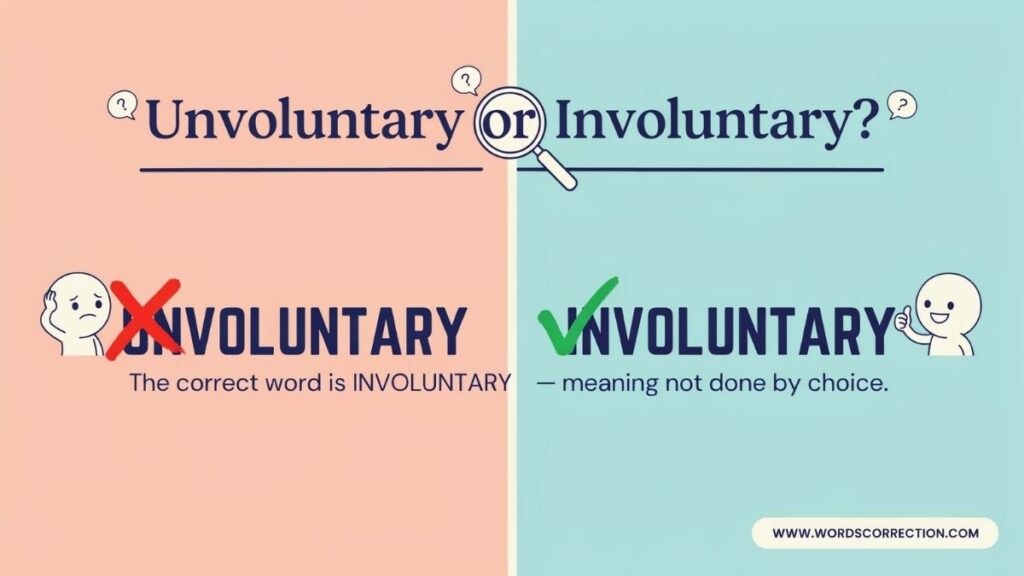
English spelling can be surprisingly tricky, especially when a word seems to follow a perfectly logical pattern. The confusion surrounding unvoluntary or involuntary is a good example. At first glance, “unvoluntary” appears natural because English often uses “un-” to form opposites, as in unhappy and unwilling. Yet English has its own vocabulary rules, and logic doesn’t always get the final vote. The standard word is involuntary, which describes something done without deliberate choice, conscious intention, or voluntary control. In this article, you’ll learn why involuntary is preferred, whether unvoluntary is correct, and how to use the right form confidently in everyday and formal writing.
Unvoluntary or Involuntary Quick Answer
The correct standard spelling is involuntary.
Involuntary describes something that happens without deliberate choice, conscious intention, or voluntary control. It can refer to physical movements, emotional reactions, reflexes, biological processes, and other actions that occur automatically or without conscious direction.
Unvoluntary, although understandable, is not the standard modern form for this meaning.
| Word | Standard modern usage | Meaning | Example |
| Voluntary | Yes | Done by choice or free will | She made a voluntary decision. |
| Involuntary | Yes | Not deliberately chosen or controlled | He made an involuntary movement. |
| Involuntarily | Yes | Without deliberate intention | She laughed involuntarily. |
| Unvoluntary | Generally not standard | Intended to mean “not voluntary” | Avoid in normal modern writing. |
If you’re wondering which is correct, unvoluntary or involuntary, use involuntary.
Unvoluntary or Involuntary Examples
Here are some quick examples:
- The loud noise caused an involuntary reaction.
- She made an involuntary movement when the doctor touched her knee.
- He gave an involuntary gasp when the glass fell.
- Blinking is generally an involuntary action.
- She laughed involuntarily at the unexpected joke.
The pattern is consistent: when something happens without deliberate control, involuntary usually fits.
Learn the difference between more words people mix up
Doggie or Doggy Which Spelling Is Correct?
Involuntary Meaning
The basic involuntary meaning is “not done by deliberate choice or conscious control.”
When you act voluntarily, you make a conscious decision to do something. When an action is involuntary, it happens without that deliberate decision.
For example, choosing to wave at someone is voluntary. Blinking when something suddenly approaches your eye is generally involuntary.
The word can describe both ordinary human behavior and biological processes.
You might talk about:
- an involuntary movement
- an involuntary reaction
- an involuntary response
- an involuntary action
- an involuntary reflex
- an involuntary muscle contraction
- an involuntary gasp
- an involuntary laugh
The central idea remains the same: the person does not deliberately choose the action at the moment it occurs.
Involuntary Definition
A clear involuntary definition is:
Involuntary means occurring without deliberate choice, conscious intention, or voluntary control.
Consider this example:
The sudden noise caused an involuntary reaction
The person didn’t plan the reaction. It happened naturally in response to the unexpected sound.
However, involuntary doesn’t always mean completely unconscious. A person may notice an action while still having little or no control over its occurrence.
That distinction matters. Conscious awareness and voluntary control aren’t always the same thing.
Learn the difference between everyday English mistakes
Insight or Insite? What’s the Correct English Word?
Unvoluntary Meaning
The phrase unvoluntary meaning usually points to the idea of something being “not voluntary” or “without choice.”
That interpretation is easy to understand. The problem lies in standard usage.
Modern English already has an established word for this concept: involuntary.
Therefore, although someone may understand unvoluntary, it isn’t normally the preferred form in contemporary standard English.
If you’re searching for unvoluntary meaning in English, the most useful translation is generally involuntary.
Unvoluntary Definition
A practical unvoluntary definition would be “not voluntary.” However, that doesn’t mean unvoluntary is the form you should use.
In modern standard English, write:
involuntary
rather than:
unvoluntary
This distinction is especially important in formal writing, where established vocabulary is preferable to a word that merely appears logically constructed.
Is Unvoluntary a Word?
The question is unvoluntary a word deserves a nuanced answer.
You may find unvoluntary in historical texts, unusual usage, or isolated modern examples. A word’s appearance somewhere doesn’t necessarily mean that it is the standard contemporary choice.
English contains many rare, archaic, historical, and nonstandard forms. Some appear in dictionaries because dictionaries document language rather than simply listing words recommended for everyday use.
For practical modern writing, the distinction is straightforward:
Use involuntary.
For example:
- Standard: The movement was involuntary.
- Not recommended: The movement was unvoluntary.
Is Unvoluntary a Correct Word?
If the question means, “Is unvoluntary the standard modern English word meaning ‘not voluntary’?” the answer is generally no.
The established adjective is involuntary.
That doesn’t mean every historical occurrence of unvoluntary is meaningless or impossible to interpret. It means that modern writers should not normally choose it when they need the standard English term.
Why Is Involuntary Used Instead of Unvoluntary?
The answer becomes clearer when you look at how English vocabulary develops.
English often creates opposites with prefixes such as un-, in-, dis-, and non-. Yet these prefixes aren’t interchangeable.
For example:
- happy → unhappy
- willing → unwilling
- regular → irregular
- responsible → irresponsible
- voluntary → involuntary
The final pair may look inconsistent if you expect English to follow a simple prefix formula. Language rarely works that neatly.
Involuntary became established as the conventional opposite of voluntary. Speakers and writers have used it for centuries, and its place in modern English is firmly established.
So the issue isn’t whether unvoluntary can be understood. It can. The issue is whether it is the conventional word.
It isn’t.
Learn the difference between commonly misused words
Employees or Employee’s: Which One Is Correct?
The Origin of Voluntary
To understand involuntary, it helps to start with voluntary.
Voluntary ultimately comes from Latin voluntarius, meaning willing or proceeding from one’s will. The word is connected with the Latin noun voluntas, meaning will or desire.
English acquired the word through French and developed its modern sense around actions performed willingly or by choice.
Today, voluntary can describe anything someone chooses to do freely.
For example:
- voluntary participation
- voluntary work
- voluntary agreement
- voluntary donation
- voluntary action
If you decide to volunteer at a community event, your participation is voluntary because you choose to take part.
Why Involuntary Exists
Involuntary developed as the established opposite of voluntary.
The prefix in- in this word expresses negation. Together, the word conveys the idea of something that does not arise from voluntary choice.
The relationship is therefore easy to remember:
Voluntary → Involuntary
This doesn’t mean that every action labeled involuntary happens in exactly the same way. A reflex, a muscle contraction, and an emotional reaction can have very different mechanisms.
What they share is the absence of deliberate voluntary control.
Why Unvoluntary Sounds Right but Isn’t Standard
There is a perfectly understandable reason people write unvoluntary.
The prefix un- often means “not,” so the construction seems logical:
un- + voluntary = not voluntary
The meaning is immediately obvious.
English vocabulary, however, isn’t built entirely through logical word formation. Historical usage determines which forms become established.
That’s why a word can look grammatically possible but still sound unusual to experienced speakers and editors.
Think of it this way: unvoluntary is a plausible-looking shortcut, while involuntary is the established road.
When two forms appear to express the same idea, the established form is the safer choice.
Involuntary vs Unvoluntary: What’s the Difference?
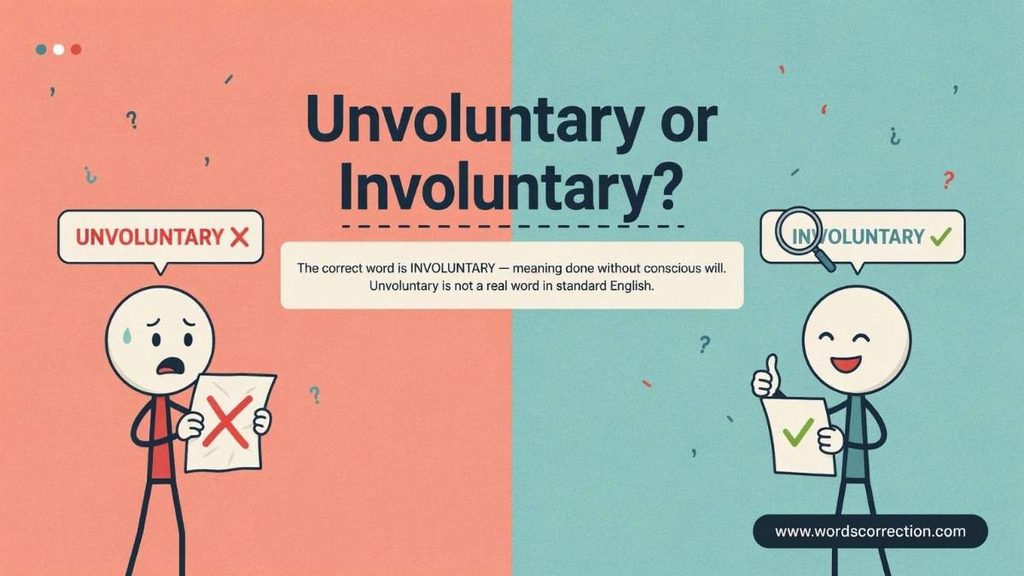
The most important difference in involuntary vs unvoluntary is their status in modern standard English.
Involuntary is established, common, and widely accepted.
Unvoluntary is rare and generally not recommended as the modern equivalent.
| Feature | Involuntary | Unvoluntary |
| Standard modern English | Yes | Generally no |
| Means “not voluntary” | Yes | Intended meaning |
| Common in formal writing | Yes | No |
| Common in everyday English | Yes | Rare |
| Used in medical terminology | Yes | No |
| Recommended for professional writing | Yes | No |
So, when comparing unvoluntary vs involuntary, there isn’t a useful modern distinction in meaning to preserve. In most cases, involuntary is simply the word you want.
What Is the Difference Between Unvoluntary and Involuntary?
If you’re asking what is the difference between unvoluntary and involuntary, focus on standard usage rather than trying to create two separate meanings.
Both forms may be understood as referring to something that isn’t voluntary. However, involuntary is the established modern English term.
For example:
The patient experienced an involuntary muscle movement.
This sentence uses standard terminology.
Writing:
The patient experienced an unvoluntary muscle movement.
may be understandable, but it sounds nonstandard and should normally be replaced with involuntary.
Learn the difference between basic English word mistakes
Chears or Cheers Difference, Meaning and Usage
Involuntary Spelling vs Unvoluntary Spelling
The correct involuntary spelling is:
involuntary
It contains the established in- prefix:
in + voluntary = involuntary
The commonly mistaken form is:
unvoluntary
A useful memory trick is to memorize the pair rather than trying to reconstruct the word every time:
voluntary ↔ involuntary
Once that pair becomes familiar, the spelling becomes much easier.
Voluntary vs Involuntary Meaning
The difference between voluntary and involuntary comes down largely to choice and control.
| Voluntary | Involuntary |
| Deliberately chosen | Not deliberately chosen |
| Usually under conscious control | Often outside conscious control |
| Done willingly | Not necessarily done willingly |
| Requires an intentional decision | May happen automatically |
| Example: raising your hand | Example: blinking |
Imagine that a teacher asks a student to raise a hand.
The student decides to raise it. That’s a voluntary action.
Now imagine that a doctor taps the knee with a reflex hammer and the lower leg moves automatically. That’s an involuntary reflex.
The contrast is clear: one action follows a conscious decision, while the other occurs automatically.
Involuntary Synonym and Related Words
If you need an involuntary synonym, choose one that matches the exact context.
Useful alternatives include:
- automatic
- unintentional
- unintended
- unconscious
- instinctive
- reflexive
- accidental
- unplanned
These words overlap with involuntary, but they aren’t interchangeable in every sentence.
For example, accidental emphasizes that something happened by chance. Automatic emphasizes that something occurs without conscious direction. Unintentional focuses on the absence of intent.
Meanwhile, unwilling describes a person who doesn’t want to do something. That isn’t necessarily the same as being involuntary.
Unvoluntary or Involuntary Synonym
If you’re searching for an unvoluntary or involuntary synonym, involuntary itself is usually the best replacement for the nonstandard form unvoluntary.
Depending on the context, you could also use:
- automatic
- unintentional
- unintended
- instinctive
- reflexive
- unconscious
Always consider the precise meaning before choosing a synonym.
Learn the difference between often confused words
Honoured or Honored Meaning, Spelling and Usage
Involuntary Action Meaning
An involuntary action is an action that occurs without deliberate conscious control.
Common examples include:
- blinking
- sneezing
- coughing
- certain reflexes
- some muscle contractions
- certain automatic bodily processes
For example:
The bright flash caused an involuntary blink.
The person didn’t consciously decide to blink at that exact moment.
The phrase involuntary action meaning therefore centers on an action that occurs without deliberate control.
Involuntary Response Meaning
An involuntary response is a reaction that occurs automatically or without deliberate intention.
For example:
His eyes widened in an involuntary response to the sudden noise.
The reaction happened immediately. He didn’t first make a conscious decision to widen his eyes.
The phrase can apply to physical and emotional responses, although the exact meaning depends on context.
Involuntary Reaction Meaning
The involuntary reaction meaning is closely related to an automatic or unplanned response.
Suppose someone suddenly drops a heavy object nearby. You might jump or gasp before consciously processing what happened.
That immediate response can be described as an involuntary reaction.
Other examples include:
- flinching at a sudden sound
- blinking at a bright flash
- pulling away from something hot
- gasping after an unexpected shock
- laughing at an unexpectedly funny moment
These reactions can occur quickly and without deliberate planning.
Learn the difference between confusing word pairs
Boxes or Boxs Correct Spelling and Usage
Involuntary Behavior Meaning
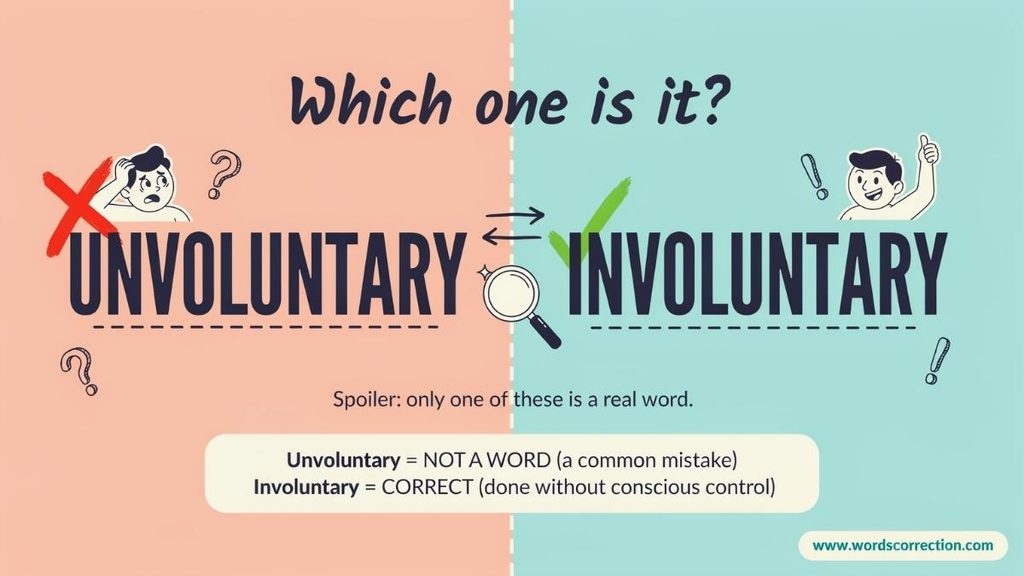
it refers to behavior that occurs without deliberate conscious control.
For example:
His involuntary smile revealed his surprise.
The person didn’t intentionally decide to smile. The expression appeared naturally in response to the situation.
However, involuntary behavior doesn’t always mean that the person has absolutely no awareness of what they’re doing. Awareness, intention, and control are separate concepts.
That distinction is especially useful in psychology, medicine, law, and other fields where precise wording matters.
Involuntary Movement Meaning
An involuntary movement is a movement that occurs without intentional control.
A minor muscle twitch provides a familiar example. So does a sudden movement caused by a reflex.
Examples include:
- muscle twitches
- certain tremors
- reflex movements
- muscle spasms
- sudden jerks
- other uncontrolled movements
The phrase involuntary movement appears frequently in medical and biological contexts.
Involuntary Muscle Movement
An involuntary muscle movement occurs when a muscle moves without a person’s deliberate command.
A brief twitch is a common example.
An involuntary movement can be harmless in ordinary circumstances, but persistent or significant movements can have many different causes. Medical terminology should therefore describe the movement rather than assume a diagnosis.
Involuntary Muscle Contractions
Muscles can contract without conscious direction. In fact, many essential body processes depend on automatic muscle activity.
The heart provides an obvious example. You don’t normally decide when each heartbeat should occur.
Smooth muscles also perform many functions without conscious control.
This is why phrases such as involuntary muscle contractions and involuntary muscles appear frequently in anatomy and biology.
Involuntary Reflex and Reflex Action
A reflex action is a rapid response to a stimulus that can occur without conscious decision-making.
Consider touching a hot surface. Your body can trigger a rapid withdrawal response before you have consciously thought through the action.
This is a classic example of an involuntary reflex.
Common examples include:
- withdrawing a hand from a painful stimulus
- blinking when an object approaches the eye
- certain knee-jerk reflexes
- rapid responses to unexpected stimuli
Not every automatic bodily process is technically a reflex. For example, the heartbeat is involuntary, but it isn’t simply the same kind of reflex as withdrawing your hand from a hot surface.
That distinction keeps the terminology accurate.
Learn the difference between tricky grammar more words
Trialled or Trialed Meaning, Difference and Usage
Examples of Involuntary Actions
The easiest way to understand involuntary is to see how it works in real situations.
Involuntary Blinking
Normal blinking generally occurs automatically, although you can deliberately blink when you choose.
Example:
She gave an involuntary blink when the bright light flashed.
Involuntary Breathing
Breathing involves both conscious and automatic control. You can deliberately alter your breathing for a time, but automatic systems continue regulating respiration.
Example:
Breathing normally continues without conscious attention.
Involuntary Sneezing
A sneeze can happen suddenly in response to irritation.
Example:
He sneezed involuntarily after breathing in dust.
Involuntary Coughing
Coughing can occur automatically when the airway becomes irritated.
Example:
She began coughing involuntarily after inhaling smoke.
Involuntary Gasp
A gasp can occur immediately after something unexpected happens.
Example:
He let out an involuntary gasp when the plate shattered.
Involuntary Laugh
Laughter isn’t always planned.
Example:
She gave an involuntary laugh when she heard the unexpected joke.
Involuntary Tears
Tears can arise from physical or emotional responses without deliberate intention.
Example:
The cold wind brought involuntary tears to his eyes.
Learn the difference between commonly mixed-up more words
Grayscale or Greyscale Which Is Correct?
Unvoluntary or Involuntary Examples
If you’re looking for unvoluntary or involuntary examples, the following comparison shows which form works in standard modern English.
| Less suitable | Preferred |
| He made an unvoluntary movement. | He made an involuntary movement. |
| She gave an unvoluntary response. | She gave an involuntary response. |
| It was an unvoluntary reaction. | It was an involuntary reaction. |
| His smile was unvoluntary. | His smile was involuntary. |
| The muscles showed unvoluntary contractions. | The muscles showed involuntary contractions. |
The preferred versions use the established English form.
Unvoluntary or Involuntary in a Sentence
If you’re wondering how to use involuntary in a sentence, consider these examples:
- The sudden noise caused an involuntary reaction.
- She made an involuntary movement when she heard the crash.
- His involuntary smile revealed his surprise.
- Blinking is usually an involuntary action.
- The patient experienced involuntary muscle contractions.
- He involuntarily stepped backward when the dog barked.
- The child gave an involuntary gasp.
- Her eyes filled with involuntary tears.
These examples demonstrate how naturally involuntary fits with nouns such as action, reaction, response, movement, and reflex.
Learn the difference between confusing more English words
Months or Monthes Which Spelling Is Correct?
Involuntarily Meaning
Involuntarily is the adverb formed from involuntary.
The involuntarily meaning is “without deliberate intention or conscious control.”
Compare the following:
- Involuntary: The movement was involuntary.
- Involuntarily: He moved involuntarily.
- Involuntariness: The involuntariness of the action became important.
The adjective describes a noun, while the adverb describes how an action occurs.
How to Use Involuntarily in a Sentence
Use involuntarily when you want to explain that someone performed an action without deliberately choosing to do so.
Examples:
- She involuntarily stepped backward.
- He involuntarily laughed at the awkward moment.
- Her hand involuntarily tightened around the handle.
- He involuntarily closed his eyes when the light flashed.
Compare:
His reaction was involuntary.
Here, involuntary modifies reaction.
He reacted involuntarily.
Here, involuntarily modifies reacted.
Common Mistakes With Involuntary and Unvoluntary
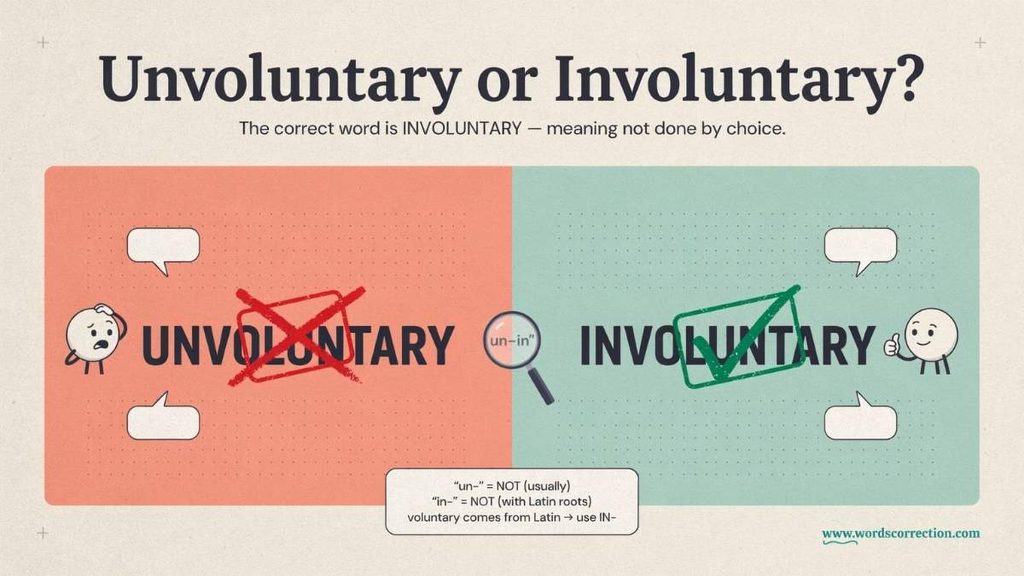
A few recurring mistakes make this spelling question more confusing than it needs to be.
Mistake: Assuming Un- Always Creates the Correct Opposite
English doesn’t use un- for every negative or opposite form.
The fact that un- works with happy doesn’t mean it will work with every adjective.
Mistake: Treating Unvoluntary as a British Spelling
Unvoluntary isn’t simply the British spelling of involuntary.
American English and British English both use involuntary as the standard form.
Mistake: Confusing Involuntary With Unwilling
These words can overlap in some situations, but they aren’t identical.
Unwilling means a person doesn’t want to do something.
Involuntary means something happens without voluntary control or deliberate choice.
For example:
She was unwilling to attend the meeting.
She made an involuntary movement.
The movement happened without deliberate control.
The distinction is subtle but important.
Mistake: Assuming Involuntary Always Means Unconscious
Something can be involuntary without the person being completely unconscious.
A person might notice a muscle twitch, recognize a facial reaction, or become aware of a reflex after it occurs.
The central idea is lack of deliberate control, not necessarily lack of awareness.
Learn the difference between tricky words and use them correctly
Bosses or Boss’s Which Is Correct? Meaning and Usage
British English vs American English Spelling
Unlike spelling pairs such as color/colour or center/centre, involuntary generally has the same spelling in American and British English.
| English variety | Standard spelling |
| American English | involuntary |
| British English | involuntary |
| Canadian English | involuntary |
| Australian English | involuntary |
| International English | involuntary |
Therefore, the answer to British English unvoluntary vs involuntary is the same practical answer as the answer for American English.
Use involuntary.
Is Unvoluntary Obsolete?
The question is unvoluntary obsolete requires some historical context.
The form has appeared in older or unusual English usage. However, historical appearances shouldn’t be confused with current standard usage.
Languages change. Words disappear, meanings shift, and alternative forms become less common over time.
Therefore, if you encounter unvoluntary in an older text, its presence doesn’t mean that modern writers should use it instead of involuntary.
Is Unvoluntary an Obsolete Word?
It is more useful to describe unvoluntary as rare or nonstandard in contemporary usage than to treat every historical occurrence as evidence of a single fixed status.
For modern writing, the important rule remains:
Use involuntary.
What Is the Opposite of Voluntary?
The opposite of voluntary is involuntary.
The two words form a clear contrast:
Voluntary: done by choice.
Involuntary: not deliberately chosen or controlled.
You can also describe the contrast with phrases such as:
- without choice
- without conscious control
- without deliberate intention
- without conscious intention
- automatically
- unintentionally
- not under conscious control
However, involuntary is the established antonym.
Antonym of Voluntary
If you’re looking for the antonym of voluntary, the standard answer is involuntary.
Examples include:
- voluntary action → involuntary action
- voluntary movement → involuntary movement
- voluntary response → involuntary response
- voluntary participation → involuntary participation
Context still matters. For instance, forced emphasizes external pressure, while involuntary emphasizes the absence of voluntary control.
What Is Another Word for Involuntary?
If you’re wondering what is another word for involuntary, several options may work depending on the context.
Possible alternatives
- automatic
- unintentional
- unintended
- unconscious
- instinctive
- reflexive
- accidental
- unplanned
No synonym is perfect in every sentence.
For example, an automatic response happens without conscious direction. An accidental action happens unintentionally or by chance. An unintentional action wasn’t meant to happen.
Those distinctions may seem small, but they can change the meaning of a sentence.
What Is Another Word for Unvoluntary?
Because unvoluntary isn’t the standard modern form, the simplest replacement is usually involuntary.
Depending on what you mean, you might also use:
- automatic
- unintentional
- unintended
- unconscious
- instinctive
- reflexive
If the intended meaning is specifically that someone didn’t want to do something, unwilling may be more accurate.
For example:
He was unwilling to participate.
This means he didn’t want to participate.
It doesn’t necessarily mean that participation occurred without conscious control.
Learn the difference between tricky words and use them correctly
Personalise or Personalize Difference,Meaning and Usage
Involuntary vs Voluntary Examples
Putting the two words side by side makes their relationship easier to remember.
| Situation | Description |
| Choosing to raise your hand | Voluntary |
| Blinking automatically | Involuntary |
| Choosing to write a message | Voluntary |
| Sneezing unexpectedly | Involuntary |
| Choosing to smile for a photograph | Voluntary |
| Gasping after a sudden surprise | Involuntary |
| Choosing to walk across a room | Voluntary |
| Pulling away from a painful stimulus | Involuntary |
| Deliberately waving to someone | Voluntary |
| Reacting instantly to a startling sound | Involuntary |
Some real-life actions involve both conscious and automatic elements. The distinction isn’t always a perfect two-column system.
A Simple Memory Trick
If unvoluntary keeps appearing in your writing, memorize this pair:
Voluntary → Involuntary
Think of them as a matched set.
You can then add the related forms:
Voluntary → Involuntary → Involuntarily
This approach works better than trying to decide which prefix sounds logical each time you write the word.
Which Spelling Should You Use?
For modern standard English, use involuntary.
For US English
Use involuntary in:
- school assignments
- professional documents
- emails
- websites
- reports
- academic writing
- everyday communication
For British English
Use involuntary as well.
There is no standard British spelling that changes the word to unvoluntary.
For Formal Writing
The safest choice is especially clear:
Use involuntary.
A formal reader expects the established vocabulary. Choosing unvoluntary can distract from your meaning even when the intended message remains understandable.
Practice Session: Fill in the Blanks
Choose the correct word to complete each sentence.
- Blinking is an __________ response that usually happens without conscious thought.
- She __________ pulled her hand away after touching the hot surface.
- The doctor explained that the muscle movement was __________.
- He __________ laughed when he heard the unexpected comment.
- Taking part in the activity was completely __________.
- Sneezing is generally considered an __________ action.
- She __________ smiled when she saw the surprise.
- The patient experienced several __________ muscle contractions.
- He made an __________ movement when he heard the loud noise.
- The decision to participate was __________, not forced.
- She __________ revealed the information during the conversation.
- His sudden gasp was an __________ reaction.
- The child __________ stepped backward after seeing the large dog.
- The term involuntary is commonly used as the opposite of __________.
- He __________ nodded before realizing what he had done.
- The movement occurred __________ and was not deliberately controlled.
- Breathing can involve both conscious and __________ processes.
- She __________ flinched when the door suddenly slammed.
- The witness said the gesture was __________ rather than intentional.
- The patient reported an __________ twitch in his eyelid.
- He __________ said the wrong name during the introduction.
- The action was __________ because nobody forced her to participate.
- In modern English, involuntary is preferred over the uncommon form __________.
- The reflex caused an __________ movement of the leg.
- He __________ reacted before he had time to think about the situation.
Answers
- involuntary
- involuntarily
- involuntary
- involuntarily
- voluntary
- involuntary
- involuntarily
- involuntary
- involuntary
- voluntary
- involuntarily
- involuntary
- involuntarily
- voluntary
- involuntarily
- involuntarily
- involuntary
- involuntarily
- involuntary
- involuntary
- involuntarily
- voluntary
- unvoluntary
- involuntary
- involuntarily
Here’s a trusted source for clear more words Comparison:
Grammar Update
Frequently Asked Questions
Is it “involuntary” or “involuntarily”?
Involuntary is an adjective used to describe a noun, while involuntarily is an adverb used to describe an action. For example, “She made an involuntary movement” and “She moved involuntarily” are both correct.
What does “involuntary” mean?
Involuntary means happening without conscious intention, choice, or control. Blinking, sneezing, and certain reflexes are common examples of involuntary actions.
What does “involuntarily” mean?
Involuntarily means doing something without intending to do it or without conscious control. For example, “He involuntarily stepped back when he heard the sound.”
What is the difference between “involuntary” and “unvoluntary”?
Involuntary is the standard and widely accepted word in modern English. Unvoluntary is obsolete or extremely uncommon in contemporary usage. In most writing and speech, use involuntary to describe something that happens without conscious choice or control.
What is another word for “involuntary”?
Depending on the context, synonyms for involuntary include unintentional, automatic, unconscious, instinctive, spontaneous, and unwilling. The most suitable synonym depends on the intended meaning.
What is another word for “involuntarily”?
Common alternatives to involuntarily include unintentionally, inadvertently, unconsciously, automatically, instinctively, and unwillingly. Choose the word that best matches the context.
What is an example of an involuntary action?
Blinking is a simple example of an involuntary action. Other examples include sneezing, certain reflex movements, breathing, and some muscle contractions.
What is an involuntary movement?
An involuntary movement is a physical movement that occurs without conscious control. Examples can include muscle twitches, reflex movements, and sudden contractions.
What is an involuntary response?
An involuntary response is a reaction that occurs automatically rather than through a conscious decision. For example, pulling your hand away from a hot surface is an involuntary response.
What is it called when you do something involuntarily?
It can be called an involuntary action or involuntary behavior. If the action occurs without awareness or intention, terms such as unconscious action or unintentional action may also be appropriate.
What is the opposite of “involuntarily”?
The usual opposite of involuntarily is voluntarily. It means doing something intentionally, willingly, or by choice.
What is a word for “without realizing”?
Depending on the context, suitable alternatives include unknowingly, unconsciously, unintentionally, inadvertently, and without realizing it.
What is another word for “unknowingly”?
Depending on the intended meaning, alternatives to unknowingly include unintentionally, inadvertently, unconsciously, and without being aware.
What is another way to say “unintentionally”?
Common alternatives include inadvertently, accidentally, unknowingly, unconsciously, and without meaning to. The best choice depends on whether the action happened by accident or without conscious intention.
What is it called when you do something without noticing?
You can describe it as doing something unconsciously, unknowingly, or without realizing it. If the action was not intended, unintentionally or inadvertently may be more precise.
What is another way to say “I did not realize”?
Professional alternatives include “I was unaware,” “I didn’t notice,” “I wasn’t aware,” “I didn’t recognize,” and “I failed to notice.” The appropriate expression depends on the context.
What is it called when someone doesn’t realize something?
Someone who doesn’t realize something may be described as unaware, uninformed, or oblivious. Unaware is generally the most neutral and professional option.
What is another word for “unknowingly doing something”?
You can describe this as acting inadvertently, acting unconsciously, doing something unintentionally, or doing something without realizing it.
What is it called when you do something unintentionally?
Doing something unintentionally can be described as acting inadvertently, accidentally, unconsciously, or without meaning to.
What is another word for “unintentional mistake”?
Depending on the context, suitable alternatives include inadvertent error, accidental error, unintended error, and oversight. In formal writing, inadvertent error is often a suitable choice.
What is it called when you say something unintentionally?
You can describe it as an inadvertent remark, an unintentional comment, or something said without meaning to. If confidential information is revealed accidentally, inadvertent disclosure may be more precise.
What is a synonym for “reveal unintentionally”?
Possible alternatives include inadvertently reveal, accidentally disclose, unintentionally disclose, and let slip. For professional or formal writing, inadvertently disclose is often the clearest option.
Conclusion
The unvoluntary or involuntary confusion shows how easily English spelling can lead us down the wrong path. Because un- commonly forms opposites, unvoluntary may seem perfectly logical at first. However, standard English uses involuntary as the established word.
Use involuntary to describe something that happens without deliberate choice, conscious intention, or voluntary control. It works naturally in phrases such as involuntary movement, involuntary reaction, involuntary response, and involuntary action. The related adverb is involuntarily.
So, when you’re choosing between unvoluntary or involuntary, there’s no need to overthink it. Choose involuntary. English may occasionally ignore its own apparent logic, but learning the established form keeps your writing accurate, natural, and professional.

Stella AJS is an experienced blogger and dedicated English language writer at Words Correction. She turns confusing grammar, word meanings, spelling, and usage into clear, practical insights that readers can easily understand and apply. With a passion for precise and engaging writing, Stella helps readers avoid common language mistakes, strengthen their vocabulary, and communicate with greater clarity and confidence.




