
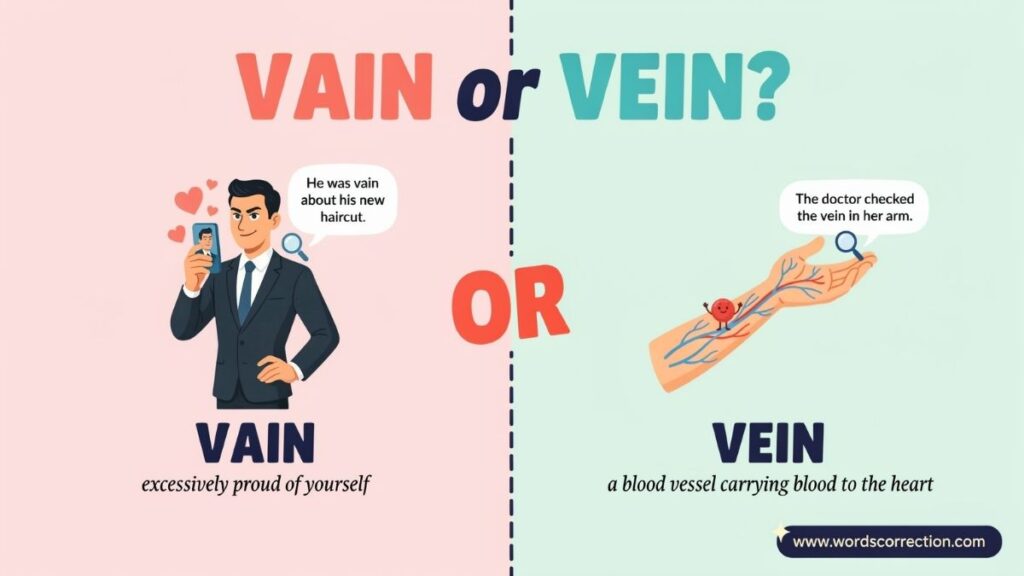
English has a remarkable way of turning simple words into surprisingly tricky choices, and “vain or vein” is a classic example. Although these words sound identical, their meanings are completely different. One describes excessive pride or a futile effort, while the other refers to a blood vessel or a mineral deposit in rock. Mix them up, and your sentence can quickly travel from a grammar lesson to an anatomy class. Fortunately, mastering the difference between vain and vein doesn’t require a linguistic microscope. Once you understand their meanings, uses, and common expressions, choosing the correct word becomes easy. Let’s clear up this confusing homophone pair once and for all.
Vain or Vein Quick Answer
The easiest way to understand vain vs vein is to connect each word with its main meaning.
- Vain is an adjective. It commonly means excessively proud of yourself or unsuccessful and pointless.
- Vein is primarily a noun. It can mean a blood vessel, a mineral deposit, or a particular quality, style, or mood.
- Vain and vein are homophones. They have the same pronunciation but different spellings and meanings.
- “In vain” means unsuccessfully or without achieving the desired result.
- “In the same vein” means in a similar style, manner, or direction.
- Vane is another homophone. It usually refers to a blade or device, especially one associated with wind.
| Word | Part of Speech | Main Meaning | Example |
| Vain | Adjective | Proud of appearance or achievements; unsuccessful | She is vain about her appearance. |
| Vein | Noun | Blood vessel; layer; style or quality | The nurse found a vein in his arm. |
| Vane | Noun | Blade or wind-related device | The weather vane turned north. |
So, if you’re asking, “Is it vain or vein?”, don’t rely on sound alone. Look at the meaning of the sentence.
What Does Vain Mean?
The word vain is an adjective with two important meanings.
First, it can describe someone who has an excessive interest in their own appearance, abilities, achievements, or attractiveness. A vain person tends to think highly of themselves and may care too much about how others see them.
For example:
She is vain about her appearance and checks her reflection before every meeting.
Here, vain describes excessive self-admiration or concern about appearance.
However, vain has another meaning that often causes confusion. It can describe something unsuccessful, useless, ineffective, or unable to produce the desired result.
For example:
They made a vain attempt to repair the damaged equipment.
The attempt did not succeed.
This second meaning explains the familiar expression “in vain.”
Learn the difference between more words people mix up
Insight or Insite? What’s the Correct English Word?
Vain Definition and Examples
The practical vain definition can be summarized as follows:
Vain: excessively proud or self-focused, especially about appearance or achievements; or unsuccessful and without the intended effect.
Here are the two main meanings side by side:
| Meaning of Vain | Explanation | Example |
| Excessively proud | Too concerned with appearance or achievements | He is vain about his hair. |
| Unsuccessful | Failing to achieve a purpose | Their search was vain. |
| Pointless | Producing no useful result | It was a vain attempt to change his mind. |
| In vain | Without success | She tried in vain to open the locked door. |
What Does Vain Mean in Everyday English?
In everyday conversation, you’ll often encounter vain when someone describes another person’s personality or when a speaker uses the expression “in vain.”
Consider these examples:
- She is vain about her appearance.
- He became vain after receiving constant praise.
- They made a vain attempt to find the missing document.
- We searched in vain for the lost key.
Notice the difference. The first two examples describe a person’s attitude. The latter two describe an unsuccessful action.
That distinction makes the word much easier to understand.
Learn the difference between everyday English mistakes
Employees or Employee’s: Which One Is Correct?
What Does Vein Mean?
The word vein is primarily a noun. Its most familiar meaning comes from human anatomy.
A vein is a blood vessel that carries blood toward the heart. Most veins carry oxygen-poor blood, although the pulmonary veins are an important exception because they carry oxygen-rich blood from the lungs to the heart.
For example:
The nurse inserted the needle into a vein in her arm.
That sentence uses the literal biological meaning of the word.
Veins form an important part of the body’s circulatory system. Blood travels away from the heart through arteries, moves through smaller blood vessels and capillaries, and then returns toward the heart through veins.
So when you see vein in a medical context, think blood vessel.
Vein Definition and Examples
The vein definition extends beyond anatomy.
A vein can refer to:
- A blood vessel that carries blood toward the heart.
- A narrow layer or deposit of material within rock.
- A particular quality, style, mood, or tendency.
- A structure or line within certain natural forms, such as a leaf.
Examples include:
- The doctor examined the vein in his arm.
- The miners discovered a vein of gold.
- The article was written in a humorous vein.
- The author returned to the same vein of thought.
This broader meaning explains why vein appears in medical, geological, literary, and everyday writing.
Learn the difference between commonly misused words
Chears or Cheers Difference, Meaning and Usage
Vain vs Vein: The Key Difference
The biggest vain and vein difference is meaning.
Think of vain as belonging to the world of pride and futility. Think of vein as belonging to the world of blood vessels, lines, deposits, and styles.
| Feature | Vain | Vein |
| Part of speech | Adjective | Noun |
| Pronunciation | /veɪn/ | /veɪn/ |
| Main literal sense | Proud or unsuccessful | Blood vessel |
| Figurative sense | Futile or pointless | Style, quality, or tendency |
| Common phrase | In vain | In the same vein |
| Example | His efforts were vain. | The doctor located a vein. |
| Main association | Pride or failure | Blood or style |
The spelling is different because these are separate words with different histories and meanings. They are not alternative spellings of the same word.
Vain vs Vein Pronunciation
The vain vs vein pronunciation is one of the main reasons these words cause spelling mistakes.
Both words are pronounced /veɪn/ in standard American English.
That makes them homophones.
What Are Homophones?
Homophones are words that sound alike but have different meanings and spellings.
Examples include:
- vain / vein / vane
- right / write
- flower / flour
- their / there / they’re
The homophones vain and vein create a particular spelling challenge because both are common English words. Your ears can’t always tell you which spelling belongs on the page.
That’s where context becomes your best guide.
the sentence discusses blood, choose vein.
If it discusses pride, choose vain.
it discusses an unsuccessful effort, choose vain.
If it describes a style or manner, choose vein.
Learn the difference between basic English word mistakes
Honoured or Honored Meaning, Spelling and Usage
Vain, Vein, and Vane: What’s the Difference?
There’s a third word worth learning because it sounds just like the other two: vane.
| Word | Meaning | Example |
| Vain | Proud or unsuccessful | His efforts were vain. |
| Vein | Blood vessel, layer, style, or quality | She has a visible vein on her hand. |
| Vane | Blade or device affected by wind or airflow | The weather vane moved in the wind. |
A weather vane, for example, indicates wind direction.
This three-way distinction is useful because someone who already confuses vain and vein can easily add vane to the mix.
A simple memory system makes the difference easier:
- Vain → vanity
- Vein → blood vessel
- Vane → weather vane
The connection between vain and vanity is especially useful because both relate to excessive pride or self-admiration.
How to Use Vain in a Sentence
Understanding the vain meaning is only half the task. You also need to know how the word works grammatically.
Because vain is an adjective, it normally describes a noun or follows a linking verb.
Vain Describing a Person
Mark is vain about his appearance.
She became vain after receiving constant compliments.
The character is portrayed as wealthy but extremely vain.
In these examples, vain describes a person’s attitude or personality.
Vain Describing an Effort
It was a vain attempt to change the decision.
They made a vain effort to repair the old machine.
His vain hopes disappeared when the results arrived.
Here, vain means unsuccessful, ineffective, or unlikely to produce the desired outcome.
Learn the difference between often confused words
Boxes or Boxs Correct Spelling and Usage
Vain in a Sentence More Examples
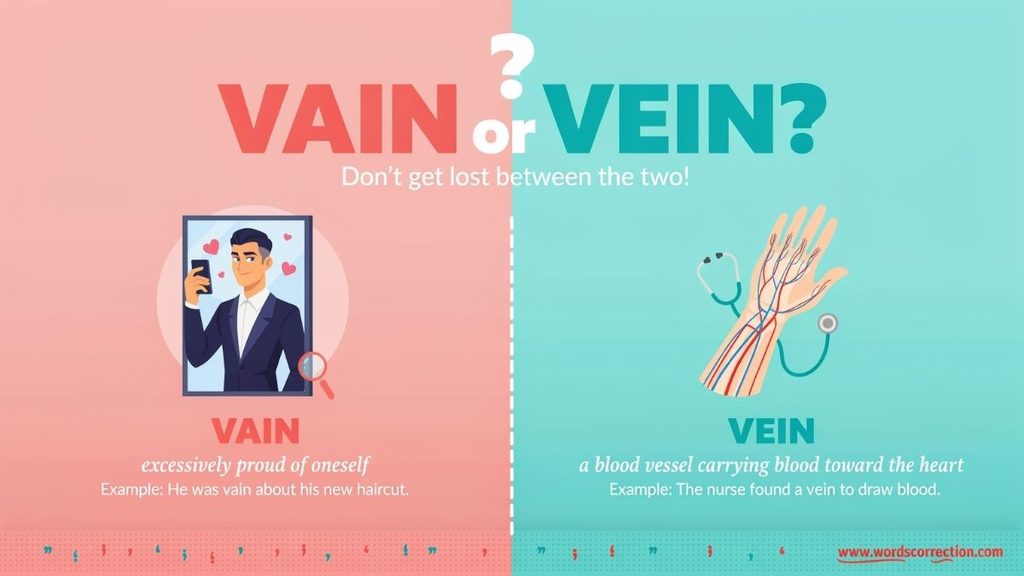
Here are useful vain examples:
- She spent hours making sure her hair looked perfect because she was extremely vain.
- His vain attempt to explain the mistake convinced nobody.
- We searched in vain for the missing key.
- They waited in vain for a response.
- The team made a vain effort to recover before the deadline.
- He wasn’t merely confident; he was becoming vain about his achievements.
The context determines which meaning applies.
How to Use Vein in a Sentence
Because vein is primarily a noun, it normally names a person, place, thing, substance, or concept.
Vein in Anatomy
The nurse found a suitable vein for the blood draw.
The doctor examined the vein in his leg.
Several veins return blood toward the heart.
Veins form part of a complex circulatory network. They aren’t simply “blue tubes,” despite the way they often appear beneath the skin. Blood inside veins is red. Veins can appear blue or green through the skin because of the interaction between light, skin, and the tissues beneath it.
Vein in Geology
Vein can also describe a narrow layer or deposit of material within rock.
The miners discovered a vein of silver.
A rich vein of iron ore was found beneath the hillside.
This use commonly appears in discussions of mining, geology, and natural resources.
Vein in Figurative Language
English also uses vein to describe a particular style, quality, mood, or direction.
The writer continued in a humorous vein.
The discussion moved into a more serious vein.
Her latest novel explores a similar vein of thought.
This figurative meaning connects naturally with the image of a physical vein running through something.
Learn the difference between confusing word pairs
Trialled or Trialed Meaning, Difference and Usage
Vain or Vein in a Sentence Side-by-Side Examples
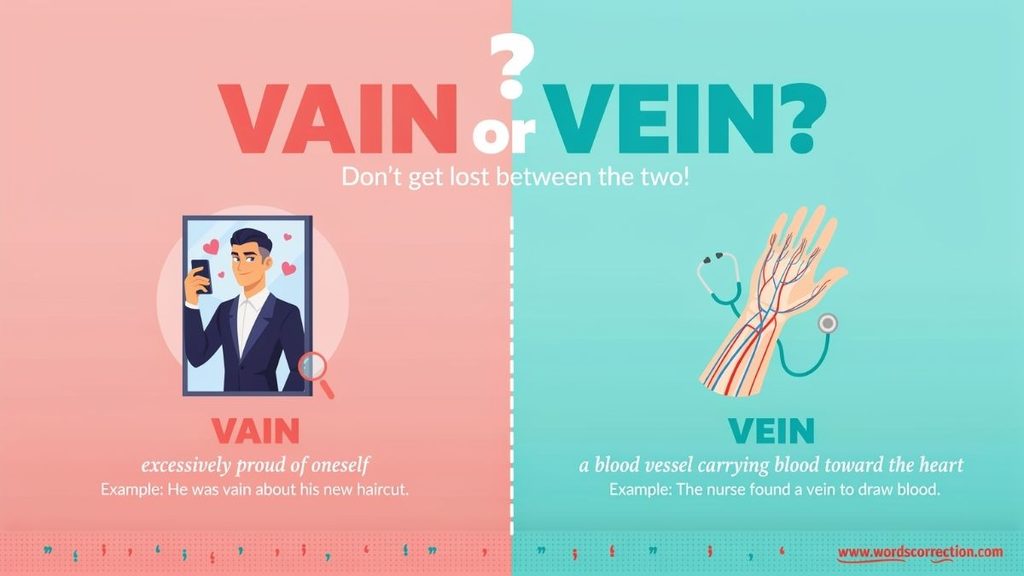
Sometimes the easiest way to understand vain or vein in a sentence is to compare the words directly.
| Sentence | Correct Word | Why? |
| She is ___ about her appearance. | Vain | It describes excessive pride. |
| The doctor examined the ___ in his arm. | Vein | It refers to a blood vessel. |
| They tried ___ to find the document. | Vain | The attempt was unsuccessful. |
| The article was written in a humorous ___. | Vein | It describes style or manner. |
| He made a ___ attempt to fix it. | Vain | The attempt was unsuccessful. |
| A mineral ___ ran through the rock. | Vein | It refers to a geological deposit. |
| Their efforts were ___ . | Vain | Their efforts produced no desired result. |
| The sequel follows the original in the same ___. | Vein | It follows a similar style or approach. |
This table captures the central vain vs vein distinction: meaning determines spelling.
“In Vain” Meaning and Usage
Few expressions cause more confusion in the vain or vein grammar question than “in vain.”
The correct spelling is always vain in this expression.
In vain means without success, without achieving the intended result, or unsuccessfully.
Examples of “In Vain”
She tried in vain to unlock the door.
We searched in vain for the missing file.
He called several times, but his efforts were in vain.
They waited in vain for a response.
The phrase has nothing to do with anatomy. Therefore, “in vein” is incorrect when you mean “without success.”
What Does “Died in Vain” Mean?
The phrase “died in vain” means that someone’s death did not achieve the purpose, cause, or desired outcome associated with their sacrifice, depending on the context.
For example:
They hoped their sacrifice would not be in vain.
The expression can carry emotional, moral, historical, religious, or literary meaning. Its precise interpretation depends on the surrounding context.
The spelling remains vain, never vein.
“In the Same Vein” Meaning
Now switch to vein.
The expression “in the same vein” means in a similar style, manner, mood, or general direction.
For example:
The second article was written in the same vein as the first.
The phrase doesn’t refer to a blood vessel. Instead, English uses the physical idea of a vein as a metaphor for a continuing line, quality, or characteristic.
You can also use:
- in a similar vein
- in a humorous vein
- in a serious vein
- in a literary vein
- in a similar vein of thought
These expressions are especially common in writing and formal discussion.
Learn the difference between tricky grammar more words
Grayscale or Greyscale Which Is Correct?
Common Mistakes With Vain and Vein
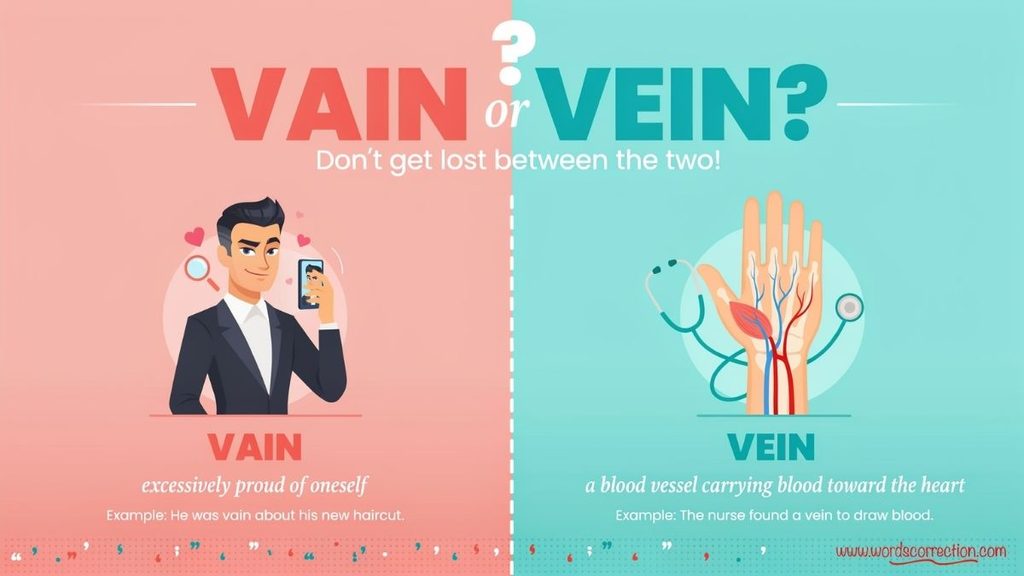
Mistake 1: Writing “In Vein”
Incorrect:
I tried in vein to contact him.
Correct:
I tried in vain to contact him.
Why? The expression means “without success,” so it requires vain.
Mistake 2: Writing “Vain” for a Blood Vessel
Incorrect:
The nurse inserted the needle into a vain.
Correct:
The nurse inserted the needle into a vein.
The sentence concerns anatomy, so vein is the correct spelling.
Mistake 3: Assuming “Vain” Always Means Conceited
Many learners know only the “proud” meaning of vain. However, the word also means unsuccessful or futile.
For example:
They made a vain attempt to stop the machine.
Here, nobody is being described as conceited. The attempt simply failed.
Mistake 4: Using “Vain” for a Style
Incorrect:
The author wrote in a humorous vain.
Correct:
The author wrote in a humorous vein.
The figurative noun vein can describe a particular style, mood, or quality.
Mistake 5: Confusing All Three Homophones
A sentence about wind may require vane, not vain or vein.
The weather vane spun during the storm.
A sentence about pride requires vain.
He was vain about his appearance.
A sentence about blood requires vein.
The nurse located a vein.
Three sounds. Three spellings. Three meanings.
Learn the difference between commonly mixed-up more words
Months or Monthes Which Spelling Is Correct?
A Simple Memory Trick for Vain and Vein
When your brain freezes between vain and vein, connect each word to something familiar.
Remember Vain With Vanity
Vain → vanity → pride
If you’re talking about someone who thinks too highly of their appearance or achievements, vain is the word you need.
This association also helps you remember the word in “in vain,” where the meaning shifts toward futility or lack of success.
Remember Vein With Blood
Vein → blood vessel
If blood is involved, think vein.
You can remember the basic idea this way:
Veins return blood toward the heart.
This is a useful everyday rule, although pulmonary veins are an important exception because they carry oxygen-rich blood from the lungs to the heart.
Remember Vane With Wind
Vane → weather vane
If the sentence involves wind direction or a blade-like device, vane is usually the word you need.
Vain or Vein Grammar: What Part of Speech Are They?
Understanding grammar makes the spelling difference easier to manage.
Vain Is an Adjective
Vain describes a person, thing, attempt, hope, effort, or action.
Examples:
- a vain person
- a vain hope
- a vain attempt
- a vain effort
It can also appear after linking verbs:
She is vain about her appearance.
Vein Is a Noun
Vein normally names something.
Examples:
- a vein in the arm
- a vein of gold
- a vein of humor
- the same vein
Its plural form is veins.
The doctor examined the veins in his legs.
This grammatical difference provides another useful shortcut when you’re deciding between vain and vein.
Vain and Vein Origins
Although vain and vein sound alike today, they have different histories.
Origin of Vain
The word vain entered English in the Middle English period. Its history traces through French to the Latin word vanus, meaning “empty” or “void.”
Earlier uses were associated with ideas such as worthless, fruitless, idle, or ineffective. That older sense remains especially clear in the expression “in vain.”
Over time, vain also developed its modern sense of excessive pride or self-admiration.
That history explains why one English word can connect two seemingly different ideas:
- excessive self-importance
- futility or lack of useful result
Both senses developed from an older concept involving emptiness or lack of substance.
Origin of Vein
Vein developed from historical words associated with blood vessels and related structures. Over time, its meaning expanded beyond anatomy.
The word came to describe mineral deposits within rock and eventually developed figurative uses involving a line, quality, tendency, or style.
That figurative meaning is easy to visualize. A physical vein runs through something. A vein of humor or vein of thought similarly suggests a recognizable quality running through writing, speech, or behavior.
Learn the difference between confusing more English words
Bosses or Boss’s Which Is Correct? Meaning and Usage
Why Are Vain and Vein So Confusing?
The answer is straightforward: they sound the same.
When someone says:
“The effort was in vain.”
you hear the sound but don’t see the spelling.
The listener has to determine the meaning from context. A fluent speaker often does this automatically, but spelling becomes harder when you’re writing quickly or learning English.
This is why the commonly confused words vain and vein create so many spelling questions. Their meanings aren’t particularly close. Their sounds are.
The pronunciation tells you:
/veɪn/
The context tells you whether to write:
vain, vein, or vane
That’s the real spelling test.
Vein in the Human Body: Useful Facts
The anatomical meaning of vein is worth understanding because it provides the word with one of its strongest associations.
Veins form a vast network throughout the body. Together with arteries, capillaries, and the heart, they support the circulation of blood throughout the body.
Veins generally return oxygen-poor blood toward the heart. However, pulmonary veins carry oxygen-rich blood from the lungs to the heart. This exception is important because the terms artery and vein describe the direction of blood flow relative to the heart rather than simply the amount of oxygen in the blood.
Many veins also contain valves that help keep blood moving in the correct direction. These valves are particularly important in the legs, where blood must travel upward against gravity.
So the vein word meaning is more than a simple vocabulary definition. It identifies an essential component of the human circulatory system.
Case Study: Choosing the Correct Word From Context
Consider these three sentences:
A. Maria was very ___ about her appearance.
B. The nurse found a ___ in his arm.
C. The team searched ___ for the missing records.
All three blanks sound exactly alike when spoken.
Yet the answers are different:
- A: vain — Maria is excessively concerned with her appearance.
- B: vein — the sentence refers to a blood vessel.
- C: vain — the team searched unsuccessfully.
This simple case study demonstrates an important lesson about English spelling.
Pronunciation alone cannot always determine spelling. Context does the heavy lifting.
Vain vs Vein: A Practical Decision Guide
When you’re unsure which spelling to use, ask yourself a few quick questions.
Is the Sentence About Pride?
Use vain.
He is vain about his appearance.
Is the Sentence About Failure or Futility?
Use vain.
Their efforts were in vain.
Is the Sentence About Blood?
Use vein.
The blood traveled through a vein.
Is the Sentence About a Mineral Deposit?
Use vein.
The miners discovered a vein of copper.
Is the Sentence About Style or Mood?
Use vein.
The article continues in a humorous vein.
Is the Sentence About Wind Direction?
Use vane.
The vane showed that the wind was coming from the west.
This six-question test handles most everyday spelling problems involving these words.
Learn the difference between tricky words and use them correctly
Personalise or Personalize Difference,Meaning and Usage
Vain or Vein in Different Types of Writing
Everyday Conversation
Vain often appears when discussing personality:
He’s a little vain about his appearance.
Vein appears naturally in health-related conversations:
The nurse couldn’t find a vein.
Professional Writing
Vain can describe unsuccessful efforts:
The company made a vain attempt to reverse the decline.
Vein can describe an approach or style:
The presentation continued in a more practical vein.
Academic Writing
Vein frequently appears in scientific, geological, literary, and historical contexts.
Researchers identified a mineral vein within the rock formation.
The study explores the same vein of thought found in earlier research.
Creative Writing
Both words can add precision to creative writing.
The prince was handsome, wealthy, and painfully vain.
Or:
The story moves into a darker vein during its final chapters.
The first sentence describes a character’s personality. The second describes a shift in tone or style.
Learn the difference between commonly confused more words in English
Unvoluntary or Involuntary Which One Is Correct?
British English vs. American English: Vain or Vein
There is no British-versus-American spelling difference between vain and vein.
American English uses:
- vain
- vein
British English uses the same spellings:
- vain
- vein
So if you’ve been wondering whether vain is American and vein is British, that’s not the case.
The distinction is based on meaning and usage, not regional spelling.
Vain or Vein Correct Spelling: A Final Checklist
Before choosing the spelling, run through this quick checklist:
- Pride or excessive self-importance? → vain
- Unsuccessful or pointless effort? → vain
- “In vain”? → vain
- Blood vessel? → vein
- Mineral deposit in rock? → vein
- Style, mood, or quality? → vein
- “In the same vein”? → vein
- Wind-related blade or weather device? → vane
The spelling becomes much easier once the meaning is clear.
Vain vs Vein vs Vane: Complete Comparison
| Word | Grammar | Core Meaning | Common Phrase | Example |
| Vain | Adjective | Proud; futile or unsuccessful | In vain | They searched in vain. |
| Vein | Noun | Blood vessel; layer; style or quality | In the same vein | The sequel follows in the same vein. |
| Vane | Noun | Blade or wind-direction device | Weather vane | The vane turned in the wind. |
This is the simplest summary of vain versus vein.
Practice Sessions: Vain or Vein
Fill in the Blanks
Choose the correct word: vain or vein.
- She spent hours admiring herself in the mirror because she was very ________.
- The doctor carefully examined the ________ in the patient’s arm.
- His efforts to find the missing documents were in ________.
- The nurse inserted the needle into a ________.
- She is too ________ about her appearance.
- They searched for the lost treasure in ________.
- A ________ carries blood toward the heart.
- He made a ________ attempt to repair the broken machine.
- The mineral ________ was discovered deep inside the rock.
- Don’t be so ________; nobody is perfect.
- Their hopes of winning the competition were not in ________.
- The surgeon located a damaged ________ during the operation.
- She checked her reflection repeatedly, showing how ________ she was.
- All his attempts to persuade them were in ________.
- The geologist discovered a gold ________ in the mountain.
- His ________ desire for attention annoyed his colleagues.
- The medical student learned about the structure of every major ________.
- We waited for hours, but our efforts were in ________.
- He is not arrogant, but he can sometimes be slightly ________.
- The blue ________ beneath her skin was clearly visible.
- Their search for a solution proved ________.
- The writer explored the subject in a humorous ________.
- She was considered ________ because she constantly talked about her beauty.
- The doctor explained how blood flows through each ________.
- His attempt to change the outcome was ultimately in ________.
Answers
- vain
- vein
- vain
- vein
- vain
- vain
- vein
- vain
- vein
- vain
- vain
- vein
- vain
- vain
- vein
- vain
- vein
- vain
- vain
- vein
- vain
- vein
- vain
- vein
- vain
Here’s a trusted source for clear more words Comparison:
Grammar Update
Frequently Asked Questions About Vain or Vein
Are vain and vein pronounced the same way?
Yes. “Vain” and “vein” are homophones, meaning they have the same pronunciation but different spellings and meanings.
Is vain ever used as a noun?
Generally, vain is used as an adjective. It describes someone who is excessively proud or an action that produces no useful result.
Can vein be used as a verb?
Yes, although its verb usage is less common. To vein something means to mark or form with vein-like lines or patterns.
What is the plural form of vein?
The plural form of vein is “veins.” For example: The doctor examined the veins in the patient’s arm.
What is the comparative form of vain?
The comparative form is usually “vainer,” and the superlative form is “vainest.” For example: He became vainer as he received more attention.
Does vain always describe a negative personality trait?
No. Although vain commonly suggests excessive pride in one’s appearance or abilities, it can also mean unsuccessful, useless, or pointless.
Can vain describe an object or thing?
Yes. The word vain can describe an action, effort, or attempt that fails to achieve its intended purpose.
What are common expressions that use the word vain?
Common expressions include “in vain,” “vain hope,” “vain attempt,” and “take someone’s name in vain.”
What does “take someone’s name in vain” mean?
The expression traditionally means using someone’s name disrespectfully, carelessly, or without proper seriousness, especially in a religious context.
Can vain and vein be used interchangeably?
No. They cannot be used interchangeably because they have completely different meanings and grammatical functions.
Is there a simple way to remember the difference between vain and vein?
Yes. Remember that “vain” is related to vanity and pride, while “vein” refers to a blood vessel or a streak-like pattern.
What words are commonly confused with vain?
Vain is commonly confused with vein and vane because all three words sound alike but have different meanings and spellings.
What does “vein” mean outside of anatomy?
Outside anatomy, vein can describe a distinctive style, mood, or approach, such as writing in a humorous vein.
Can vein refer to something found in rocks?
Yes. In geology, a vein is a narrow deposit of minerals or other materials within rock.
Is “vein” related to arteries?
Yes. Veins and arteries are both blood vessels, but they perform different functions in the circulatory system.
What is the difference between a vein and an artery?
Veins generally carry blood toward the heart, while arteries generally carry blood away from the heart.
Can the word vain be used in formal writing?
Yes. Vain is appropriate in formal writing when describing excessive pride, useless efforts, or unsuccessful attempts.
Is “vain” an old-fashioned word?
No. Vain remains a commonly used English word in both everyday and formal communication.
What is the etymology of the word vain?
The word vain comes from Old French and Latin roots associated with emptiness, worthlessness, or excessive pride.
What is the etymology of the word vein?
Vein comes from Latin “vena,” meaning a blood vessel or channel through which blood flows.
How can context help determine whether to use vain or vein?
The surrounding words usually reveal the intended meaning. If the sentence relates to pride or failure, use “vain.” If it relates to blood vessels, patterns, or style, use “vein.”
Why do English speakers confuse vain and vein?
They are frequently confused because they sound identical when spoken, even though their meanings and spellings are different.
Can “vain” be used in a figurative sense?
Yes. For example, “He made a vain attempt to change the decision” uses vain figuratively to describe an unsuccessful effort.
What is a vein of thought?
A vein of thought refers to a particular line, direction, or style of thinking or discussion.
Why is learning the difference between vain and vein important?
Understanding the difference improves spelling accuracy, grammar, vocabulary, and clarity in both spoken and written English.
Conclusion
The difference between vain and vein may be only a single letter, but their meanings couldn’t be more different. Vain describes excessive pride or an unsuccessful effort, while vein refers to a blood vessel, a mineral deposit, or a distinctive style or quality. Because these words are pronounced alike, they can easily cause confusion in writing. Fortunately, context provides the perfect clue. If you’re talking about pride, futility, or something done in vain, use vain. If you mean a blood vessel, mineral deposit, or something in the same vein, use vein. Understand this simple distinction, and these tricky homophones won’t trip up your grammar again.

Stella AJS is an experienced blogger and dedicated English language writer at Words Correction. She turns confusing grammar, word meanings, spelling, and usage into clear, practical insights that readers can easily understand and apply. With a passion for precise and engaging writing, Stella helps readers avoid common language mistakes, strengthen their vocabulary, and communicate with greater clarity and confidence.




