
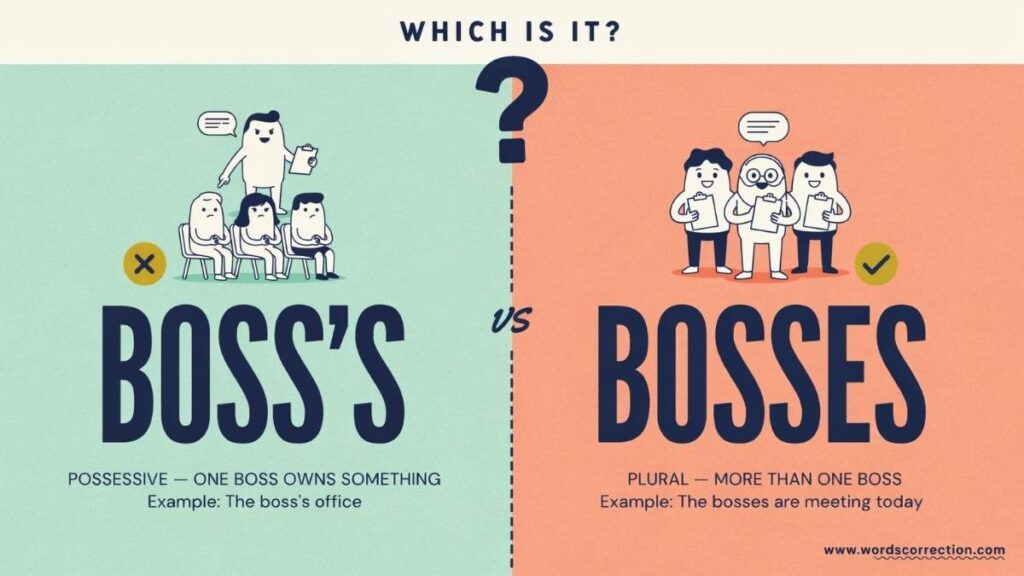
English punctuation has a curious way of turning one tiny apostrophe into a surprisingly confusing grammar puzzle. If you’ve ever hesitated over “bosses or boss’s,” you’re certainly not alone. These forms look remarkably similar, yet each serves a different grammatical purpose. Bosses refers to more than one boss, while boss’s shows that something belongs to one boss. Then there’s bosses’, which indicates possession by multiple bosses. It’s enough to make anyone second-guess an apostrophe. Fortunately, this guide makes the distinction simple with clear rules, practical examples, and helpful explanations. By the end, you’ll know exactly which form to use and why.
Bosses or Boss’s Quick Answer
The correct form depends on what you mean.
- boss = one boss
- bosses = more than one boss
- boss’s = something belonging to one boss
- bosses’ = something belonging to multiple bosses
So, if you’re asking which is correct, bosses or boss’s, both can be correct. They simply have different grammatical functions.
For example:
The bosses attended the conference.
Here, bosses is a plural noun. It refers to more than one person.
Now compare it with:
The boss’s office is on the second floor.
Here, boss’s is a singular possessive noun. The office belongs to or is associated with one boss.
There’s also a third possibility:
The bosses’ offices are on the second floor.
In this sentence, several bosses have offices. Therefore, bosses’ is the plural possessive form.
Understand confusing English more words simply
Inconsolable or Unconsolable Which Is Correct?
Boss, Bosses, Boss’s, or Bosses’: The Basic Rule
| Form | Meaning | Grammatical Role | Example |
| boss | One boss | Singular noun | My boss is helpful. |
| bosses | More than one boss | Plural noun | The bosses arrived. |
| boss’s | Belonging to one boss | Singular possessive | My boss’s office is upstairs. |
| bosses’ | Belonging to multiple bosses | Plural possessive | The bosses’ offices are upstairs. |
This distinction answers most questions about bosses or boss’s.
Bosses vs Boss’s: What Is the Difference?
The easiest way to understand boss’s vs bosses is to ask one question:
Are you talking about the number of bosses, or are you showing possession?
If you mean more than one boss, use bosses.
If you mean something belonging to or associated with one boss, use boss’s.
For example:
Three bosses attended the meeting.
The sentence focuses on the number of people.
Now consider:
One boss’s presentation impressed the team.
The sentence focuses on something associated with one boss.
The difference between boss’s and bosses is therefore grammatical rather than merely visual. The apostrophe changes the role of the word.
Learn the difference between confusing more English words
Where or When Difference and correct usage
Bosses Meaning and Usage
The bosses meaning is simply the plural meaning of the noun boss. The word bosses refers to two or more people who supervise, manage, or direct others.
The bosses definition can therefore be summarized as the plural form of boss.
For example:
The bosses discussed the company’s new policy.
There is no apostrophe because the sentence doesn’t show possession. It simply tells you that several bosses took part in the discussion.
Other examples include:
- The bosses met with the employees.
- Several bosses attended the annual conference.
- The bosses reviewed the proposal.
- Two bosses approved the schedule.
If you’re looking for the bosses meaning in English, the essential point is simple: bosses means more than one boss.
Boss’s Meaning and Usage
The boss’s meaning changes because the apostrophe changes the grammatical role.
Boss’s is the singular possessive form of boss. It normally indicates that something belongs to, relates to, or is associated with one boss.
For example:
My boss’s desk is near the window.
The desk belongs to or is associated with one boss.
You can also write:
The boss’s decision surprised everyone.
The decision came from one boss.
The phrase boss’s meaning in English can therefore be summarized as the possessive form of the singular noun boss.
The apostrophe matters. Without it, bosses is a plural noun instead.
Learn the difference between commonly mixed-up more words
Doggie or Doggy Which Spelling Is Correct?
Is Bosses a Word?
Yes. Bosses is a correct English word.
If you’re wondering is bosses a word, the answer is straightforward. It is the standard plural form of the noun boss.
You can use bosses whenever you refer to more than one boss.
For example:
The bosses are meeting with the employees this afternoon.
The word doesn’t need an apostrophe because nothing in the sentence indicates possession.
This also answers the question is bosses a correct word. Yes, it is.
What Is the Plural of Boss?
The plural of boss is bosses.
English forms many plurals by adding -s or -es. Because boss ends in s, its standard plural form is bosses.
The pattern is:
boss → bosses
Examples include:
- one boss
- two bosses
- one manager
- two managers
- one supervisor
- several supervisors
The important point is that bosses doesn’t need an apostrophe simply because the word already ends in s.
That is a common punctuation mistake.
Learn the difference between tricky grammar more words
Insight or Insite? What’s the Correct English Word?
Boss Plural Form and Plural Form of Boss
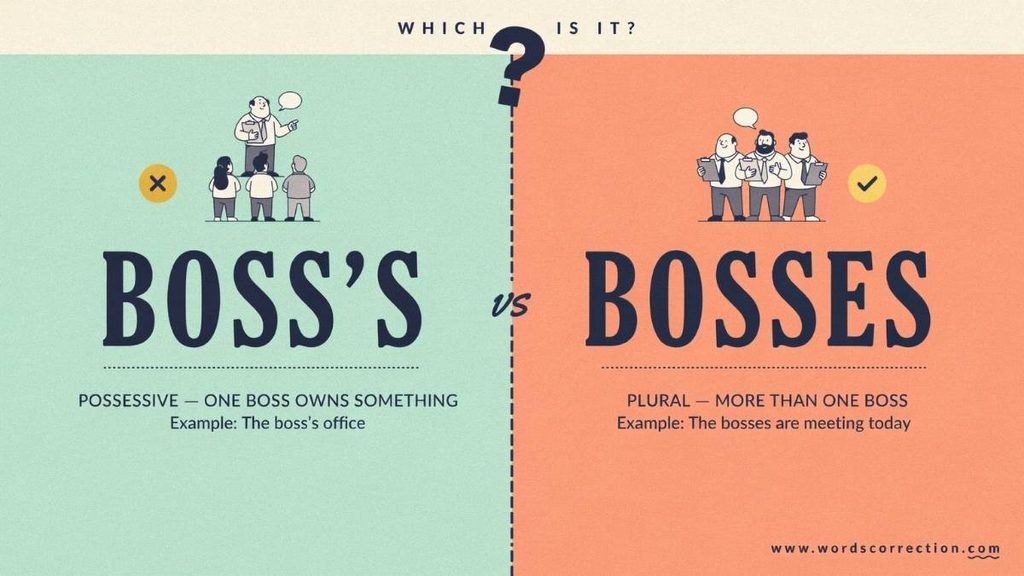
The boss plural form is bosses.
Likewise, the plural form of boss is bosses.
Don’t write boss’s when you simply want to make the noun plural.
Incorrect:
The boss’s are attending the meeting.
Correct:
The bosses are attending the meeting.
The apostrophe doesn’t make an ordinary noun plural. In this context, it signals possession.
What Is the Possessive Form of Boss?
The possessive of boss is boss’s when you’re talking about one boss.
This follows the common English pattern for a singular noun:
singular noun + ’s
So:
- boss → boss’s
- manager → manager’s
- employee → employee’s
- supervisor → supervisor’s
For example:
The boss’s office is locked.
The office belongs to or is associated with one boss.
How Do You Make Boss Possessive?
To make boss possessive when referring to one boss, add an apostrophe followed by s:
boss → boss’s
Examples include:
- boss’s car
- boss’s office
- boss’s decision
- boss’s instructions
- boss’s assistant
- boss’s signature
The same general principle applies to many nouns ending in s when they are singular.
Learn the difference between confusing word pairs
Employees or Employee’s: Which One Is Correct?
Singular Possessive of Boss
The singular possessive of boss is boss’s.
Consider these examples:
The boss’s phone rang.
I followed my boss’s instructions.
The boss’s assistant scheduled the meeting.
Each sentence refers to one boss.
The apostrophe appears before the final s in the possessive form:
boss’s
That is the key visual difference between boss’s and bosses.
What Is the Plural Possessive of Boss?
The plural possessive of boss is bosses’.
This form involves two steps:
- Make boss plural: bosses
- Add an apostrophe: bosses’
The pattern is:
boss → bosses → bosses’
The apostrophe comes after the s because bosses is already plural.
For example:
The bosses’ meeting lasted three hours.
The meeting involved or was associated with multiple bosses.
Compare that sentence with:
The boss’s meeting lasted three hours.
That sentence refers to one boss.
The difference may look tiny, but the grammatical meaning changes.
Bosses’ Meaning
The bosses’ meaning is possessive and plural. It refers to something belonging to, associated with, or connected to more than one boss.
Examples include:
- the bosses’ decision
- the bosses’ offices
- the bosses’ responsibilities
- the bosses’ meeting
- the bosses’ expectations
Notice that the apostrophe comes after the plural s.
This is the standard pattern for a regular plural noun that already ends in s.
Learn the difference between often confused words
Chears or Cheers Difference, Meaning and Usage
Boss’s, Bosses, or Bosses’: What’s the Difference?
This is the distinction worth remembering:
boss = one
bosses = more than one
boss’s = one boss + possession
bosses’ = multiple bosses + possession
Think of it as a simple four-part system:
BOSS
|
+————-+————-+
| |
One boss More than one
| |
boss bosses
| |
Add ’s for possession Add ’ for possession
| |
boss’s bosses’
Once you understand this pattern, the apostrophes stop looking random.
How to Use Boss’s in a Sentence
Learning how to use boss’s becomes easier when you identify the owner first.
If one boss owns, controls, provides, makes, or has a relationship with something, use boss’s.
Boss’s in a Sentence: Examples
My boss’s office is upstairs.
One boss has the office.
I followed my boss’s instructions.
One boss gave the instructions.
The boss’s decision affected the entire department.
One boss made the decision.
Her boss’s email arrived early this morning.
One boss sent the email.
The boss’s assistant answered the phone.
One boss has an assistant.
These examples also show that possession doesn’t always mean literal ownership. The relationship can involve responsibility, authority, authorship, association, or connection.
For example, a boss doesn’t necessarily own a decision. However, the decision can still be described as the boss’s decision.
Boss’s Example Sentence
A simple boss’s example sentence is:
The boss’s meeting starts at nine.
The phrase tells you that one boss is connected to the meeting.
If several bosses are involved, the form changes:
The bosses’ meeting starts at nine.
That one apostrophe position changes the number of people involved.
Learn the difference between basic English word mistakes
Honoured or Honored Meaning, Spelling and Usage
How to Use Bosses in a Sentence

Knowing how to use bosses requires no apostrophe when you’re simply talking about multiple people.
Use bosses when you mean two or more bosses.
Bosses in a Sentence: Examples
The bosses met after lunch.
Several bosses attended the training session.
The employees spoke with their bosses.
Three bosses reviewed the proposal.
The bosses agreed on a new schedule.
These are all ordinary plural uses.
Bosses Example Sentence
A straightforward bosses example sentence is:
The bosses discussed the new workplace policy.
The noun bosses is plural. It doesn’t show possession.
Another example is:
Multiple bosses attended the company’s annual meeting.
Again, the word simply refers to more than one boss.
Learn the difference between commonly misused words
Boxes or Boxs Correct Spelling and Usage
How to Use Bosses’ Correctly
Use bosses’ when you have multiple bosses and need to show possession or association.
For example:
The bosses’ offices are on the third floor.
The offices belong to or are associated with several bosses.
Compare these sentences:
The boss’s office is on the third floor.
The bosses’ offices are on the third floor.
The first refers to one boss.
The second refers to multiple bosses.
When Should You Use Bosses’?
Use bosses’ when both conditions apply:
- You’re referring to more than one boss.
- You’re showing possession or association.
Examples include:
- bosses’ offices
- bosses’ decisions
- bosses’ responsibilities
- bosses’ expectations
- bosses’ meeting
Learn the difference between everyday English mistakes
Trialled or Trialed Meaning, Difference and Usage
Bosses’ vs Boss’s: A Clear Comparison
The bosses’ vs boss’s distinction comes down primarily to number.
| Phrase | Number of Bosses | Meaning |
| boss’s office | One | Office associated with one boss |
| bosses’ offices | More than one | Offices associated with multiple bosses |
| boss’s decision | One | Decision made by one boss |
| bosses’ decision | More than one | Decision made by multiple bosses |
| boss’s assistant | One | Assistant associated with one boss |
| bosses’ assistants | More than one | Assistants associated with multiple bosses |
Notice the pattern:
boss’s → apostrophe before s
bosses’ → apostrophe after s
That distinction is at the heart of the boss’s vs bosses grammar question.
Common Mistakes With Bosses or Boss’s
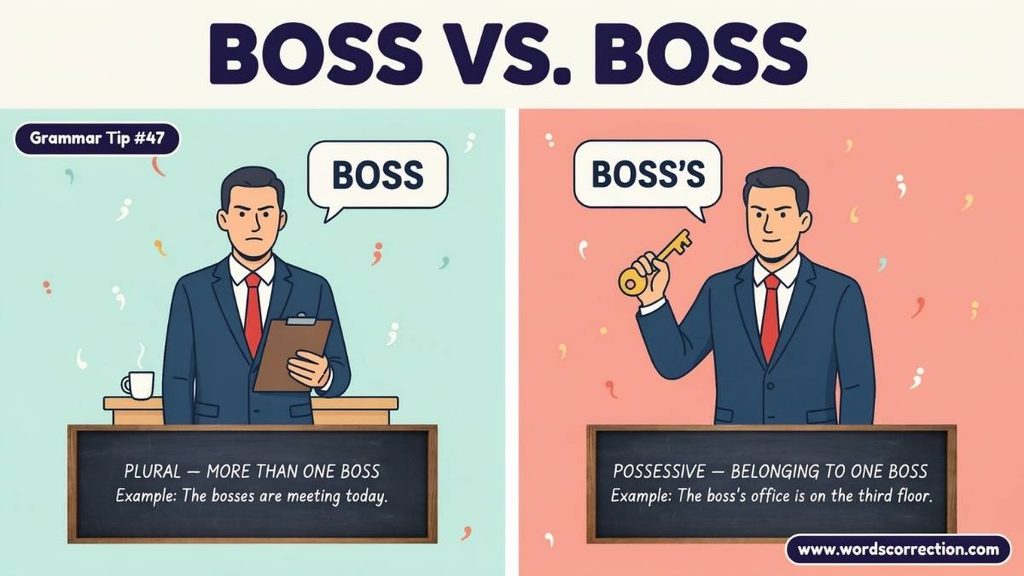
Apostrophes cause trouble because people sometimes treat them as decoration. They aren’t. In possessives, they communicate grammatical relationships.
Mistake 1: Using Boss’s as the Plural
Incorrect:
The boss’s are waiting outside.
Correct:
The bosses are waiting outside.
Why? The sentence refers to multiple people. Therefore, you need the plural noun bosses.
Mistake 2: Forgetting the Apostrophe in Boss’s
Incorrect:
My bosses office is nearby.
Correct:
My boss’s office is nearby.
The first version can be read as a plural form. The second clearly shows that one boss is associated with the office.
Mistake 3: Confusing Boss’s and Bosses’
Consider:
The boss’s car
This means one boss has the car.
Now:
The bosses’ cars
This means multiple bosses have cars.
The position of the apostrophe matters.
Mistake 4: Writing Bosses’ for One Boss
Incorrect:
My bosses’ office is upstairs.
If you’re referring to one boss, the standard form is:
My boss’s office is upstairs.
Use bosses’ only when the noun is plural.
Mistake 5: Adding Apostrophes to Ordinary Plurals
Incorrect:
The employee’s attended the meeting.
Correct:
The employees attended the meeting.
The apostrophe doesn’t belong in an ordinary plural.
This is one of the most useful apostrophe rules to remember:
A plural noun doesn’t automatically need an apostrophe.
Learn the difference between more words people mix up
Grayscale or Greyscale Which Is Correct?
Plural vs. Possessive: The Real Grammar Difference
The confusion becomes much easier when you separate plural vs possessive.
A plural noun tells you there is more than one.
A possessive noun shows ownership, association, or another relationship.
Compare:
The managers arrived.
Managers is plural.
Now:
The manager’s office is open.
Manager’s is singular possessive.
And:
The managers’ offices are open.
Managers’ is plural possessive.
The same grammatical structure applies to boss:
| Grammatical Idea | Form |
| Singular | boss |
| Plural | bosses |
| Singular possessive | boss’s |
| Plural possessive | bosses’ |
Understanding this plural noun vs possessive noun distinction can help you with many other English nouns.
Learn the difference between tricky words and use them correctly
Months or Monthes Which Spelling Is Correct?
Apostrophe Before S vs. Apostrophe After S
Here’s a useful visual rule.
Apostrophe Before S: Boss’s
When the noun is singular, use ’s:
boss’s
The pattern is:
singular noun + ’s
Examples:
- boss’s
- manager’s
- supervisor’s
- employee’s
Apostrophe After S: Bosses’
When the noun is a regular plural ending in s, place the apostrophe after the final s:
bosses’
The pattern is:
plural noun ending in s + ’
Examples:
- bosses’
- managers’
- supervisors’
- employees’
This is one of the central possessive apostrophe rules in English.
Bosses or Boss’s Pronunciation
Spelling and pronunciation create another useful distinction.
Bosses or boss’s are generally pronounced differently.
Bosses has two syllables, while boss’s has one syllable.
The plural ending in bosses adds an extra syllable. The possessive boss’s does not create the same two-syllable pattern.
This means boss’s vs bosses pronunciation can sometimes help you identify which form someone means in spoken English.
Boss’s Pronunciation
The singular possessive boss’s generally keeps the same basic syllable count as boss while adding the possessive ending sound.
Bosses Pronunciation
The plural bosses has an additional syllable.
This distinction can help English learners recognize whether someone means a singular possessive noun or a plural noun during conversation.
Bosses or Boss’s in Everyday Writing
The difference appears constantly in workplace English.
Email Example
I’ve attached the document following my boss’s instructions.
Here, boss’s refers to one boss.
Compare:
The bosses have reviewed the attached document.
Here, bosses refers to multiple bosses.
Workplace Example
The boss’s office will be closed this afternoon.
One boss.
The bosses’ offices will be closed this afternoon.
Multiple bosses.
Formal Writing Example
The boss’s approval is required before the project begins.
One boss must provide approval.
The bosses’ approval is required before the project begins.
Several bosses must provide approval.
Informal Example
My boss’s reaction was hilarious.
One boss.
My bosses are surprisingly relaxed about the deadline.
More than one boss.
Boss or Bosses Which Form Should You Choose?
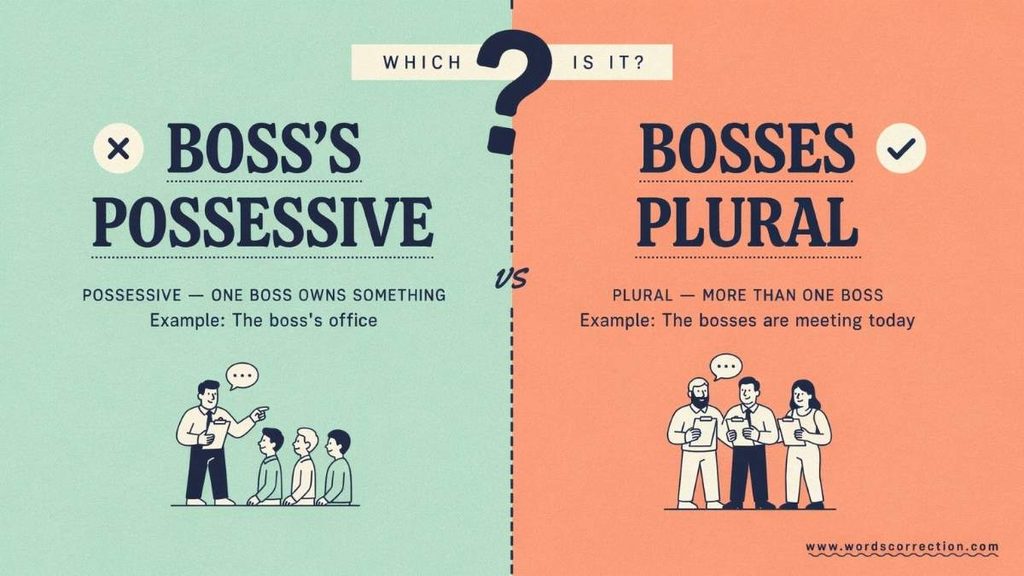
The question boss or bosses is really a question about number.
Use boss when you mean one boss.
Use bosses when you mean more than one boss.
Examples:
- My boss called me.
- My bosses called me.
- One boss approved the request.
- Several bosses approved the request.
If possession enters the sentence, you then need to decide between boss’s and bosses’.
When to Use Boss’s
Use boss’s when:
- You mean one boss.
- You need to show possession or association.
- The following noun relates to that one boss.
Examples:
- boss’s office
- boss’s car
- boss’s decision
- boss’s instructions
- boss’s schedule
A useful test is to replace the phrase mentally with “belonging to one boss.”
If that meaning works, boss’s is likely the form you need.
When to Use Bosses
Use bosses when:
- You mean more than one boss.
- You aren’t showing possession.
- The word functions simply as a plural noun.
Examples:
- The bosses arrived.
- Several bosses attended.
- The bosses voted.
- Two bosses disagreed.
If you can replace the word with “more than one boss,” you probably need bosses.
When to Use Bosses’
Use bosses’ when:
- You mean multiple bosses.
- You want to show possession, association, responsibility, or connection.
Examples:
- bosses’ offices
- bosses’ decisions
- bosses’ responsibilities
- bosses’ expectations
- bosses’ meeting
The formation is simple:
boss → bosses → bosses’
First make the noun plural. Then add the apostrophe.
Case Study: One Boss vs. Multiple Bosses
Imagine a company with three department heads.
One department head makes a decision about an employee’s schedule.
You could write:
The boss’s decision changed the employee’s schedule.
The sentence refers to one boss.
Now imagine all three department heads make the decision together:
The bosses’ decision changed the employee’s schedule.
Now the decision belongs to or comes from multiple bosses.
Finally, if you’re simply describing the department heads:
The bosses met with the employee.
No apostrophe is necessary because you’re using a straightforward plural noun.
This simple case study captures the entire distinction:
boss’s → one + possession
bosses → multiple
bosses’ → multiple + possession
A Quick Memory Trick for Bosses or Boss’s
Here’s an easy way to remember the forms:
Count first. Possess second.
Ask:
One?
- boss
- boss’s if possessive
More than one?
- bosses
- bosses’ if possessive
In other words:
One boss owns or is associated with something → boss’s
Several bosses own or are associated with something → bosses’
Several bosses are simply being discussed → bosses
This approach is much safer than trying to memorize apostrophe placement on its own.
Practice Session: Fill in the Blanks
Choose the correct form: boss, boss’s, bosses, or bosses’.
- My ______ asked me to finish the report by Friday.
- The ______ are attending the annual conference.
- I left the document on my ______ desk.
- The ______ office is next to the conference room.
- Several ______ joined the meeting this morning.
- My ______ instructions were clear.
- The ______ discussed the company’s new policy.
- We followed our ______ advice.
- The ______ decision affected the entire department.
- I spoke with my ______ about the project.
- The two ______ approved the proposal.
- My ______ car is parked outside.
- The ______ meeting lasted nearly three hours.
- Our ______ agreed to the new schedule.
- The ______ offices are located on the top floor.
- I need to ask the ______ for permission.
- The ______ were pleased with the team’s performance.
- My ______ feedback helped me improve my work.
- The ______ responsibilities include managing several departments.
- We were invited to the ______ meeting.
- The ______ assistant prepared the documents.
- Several ______ shared their opinions during the discussion.
- I followed my ______ instructions carefully.
- The ______ decision was announced to all employees.
- The ______ schedules were changed because of the meeting.
Answer
- boss
- bosses
- boss’s
- boss’s
- bosses
- boss’s
- bosses
- boss’s
- boss’s
- boss
- bosses
- boss’s
- bosses’
- boss
- bosses’
- boss
- bosses
- boss’s
- boss’s
- bosses’
- boss’s
- bosses
- boss’s
- boss’s
- bosses’
Quick Reminder
- Boss = one person
- Boss’s = something belonging to one boss
- Bosses = more than one boss
- Bosses’ = something belonging to multiple bosses
Here’s a trusted source for clear more words Comparison:
Grammar Update
Frequently Asked Questions
Is it “bosses” or “boss’s”?
Both bosses or boss’s are correct, but they have different meanings. Bosses is the plural form of boss, while boss’s is the singular possessive form.
What is the difference between “bosses” and “boss’s”?
Bosses refers to more than one boss. Boss’s indicates that something belongs to one boss. For example, “The bosses arrived” refers to several bosses, while “The boss’s office is open” shows possession.
Is “boss’s” grammatically correct?
Yes. Boss’s is the standard singular possessive form of boss. For example, “I found the boss’s keys.”
Is “bosses” a correct word?
Yes. Bosses is the standard plural form of boss. For example, “The bosses attended the meeting.”
What is the plural form of “boss”?
The plural form of boss is bosses. The -es ending is added because boss ends in s.
What is the possessive form of “boss”?
The singular possessive form is boss’s. It shows that something belongs to one boss, as in “the boss’s desk.”
What is the plural possessive form of “boss”?
The plural possessive form is bosses’. It shows that something belongs to more than one boss, as in “the bosses’ offices.”
Is it “boss’s” or “bosses’”?
Use boss’s when one boss owns or is associated with something. Use bosses’ when two or more bosses own or are associated with something.
Is it “bosses” or “bosses’”?
Use bosses when you are simply referring to more than one boss. Use bosses’ when you need to show possession by multiple bosses.
When should you use “boss’s”?
Use boss’s when something belongs to one boss. For example, “My boss’s car is outside.”
When should you use “bosses’”?
Use bosses’ when something belongs to multiple bosses. For example, “The bosses’ decision was announced today.”
Does “boss’s” mean more than one boss?
No. Boss’s is a singular possessive form. It refers to one boss and shows possession or association.
Does “bosses” show possession?
No. Bosses is simply the plural form of boss. To show possession by multiple bosses, use bosses’.
Where does the apostrophe go in “bosses”?
When bosses is simply plural, there is no apostrophe. When showing possession by multiple bosses, place the apostrophe after the s: bosses’.
How do you use “bosses” in a sentence?
Bosses is used when referring to more than one boss. For example: “The bosses discussed the new policy.”
How do you use “boss’s” in a sentence?
Boss’s is used to show possession by one boss. For example: “My boss’s office is on the second floor.”
How do you use “bosses’” in a sentence?
Bosses’ is used to show possession by multiple bosses. For example: “The bosses’ meeting lasted two hours.”
Is it “my boss’s” or “my bosses”?
The correct form depends on the meaning. My boss’s refers to one boss and something belonging to that person. My bosses refers to two or more bosses.
Is it “my bosses” or “my bosses’”?
Use my bosses when referring to multiple bosses. Use my bosses’ when something belongs to those bosses. For example, “My bosses approved the plan” versus “My bosses’ decision was final.”
Is “boss’s” used before a noun?
Yes. Boss’s commonly appears before a noun to show possession, such as “boss’s office,” “boss’s car,” or “boss’s decision.”
Can “bosses” be used to show possession?
No. Bosses is the plural form and does not indicate possession by itself. The plural possessive form is bosses’.
Is “boss’s” singular or plural?
Boss’s is singular possessive. It refers to one boss and something that belongs to or is associated with that person.
Is “bosses” singular or plural?
Bosses is plural. It refers to two or more bosses.
Is “bosses’” singular or plural?
Bosses’ is plural possessive. It refers to something belonging to two or more bosses.
Why does “boss” become “bosses” in the plural?
Because boss ends in s, its standard plural form is made by adding -es, resulting in bosses.
Is “bosss” a correct spelling?
No. Bosss is not the standard spelling. The correct forms are boss, boss’s, bosses, and bosses’, depending on the intended meaning.
Conclusion
The confusion between bosses, boss’s, and bosses’ may seem minor, but each form has a different grammatical purpose. Once you understand the difference, choosing the correct form becomes simple.
Use bosses as the plural form of boss when referring to more than one person: “The bosses attended the meeting.” Use boss’s as the singular possessive form when something belongs to one boss: “My boss’s office is on the second floor.” When something belongs to multiple bosses, use the plural possessive bosses’: “The bosses’ decision was announced this morning.”
A simple way to remember the difference is to ask yourself whether you are talking about more than one boss or showing ownership. The apostrophe is not just decorative punctuation—it changes the meaning of the sentence.
So, keep this quick rule in mind: bosses = plural, boss’s = singular possessive, and bosses’ = plural possessive. Master this small distinction, and you’ll have one less grammar mistake to worry about at work—because your boss probably has enough to keep you busy already!

Stella AJS is an experienced blogger and dedicated English language writer at Words Correction. She turns confusing grammar, word meanings, spelling, and usage into clear, practical insights that readers can easily understand and apply. With a passion for precise and engaging writing, Stella helps readers avoid common language mistakes, strengthen their vocabulary, and communicate with greater clarity and confidence.




