
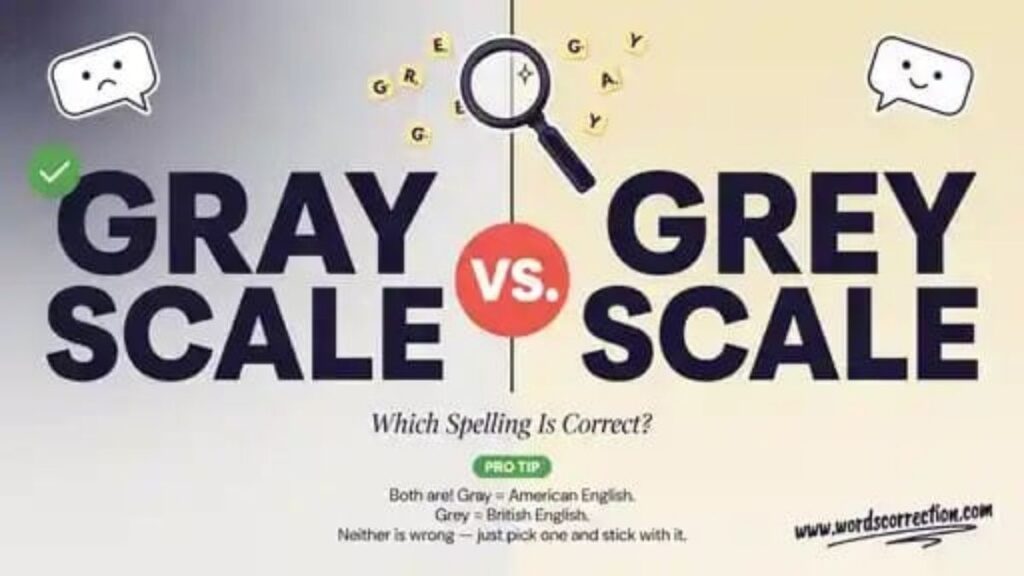
The question “grayscale or greyscale” seems simple until that extra “e” suddenly creates a spelling puzzle. Is one version incorrect, or are both acceptable? Thankfully, there’s no need to launch a full-scale spelling investigation. Both terms refer to the same concept: a range of tones from black through gray or grey to white. The difference mainly comes down to regional English usage. American English generally prefers “grayscale,” while British English commonly uses “greyscale.” In this guide, we’ll clear up the confusion, explain the meaning, spelling, pronunciation, and usage of both forms, and help you choose the right spelling for your audience and writing style.
Grayscale or Greyscale Quick Answer
The simplest answer is this:
Grayscale is the standard spelling in American English, while greyscale is the standard spelling in British English.
The grayscale greyscale difference is therefore mainly a matter of spelling rather than meaning.
| Spelling | Preferred Usage | Meaning |
| Grayscale | American English | A range of gray tones from black to white |
| Greyscale | British English | A range of grey tones from black to white |
| Gray scale | Less common as the technical term | Usually written as grayscale |
| Grey scale | Less common as the technical term | Usually written as greyscale |
If you’re writing for an American audience, grayscale is the natural choice. If you’re following British English conventions, greyscale is usually preferable.
Neither spelling should automatically be treated as incorrect.
Is It Grayscale or Greyscale Correct?
Yes, both spellings are correct in the appropriate regional context.
The easiest way to remember the distinction is to look at the underlying color word:
- gray → grayscale
- grey → greyscale
American English generally uses gray, while British English generally uses grey. The compound terms follow the same pattern.
For example:
The photographer converted the image to grayscale.
An equivalent sentence in British English would be:
The photographer converted the image to greyscale.
The meaning remains the same.
Fix common more word mistakes in English
Unattentive or Inattentive Meaning and Usage
What Does Grayscale or Greyscale Mean?
The grayscale meaning refers to a range of neutral visual tones extending from black to white.
Imagine a scale with pure black at one end and pure white at the other. Every intermediate shade represents a different level of gray. Together, these values create a grayscale or greyscale.
The term appears in many fields, including:
- Photography
- Digital imaging
- Graphic design
- Digital art
- Printing
- Image processing
- Computer graphics
- Display technology
A grayscale image doesn’t necessarily contain only black and white. In fact, it can contain hundreds of distinct tonal values.
For example, a typical 8-bit grayscale image can represent 256 intensity levels, ranging from 0 for black to 255 for white. Those intermediate values allow photographs to preserve subtle details in shadows, highlights, texture, and facial features.
Grayscale Definition
A practical grayscale definition is:
Grayscale is a visual or digital representation that uses a range of neutral tones between black and white instead of conventional hues.
In digital imaging, each pixel typically carries a value representing its intensity or brightness. The exact technical implementation can vary depending on the image system and color model.
The important point is that grayscale focuses on tonal values rather than hue and saturation.
Greyscale Definition
The greyscale definition is essentially the same.
Greyscale is the British English spelling for a range or representation of neutral tones extending from black to white.
The spelling changes, but the underlying concept doesn’t.
That makes grayscale definition in English and greyscale definition in English nearly identical. The regional spelling is the main distinction.
Learn the difference between confusing more English words
Handle or Handel Correct Spelling and Usage
Grayscale vs Greyscale: What Is the Difference?
When considering grayscale vs greyscale, there is no major difference in the concept being described.
Both words can refer to:
- A range of gray or grey tones
- A grayscale or greyscale image
- A method of representing visual information
- A photographic effect
- A design palette
- A digital imaging process
| Feature | Grayscale | Greyscale |
| Main variety of English | American English | British English |
| Related spelling | Gray | Grey |
| Meaning | Same | Same |
| Pronunciation | Generally the same | Generally the same |
| Used in photography | Yes | Yes |
| Used in digital imaging | Yes | Yes |
| Used in graphic design | Yes | Yes |
| Correct spelling | Yes | Yes |
In other words, the greyscale vs grayscale distinction is comparable to the broader gray vs grey distinction.
Gray vs Grey
The spelling difference begins with the color itself.
Gray is the standard American English spelling.
Grey is the standard British English spelling.
Both refer to the same neutral color.
Once these words combine with scale, the regional spelling difference carries over:
- gray + scale = grayscale
- grey + scale = greyscale
This simple connection explains most of the confusion surrounding grayscale spelling and greyscale spelling.
Why Is It Called Grayscale?
The word is fairly literal.
A scale represents a range of values. A grayscale represents a range of gray tones, generally moving from black through intermediate shades to white.
That is why people ask why is it called grayscale. The name reflects the idea of a scale of gray values.
Why Is It Called Greyscale?
The British form follows exactly the same logic.
Grey + scale = greyscale.
The only change is the spelling of grey.
Therefore, the explanation for why is it called greyscale is the same as the explanation for grayscale. Both names describe a scale of neutral tones.
Learn the difference between commonly mixed-up more words
Inconsolable or Unconsolable Which Is Correct?
British English vs American English Spelling
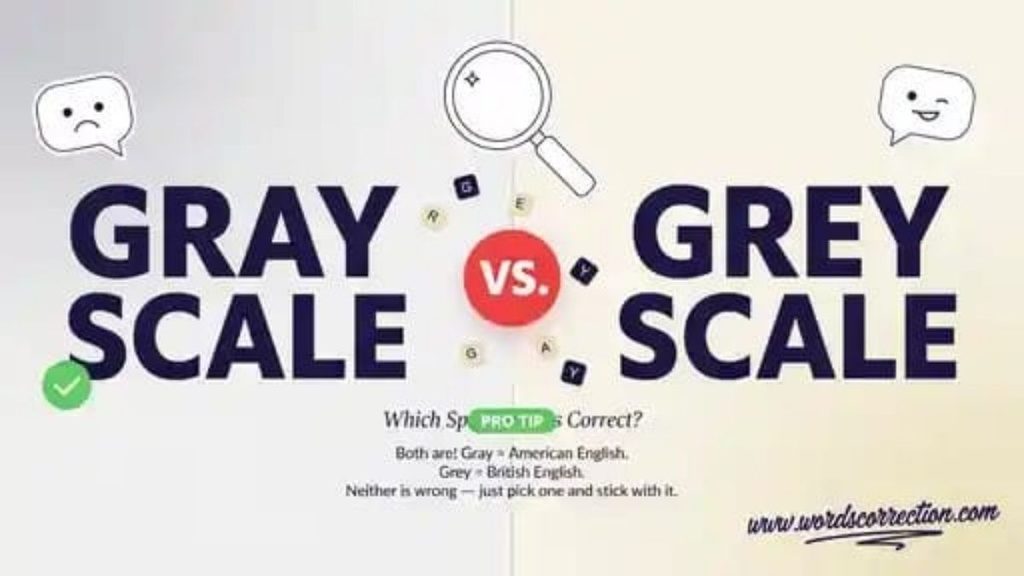
Regional spelling conventions determine which form will look most natural to your readers.
Grayscale in American English
Grayscale is the preferred form in American English.
You’ll commonly see it in:
- US technical documentation
- American photography publications
- Digital imaging software
- Graphic design resources
- Printing discussions
- Computer graphics
- Educational materials
For example:
The editor converted the photograph to grayscale before adjusting the contrast.
Another example:
The printer offers a separate grayscale setting for documents.
If your content follows American English, grayscale in American English is the preferred spelling.
Greyscale in British English
Greyscale follows the British spelling of grey.
For example:
The photographer converted the image to greyscale.
Or:
The designer created a subtle greyscale palette for the website.
When writing in British English, greyscale in British English is generally the more appropriate choice.
Learn the difference between tricky grammar more words
Where or When Difference and correct usage
What About Commonwealth English?
English usage across Commonwealth countries isn’t completely uniform. British spelling has influenced many varieties of English, but local usage, technical terminology, publishers, and organizational style guides can affect which form appears.
As a result, greyscale is widely recognized outside the United States, while grayscale is strongly associated with American English and is also common in international technical contexts.
The safest approach is simple: follow the style guide and audience for your specific publication.
Grayscale and Greyscale in Photography
Photography provides one of the clearest examples of the term in everyday use.
Grayscale photography represents an image through tonal differences rather than conventional color. Instead of displaying red, blue, green, yellow, and other hues, the image uses neutral values ranging from dark to light.
This can dramatically change how a photograph feels.
A color photograph might draw attention to the bright red of a vehicle or the blue of a sky. Once converted to grayscale, those colors no longer compete for attention. Instead, the viewer notices contrast, texture, lighting, shape, and composition.
The British equivalent is greyscale photography.
Learn the difference between confusing word pairs
Doggie or Doggy Which Spelling Is Correct?
What Does Grayscale Mean in Photography?

In photography, grayscale generally means representing an image through different levels of lightness and darkness without displaying its original colors.
However, grayscale conversion isn’t simply a matter of making every pixel “gray.” A conversion method determines how the original color information contributes to the resulting tonal value.
This matters because human vision doesn’t perceive every color as equally bright. A bright green and a deep blue can have very different perceived luminance even when their numerical color values might appear similar in a basic calculation.
Consequently, image-editing software can use specific formulas or algorithms to produce more visually appropriate grayscale results.
Grayscale vs Black and White
The phrase black and white grayscale can cause confusion because people often use “black and white” casually to describe any image without color.
Technically, however, grayscale can contain a large number of intermediate tones.
A grayscale image might include:
- Pure black
- Very dark gray
- Medium gray
- Light gray
- Very light gray
- Pure white
A strictly two-tone image contains only black and white.
That distinction matters in digital imaging, printing, photography, and graphic design.
A portrait with smooth skin tones and subtle shadows is fundamentally different from a graphic containing only solid black shapes against a white background.
The same distinction applies to black and white greyscale. Although the phrase may be used informally, a greyscale image can contain far more than two colors or values.
Learn the difference between often confused words
Insight or Insite? What’s the Correct English Word?
Grayscale vs Monochrome
The grayscale vs monochrome distinction is worth understanding because the words are sometimes used interchangeably.
Monochrome has a broader meaning. It generally refers to an image or design based on a single color or color family.
Grayscale is more specific because it uses neutral tones between black and white.
For example, an image made entirely from different shades of blue could be considered monochromatic. It wouldn’t normally be described as grayscale.
So:
- Grayscale = neutral black-to-white tonal range
- Monochrome = broader concept involving one color or color family
That means greyscale vs monochrome has essentially the same distinction.
Grayscale in Digital Imaging
Digital imaging gives grayscale a more technical dimension.
Digital images consist of pixels, and each pixel stores information used to determine its appearance. In an 8-bit grayscale image, each pixel can typically represent one of 256 intensity levels.
The basic range is:
- 0 = black
- 255 = white
- 1–254 = intermediate gray values
This tonal range allows digital images to preserve considerable detail even without conventional color information.
By comparison, a standard RGB image uses three color channels: red, green, and blue. Grayscale representation focuses on a single intensity-related value instead.
Learn the difference between basic English word mistakes
Employees or Employee’s: Which One Is Correct?
Grayscale Conversion
transforms a color image into a representation based on gray tones.
A simple average of red, green, and blue values can produce a basic result, but many systems use weighted calculations because human vision responds differently to different wavelengths.
This is one reason a grayscale conversion can preserve a convincing sense of brightness even after the original color disappears.
The spelling doesn’t affect the technology. Grayscale conversion and greyscale conversion describe the same general process.
Grayscale Art, Drawing and Design
Artists have long relied on tonal values to create depth and form.
Grayscale art uses differences between dark and light areas to communicate shape, volume, texture, and atmosphere. The British equivalent is greyscale art.
The same principle applies to:
- Grayscale drawing
- Greyscale drawing
- Digital painting
- Concept art
- Portrait studies
- Illustration
- Graphic design
A grayscale study can help an artist evaluate the structure of an image before introducing color.
For example, a portrait might contain subtle changes around the cheekbones, eyes, nose, and jaw. Those tonal shifts help create the illusion of three-dimensional form.
Grayscale Design
Grayscale design uses neutral tones instead of a broad color palette.
Designers may use it to:
- Test visual hierarchy
- Evaluate contrast
- Simplify a composition
- Create a restrained aesthetic
- Focus attention on typography
- Prepare certain print materials
- Study tonal balance
A grayscale design can also expose weaknesses that color sometimes conceals. If a design becomes confusing when color is removed, important information may depend too heavily on hue rather than structure, contrast, or typography.
Learn the difference between commonly misused words
Chears or Cheers Difference, Meaning and Usage
Grayscale Mode and Greyscale Mode
Modern phones and computers may include a grayscale mode that removes or greatly reduces color from the display.
The British spelling is greyscale mode.
When enabled, colorful interface elements, photographs, videos, and icons appear as neutral tones. The exact purpose and behavior depend on the device and operating system.
Related terms include:
- Grayscale screen
- Grayscale display
- Grayscale setting
- Grayscale accessibility
- Grayscale phone setting
- Grayscale digital screen
Grayscale in Android
Grayscale in Android generally refers to a device feature that changes the display so that colors appear as shades of gray.
The exact location and name of the setting can differ between Android versions and manufacturers. Some devices place the option under accessibility settings, while others may associate it with digital wellbeing or display features.
If you’re searching for how to turn on grayscale or how to turn off grayscale, check your device’s current settings because the menu structure isn’t identical across all Android phones.
The same principle applies to searches such as grayscale mode Android, grayscale mode phone, and grayscale filter Android.
Learn the difference between everyday English mistakes
Honoured or Honored Meaning, Spelling and Usage
Grayscale Filter and Image Editing
A grayscale filter changes an image so that its visible colors are represented through neutral tones.
In photo editing, this effect can provide a quick way to study an image’s tonal structure. It can also create a classic, restrained visual style.
The British spelling is greyscale filter.
Still, a filter isn’t necessarily identical to a technically accurate grayscale conversion. Different software applications can use different algorithms, presets, or visual effects.
For general writing, however, both terms describe the same broad visual idea.
Is Grayscale One Word or Two?
The established technical terms are normally written as one word:
- grayscale
- greyscale
The forms gray scale and grey scale can appear in some contexts, but the single-word forms are generally preferable when referring to the established imaging concept.
Therefore, if you’re deciding between gray scale and grayscale, use grayscale in American English.
Likewise, use greyscale rather than grey scale when following the standard British form.
How Do You Spell Grayscale?
In American English, the preferred spelling is:
grayscale
It combines gray and scale into one word.
How Do You Spell Greyscale?
In British English, the preferred spelling is:
greyscale
It combines grey and scale into one word.
Neither form normally requires a hyphen.
How to Use Grayscale in a Sentence
The word can function as a noun or adjective depending on the sentence.
Examples include:
- The editor converted the photograph to grayscale.
- The printer has a grayscale option.
- The artist created a detailed grayscale drawing.
- The website uses a minimalist grayscale design.
- The image contains a broad grayscale tonal range.
These examples demonstrate how the word works naturally in different contexts.
How to Use Greyscale in a Sentence
The British form works in the same grammatical way:
- The editor converted the photograph to greyscale.
- The printer offers greyscale printing.
- The artist created a detailed greyscale drawing.
- The designer selected a muted greyscale palette.
- The photograph has a wide greyscale tonal range.
The grammar doesn’t change simply because the spelling does.
Learn the difference between more words people mix up
Boxes or Boxs Correct Spelling and Usage
Common Mistakes With Grayscale and Greyscale
The two spellings cause surprisingly few real language problems once the regional distinction is clear. Most mistakes come from treating one regional form as universally correct.
Assuming Greyscale Is Wrong
Greyscale isn’t wrong.
It’s the standard British English spelling and is widely understood internationally.
A British publication doesn’t need to replace greyscale with grayscale simply because American English favors the latter.
Assuming Grayscale Is Wrong
The opposite assumption is equally misleading.
Grayscale is the standard American English form. An American writer doesn’t need to change it to greyscale.
Mixing Gray and Grey
Consistency is important.
An American English document will normally use:
gray → grayscale
A British English document will normally use:
grey → greyscale
However, exceptions can occur when you reproduce an official name, quotation, product label, or software terminology.
Switching Between Grayscale and Greyscale
Avoid switching between the two spellings without a reason.
For example, an article that uses grayscale throughout shouldn’t suddenly use greyscale halfway through. The change can make the writing look inconsistent even though both forms are valid.
Choose the spelling that matches your audience and maintain it throughout the piece.
Confusing Grayscale With Black and White
A grayscale image can contain numerous tonal values. It isn’t automatically limited to pure black and pure white.
That difference becomes especially important in photography and digital imaging, where subtle tonal transitions carry information about depth, texture, lighting, and form.
Treating Grayscale and Monochrome as Exact Synonyms
The terms overlap, but they aren’t always interchangeable.
Monochrome is broader. Grayscale specifically describes neutral tones between black and white.
Using the more precise term can prevent confusion in technical and educational writing.
Grayscale and Greyscale Synonyms
If you’re looking for a grayscale synonym or greyscale synonym, the best choice depends on the context.
Related terms include:
- Monochrome
- Monochromatic
- Gray tones
- Grey tones
- Black-and-white imagery
- Neutral tones
However, these aren’t perfect synonyms in every situation.
For instance, monochrome can include a single hue such as blue. Grayscale specifically refers to neutral tones. Likewise, black and white may describe an image containing only two values, while grayscale can include many intermediate shades.
For technical precision, grayscale or greyscale remains the better term.
Grayscale Medical and Greyscale Disease: A Different Meaning
Search engines sometimes associate greyscale with an entirely different subject.
You may encounter searches such as:
- greyscale disease
- grayscale disease
- greyscale medical
- grayscale medical
- what is greyscale disease
- greyscale disease meaning
In this context, greyscale does not refer to photography or digital imaging.
Greyscale Disease in Game of Thrones
Greyscale is a fictional disease in Game of Thrones and A Song of Ice and Fire. It isn’t a real medical condition.
Within the fictional story, the disease affects the skin and can cause it to become hardened and stone-like.
Two prominent characters associated with greyscale are Jorah Mormont and Shireen Baratheon.
That is why searches for greyscale Game of Thrones, greyscale disease Game of Thrones, greyscale Jorah Mormont, and greyscale Shireen Baratheon can appear alongside searches about grayscale photography and technology.
These are completely separate meanings.
Is Greyscale Disease Real?
No.
The greyscale disease meaning belongs to a fictional world. It shouldn’t be presented as an actual medical diagnosis.
Real medical conditions can cause skin discoloration, scaling, thickening, or other visible changes, but the specific disease called greyscale in Game of Thrones is fictional.
Learn the difference between similar English words the easy way
Trialled or Trialed Meaning, Difference and Usage
Grayscale vs Greyscale: Comparison at a Glance
| Question | Answer |
| Is grayscale correct? | Yes |
| Is greyscale correct? | Yes |
| Which is preferred in US English? | Grayscale |
| Which is preferred in British English? | Greyscale |
| Do they generally mean the same thing? | Yes |
| Are they normally pronounced differently? | No |
| Can both describe image processing? | Yes |
| Can both describe photography? | Yes |
| Are both normally written as one word? | Yes |
| Is the Game of Thrones greyscale disease real? | No |
| Is grayscale identical to pure black and white? | No |
| Is grayscale related to monochrome? | Yes |
Which Is Correct: Grayscale or Greyscale?
So, which is correct, grayscale or greyscale?
The answer depends on your variety of English.
Choose grayscale when writing in American English.
Choose greyscale when writing in British English.
For a global audience, either form can be appropriate. What matters most is consistency and adherence to the style guide or terminology used by your publication, organization, or audience.
Should I Use Grayscale or Greyscale?
Use this quick guide:
Choose grayscale if:
- You’re writing in American English.
- Your primary audience is in the United States.
- Your publication follows US spelling.
- You’re creating US-focused technical or educational content.
Choose greyscale if:
- You’re writing in British English.
- Your primary audience is in the United Kingdom.
- Your publication follows British spelling.
- Your organization prefers British terminology.
For an international audience:
- Follow your organization’s style guide.
- Consider the terminology used by the relevant software or technical standard.
- Choose one spelling when no specific convention applies.
Use that spelling consistently.
Practice Session: Grayscale or Greyscale
Instructions: Fill in each blank with the most appropriate word or phrase. Try to complete all 25 questions before checking the answer key.
Fill-in-the-Blank
- __________ refers to a range of shades from black to white without color.
- __________ is the preferred spelling in American English.
- __________ is the spelling commonly used in British English.
- Grayscale and greyscale have the same basic __________.
- A black-and-white photograph can be represented as a __________ image.
- The designer used __________ to create a simple, neutral visual effect.
- The British English spelling of “grayscale” is __________.
- The American English spelling of “greyscale” is __________.
- A grayscale image contains different __________ of gray.
- Black and white represent the two extremes of the __________ range.
- __________ is a related term that can describe an image based on a single color or tonal range.
- A strictly black-and-white image may contain only __________ tones.
- Grayscale is widely used in digital __________ and photography.
- A smartphone that displays content only in shades of gray may be using __________ mode.
- Switching a screen to grayscale does not necessarily eliminate __________ light.
- Grayscale artwork can emphasize shadows, highlights, texture, and __________.
- When choosing between grayscale and greyscale, consider your target __________.
- In American English, the standard spelling is __________.
- In British English, the standard spelling is __________.
- Grayscale images generally do not contain colored __________.
- Different gray tones can create variations in brightness and __________.
- If a smartphone suddenly appears black and white, a __________ setting may have been activated.
- Artists often use grayscale to focus on shading and __________ rather than color.
- Grayscale is commonly used in photography, printing, graphic design, and digital __________.
- Although grayscale and greyscale have different spellings, they share the same basic __________.
Answer Session
- Grayscale
- Grayscale
- Greyscale
- meaning
- grayscale
- grayscale
- greyscale
- grayscale
- shades
- grayscale
- Monochrome
- two
- imaging
- grayscale
- blue
- contrast
- audience
- grayscale
- greyscale
- hues
- contrast
- grayscale
- contrast
- art
- meaning
Here’s a trusted source for clear more words Comparison:
Grammar Update
FAQs About Grayscale or Greyscale
What does grayscale mean?
Grayscale means using different shades of gray between black and white instead of colors. It is commonly used in photos, digital images, printing, and design.
What is greyscale?
Greyscale is another spelling of grayscale. Both words have the same meaning. The main difference is regional spelling.
Which is correct: greyscale or grayscale?
Both are correct. Grayscale is preferred in American English, while greyscale is commonly used in British English.
What is another name for grayscale?
Monochrome is a related term, but it does not always mean exactly the same thing. Grayscale specifically uses shades of gray from black to white.
What is the opposite of grayscale?
The opposite of grayscale is generally a color image. Color images use different hues, while grayscale images use only shades of gray.
What is grayscale color?
A grayscale color is a shade of gray without a specific hue. The range goes from black through different shades of gray to white.
What does grayscale look like in real life?
Grayscale looks like a picture made up of black, white, and different shades of gray. A black-and-white photograph is a common example.
How do you use greyscale in a sentence?
You can use greyscale to describe an image or design that uses shades of gray. For example: “The artist created a greyscale drawing.”
What is grayscale mode?
Grayscale mode is a device setting that displays the screen in shades of gray instead of normal colors. It is available on many smartphones and other digital devices.
Does grayscale still emit blue light?
Yes. Grayscale does not completely remove blue light from a screen. It changes the colors displayed, while blue-light filters are designed specifically to reduce or adjust blue light.
Does grayscale reduce dopamine?
There is no strong evidence that grayscale directly reduces dopamine levels. It may make a phone less visually appealing, which could encourage some people to use it less.
Does grayscale improve sleep?
Grayscale is not proven to improve sleep by itself. Reducing screen time and brightness before bed may be more helpful for healthy sleep habits.
Is grayscale better for your eyes?
Grayscale is not automatically better for your eyes. Eye comfort can also depend on screen brightness, viewing distance, screen time, and taking regular breaks.
What does grayscale do to the mind?
Grayscale can make a phone less visually stimulating because colorful apps, photos, and notifications appear in gray tones. Its effect can vary from person to person.
Is grayscale healthier than a color display?
There is no clear evidence that grayscale is generally healthier than a color display. Some people may find it useful for reducing visual distractions.
Does grayscale actually work?
Yes. Grayscale changes an image or screen from full color to different shades of gray. Itsusefulness for reducing distractions depends on the individual.
Does using your phone in grayscale help?
It can help some people reduce visual distractions. Colorful apps and notifications may feel less attractive when displayed in grayscale.
Why did my phone suddenly turn grayscale?
Your phone may have switched to grayscale because a display, accessibility, bedtime, focus, or digital-wellbeing setting was turned on.
Why did my Android phone suddenly turn black and white?
Your Android phone may have grayscale, color correction, or bedtime mode enabled. The location of these settings can vary depending on your phone model and Android version.
How do I get my phone back to color from black and white?
Open your phone’s Display or Accessibility settings and look for grayscale, color filters, or color correction. Turn off the active setting to restore normal colors.
Why is my screen stuck in black and white?
Your screen may be stuck in black and white because grayscale or a color filter is enabled. Check your Display and Accessibility settings.
How do I get out of grayscale mode?
Go to your phone’s Display or Accessibility settings and turn off Grayscale, Color Filters, or Color Correction. If the setting returns automatically, check scheduled modes.
How do I restore the default screen colors?
Check your phone’s Display and Accessibility settings for color filters, grayscale, or color correction. Turn off any setting that changes your screen colors.
Can grayscale be used for drawings and photographs?
Yes. Grayscale is commonly used for photographs, drawings, and digital artwork. It helps emphasize shading, contrast, shadows, and highlights.
Is grayscale the same as black and white?
Not exactly. Grayscale contains many shades between black and white. A strictly black-and-white image may contain only black and white, with no intermediate shades.
Why is grayscale used in photography and design?
Grayscale helps designers and photographers focus on contrast, lighting, texture, shadows, and composition without the distraction of color.
Conclusion
So, is it grayscale or greyscale? Fortunately, this spelling debate doesn’t require a visit from the grammar police. Both spellings are correct, but your choice depends mainly on the variety of English you’re using. Grayscale is the preferred spelling in American English, while greyscale is commonly used in British English and other varieties influenced by British usage.
The meaning remains the same. Both words describe a range of tones that extends from black through different shades of gray or grey to white. You’ll find the terms in photography, digital imaging, graphic design, printing, art, and image editing.
There’s also an easy memory trick: gray → grayscale, while grey → greyscale. Once you remember that pattern, the spelling becomes much less confusing.
Consistency matters, too. If you’re writing for an American audience, grayscale is usually the better choice. If your readers follow British English, greyscale is generally more appropriate. Using both spellings interchangeably in the same piece can make your writing look inconsistent, even though neither form is inherently wrong.
It’s also important not to treat grayscale, black and white, and monochrome as exact synonyms. Grayscale can contain many shades between black and white. A traditional black-and-white image may contain only black and white, while monochrome is a broader term for an image based on variations of a single color.
Ultimately, the grayscale or greyscale question is much easier than it first appears. Choose the spelling that matches your audience, keep your usage consistent, and you’ll be on solid linguistic ground. After all, one little “e” shouldn’t turn a simple spelling choice into a full-blown mystery.

Stella AJS is an experienced blogger and dedicated English language writer at Words Correction. She turns confusing grammar, word meanings, spelling, and usage into clear, practical insights that readers can easily understand and apply. With a passion for precise and engaging writing, Stella helps readers avoid common language mistakes, strengthen their vocabulary, and communicate with greater clarity and confidence.




