
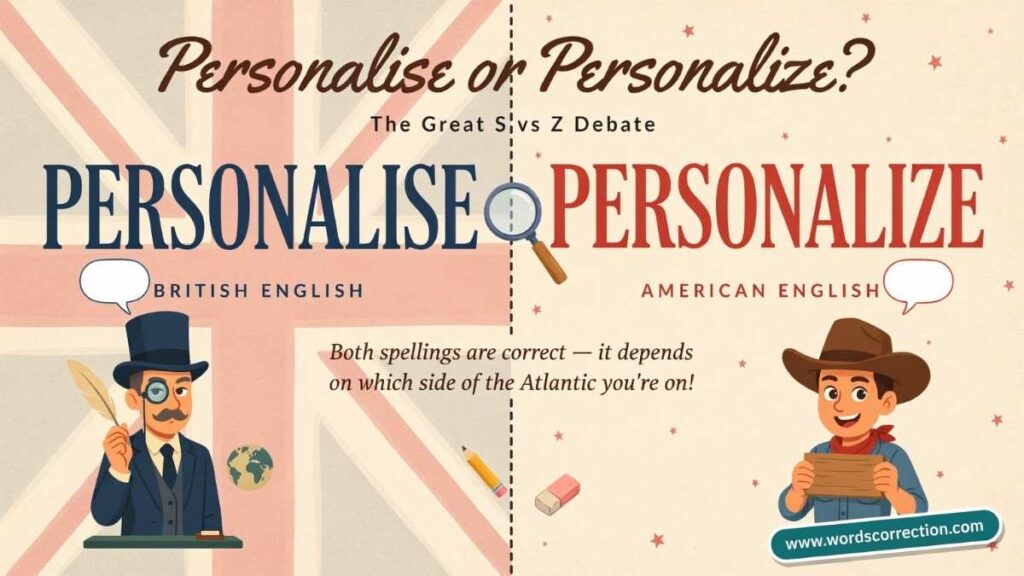
The choice between personalise or personalize can turn a simple spelling decision into a surprisingly tricky grammar puzzle. The two forms look different, but their difference isn’t about meaning or grammatical function. Instead, it comes down to a familiar distinction between British English and American English spelling. Both words mean to make something suited or tailored to a particular person. The real challenge is knowing which spelling matches your audience and writing style. In this guide, you’ll discover the meaning, usage, spelling patterns, examples, and key differences between personalise or personalize, along with a simple rule to help you choose confidently and write consistently.
Personalise or Personalize Quick Answer
The answer is straightforward:
Personalize is the standard American English spelling. Personalise is the common British English spelling.
Both forms mean to make something suited, relevant, or specific to a particular person. This can involve using someone’s preferences, personal details, needs, or choices.
| Spelling | Main Usage | Meaning |
| personalize | American English | To make something suited to a particular person |
| personalise | British English | To make something suited to a particular person |
| personalized | American English | Past tense or adjective form |
| personalised | British English | Past tense or adjective form |
| personalization | American English | The process of making something personal or individual |
| personalisation | British English | The process of making something personal or individual |
| personalizing | American English | Present participle or gerund |
| personalising | British English | Present participle or gerund |
If you’re asking which is correct personalise or personalize, the answer depends on the variety of English you’re using.
- US English: personalize
- UK English: personalise
- International writing: follow the style guide or regional convention required for your audience
The important thing is consistency.
What Does Personalize Mean?
The personalize meaning is simple: to change, design, or adapt something so that it suits a particular person.
The word often involves adding a personal touch, but personalization can go much further than adding a name.
For example, a company might personalize an email using a customer’s name and previous purchases. A website might personalize recommendations according to a user’s interests. A student might personalize a study plan around specific learning needs.
In short, to personalize something is to make it more relevant or suitable for an individual.
Learn the difference between more words people mix up
Where or When Difference and correct usage
Personalize Definition
A clear personalize definition is:
Personalize means to make something more suitable, relevant, or distinctive for a particular person by considering that person’s preferences, needs, characteristics, or personal details.
The exact action depends on the context.
For example:
- You can personalize a gift with someone’s name.
- You can personalize an email for a particular recipient.
- You can personalize an app by changing its settings.
- You can personalize a learning plan around a student’s needs.
- You can personalize a shopping experience using customer preferences.
Personalization doesn’t always mean adding a name or initials. It can also involve changing content, features, recommendations, settings, or services.
Personalize in a Sentence
Here are practical examples of personalize in a sentence:
- You can personalize your profile by adding a photo.
- The company allows customers to personalize their products.
- The teacher used different materials to personalize the learning experience.
- The website uses user preferences to personalize recommendations.
- She decided to personalize the gift with his initials.
In every example, something becomes more suitable for a specific person or their individual preferences.
What Does Personalise Mean?
If you’re searching for the personalise meaning, the definition is essentially the same as personalize.
Personalise means to adapt, modify, or design something so that it suits a particular person.
The meaning doesn’t change because the spelling uses s instead of z.
The difference is primarily regional:
- personalize → American English
- personalise → British English
Personalise Definition
A useful personalise definition is:
Personalise means to adapt or modify something for a particular person by taking that person’s preferences, needs, characteristics, or personal details into account.
For example:
- You can personalise a birthday card.
- A website can personalise recommendations.
- A student can personalise a study plan.
- A business can personalise its customer service.
- You can personalise your phone settings.
Personalise in a Sentence
Here are several examples of personalise in a sentence:
- You can personalise the invitation with the guest’s name.
- The app lets users personalise their notification settings.
- The company aims to personalise the customer experience.
- Teachers can personalise lessons to meet individual needs.
- She chose to personalise the notebook with her initials.
If you’re writing in American English, simply replace personalise with personalize. The meaning remains unchanged.
Learn the difference between everyday English mistakes
Doggie or Doggy Which Spelling Is Correct?
Personalize vs Personalise: What Is the Difference?
The personalize vs personalise difference is primarily a matter of spelling convention.
Both forms:
- are verbs
- have the same basic meaning
- normally have the same pronunciation
- describe adapting something for an individual
- form related words in the same way
- are accepted within their respective regional English conventions
The visible difference is the final letter:
personalize → z
personalise → s
This is one example of broader regional spelling differences between British and American English.
Personalise vs Personalize Difference at a Glance
| Feature | Personalize | Personalise |
| Part of speech | Verb | Verb |
| Meaning | Make something suited to a person | Make something suited to a person |
| Common regional convention | American English | British English |
| Pronunciation | Generally the same | Generally the same |
| Past form | personalized | personalised |
| Noun form | personalization | personalisation |
| -ing form | personalizing | personalising |
So, personalise vs personalize isn’t a difference in word meaning. It is primarily a difference in spelling convention.
Personalize or Personalise Spelling Why Does It Differ?
The personalize or personalise spelling question is part of a broader pattern in English.
American English frequently uses -ize where British English commonly uses -ise.
For example:
| American English | British English |
| organize | organise |
| recognize | recognise |
| realize | realise |
| personalize | personalise |
| apologize | apologise |
| modernize | modernise |
However, the spelling system is more complicated than a simple “American z, British s” rule. British English also accepts some -ize spellings, depending on the word and the dictionary or style guide being followed.
For personalize/personalise, however, the regional distinction is easy to recognize.
The spelling difference doesn’t create a new definition. Both forms refer to the same action.
Learn the difference between commonly misused words
Insight or Insite? What’s the Correct English Word?
American English vs British English
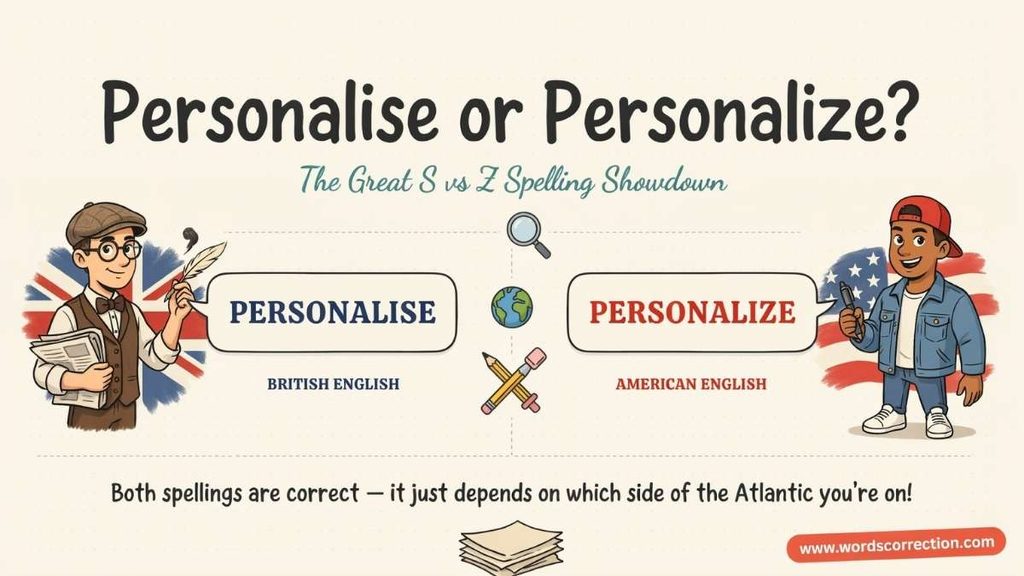
The British vs American English distinction provides the clearest way to understand these spellings.
Personalize in American English
In standard American English spelling, the preferred form is personalize.
Examples include:
- We can personalize your account.
- Customers can personalize their orders.
- The software lets users personalize their dashboards.
- You can personalize the message before sending it.
If you’re writing for an American publication, company, school, or audience, personalize is generally the appropriate choice.
So, is personalize an American spelling?
Yes. Personalize is the standard American form.
Personalise in British English
In British English, the commonly preferred spelling is personalise.
Examples include:
- You can personalise your account.
- Customers can personalise their orders.
- The software lets users personalise their dashboards.
- You can personalise the message before sending it.
So, is personalise a British spelling?
Yes. Personalise is a standard British spelling.
What About Personalise in American English?
If you’re searching for personalise American English, the usual US form is personalize.
American readers generally understand personalise, but it doesn’t match the standard US spelling convention.
The reverse is also true. British readers understand personalize, but personalise is the common spelling in British English.
Understanding both forms is useful, but using the appropriate form for your audience makes your writing more consistent.
Learn the difference between basic English word mistakes
Employees or Employee’s: Which One Is Correct?
Is It Personalise or Personalize?
If you’re asking is it personalise or personalize, first identify the English variety you’re using.
Use Personalize When
- Writing in American English
- Writing for a US audience
- Creating US-focused website content
- Preparing American business documents
- Writing US marketing material
- Following a US English style guide
Use Personalise When
- Writing in British English
- Writing for a UK audience
- Creating UK-focused website content
- Preparing British business documents
- Writing UK marketing material
- Following a British English style guide
This simple rule makes when to use personalise and when to use personalize much easier to remember.
Personalize or Personalise in UK and US English
A quick memory rule is:
UK → personalise
US → personalize
This distinction is part of the broader difference between UK spelling and US spelling.
| Region or Style | Common Form |
| United States | personalize |
| United Kingdom | personalise |
| US English | personalize |
| UK English | personalise |
Other English-speaking regions may follow different editorial preferences. Canadian, Australian, and New Zealand English can show a mixture of British and American influences.
When writing for a specific publication or organization, its style guide should take priority.
Learn the difference between often confused words
Chears or Cheers Difference, Meaning and Usage
The Origin of Personalize and Personalise
The history of these words starts with personal, which ultimately comes from Latin through French and is connected with the concept of a person or individual.
English developed the verb personalize to describe the process of making something personal or adapting it for an individual.
The British spelling personalise represents a regional spelling variant of the same verb.
The broader -ize/-ise distinction developed through the history of English spelling and editorial practice. American English standardized many -ize forms, while British English commonly uses -ise forms in words such as personalise.
However, British English isn’t completely uniform. Some British dictionaries and publishers retain or prefer -ize in certain words.
That’s why it’s more accurate to describe personalize and personalise as regional spelling variants rather than claiming that one is inherently correct and the other incorrect.
Personalize and Personalise Pronunciation
Another common question concerns pronunciation.
The spelling difference between personalize and personalise normally doesn’t create a different pronunciation. Both forms use a voiced z sound at the end.
Accent can affect vowel sounds and rhythm, but the s/z spelling difference itself doesn’t normally change how the verb is pronounced.
If you’re searching for how to pronounce personalize, personalize pronunciation, how to pronounce personalise, or personalise pronunciation, focus on the spoken form rather than assuming the written s in personalise produces an /s/ sound.
The spelling is regional. The pronunciation is generally the same.
Learn the difference between confusing word pairs
Honoured or Honored Meaning, Spelling and Usage
Personalize vs Personalise Related Word Forms
The spelling difference continues through the related forms of the verb.
| American English | British English |
| personalize | personalise |
| personalized | personalised |
| personalizing | personalising |
| personalization | personalisation |
Understanding this pattern prevents another common problem: knowing the basic verb but becoming uncertain about its related forms.
Personalised vs Personalized
The personalised vs personalized distinction follows the same regional pattern.
- personalized → American English
- personalised → British English
For example:
US English: The website provides personalized recommendations.
UK English: The website provides personalised recommendations.
The personalised meaning and personalized meaning are the same. Both describe something adapted or tailored for a particular person.
Learn the difference between tricky grammar more words
Boxes or Boxs Correct Spelling and Usage
Personalisation vs Personalization
The noun also follows the regional spelling pattern:
- personalization → American English
- personalisation → British English
The personalization meaning is the process of adapting something to a particular person.
The personalisation meaning is the same.
For example:
US English: Personalization can make online content more relevant to users.
UK English: Personalisation can make online content more relevant to users.
Only the spelling changes.
Personalising vs Personalizing
The present participle follows the same pattern:
- personalizing → American English
- personalising → British English
The personalizing meaning is the process of making something more personal or suited to an individual.
The personalising meaning is identical.
For example:
US English: The company is personalizing its emails.
UK English: The company is personalising its emails.
Again, the meaning doesn’t change.
Learn the difference between commonly mixed-up more words
Trialled or Trialed Meaning, Difference and Usage
Personalize and Personalise Examples
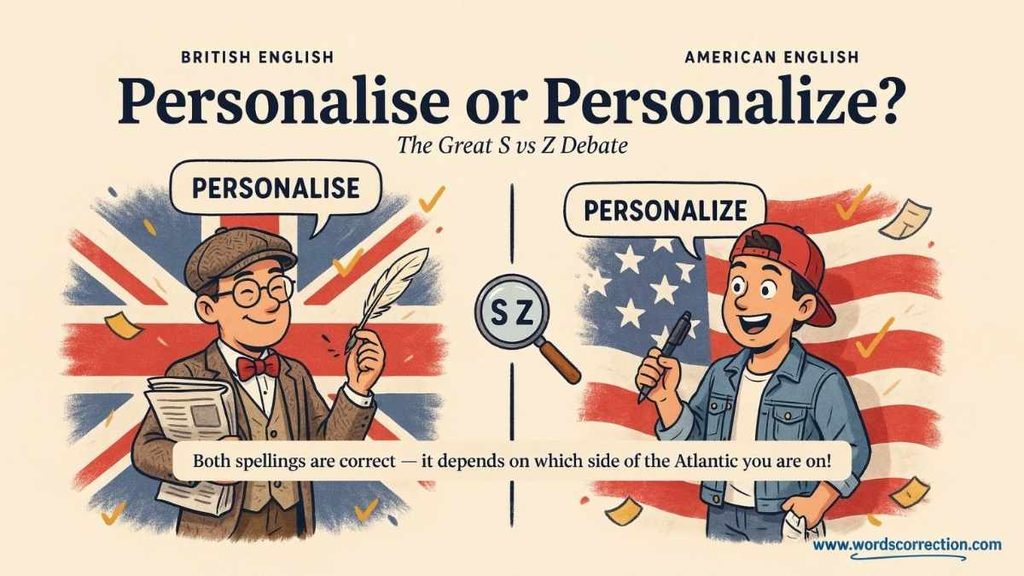
Real-world examples make the spelling distinction easier to remember.
Everyday Examples
- You can personalize the notebook with your name.
- She decided to personalise the card with a short message.
- The app lets users personalize their home screen.
- Customers can personalise their orders.
Technology Examples
Modern software uses personalization in many different ways.
You might:
- personalize your privacy settings
- personalize your profile
- personalize your notifications
- personalize your dashboard
- personalize content recommendations
In British English, the same expressions become:
- personalise your privacy settings
- personalise your profile
- personalise your notifications
- personalise your dashboard
- personalise content recommendations
The underlying action remains exactly the same.
Business and Marketing Examples
Businesses often use personalization to create a more relevant customer experience.
For example:
US English: The retailer personalized its email campaign according to each customer’s previous purchases.
UK English: The retailer personalised its email campaign according to each customer’s previous purchases.
Personalization can involve:
- a customer’s name
- previous purchases
- browsing behavior
- location
- user preferences
- product interests
- communication preferences
The objective is often to provide a tailored experience instead of showing identical content to every customer.
Education Examples
Personalization also has an important role in education.
For example:
US English: The school uses personalized learning plans to address individual needs.
UK English: The school uses personalised learning plans to address individual needs.
Here, personalization can involve adapting materials, activities, feedback, pacing, or learning goals to a student’s needs.
Learn the difference between confusing more English words
Grayscale or Greyscale Which Is Correct?
Personalize vs Customize: Are They the Same?
Personalize and customize have related meanings, but they’re not always interchangeable.
To personalize something usually means adapting it for a specific person, often using that person’s characteristics, preferences, or behavior.
To customize something often means changing it according to selected requirements or preferences.
For example:
The website personalized the recommendations based on my browsing history.
The focus is on the system tailoring recommendations to the individual.
Compare that with:
I customized the dashboard by moving the widgets.
Here, the focus is on changes the user deliberately made.
The distinction isn’t absolute. Depending on the context, personalize, customize, tailor, adapt, and modify can overlap.
A useful rule is:
Personalize = make something more relevant to a particular person.
Customize = change something according to selected preferences or requirements.
Both can produce a customized experience, but the emphasis can differ.
Common Mistakes With Personalize and Personalise
Treating Personalise as a Misspelling
A US reader may see personalise and assume it’s an error.
That isn’t necessarily the case.
Personalise is a standard spelling in British English.
Treating Personalize as Incorrect
The opposite mistake can happen as well.
A British English writer may see personalize and assume it’s wrong.
It isn’t. Personalize is the standard American English spelling and also appears in some British English contexts.
Mixing Regional Spellings
Using both forms in the same piece of writing can make the content look inconsistent.
For example:
Our software lets you personalize your account and personalise your dashboard.
A US English version should normally use personalize throughout.
A UK English version should normally use personalise throughout.
Choosing Based on Pronunciation
The pronunciation doesn’t provide a useful reason to choose one spelling over the other.
Both forms are generally pronounced the same way.
The choice should come from the regional spelling convention you’re following.
Confusing Personal With Personalize
These words are related, but they have different grammatical functions.
Personal is an adjective:
This is a personal message.
Personalize is a verb:
You can personalize the message.
Personalized can function as an adjective or past participle:
She received a personalized message.
Understanding these verb forms makes correct usage much easier.
How to Choose the Correct Spelling
If you’re wondering how do you spell personalise or personalize, start with your intended audience.
Choose Personalize for US English
Use personalize when writing primarily for an American audience.
For example:
Customers can personalize their accounts.
Choose Personalise for UK English
Use personalise when following British spelling conventions.
For example:
Customers can personalise their accounts.
Follow the Relevant Style Guide
A publication, company, school, or organization may have its own style guide.
For professional writing, consistency matters across:
- website content
- product documentation
- marketing campaigns
- customer emails
- reports
- educational materials
- editorial content
If the style guide specifies US English, use personalize. If it specifies UK English, use personalise.
Learn the difference between tricky words and use them correctly
Months or Monthes Which Spelling Is Correct?
Case Study A Website Serving US and UK Readers

Consider a software company with customers in both the United States and United Kingdom.
Its US-facing website might say:
Personalize your dashboard to match your workflow.
Its UK-facing website might say:
Personalise your dashboard to match your workflow.
The product hasn’t changed. The feature hasn’t changed. The meaning hasn’t changed.
Only the regional spelling has changed.
This illustrates an important point about localization. Adapting content for different regions isn’t limited to translating different languages. It can also involve English spelling variations, vocabulary, punctuation, dates, measurements, and other conventions.
For an international business, maintaining a consistent regional style can make content feel more natural and professionally edited.
Personalize or Personalise: Which Spelling Is Correct?
So, which is correct personalise or personalize?
Both are correct within their appropriate regional spelling conventions.
The practical rule is:
American English → personalize
British English → personalise
Instead of asking which form is universally correct, ask which form fits the English variety you’re using.
That approach works for websites, business documents, academic writing, marketing copy, and everyday communication.
Learn the difference between similar English words the easy way
Bosses or Boss’s Which Is Correct? Meaning and Usage
Personalise or Personalize: Quick Reference
| Question | Answer |
| Is personalise a word? | Yes. It is a standard British English spelling. |
| Is personalize a word? | Yes. It is the standard American English spelling. |
| Are personalise and personalize the same? | Yes. They have the same basic meaning and grammatical function. |
| Are personalize and personalise different? | They differ primarily in regional spelling. |
| Is personalize British or American? | It is the standard American form. |
| Is personalise British or American? | It is commonly used in British English. |
| Does the meaning change? | No. |
| Does pronunciation normally change? | No meaningful difference results from the spelling alone. |
| Should both forms appear in one article? | Usually not. Choose one regional style and remain consistent. |
| Is personalized US spelling? | Yes. |
| Is personalised UK spelling? | Yes. |
| Is personalization US spelling? | Yes. |
| Is personalisation UK spelling? | Yes. |
Practice Session: Personalise or Personalize
Complete each sentence with the correct word or form. Try the questions first, then check your answers below.
- The website allows users to ______ their profiles with a photo and short biography.
- In British English, the preferred spelling is ______.
- In American English, the preferred spelling is ______.
- The company offers a ______ shopping experience based on each customer’s preferences.
- The teacher prepared ______ learning materials for every student.
- She decided to ______ the gift by adding her friend’s name.
- The British English spelling of “personalized” is ______.
- The American English spelling of “personalised” is ______.
- The app uses customer preferences to ______ its recommendations.
- The hotel provides a ______ service based on each guest’s needs.
- You can ______ your phone settings to make them more convenient.
- The teacher ______ the lesson to suit the students’ different abilities.
- The company sent a ______ email to each customer.
- The British English spelling of “personalizing” is ______.
- The American English spelling of “personalising” is ______.
- Adding someone’s initials to a notebook is an example of ______ an item.
- Customers can ______ their orders before completing the purchase.
- The school provides ______ support to meet individual student needs.
- She ______ the invitation by adding each guest’s name.
- The American spelling of the verb uses a z: ______.
- The British spelling of the verb uses an s: ______.
- A message created specifically for one person is called a ______ message.
- The company plans to ______ its services according to customer preferences.
- “Personalise” and “personalize” have the same ______.
- When writing in British English, use ______ instead of “personalize.”
Answers
- personalize
- personalise
- personalize
- personalized
- personalized
- personalize
- personalised
- personalized
- personalize
- personalized
- personalize
- personalized
- personalized
- personalising
- personalizing
- personalizing
- personalize
- personalized
- personalized
- personalize
- personalise
- personalized
- personalize
- meaning
- personalise
Here’s a trusted source for clear more words Comparison:
Grammar Update
FAQ’s
Is “personalise” or “personalize” the correct spelling?
Both are correct. Personalise is the usual British English spelling, while personalize is the standard American English spelling.
What does “personalize” mean?
“Personalize” means to change or adapt something to make it more suitable for a particular person, their preferences, or their needs.
What does “personalise” mean?
“Personalise” has the same meaning as “personalize.” It means to make something more specific or relevant to an individual.
What is the difference between “personalise” and “personalize”?
The main difference is spelling, not meaning. Personalise is commonly used in British English, while personalize is used in American English.
How do Americans spell “personalised”?
In American English, personalised is spelled personalized, with a z.
Which is correct: “personalised” or “personalized”?
Both spellings are correct. Use personalised for British English and personalized for American English.
What does it mean to personalize something?
To personalize something means to adapt it for a particular person. For example, adding someone’s name to a gift can make it more personal.
Can you personalize someone?
Not usually. The verb personalize is generally used for things such as products, services, content, or experiences. A more natural expression is “personalize something for someone.”
What is an example of personalization?
Using a customer’s name in an email, recommending content based on their interests, or adapting a service to their preferences are examples of personalization.
Can you use “personalised” in a sentence?
Yes. “The school provides personalised support to help each student succeed.”
Can you use “personalized” in a sentence?
Yes. “The app provides personalized recommendations based on the user’s interests.”
How do you spell “personalize” in American English?
The correct American English spelling is personalize.
How do you spell “personalise” in British English?
The correct British English spelling is personalise.
What is another word for “personalize”?
Depending on the context, alternatives include customize, tailor, adapt, modify, and individualize.
What is another word for “personalised”?
Possible alternatives include customized, tailored, adapted, individualized, and personalized.
What is the difference between “personalized” and “individualized”?
Both words describe something adapted to an individual. Personalized is a broad term, while individualized often highlights adjustments made to meet a person’s specific needs.
What is personalized learning in simple words?
Personalized learning is an approach in which teaching and learning activities are adapted to a student’s individual needs, interests, abilities, or goals.
What are some examples of personalized learning activities?
Examples include self-paced lessons, individualized assignments, interest-based projects, tailored learning materials, and personalized feedback.
What is a personalized system of instruction?
A personalized system of instruction is a teaching approach that allows students to work through learning materials according to their individual needs and progress.
What are the four pillars of personalized learning?
There is no single universally accepted four-pillar model. However, many frameworks emphasize learner-centered instruction, flexible pacing, individual learning pathways, and student choice or agency.
What is the difference between “personalized” and “customized”?
Personalized generally means adapted to an individual’s preferences or needs. Customized usually means modified according to specific requirements or choices. The terms can overlap in many contexts.
What does it mean when something is personalized?
It means that something has been adapted or designed for a particular person rather than being completely general or standard.
What are common examples of personalization?
Examples include personalized emails, tailored recommendations, customized profiles, targeted content, personalized learning materials, and user-specific settings.
How can I personalize an item?
You can personalize an item by adding a name, initials, message, image, design, color, or another feature that makes it unique to the recipient.
What is a personalized message?
A personalized message is written or adapted for a specific person. It may include their name, interests, situation, or other relevant details.
What does “personalize” mean in technology?
In technology, “personalize” means adjusting content, settings, recommendations, or features according to a user’s preferences, needs, or behavior.
Conclusion
The personalise or personalize confusion becomes much easier once you understand the regional spelling difference. Personalize is the standard form in American English, while personalise is commonly used in British English. Both forms have the same meaning, pronunciation, and grammatical function. The difference is simply a matter of regional spelling conventions.
For US audiences, choose personalize. For UK audiences, personalise is generally the appropriate choice. Above all, keep your spelling consistent throughout your writing. Mixing regional variants can make an otherwise polished piece look a little undecided. Once you know your audience and follow the appropriate spelling convention, choosing between personalise or personalize is no longer a confusing grammar hurdle.

Stella AJS is an experienced blogger and dedicated English language writer at Words Correction. She turns confusing grammar, word meanings, spelling, and usage into clear, practical insights that readers can easily understand and apply. With a passion for precise and engaging writing, Stella helps readers avoid common language mistakes, strengthen their vocabulary, and communicate with greater clarity and confidence.




