
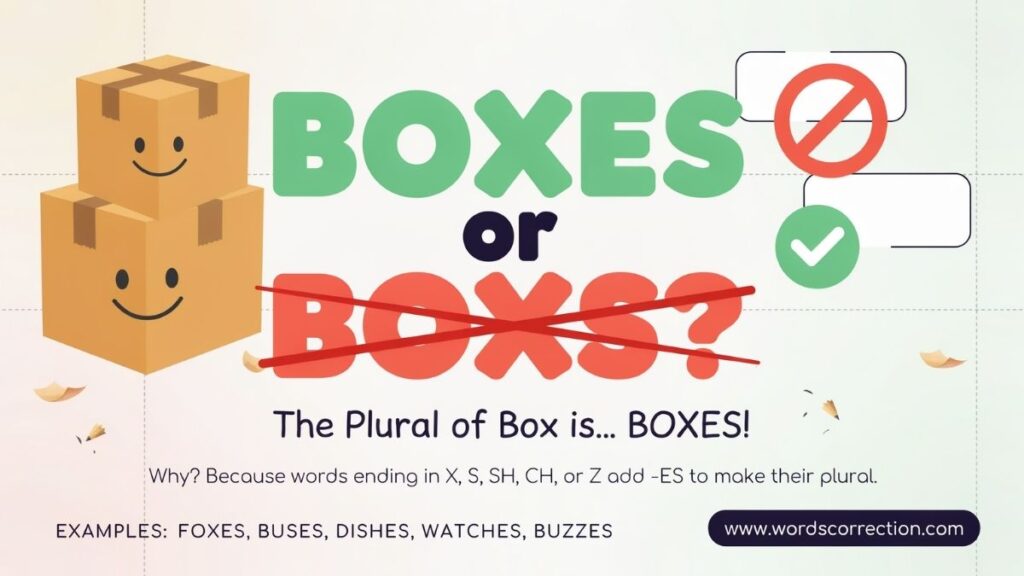
The phrase “boxes or boxs” can create more confusion than you might expect from such a simple spelling question. At first glance, adding an -s to “box” seems perfectly reasonable because many English nouns form their plurals that way. However, English has a few spelling rules that refuse to make things quite that easy. The correct plural is “boxes,” not “boxs.” Understanding the reason behind this small change can help you avoid a common grammar and spelling mistake. In this guide, we’ll explain the boxes or boxs difference, explore the pluralization rule, and show you how to use “boxes” correctly in everyday and formal writing.
Boxes or Boxs Quick Answer
The correct spelling of boxes is boxes, not boxs.
| Form | Correct? | Function | Example |
| box | Yes | Singular noun | I need one box. |
| boxes | Yes | Plural noun | I need three boxes. |
| boxs | No | Incorrect standard plural | Three boxs |
| box’s | Yes | Singular possessive | The box’s lid is open. |
| boxes’ | Yes | Plural possessive | The boxes’ lids are open. |
If you’re asking, “What is the plural of box?”, the answer is boxes.
For example:
- There is one box on the table.
- There are four boxes on the table.
- The box’s handle is broken.
- The boxes’ handles are broken.
The key is to distinguish between a plural noun and a possessive noun.
Why Is Boxs Incorrect?
The spelling boxs comes from applying the basic plural rule too broadly.
Many regular nouns form their plural by adding -s:
- book → books
- car → cars
- table → tables
- chair → chairs
However, many nouns ending in -x form their plural with -es:
- box → boxes
- fox → foxes
- tax → taxes
- fax → faxes
- mix → mixes
- prefix → prefixes
Therefore, the standard box plural spelling is boxes.
Box Plural Spelling Rule
A useful rule for English plural nouns ending in x is:
Many nouns ending in -x form their plural by adding -es.
For box, the process is:
box + es = boxes
This is part of the broader system of standard English pluralization rules. The ending of a noun often helps determine whether you should add -s or -es.
Other Words Ending in X
Learning the pattern becomes easier when you compare several examples.
| Singular | Plural |
| box | boxes |
| fox | foxes |
| tax | taxes |
| fax | faxes |
| mix | mixes |
| suffix | suffixes |
| prefix | prefixes |
These examples show that adding -es to nouns ending in x is a common spelling pattern in English.
Learn the difference between tricky words and use them correctly
Honoured or Honored Meaning, Difference, Spelling and Usage
What Is the Plural of Box?
The plural of box is boxes.
The singular form box refers to one item:
A box is sitting beside the door.
The plural form boxes refers to two or more:
Several boxes are sitting beside the door.
This distinction is an example of grammatical number. English uses singular and plural forms to show whether you’re talking about one countable thing or more than one.
One Box or Two Boxes?
Numbers make the difference particularly clear.
| Quantity | Correct form | Example |
| 1 | one box | She bought one box. |
| 2 | two boxes | She bought two boxes. |
| 5 | five boxes | They packed five boxes. |
| 20 | twenty boxes | The warehouse received twenty boxes. |
Therefore, the correct forms are:
- one box
- two boxes
- ten boxes
- several boxes
- many boxes
In ordinary writing, two box and ten box are not correct when you’re simply counting separate boxes.
There are specialized expressions in which the singular form appears as part of a compound phrase, such as two-box system or two-box set. That is a different grammatical construction. When you’re counting the objects themselves, use two boxes.
Learn the difference between confusing more English words
Inact or Enact Which Spelling Is Correct?
Meaning and Usage

Boxes is the plural form of box, but the word can have several meanings depending on context.
Boxes as Containers
The most familiar meaning refers to containers with sides that enclose or hold something.
Boxes can be made from:
- Cardboard
- Plastic
- Wood
- Metal
- Paperboard
For example:
The movers packed the dishes into sturdy boxes.
Here, boxes refers to physical containers.
Common expressions include:
- Moving boxes
- Storage boxes
- Shipping boxes
- Gift boxes
- Cardboard boxes
- Product boxes
- Lunch boxes
- Jewelry boxes
The plural form simply indicates that more than one container is involved.
Learn the difference between more words people mix up
Chears or Cheers Difference, Meaning and Usage
Boxes as Marked Spaces
A box can also mean a marked area on a form, worksheet, diagram, or document.
For example:
Check the boxes that apply to your situation.
In this sentence, boxes doesn’t refer to containers. It refers to separate spaces where the reader can place a check mark or another symbol.
You may find boxes in:
- Forms
- Surveys
- Flowcharts
- Diagrams
- Worksheets
- Tables
- Maps
- Games
The context determines the meaning.
Boxes as Enclosed Areas
The word box can also describe a designated or enclosed area.
For example:
The theater has several private boxes.
Here, boxes refers to special seating areas rather than containers.
The plural spelling remains the same because the underlying noun is still box.
Boxes of Products
English often uses box to describe a packaged quantity.
Examples include:
- a box of cereal
- two boxes of tissues
- three boxes of cookies
- four boxes of printer paper
Consider this sentence:
We ordered three boxes of cookies.
The word boxes counts the containers or packages. The noun following of identifies what those packages contain.
Learn the difference between commonly mixed-up more words
Maxxed or Maxed: Which Spelling Is Correct?
Box or Boxes Grammar
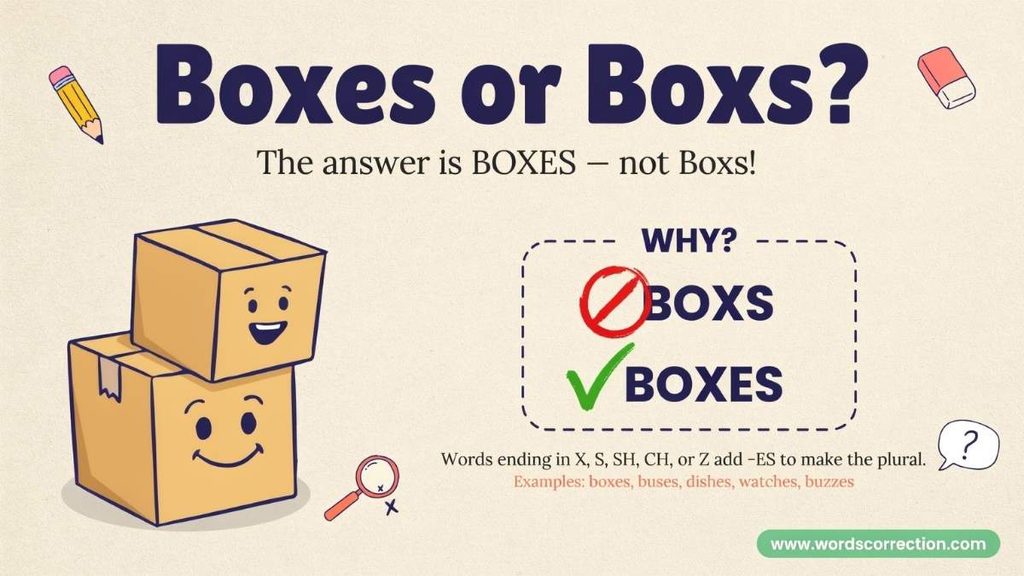
The main difference between box and boxes is grammatical number.
Box is singular.
Boxes is plural.
Words that appear alongside the noun can also show which form you need.
| Singular | Plural |
| a box | several boxes |
| one box | two boxes |
| this box | these boxes |
| that box | those boxes |
| the box | the boxes |
Compare these sentences:
This box contains old photographs.
These boxes contain old photographs.
Notice that the change isn’t limited to the noun. The verb changes from contains to contain because the subject changes from singular to plural.
Understanding the singular and plural form of box therefore helps with both spelling and sentence structure.
Learn the difference between tricky grammar more words
Unattentive or Inattentive Meaning and Usage
How to Use Boxes in a Sentence
The word boxes appears naturally in everyday, academic, workplace, and formal writing.
Everyday Examples
- The garage is filled with empty boxes.
- Please put the toys in these boxes.
- We need two boxes for the books.
- The delivery arrived with six boxes.
- She labeled all the boxes before moving.
Workplace Examples
- The office received five boxes of printer paper.
- Please place the equipment in the labeled boxes.
- The warehouse team inspected the boxes before shipping them.
- We stored the documents in secure boxes.
Academic Examples
- The diagram divides the process into four boxes.
- Students should check the boxes next to the correct answers.
- The researcher organized the information into separate boxes.
Formal Examples
- Applicants must check the appropriate boxes before submitting the form.
- The application contains several boxes that require additional information.
These examples demonstrate how to use boxes correctly in a sentence while showing the different meanings the word can have.
Boxes as a Verb
There is another useful point to understand: boxes can also function as a verb.
The verb box can mean to put something into a box or package it in boxes. Its third-person singular present form is boxes.
For example:
The employee boxes each product before shipping it.
Here, boxes is a verb.
Compare that with:
The employee stacked the boxes near the door.
In the second sentence, boxes is a plural noun.
The spelling is identical, but the grammatical function is different. Context tells you whether boxes acts as a noun or verb.
| Sentence | Role of “boxes” |
| The boxes are heavy. | Plural noun |
| She boxes the products every afternoon. | Verb |
Learn the difference between confusing word pairs
Handle or Handel Correct Spelling, Meaning, and Usage
Boxes, Box’s, and Boxes’ Understanding the Difference

A common source of confusion is the difference between boxes, box’s, and boxes’.
Box
Box is the singular noun.
The box is empty.
Boxes
Boxes is the plural noun.
The boxes are empty.
Box’s
Box’s is the singular possessive form.
The box’s lid is damaged.
The lid belongs to one box.
Boxes’
Boxes’ is the plural possessive form.
The boxes’ lids are damaged.
The lids belong to multiple boxes.
| Form | Function | Example |
| box | Singular | The box is large. |
| boxes | Plural | The boxes are large. |
| box’s | Singular possessive | The box’s lid is large. |
| boxes’ | Plural possessive | The boxes’ lids are large. |
The important point is that an apostrophe doesn’t normally make a noun plural. That’s why box’s shouldn’t replace boxes when you’re talking about more than one box.
Learn the difference between often confused words
Inconsolable or Unconsolable Which Is Correct?
Common Spelling Mistakes With Boxes
The most obvious mistake is using boxs instead of boxes.
Incorrect:
I packed three boxs.
Correct:
I packed three boxes.
However, writers can also confuse the plural with possessive forms.
Writing Boxs Instead of Boxes
Boxs is not the standard plural form.
Incorrect:
The boxs are in the garage.
Correct:
The boxes are in the garage.
Using Box’s for the Plural
An apostrophe is not needed to make box plural.
Incorrect:
I bought two box’s.
Correct:
I bought two boxes.
Using Two Box
When you’re counting separate boxes, use the plural.
Incorrect:
We need two box.
Correct:
We need two boxes.
Specialized compound expressions can use the singular form, such as two-box system. In ordinary sentences, however, the counted noun should be plural.
Learn the difference between basic English word mistakes
Where or When Difference and correct usage
Boxes or Boxs Examples
A direct comparison makes the correct form easy to recognize.
| Incorrect | Correct |
| I have three boxs. | I have three boxes. |
| The boxs are empty. | The boxes are empty. |
| She packed five boxs. | She packed five boxes. |
| Move those boxs outside. | Move those boxes outside. |
| We ordered two boxs of paper. | We ordered two boxes of paper. |
| There are several boxs in storage. | There are several boxes in storage. |
The correction follows the same pattern every time:
box → boxes
Why Does Boxes Have an Extra Syllable?
The pronunciation of boxes also helps explain its spelling.
In standard American English, box has one syllable, while boxes has two. The plural ending adds a sound rather than functioning as a silent spelling change.
This is part of a broader relationship between spelling and pronunciation in English plural nouns.
Compare:
- book → books
- cat → cats
- box → boxes
- dish → dishes
- bus → buses
The plural ending can sound different depending on the final sound of the singular noun.
For box, the final sound makes the -es ending pronounced as an additional syllable. This is one reason the spelling pattern makes sense when you consider both written English and spoken English.
Learn the difference between commonly misused words
Doggie or Doggy Which Spelling Is Correct?
Plural Nouns Ending in X, S, SH, and CH
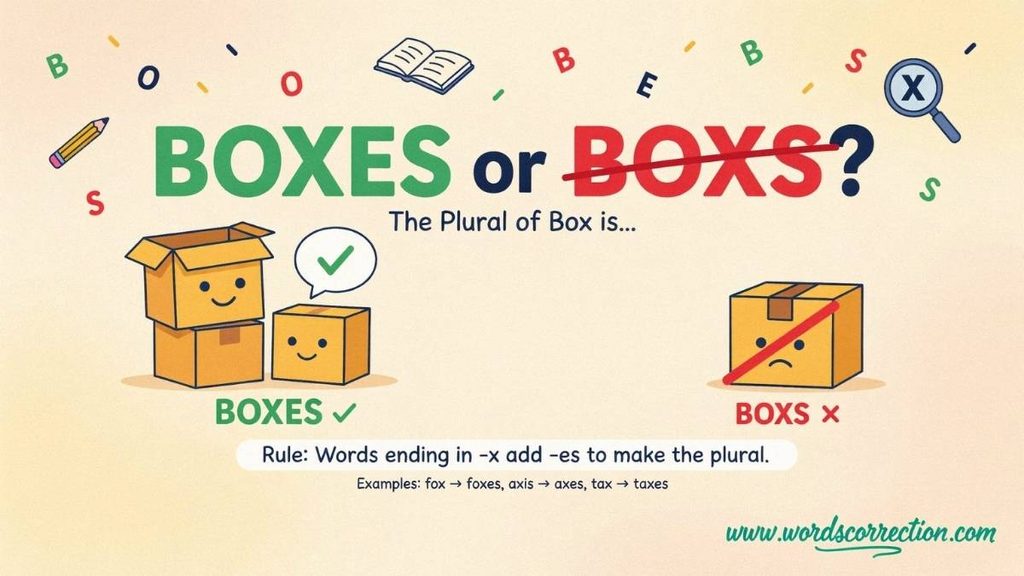
The word box belongs to a larger group of nouns that commonly use -es in the plural.
| Ending | Singular | Plural |
| -x | box | boxes |
| -s | bus | buses |
| -sh | dish | dishes |
| -ch | church | churches |
| -z | quiz | quizzes |
This pattern is useful when learning plural noun rules.
It also helps explain why English doesn’t rely on one universal rule for every noun. Different noun endings can affect the plural form.
For English learners, grouping words according to their endings can make noun pluralization easier to understand than memorizing isolated words.
The Origin and History of Box and Boxes
The word box has a long history in English and has developed several related meanings.
It has been used to describe containers and enclosed spaces. Over time, the word also gained other meanings based on the shape, function, or enclosed nature of an object or area.
The noun later developed related verb uses. Today, box can refer to putting something into a container as well as several other actions depending on context.
The plural boxes follows the established English spelling pattern for nouns ending in -x.
The modern standard forms are therefore:
box → boxes
Is Boxen the Plural of Box?
No. Boxes is the standard modern plural of box.
The form boxen may occasionally appear as a humorous or deliberately unusual formation. It isn’t the normal plural used in standard English.
If you’re writing an essay, report, email, article, or other formal text, use boxes.
Learn the difference between everyday English mistakes
Insight or Insite? What’s the Correct English Word?
American English vs. British English
There is no standard American-versus-British spelling difference for this word.
Both varieties use:
box → boxes
| Variety | Singular | Plural |
| American English | box | boxes |
| British English | box | boxes |
Unlike words such as color/colour or center/centre, the plural of box does not change between American and British English.
How to Remember the Correct Spelling
If you often hesitate over boxes or boxs, remember the -x + -es pattern.
Think of these words together:
box → boxes
fox → foxes
tax → taxes
The shared pattern provides a simple memory aid.
When a noun ends in x, check whether it needs -es in the plural. For box, the answer is yes.
box + es = boxes
Once you recognize the pattern, boxs should immediately look unusual.
Learn the difference between more words people mix up
Employees or Employee’s: Which One Is Correct?
Boxes vs. Boxs: Quick Comparison
| Feature | Boxes | Boxs |
| Standard spelling | Yes | No |
| Plural of box | Yes | No |
| Used in formal English | Yes | No |
| Follows standard plural rules | Yes | No |
| Example | four boxes | four boxs |
There isn’t a standard spelling choice between these two forms. Boxes is the correct form.
Practice Session: Boxes or Boxs
Instructions: Complete each sentence with the correct word or phrase.
Fill in the Blanks
- The correct plural form of the word “box” is __________.
- The spelling “boxs” is considered __________ in standard English.
- Nouns ending in -x generally form their plural by adding the suffix __________.
- She carefully packed her belongings into several __________.
- The singular form of “boxes” is __________.
- A container used to store or hold objects is called a __________.
- The word “boxes” has __________ syllables.
- The word “fox” follows a similar pluralization rule as the word __________.
- The plural form of “fox” is __________.
- The plural form of “tax” is __________.
- The word “box” is a __________ noun because it can be counted.
- The suffix added to “box” to form its plural is __________.
- Writing “boxs” instead of “boxes” is a common spelling __________.
- There were several cardboard __________ stacked in the warehouse.
- The word “box” can be used as both a noun and a __________.
- The plural form of “mix” is __________.
- Nouns ending in certain sounds often require -es instead of simply adding __________.
- “Boxes” is the standard spelling in both British and __________ English.
- The word “boxes” refers to more than __________ container.
- Correct pluralization improves grammatical __________ and readability.
- A noun that follows standard pluralization rules is known as a __________ noun.
- The word “box” contains __________ syllable.
- Adding -es to the word “box” creates its correct __________ form.
- To pluralize most nouns ending in -x, add the suffix __________.
- The correct spelling is “boxes,” not __________.
Answer Session
- Boxes
- Incorrect
- -es
- Boxes
- Box
- Box
- Two
- Box
- Foxes
- Taxes
- Countable
- -es
- Mistake
- Boxes
- Verb
- Mixes
- -s
- American
- One
- Accuracy
- Regular
- One
- Plural
- -es
- Boxs
Here’s a trusted source for clear more words Comparison:
Grammar Update
Frequently Asked Questions
Why is “boxes” the correct plural form of “box”?
“Boxes” is the correct plural form of “box” because English nouns ending in -x generally require the suffix -es when forming their plural.
What is the pluralization rule for words ending in -x?
Most nouns ending in -x form their plural by adding -es rather than simply adding -s. For example, box becomes boxes, and fox becomes foxes.
Why is “boxs” an incorrect spelling?
“Boxs” is incorrect because it does not follow the standard English spelling rule for nouns ending in -x. The correct plural form is “boxes.”
Are there other words that follow the same pluralization rule as “box”?
Yes. Several English nouns ending in -x follow the same pattern, including foxes, taxes, mixes, and fixes.
How does the pronunciation of “boxes” differ from “box”?
“Box” is a one-syllable word, whereas “boxes” has two syllables. The -es ending adds an extra syllable to the plural form.
Is “box” a regular noun in English grammar?
Yes. “Box” is a regular countable noun because it follows the standard pluralization rule of adding -es.
What type of noun is “box”?
“Box” is a common, concrete, countable noun. It generally refers to a container used to hold, store, or transport objects.
Can “box” be used as both a noun and a verb?
Yes. As a noun, “box” refers to a container or enclosed space. As a verb, it can mean to place something inside a container or participate in the sport of boxing.
Do all nouns ending in -x take -es in the plural form?
Most common nouns ending in -x take -es to form their plural. However, English includes some exceptions and borrowed terms that may follow different spelling conventions.
What is the difference between regular and irregular plural nouns?
Regular plural nouns follow standard spelling rules, such as adding -s or -es. Irregular plural nouns form their plural in different ways and often need to be memorized.
Why is correct pluralization important in English writing?
Correct pluralization improves grammatical accuracy, readability, and clarity, helping writers communicate effectively in both formal and informal contexts.
Can “boxes” be used as the subject of a sentence?
Yes. “Boxes” can function as the subject of a sentence when referring to multiple containers or objects. For example: “The boxes are stored in the warehouse.”
Can “boxes” be used as the object of a sentence?
Yes. “Boxes” can function as a direct object or indirect object depending on the sentence structure. For example: “They moved the boxes upstairs.”
Does the word “box” have multiple meanings?
Yes. Depending on the context, “box” can refer to a container, a square-shaped area, a television, or the sport of boxing.
Is the spelling “boxes” the same in British and American English?
Yes. “Boxes” is the standard plural spelling in both British English and American English.
What is the most common mistake when pluralizing the word “box”?
The most common mistake is writing “boxs” instead of “boxes.” This happens when writers incorrectly add only -s to a noun ending in -x.
How can English learners remember the plural rule for “box”?
A simple way to remember the rule is that nouns ending in -x usually take -es to form their plural. Therefore, box becomes boxes.
Are English pluralization rules always consistent?
English pluralization rules are generally consistent, but the language also contains irregular nouns and exceptions. Learning common spelling patterns can help improve accuracy.
Can proper nouns ending in -x follow the same pluralization rule?
Some proper nouns ending in -x may follow standard pluralization rules. However, the correct form depends on the specific name and its grammatical context.
How does the word “boxes” demonstrate the relationship between spelling and pronunciation?
The word “boxes” illustrates how spelling and pronunciation work together. The addition of -es creates an extra syllable, making the plural form easier to pronounce.
Can “boxes” be used in compound nouns?
Yes. “Boxes” commonly appears in compound expressions such as cardboard boxes, storage boxes, gift boxes, and moving boxes.
What is the function of the suffix -es in “boxes”?
The suffix -es indicates that the noun is plural. It is added to words ending in certain sounds, including -x, to form their plural correctly.
Can incorrect plural spelling affect professional writing?
Yes. Incorrect plural forms can reduce clarity, undermine grammatical accuracy, and create an unprofessional impression in academic, business, and everyday communication.
Why do some English learners find nouns ending in -x difficult to pluralize?
These nouns can be challenging because they require -es instead of the more commonly used -s ending. Understanding the spelling rule and practicing examples can help learners avoid mistakes.
What is the easiest way to remember the plural form of “box”?
The simplest rule is: Nouns ending in -x generally take -es to form their plural. Therefore, “boxes” is the correct plural form of “box.”
Conclusion
The boxes or boxs question may seem like a small spelling issue, but one letter can make a noticeable difference in correct English. The answer is clear: boxes is the correct plural of box, while boxs is not a standard English spelling. The reason is simple: many nouns ending in -x form their plural by adding -es rather than simply adding -s.
The pattern is easy to remember: box → boxes. One box sits on the shelf, while two or more become boxes. Once you understand this pluralization rule, there’s little reason to let “boxs” sneak into your writing again. Whether you’re writing an email, completing an assignment, or preparing a formal document, choosing boxes keeps your spelling accurate, your grammar clear, and your writing professional.

Stella AJS is an experienced blogger and dedicated English language writer at Words Correction. She turns confusing grammar, word meanings, spelling, and usage into clear, practical insights that readers can easily understand and apply. With a passion for precise and engaging writing, Stella helps readers avoid common language mistakes, strengthen their vocabulary, and communicate with greater clarity and confidence.




