

English can turn even the simplest words into a small spelling puzzle. Chears or cheers is a classic example. Although the two spellings may sound similar, only one is correct in standard English. If you’ve ever paused before writing “chears” or “cheers,” you’re not alone. The confusion becomes even more interesting because cheers has several meanings. It can be a celebratory toast, an expression of encouragement, or an informal way to say thank you or goodbye. In this guide, we’ll clear up the chears or cheers confusion, explain the correct spelling and meaning, and show you how to use cheers naturally and confidently.
Chears or Cheers Quick Answer
Cheers is the correct spelling.
Chears is generally an incorrect spelling when the writer intends to use the English word cheers.
| Word | Correct? | Meaning |
| Cheers | Yes | A toast, expression of encouragement, informal thanks, or informal goodbye |
| Chears | No | Usually a misspelling of “cheers” |
Therefore, if you’re wondering which is correct chears or cheers, use cheers.
The correct spelling of cheers is:
Cheers
Not chears.
Is “Chears” a Word?
One common question is is chears a word?
In standard modern English, chears isn’t the normal spelling of the word used for a toast, encouragement, thanks, or farewell. When someone writes chears in one of these contexts, they almost certainly intend to write cheers.
A word or spelling can occasionally appear as part of a name, title, username, or other proper expression without becoming a standard English vocabulary word. Therefore, unusual appearances of chears shouldn’t be confused with the standard English word cheers.
Is “Cheers” a Word?
Yes. Cheers is a well-established English word and expression.
It has several recognized uses, including drinking to someone’s health, expressing encouragement, and functioning as an informal expression of thanks or farewell.
The exact meaning depends on the context in which you encounter it.
Learn the difference between confusing more English words
Presence or Presense Which Spelling Is Correct?
What Does Cheers Mean?
The cheers meaning changes according to the situation. That’s why the word can sometimes seem confusing to English learners.
The main meanings include:
- A toast before drinking.
- An expression of good wishes.
- A shout or expression of support and encouragement.
- An informal British expression meaning thank you.
- An informal British expression meaning goodbye.
- A form of the verb cheer, as in “She cheers for her team.”
In everyday English, context usually makes the intended meaning clear.
Cheers as a Toast
The most familiar use appears when people raise their glasses before drinking.
Imagine a group celebrating a friend’s new job. Everyone raises a glass, and someone says:
“Cheers!”
Here, cheers expresses goodwill and celebration. Depending on the occasion, it can carry the sense of wishing someone good health, good luck, happiness, or success.
You might hear:
“To your new job. Cheers!”
Or:
“Here’s to many more successful years. Cheers!”
This is the classic cheers toast meaning.
Learn the difference between commonly mixed-up more words
To or Too Clear Difference, Meaning and Usage
Cheers as an Expression of Encouragement
The word also relates to the idea of cheering someone on.
For example:
The crowd erupted in cheers when the team scored.
Here, cheers means enthusiastic shouts of support or approval. Nobody is necessarily drinking. The word simply describes the positive response from the crowd.
You may encounter this meaning at:
- Sports events
- Concerts
- School competitions
- Public celebrations
- Performances
- Award ceremonies
This sense connects cheers with encouragement, applause, enthusiasm, and approval.
Cheers as “Thank You”
In British English, cheers can also mean thank you in informal conversation.
For example:
“I saved you a seat.”
“Cheers!”
The speaker isn’t making a toast. Instead, cheers expresses gratitude.
Another example is:
“Here’s the information you needed.”
“Cheers. That’s really helpful.”
This use is especially common in conversational British English.
Cheers as “Goodbye”
In informal British English, cheers can also function as a casual farewell.
For example:
“I’m heading home now. Cheers!”
Or:
“See you tomorrow. Cheers!”
In this context, cheers has a meaning similar to bye, see you, or take care.
The tone is friendly and relaxed rather than formal.
Learn the difference between tricky grammar more words
Inact or Enact Which Spelling Is Correct?
Meaning in English for both
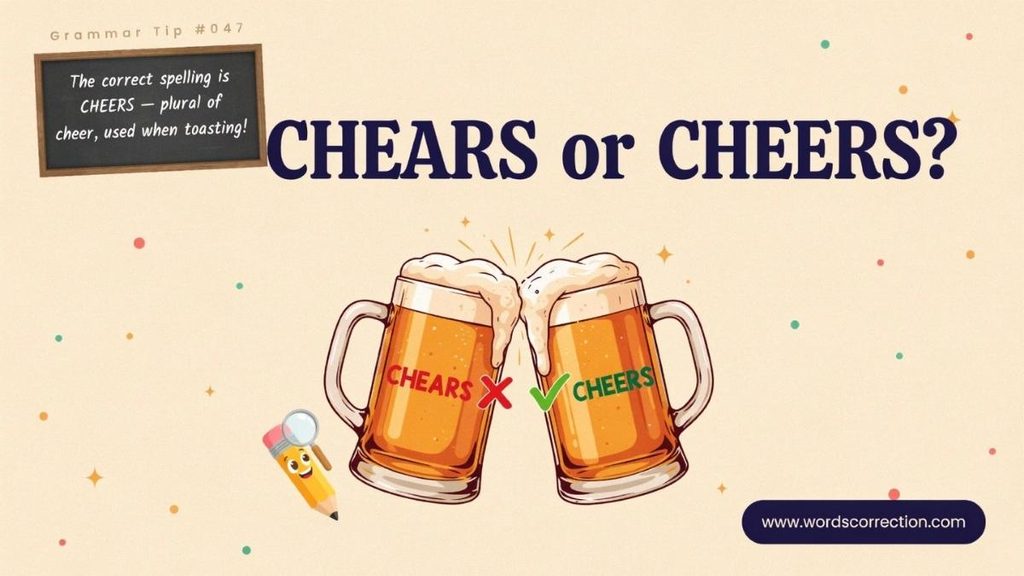
If you’re searching for chears or cheers meaning in English, the important distinction is that cheers is the standard English word.
There isn’t a separate standard meaning assigned to chears in the way there are different meanings for cheers.
The meaning of cheers depends on context.
| Context | Meaning |
| Raising a glass | A toast or good wishes |
| Sports crowd | Shouts of encouragement |
| British conversation | Thank you |
| British farewell | Goodbye |
| Celebration | Good wishes or approval |
| Verb usage | Encourages or supports |
This range of meanings explains why understanding what does cheers mean in English requires more than memorizing a single dictionary definition.
Why Is “Cheers” Spelled With “EE”?
The chears or cheers spelling confusion often comes from pronunciation.
The standard spelling is:
C-H-E-E-R-S
The word contains the double e spelling found in cheer.
Because English spelling doesn’t always correspond perfectly to pronunciation, people sometimes write words according to how they think they sound. That’s one reason chears may appear as a misspelling.
However, standard English uses:
cheer → cheers
It doesn’t use:
chear → chears
Therefore, if you’re wondering how do you spell cheers, remember the double e.
A Simple Way to Remember the Spelling
Think of the base word:
Cheer + s = Cheers
Once you remember cheer, the correct spelling of cheers becomes much easier.
Learn the difference between confusing word pairs
Maxxed or Maxed: Which Spelling Is Correct?
Cheers Pronunciation
The pronunciation of cheers can vary slightly between English accents, particularly between British and American English.
The word begins with the ch sound and ends with an r sound followed by a z sound in many varieties of English.
The important point for spelling is that different pronunciations don’t change the standard spelling.
Whether you’re speaking American English or British English, the standard written form remains:
Cheers
Not chears.
Why “Chears” Is Usually Wrong
The spelling chears may look plausible because English contains several words with different vowel patterns. However, standard modern English uses cheer, not chear.
The correct forms include:
- cheer
- cheers
- cheered
- cheering
The incorrect forms, when intended as forms of cheer, include:
- chear
- chears
- cheared
- chearing
This distinction is important because chears vs cheers isn’t a case of two accepted spelling variants. They’re not equivalent alternatives.
If you’re asking is “chears” the correct spelling, the answer is no when you mean the standard English word.
The Origin and History of “Cheers”
The history of cheers is closely connected to the history of cheer.
The word cheer has roots in Middle English and Anglo-French. Its earlier meanings were connected with the face, expression, mood, and state of mind.
Over time, the meaning expanded toward ideas such as:
- Happiness
- Good spirits
- Encouragement
- Support
- Approval
- Celebration
That development helps explain why the modern word can be used in several seemingly different situations.
Learn the difference between often confused words
Unattentive or Inattentive Meaning and Usage
How “Cheers” Became a Drinking Expression
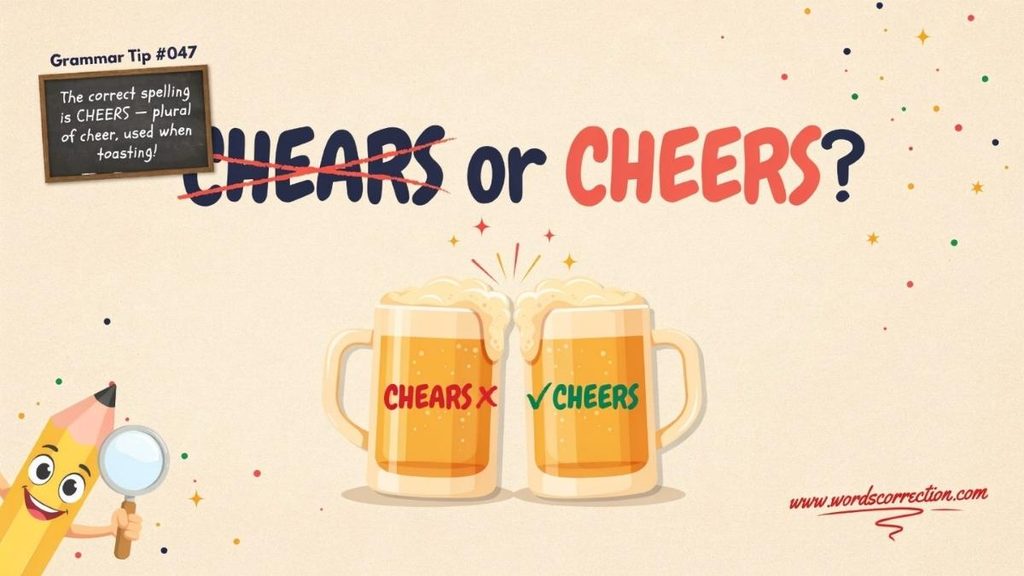
The drinking use of cheers developed from the broader idea of positive feeling and goodwill.
When people say cheers before drinking, they’re traditionally expressing good wishes toward one another.
A toast might celebrate:
- Good health
- Friendship
- Marriage
- A new job
- A birthday
- An achievement
- A successful future
The expression eventually became a familiar part of social drinking culture.
Today, saying cheers when drinking is often a simple social convention. It can be meaningful without requiring a long speech.
How “Cheers” Developed Different Meanings
The word’s broader history also helps explain why it can appear outside drinking situations.
Encouragement, goodwill, gratitude, and celebration all share a common positive tone. Over centuries, cheer and cheers developed uses that reflect these related ideas.
That’s why a person can say “Cheers!” after receiving a favor or use “Cheers” as a farewell without mentioning a drink at all.
British English vs American English
The spelling isn’t different between British and American English. The main difference concerns usage.
British Meaning of Cheers
In British English, cheers has several common informal uses.
It can mean:
- Thank you
- Goodbye
- A drinking toast
For example:
“I brought the documents you needed.”
“Cheers!”
Here, it means thank you.
Or:
“I’m off now. Cheers!”
Here, it means goodbye.
These uses are strongly associated with informal British English.
American English
American English commonly uses cheers as a drinking toast.
For example:
“Cheers to the newlyweds!”
It can also appear in expressions of celebration, encouragement, and approval.
However, the British use of cheers as a routine substitute for thank you or goodbye is less characteristic of everyday American English.
Does American English Spell It “Chears”?
No.
American English uses:
Cheers
British English also uses:
Cheers
There is no standard American-versus-British spelling choice between chears and cheers.
Learn the difference between basic English word mistakes
Handle or Handel Correct Spelling, Meaning, and Usage
How to Use Correctly
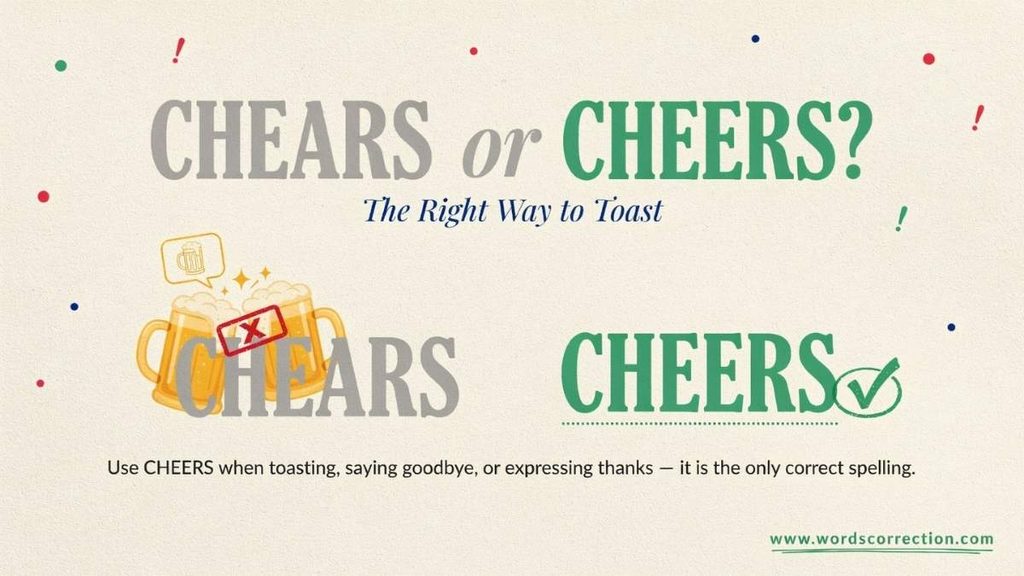
Learning how to use cheers correctly becomes easier when you identify the intended meaning.
Cheers as a Toast
Use cheers when making a drinking toast.
“To a successful year ahead. Cheers!”
This is appropriate in a social setting where people are celebrating together.
Cheers for Encouragement
Use cheers as a noun when describing supportive shouts.
The team walked onto the field to loud cheers from the fans.
The word describes the crowd’s enthusiastic response.
Cheers as Thank You
In informal British English:
“I brought you a coffee.”
“Cheers!”
The meaning is essentially thank you.
Cheers as Goodbye
In informal British English:
“I’ll see you next week. Cheers!”
The meaning is a casual goodbye.
Cheers as an Email Sign-Off
You may also see:
Cheers,
Daniel
This closing sounds friendly and informal.
It can work well when writing to:
- Friends
- Familiar colleagues
- Clients with whom you have an established casual relationship
- Professional contacts in relaxed workplaces
However, it may be inappropriate for highly formal communication.
For a formal letter or sensitive business message, alternatives such as Sincerely, Kind regards, or Best regards may be more suitable.
Cheers in a Sentence
Understanding cheers in a sentence is one of the easiest ways to see how context changes the meaning.
Cheers Example Sentence: Toast
Everyone raised their glasses and said, “Cheers!”
Here, cheers is a drinking toast.
Learn the difference between commonly misused words
Inconsolable or Unconsolable Which Is Correct?
Cheers Example Sentence: Encouragement
The players walked onto the field to loud cheers from the crowd.
Here, cheers means shouts of support.
Cheers Example Sentence: Thank You
“I saved you a seat.” “Cheers!”
Here, the expression means thank you.
Cheers Example Sentence: Goodbye
“I’m leaving now. Cheers!”
Here, the expression functions as a casual farewell.
Cheers Example Sentence: Email
Cheers,
Sam
Here, cheers acts as an informal email sign-off.
These examples show why the phrase cannot always be translated into one fixed meaning.
Chears or Cheers in a Sentence
If you’re searching for chears or cheers in a sentence, the correct form is cheers.
Incorrect
“Chears for your help.”
Correct
“Cheers for your help.”
Another example:
Incorrect
“Everyone raised their glasses and shouted, ‘Chears!’”
Correct
“Everyone raised their glasses and shouted, ‘Cheers!’”
The problem isn’t the sentence structure. It’s the spelling.
Learn the difference between everyday English mistakes
Where or When Difference and correct usage
Common Mistakes With Cheers
Writing “Chears” Instead of “Cheers”
This is the most common error.
Incorrect: Chears
Correct: Cheers
The easiest solution is to remember the base word cheer.
Assuming Cheers Always Refers to Drinking
It doesn’t.
Consider:
“Cheers for helping me with the project.”
In British English, this can simply mean thanks for helping me.
The context determines the meaning.
Using Cheers in Formal Writing
Although cheers is a legitimate English expression, its tone is usually informal.
For example:
Cheers, James
sounds relaxed and friendly.
By comparison
Sincerely, James
sounds more formal
Neither is automatically better. The right choice depends on your audience, relationship, and purpose.
Learn the difference between more words people mix up
Doggie or Doggy Which Spelling Is Correct?
Confusing Cheer and Cheers
The words cheer and cheers are closely related but can have different grammatical functions.
| Word | Example | Function |
| cheer | We heard a cheer. | Noun |
| cheer | We cheer for our team. | Verb |
| cheers | The crowd gave loud cheers. | Plural noun |
| cheers | She cheers for the team. | Verb |
| cheered | The crowd cheered loudly. | Past-tense verb |
| cheering | Everyone was cheering. | Present participle |
Understanding this distinction prevents another common vocabulary mistake.
Using Cheers Without Considering the Audience
The expression can sound natural and friendly in one conversation but overly casual in another.
For example, “Cheers!” works naturally between friends. It may also work between colleagues who regularly communicate informally.
However, if you’re writing a highly formal professional letter, spelling the word correctly isn’t enough. You also need to consider whether the tone fits.
Cheers vs Chears Comparison
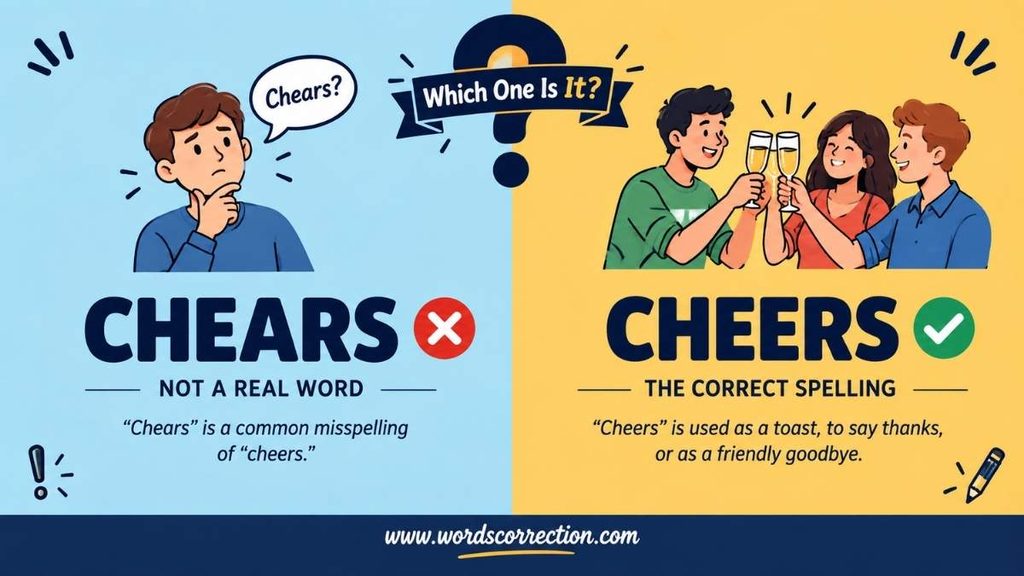
The chears vs cheers distinction is ultimately a spelling issue.
| Feature | Chears | Cheers |
| Standard English spelling | No | Yes |
| Correct spelling | No | Yes |
| Drinking toast | No | Yes |
| Informal British “thank you” | No | Yes |
| Informal British “goodbye” | No | Yes |
| Expression of support | No | Yes |
| Related to “cheer” | No | Yes |
This isn’t like comparing two accepted variants such as color and colour. Chears isn’t a standard alternative spelling of cheers.
Cheers vs Similar Words and Expressions
Understanding related expressions can make the meaning of cheers even clearer.
Cheers vs Hooray
Hooray usually expresses excitement, celebration, or approval.
“Hooray! We won!”
Cheers can also express celebration, but it has additional meanings, especially as a toast or informal British expression of thanks or farewell.
Cheers vs Thanks
Thanks directly expresses gratitude.
Cheers can also express gratitude in informal British English.
For example:
“Thanks for your help.”
is broadly understood across English varieties.
“Cheers for your help.”
sounds more informal and is particularly associated with British English.
Cheers vs Best Regards
These expressions have very different levels of formality.
Cheers, David
is casual and friendly.
Best regards, David
is more neutral and professional.
The choice depends on your relationship with the reader.
Cheer vs Cheers
Cheer can function as a noun or verb.
Cheers can be the plural noun, a third-person singular verb, or an informal exclamation.
For example:
The crowd gave a cheer.
The crowd gave several cheers.
She cheers for her team.
Cheers!
The spelling changes because the grammatical role changes.
Learn the difference between tricky words and use them correctly
Insight or Insite? What’s the Correct English Word?
How to Remember the Correct Spelling of Cheers
If chears or cheers spelling keeps causing trouble, use one simple memory trick.
Start with the base word:
Cheer
Then add s:
Cheers
Remember the double e:
C-H-E-E-R-S
Don’t switch the ee to ea.
A useful mental association is to group the words together:
- cheer
- cheerful
- cheering
- cheered
- cheers
They all keep the ee spelling.
Chears or Cheers Case Studies
Case Study: A Birthday Toast
A group of friends gathers for a birthday dinner. One person raises a glass and says:
“To another great year. Cheers!”
Here, cheers is a celebratory toast. It expresses good wishes for the birthday person’s future.
Writing “chears” would be a spelling error.
Case Study: A British Conversation
A friend hands someone a cup of coffee.
“Here you go.”
“Cheers!”
There is no drinking toast involved.
In this context, cheers means thank you.
This is a good example of why context matters when interpreting the cheers expression meaning.
Case Study Ending a Conversation
A colleague says:
“I’ll send the report this afternoon.”
The other person replies:
“Cheers. See you tomorrow.”
Here, cheers creates a relaxed and friendly conversational tone. It can express appreciation while also fitting naturally into a farewell.
Learn the difference between similar English words the easy way
Employees or Employee’s: Which One Is Correct?
Why Do People Say Cheers When Drinking?
The question why do people say cheers when drinking has a linguistic and social answer.
A traditional toast expresses goodwill toward the people sharing the drink. Saying cheers can communicate good health, good luck, friendship, congratulations, or celebration.
The gesture often involves people raising a glass and sometimes clinking glasses.
For example:
“To your success. Cheers!”
The expression doesn’t necessarily carry one exact message. Its meaning depends on the occasion.
At a wedding, it might express congratulations.
In birthday party, it might express celebration.
At a retirement gathering, it might express appreciation and good wishes.
The common thread is positive social intent.
What Does Cheers Mean When Raising a Glass?
When someone asks what does cheers mean when raising a glass, the answer is usually a toast or expression of good wishes.
It can communicate:
- Good health
- Good luck
- Congratulations
- Friendship
- Happiness
- Success
- Best wishes
For example:
“Cheers to your new home!”
This doesn’t simply acknowledge the act of drinking. It directs a positive wish toward the person or event being celebrated.
Can Cheers Mean Thank You?
Yes.
The cheers thank you meaning is particularly common in informal British English.
For example:
“I picked up the tickets for you.”
“Cheers!”
The speaker means thank you.
This use is casual and conversational. It would not normally be the best choice in highly formal writing.
Can Cheers Mean Goodbye?
Yes.
The cheers goodbye meaning is also associated with informal British English.
For example:
“I’m off now. Cheers!”
Here, cheers works as a casual farewell.
It can be similar to:
- Bye
- See you
- See you later
- Take care
Again, context and tone determine the exact feeling.
When Should You Say Cheers?
If you’re wondering when should you say cheers, consider both the meaning and the audience.
Use “Cheers” When
- You’re making a casual drinking toast.
- You’re celebrating with friends or colleagues.
- You’re expressing informal gratitude in British English.
- You’re saying goodbye casually in British English.
- You’re describing enthusiastic support from a crowd.
- You’re using a friendly, informal email sign-off.
Choose Another Expression When
- You’re writing a highly formal document.
- Your audience may not understand the intended British usage.
- You need a precise expression of gratitude.
- You need a formal farewell.
- The context requires professional rather than conversational language.
The goal isn’t to avoid cheers. The goal is to match the expression to the situation.
Practice Session
Fill in the Blanks
Complete each sentence by filling in the blank with the correct word or phrase.
- The correct spelling is ______, not “chears.”
- Everyone raised their glasses and said, “______!”
- Her kind words brought great ______ to the family.
- The fans began to ______ for their favorite team.
- In British English, “cheers” can be used to mean ______.
- “Chears” is generally considered a ______ of “cheers.”
- We said “______” before taking a drink.
- The crowd gave a loud ______ when the player scored.
- “Cheers” can also be used as an informal ______.
- In Mexico, people commonly say “______” when making a toast.
- The correct word is “______,” not “chear.”
- She tried to ______ her friend after the disappointing news.
- “Best regards” is more ______ than “cheers” in a professional email.
- “Cheers for your help” is another way to say “______ for your help.”
- He ended his informal email with “______.”
- The team celebrated their victory with a toast and shouted, “______!”
- “Chear” is not a standard ______ English word.
- The teacher encouraged the students to ______ for their classmates.
- “Cheers” can mean “thanks” in informal ______ English.
- If someone says “cheers” to thank you, you can respond with “You’re ______.”
- “Cheers” is commonly used as a drinking ______.
- The children gave a loud ______ when their team won.
- In a formal email, “Best regards” is usually more appropriate than “______.”
- The word “cheers” can express goodwill, gratitude, or a casual ______.
- Remember: “cheers” is correct, while “______” is a misspelling.
Answer Session
- cheers
- Cheers
- cheer
- cheer
- thanks
- misspelling
- Cheers
- cheer
- goodbye
- ¡Salud!
- cheer
- cheer
- formal
- thanks
- Cheers
- Cheers
- modern
- cheer
- British
- welcome
- toast
- cheer
- cheers
- farewell
- chears
Here’s a trusted source for clear more words Comparison:
Grammar Update
Frequently Asked Questions
Is “chear” a word?
No. “Chear” is not a standard English word. It is generally considered a misspelling of “cheer.”
What does “chears” mean?
“Chears” is not the standard spelling in English. If you mean the expression used when raising a glass, the correct spelling is “cheers.”
How do you spell “chear”?
The correct spelling is “cheer.” It can refer to happiness, encouragement, or support. For example: Her kind words brought cheer to the team.
What is the difference between “cheer” and “chear”?
“Cheer” is the correct English word, while “chear” is generally a misspelling. “Cheer” can describe happiness, encouragement, or a shout of support.
Is it “cheers” or “chears”?
“Cheers” is the correct spelling. “Chears” is a misspelling and should be avoided in standard English.
What is a “chear”?
“Chear” is not a standard modern English word. If you intend to use the word meaning happiness, encouragement, or support, use “cheer.”
What does “chear” mean in English?
“Chear” has no standard meaning in modern English. In most cases, it is simply a misspelling of “cheer.”
Is “cheers” plural?
Yes. “Cheers” can be the plural form of “cheer.” It is also commonly used as an expression when making a toast, thanking someone, or saying goodbye.
What can I say instead of “cheers”?
The best alternative depends on the context. You can use “thanks,” “thank you,” “best wishes,” “to your health,” “here’s to you,” or “good luck.”
What do Mexicans say for “cheers”?
In Mexico, people commonly say “¡Salud!” when making a toast. It literally means “health” and expresses good wishes while drinking.
Can Americans say “cheers”?
Yes. Americans can use “cheers,” especially when making a toast. However, using “cheers” to mean “thanks” or “goodbye” is more closely associated with British English.
What is a slang term for “cheers”?
There is no single slang replacement for “cheers.” Depending on the situation, informal alternatives include “thanks,” “bottoms up,” and “here’s to us.”
Can you say “cheers” in everyday conversation?
Yes. “Cheers” is commonly used in informal conversation. Its meaning depends on the context and may refer to a toast, thanks, or goodbye.
Why do people say “cheers”?
People say “cheers” for different reasons. It can be used as a drinking toast, an informal expression of gratitude, or a casual farewell.
What do Americans say instead of “cheers”?
Americans may use “cheers” for a toast. When expressing gratitude or ending a conversation, they often use “thanks,” “thank you,” “bye,” or “take care.”
Do the Irish say “cheers”?
Yes. “Cheers” is widely understood and used in Ireland, particularly as a drinking toast and an informal expression of thanks.
Why do Brits say “cheers”?
In British English, “cheers” has several everyday uses. It can be used as a toast, an informal way to say “thanks,” or a casual goodbye.
When should I say “cheers”?
You can say “cheers” when making a toast, thanking someone informally, or saying goodbye in a casual setting. In formal situations, a more traditional expression may be more appropriate.
How do you say “cheers” when drinking?
Simply raise your glass and say “Cheers!” before taking a drink. It is a common way to make a friendly toast.
How do English speakers use “cheers”?
English speakers use “cheers” in several contexts. It can serve as a drinking toast, an informal expression of thanks, or a casual farewell, particularly in British English.
Can you say “cheers” instead of “thank you”?
Yes. “Cheers” can mean “thanks” in informal British English. In formal communication, “thank you” is usually the better choice.
What do British people say instead of “thanks”?
In informal British English, “cheers” is a common alternative to “thanks.” It gives the conversation a relaxed and friendly tone.
Do Americans say “cheers” to mean “thanks”?
They can, but “cheers” is more commonly used to mean “thanks” in British English. American speakers generally prefer “thanks” or “thank you.”
Why do people say “cheers” instead of “thanks”?
In informal British English, “cheers” is commonly used to express gratitude. It has a relaxed, conversational tone and is especially common in everyday interactions.
Is it okay to say “cheers”?
Yes. “Cheers” is appropriate in most informal situations. However, it may sound too casual for some formal or professional settings.
How should you respond when someone says “cheers”?
The appropriate response depends on the context. If “cheers” means “thanks,” you can say “you’re welcome,” “no problem,” or “my pleasure.” If it is a toast, you can simply respond with “cheers!”
Can “cheers” be used as a goodbye?
Yes. “Cheers” can be used as an informal goodbye, especially in British English. It is best suited to casual conversations.
Can you end an email with “cheers”?
Yes. “Cheers” can be used as an email sign-off when the tone is friendly or informal. For formal business emails, “Best regards” or another professional closing may be more appropriate.
Which is more formal: “cheers” or “best regards”?
“Best regards” is more formal than “cheers.” “Cheers” creates a relaxed, conversational tone, while “best regards” is generally more appropriate for professional correspondence.
Does “cheers” mean “thanks”?
Yes. “Cheers” can mean “thanks,” particularly in British English. For example: “Cheers for your help.” In American English, “thanks” is usually more common.
Conclusion
The chears or cheers confusion may seem like a tiny spelling problem, but choosing the right word can make your writing much clearer. The correct spelling is cheers, while “chears” is generally considered a misspelling in standard English.
Remember that cheers has several useful meanings. You can say it when raising a glass, celebrating an occasion, encouraging someone, thanking a person, or saying goodbye in informal British English. Its meaning depends on the context, but its spelling stays the same.
So, if you’re wondering, “Is it chears or cheers?” there’s no need to lose your cheers over it. Just remember the double e: cheers. Once that little spelling trick sticks, this common grammar and vocabulary confusion becomes much easier to avoid.

Stella AJS is an experienced blogger and dedicated English language writer at Words Correction. She turns confusing grammar, word meanings, spelling, and usage into clear, practical insights that readers can easily understand and apply. With a passion for precise and engaging writing, Stella helps readers avoid common language mistakes, strengthen their vocabulary, and communicate with greater clarity and confidence.




