
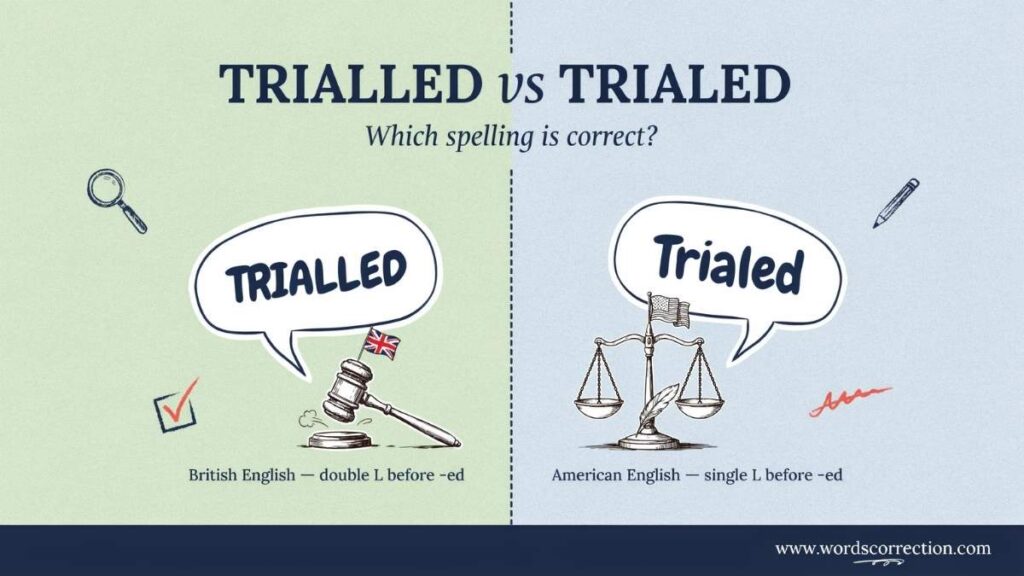
The spelling trialled or trialed can make even confident writers pause. One extra “l” suddenly turns a simple verb into a spelling puzzle, especially when British and American English follow different conventions. Fortunately, neither spelling is wrong. Trialled is the standard British English form, while trialed is preferred in American English. Both words have the same meaning: tested, evaluated, or used experimentally. The real challenge is knowing which spelling suits your audience and maintaining consistency throughout your writing. This guide explains the trialled vs trialed difference, meaning, spelling rules, grammatical usage, and practical examples to help you write with confidence.
Trialled or Trialed Quick Answer
The short answer is simple:
| Spelling | Main English variety | Meaning |
| Trialled | British English | Tested or evaluated something |
| Trialed | American English | Tested or evaluated something |
Both are past tense and past participle forms of the verb trial.
For example:
- British English: The company trialled the new software last month.
- American English: The company trialed the new software last month.
The meaning remains exactly the same.
So, is trialled or trialed correct? Both are correct. Your choice depends mainly on the variety of English you are using.
Trialed Meaning: What Does Trialed Mean?
Trialed is the American English spelling of the past tense and past participle of trial when trial is used as a verb.
As a verb, trial means to test something carefully to determine whether it works effectively, performs well, or is suitable for a particular purpose.
Therefore, trialed meaning can be understood as:
Tested, evaluated, examined, or used experimentally to determine effectiveness or suitability.
Examples of Trialed
- The company trialed a new customer service system.
- Researchers trialed the treatment on a small group.
- The school trialed a digital learning platform.
- Engineers trialed the new equipment before full production.
- The government trialed the policy in several regions.
In each sentence, trialed indicates that something was tested before wider use or implementation.
Learn the difference between more words people mix up
Inact or Enact Which Spelling Is Correct?
Trialled Meaning: What Does Trialled Mean?
Trialled has exactly the same meaning as trialed. It is the British English spelling.
The word describes something that was tested, assessed, or used experimentally to determine whether it was effective or appropriate.
Examples of Trialled
- The company trialled a new payment system.
- Researchers trialled several treatments.
- The school trialled a new teaching method.
- Engineers trialled the equipment under controlled conditions.
- The government trialled the program in selected communities.
The extra l does not change the meaning. It simply reflects a different spelling convention.
Trialled vs Trialed Difference
The main trialled or trialed difference is regional spelling.
There is no meaningful difference in definition or pronunciation.
| Feature | Trialled | Trialed |
| Meaning | Tested or evaluated | Tested or evaluated |
| Grammar | Past tense/past participle | Past tense/past participle |
| British English | Standard | Less typical |
| American English | Less typical | Standard |
| Pronunciation | Same | Same |
| Meaning | Same | Same |
| Base verb | Trial | Trial |
| Present form | Trials | Trials |
For example:
British English:
The researchers trialled the new vaccine.
American English:
The researchers trialed the new vaccine.
Both sentences communicate the same idea.
The difference between trialled and trialed is therefore primarily a matter of spelling convention.
Learn the difference between everyday English mistakes
Maxxed or Maxed: Which Spelling Is Correct?
Is Trialled or Trialed the Correct Spelling?
Both spellings are correct.
If you are writing for a US audience, trialed is generally the better choice.
If you are writing for a UK audience, trialled is generally the better choice.
The most important rule is consistency. If you choose one regional spelling system, continue using it throughout the document.
For example, an American English document would normally use:
- trialed
- canceled
- traveled
- labeled
A British English document would normally use:
- trialled
- cancelled
- travelled
- labelled
Regional spelling systems often affect several words, not just one.
Why British English Uses Trialled
British English commonly doubles the final consonant when adding certain suffixes to words that meet particular spelling conditions.
The same pattern appears in words such as:
- travel → travelled
- cancel → cancelled
- model → modelled
- label → labelled
The spelling trialled follows this convention.
The base word is trial, and the final l is doubled when the past-tense ending is added:
trial + led → trialled
The same pattern appears in the present participle:
trial + ling → trialling
This is why British English generally uses trialled and trialling.
Why American English Uses Trialed
American English often follows a simpler spelling pattern for words ending in l.
Instead of doubling the final l, American English commonly keeps a single l:
- trial → trialed
- trial → trialing
This approach can also be seen in several other spelling differences between American and British English.
For example:
| American English | British English |
| traveled | travelled |
| canceled | cancelled |
| labeled | labelled |
| modeled | modelled |
| trialed | trialled |
These differences do not indicate different meanings. They reflect different spelling conventions.
Learn the difference between commonly misused words
Unattentive or Inattentive Meaning and Usage
Trialled vs Trialed Spelling Rules

The difference between trialled vs trialed spelling becomes easier to understand when you look at related verb forms.
British English
The common forms are:
- Trial
- Trials
- Trialled
- Trialling
American English
The common forms are:
- Trial
- Trials
- Trialed
- Trialing
Consider these examples:
British English:
The team is trialling the new system.
The team trialled the system last year.
American English:
The team is trialing the new system.
The team trialed the system last year.
The grammatical meaning remains unchanged.
Trialled or Trialed Verb Forms
Understanding the complete verb pattern can prevent confusion.
| Verb form | British English | American English |
| Base form | trial | trial |
| Third-person singular | trials | trials |
| Past tense | trialled | trialed |
| Past participle | trialled | trialed |
| Present participle | trialling | trialing |
Both varieties use trial as the base verb.
The main spelling variation appears when suffixes are added.
Learn the difference between basic English word mistakes
Handle or Handel Correct Spelling, Meaning, and Usage
What Is the Past Tense of Trial?
The past tense of trial can be trialled or trialed, depending on the English variety.
British English
Trial → trialled
Example:
The hospital trialled the new treatment last year.
American English
Trial → trialed
Example:
The hospital trialed the new treatment last year.
Both forms are grammatically correct.
The same distinction applies when the word functions as a past participle.
Trialed vs Tried: Are They the Same?
No. Trialed and tried are related in meaning in some contexts, but they are not interchangeable in every sentence.
Tried is the past tense and past participle of try.
Trialed is the American English past tense and past participle of trial.
The verbs can sometimes overlap because both may involve testing or attempting something.
However, their usual uses differ.
Try
Try often means to make an attempt or use something to see whether it works or suits you.
Example:
I tried a different approach.
Trial
Trial as a verb usually suggests a more formal, systematic, or planned test.
Example:
The researchers trialed the new treatment.
This distinction matters in professional, scientific, medical, technical, and government writing.
Learn the difference between often confused words
Inconsolable or Unconsolable Which Is Correct?
Trialled or Trialed in a Sentence
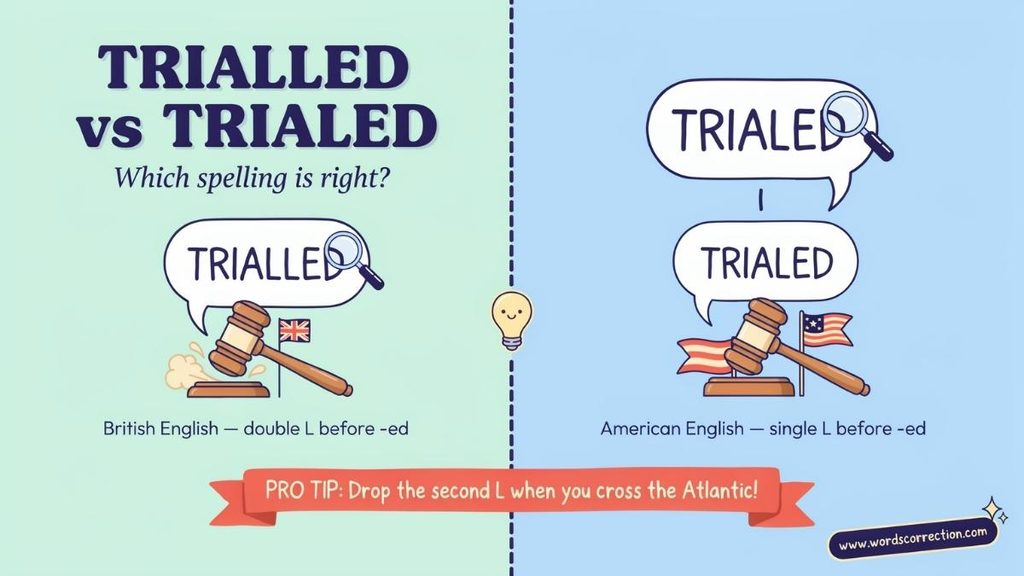
Seeing both forms in context makes the difference much easier to remember.
Trialled in a Sentence
- The researchers trialled the new treatment for six months.
- The school trialled a four-day timetable.
- The company trialled the software with a small group of users.
- Engineers trialled the machine under difficult conditions.
- The government trialled the new transportation policy.
Trialed in a Sentence
- The researchers trialed the new treatment for six months.
- The school trialed a four-day timetable.
- The company trialed the software with a small group of users.
- Engineers trialed the machine under difficult conditions.
- The government trialed the new transportation policy.
Notice what changes: only the spelling.
Trialled or Trialed in Science and Research
The verb trial is especially common in scientific and research contexts because researchers frequently test treatments, methods, materials, technologies, and procedures.
For example:
Researchers trialed the new testing method before introducing it across the laboratory.
In British English, the same sentence would use:
Researchers trialled the new testing method before introducing it across the laboratory.
The word is particularly useful when the testing process is organized or systematic.
Common expressions include:
- trial a treatment
- trial a procedure
- trial a method
- trial a device
- trial a material
- trial a technology
- trial an intervention
- trial a system
The term clinical trial, however, is a noun phrase. It does not automatically require trialed or trialled because the word is functioning as a noun rather than a verb.
Trialled or Trialed in Technology and Software
Technology companies often trial new software features, platforms, security systems, and digital tools before making them widely available.
For example:
The company trialed the new software with selected customers.
A British English publication might write:
The company trialled the new software with selected customers.
Both versions are correct.
In technical documentation, consistency becomes particularly important because software documentation may be read by international audiences.
If the document follows US English, use trialed consistently.
If it follows UK English, use trialled consistently.
Learn the difference between confusing word pairs
Where or When Difference and correct usage
both in Business Writing
Business writing frequently uses trial to describe testing a product, service, strategy, or process.
Examples include:
- The company trialed a new pricing strategy.
- The retailer trialed self-checkout technology.
- The marketing team trialed two different campaigns.
- The organization trialled a flexible working arrangement.
- The business trialled the service in three locations.
In professional writing, the choice should match the organization’s preferred style guide and target audience.
A spelling inconsistency can make otherwise polished content look careless.
Trialled or Trialed in Education
Educational institutions may trial new teaching methods, schedules, technologies, or assessment systems.
For example:
The university trialed a new online examination system.
In British English:
The university trialled a new online examination system.
The word works particularly well when a school, college, or university tests a new approach before adopting it permanently.
Trialled or Trialed in Government and Public Policy
Governments and public organizations also use trial as a verb when they introduce a policy or service on a limited basis before deciding whether to expand it.
For example:
The government trialed the program in several cities.
British English:
The government trialled the program in several cities.
This usage emphasizes controlled or limited implementation.
A policy may be trialed for several months. Officials can then assess the results before deciding whether to introduce it more broadly.
Learn the difference between tricky grammar more words
Doggie or Doggy Which Spelling Is Correct?
Common Mistakes With Trialled and Trialed
Several mistakes frequently appear when writers are unsure about the correct spelling.
Mistake 1: Treating One Spelling as Universally Correct
Some writers assume that trialled is always correct because they have seen it in British publications.
Others assume that trialed is always correct because it is familiar from American sources.
Neither assumption is accurate.
Both spellings are legitimate.
Mistake 2: Mixing Regional Spelling
A document might contain:
The company trialled the software and later canceled the project.
This combination may look inconsistent in a document otherwise intended to follow one spelling system.
A British English version would normally use:
The company trialled the software and later cancelled the project.
An American English version would normally use:
The company trialed the software and later canceled the project.
Consistency creates a more professional appearance.
Mistake 3: Confusing Trialed With Tried
Remember that trialed comes from trial, while tried comes from try.
Incorrectly replacing one with the other can change the intended meaning or tone.
Compare:
The researchers trialed the treatment.
with:
The researchers tried the treatment.
The first sentence suggests a formal testing process. The second is broader and less specific.
Learn the difference between commonly mixed-up more words
Insight or Insite? What’s the Correct English Word?
Is Trialled a Real Word?
Yes. Trialled is a standard and established spelling.
It is the conventional British English past tense and past participle of trial when used as a verb.
It appears in British dictionaries and in professional, academic, scientific, educational, and government writing.
Therefore, trialled is grammatically correct.
Is Trialed a Real Word?
Yes. Trialed is also a standard spelling.
It is commonly used in American English as the past tense and past participle of the verb trial.
Therefore, trialed is grammatically correct in American English.
There is no reason to treat either spelling as a misspelling simply because it differs from the version used in another English variety.
British English Trialled vs American English Trialed
The easiest way to remember the distinction is:
British English → trialled
American English → trialed
This follows a broader pattern of spelling differences between the two varieties.
British English Examples
- travelled
- cancelled
- labelled
- modelled
- trialled
American English Examples
- traveled
- canceled
- labeled
- modeled
- trialed
These differences are examples of regional language variation rather than differences in grammar or meaning.
What About Australian, Canadian, and New Zealand English?
English spelling does not divide neatly into only two categories.
Australian English and New Zealand English generally follow many British spelling conventions. As a result, trialled is commonly used in these varieties.
Canadian English is more mixed. Canadian usage contains both British and American influences, so spelling can vary according to the word, publication, institution, and style guide.
For an international audience, the best strategy is to identify the intended language standard and apply it consistently.
Learn the difference between confusing more English words
Employees or Employee’s: Which One Is Correct?
Should You Use Trialled or Trialed in Formal Writing?
The answer depends on your audience.
Use Trialed When Writing for:
- A US audience
- American companies
- American academic institutions
- US government or professional contexts
- Publications following American English
- Websites targeting US readers
Use Trialled When Writing for:
- A UK audience
- British companies
- UK academic institutions
- British government or professional contexts
- Publications following British English
- Publications using UK spelling conventions
Neither spelling is inherently more formal.
The regional standard determines which form is appropriate.
Learn the difference between tricky more English words
Honoured or Honored Meaning, Difference, Spelling and Usage
both in Academic Writing
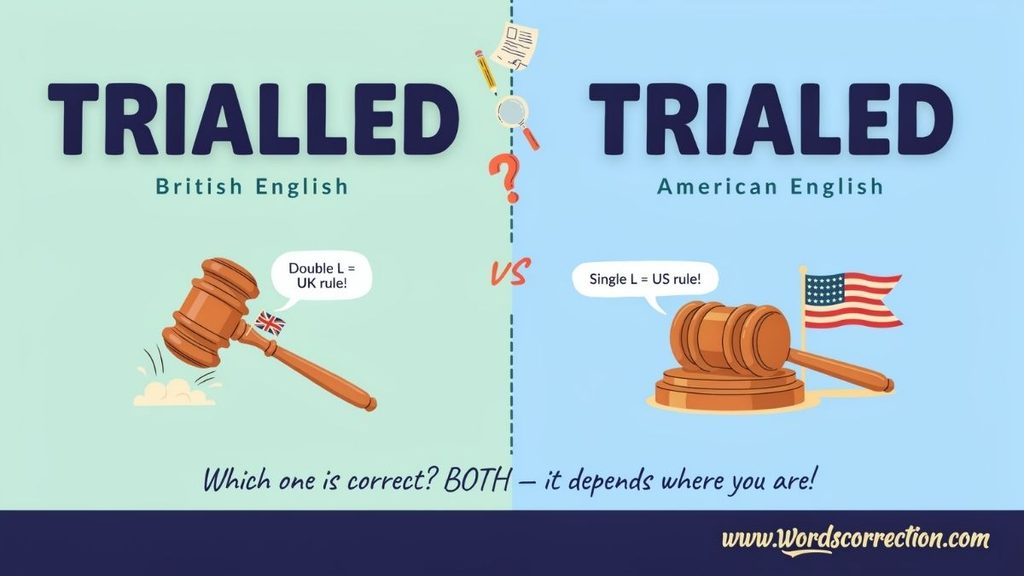
Academic writers should follow the spelling convention required by their institution, publisher, journal, or chosen style guide.
For example, an American academic paper might state:
The researchers trialed three different methods before selecting the final procedure.
A British academic paper might state:
The researchers trialled three different methods before selecting the final procedure.
The important issue is not choosing the spelling that looks more sophisticated. It is following the required language standard consistently.
Trialled or Trialed for Professional Writing
Professional English depends heavily on audience and organizational standards.
Before choosing between the two forms, consider:
- Who will read the document?
- Which country or region does the organization serve?
- Does the organization have a style guide?
- Which spelling system does the rest of the document use?
- Is the document intended for a specific publication or market?
If the rest of your document follows American spelling, trialed is the natural choice.
If it follows British spelling, trialled is the natural choice.
Trialled or Trialed for an International Audience
When writing for an international audience, either spelling can work.
The key is consistency.
If your website uses American English throughout, use trialed.
If your website follows British English, use trialled.
Do not switch between them simply because both forms appear in search results.
A consistent language style is easier for readers to understand and gives your content a more professional appearance.
Trialled or Trialed for SEO Content
Both spellings can be useful for SEO because users from different English-speaking regions may search for different versions.
For example, searches may include:
- trialled or trialed
- trialled vs trialed
- trialed or trialled meaning
- trialled meaning
- trialed meaning
- trialled or trialed difference
- is trialled or trialed correct
- trialled or trialed in a sentence
- British English trialled
- American English trialed
However, SEO content should never sacrifice readability for keyword placement.
Use the primary spelling naturally. Explain the alternative where it is genuinely relevant.
A clear comparison page can address both forms without awkward repetition.
Learn how to use confusing more words correctly
Chears or Cheers Difference, Meaning and Usage
Trialled or Trialed Pronunciation and Spelling
One useful point is that trialled and trialed are generally pronounced the same way.
The spelling changes, but the pronunciation does not normally change simply because one form contains an additional l.
This is another reason the difference can feel confusing. When spoken aloud, there is no obvious clue about which spelling a writer should use.
The spelling depends on the English variety and the writing context.
How to Remember Trialled vs Trialed
A simple memory trick can help:
British English doubles the L: trialled.
American English keeps one L: trialed.
Think of the pattern:
British: travelled, cancelled, labelled, trialled
American: traveled, canceled, labeled, trialed
This is not a universal rule for every word ending in l, but it provides a useful reminder for this group of spellings.
Quick Comparison: Trialled vs Trialed
| Question | Answer |
| Are trialled and trialed the same word? | Yes, they are spelling variants of the same verb. |
| What does trialled mean? | Tested or evaluated. |
| What does trialed mean? | Tested or evaluated. |
| Is trialled correct? | Yes. |
| Is trialed correct? | Yes. |
| Which is British English? | Trialled. |
| Which is American English? | Trialed. |
| What is the past tense of trial? | Trialled or trialed. |
| What is the past participle? | Trialled or trialed. |
| Do they have different meanings? | No. |
| Are they pronounced differently? | Generally, no. |
| Can both appear in English writing? | Yes. |
| Should you use both in one document? | Usually no. Choose one regional style and remain consistent. |
Practice Session: Trialled or Trialed
Fill in the Blanks
Choose the correct form: trialled or trialed.
- The British company ______ the new software before its official release.
- The American researchers ______ a new method last year.
- The treatment was successfully ______ in several hospitals.
- The new educational program was ______ by local schools.
- The engineers ______ the machine for several months.
- The company ______ the product in the United Kingdom.
- The scientists ______ the experimental procedure carefully.
- The new system was ______ before being introduced nationwide.
- Australian authorities ______ the new traffic regulations.
- The American manufacturer ______ the equipment extensively.
- The software had already been ______ by thousands of users.
- The research team ______ the new technology during the summer.
- The British newspaper reported that the service had been ______ successfully.
- The company ______ several marketing strategies before choosing one.
- The American hospital ______ the new medical device last year.
- The new teaching method was ______ in several classrooms.
- British engineers ______ the prototype under different conditions.
- The researchers ______ the vaccine before recommending it for wider use.
- The organization ______ a new workplace policy in selected offices.
- The American team ______ the software extensively before launch.
- The product was ______ in Australia before becoming commercially available.
- The company had ______ several designs before selecting the final version.
- The British government ______ the new system in a limited number of regions.
- The American researchers ______ the experimental treatment on volunteers.
- The new technology was carefully ______ before its public release.
Answer Session
- trialled
- trialed
- trialled
- trialled
- trialled
- trialled
- trialled
- trialled
- trialled
- trialed
- trialled
- trialled
- trialled
- trialled
- trialed
- trialled
- trialled
- trialled
- trialled
- trialed
- trialled
- trialled
- trialled
- trialed
- trialled
Here’s a trusted source for clear more words Comparison:
Grammar Update
Frequently Asked Questions About Trialled or Trialed
Is “trialled” acceptable in formal English writing?
Yes, “trialled” is perfectly acceptable in formal English writing and is commonly used in British, Australian, and Canadian English.
Is “trialed” considered an incorrect spelling?
No, “trialed” is not incorrect. It is the standard American English spelling of the past tense and past participle of the verb “trial.”
Why are there two spellings of the word “trialled”?
The difference results from regional spelling conventions. British English typically doubles the final consonant before adding “-ed,” while American English generally uses a single “l.”
Which spelling is preferred in British English?
“Trialled” is the standard and more widely preferred spelling in British English.
Which spelling should I use in academic writing?
Use the spelling that aligns with your institution’s preferred English variety or the style guide you are required to follow. Consistency is the most important factor.
Can “trialled” and “trialed” be used interchangeably?
Yes, both spellings have the same meaning and grammatical function. The appropriate choice depends on the regional variety of English being used.
Are “trialled” and “trialed” pronounced differently?
No, both spellings have the same pronunciation in standard English.
What is the difference between “trialling” and “trialing”?
“Trialling” is the preferred spelling in British English, while “trialing” is more commonly used in American English. Both forms refer to the process of testing or evaluating something.
What is the present-tense form of “trialled”?
The present-tense form is “trial.” For example: “The researchers trial new treatments before recommending them.”
What is the base form of the verb “trialled”?
The base form is “trial.” “Trialled” is its past tense and past participle form.
Is “trialled” a regular verb form?
Yes, “trialled” is the regular past tense and past participle form of the verb “trial.”
Can “trialled” be used when describing product testing?
Yes, “trialled” is commonly used to describe the testing or evaluation of products, services, software, and other innovations.
Is “trialed” appropriate for American business writing?
Yes, “trialed” is widely accepted and commonly used in American business, technical, and professional writing.
Is there a difference between “trialled” and “tested”?
Both words can describe the process of evaluating something. However, “trialled” often suggests testing something in a practical, experimental, or real-world situation.
When should I use British spelling instead of American spelling?
Use British spelling when writing for audiences in the United Kingdom or when following a British English style guide.
When should I use American spelling instead of British spelling?
American spelling is generally appropriate when writing for audiences in the United States or following American English editorial standards.
Does Microsoft Word recognize both “trialled” and “trialed”?
Yes, both spellings are generally recognized by Microsoft Word when the appropriate English language settings are enabled.
Does using “trialled” or “trialed” affect SEO?
No, either spelling can be used effectively for SEO. Search engines generally recognize regional spelling variations and understand their shared meaning.
Is “trialled” commonly used in Australian English?
Yes, “trialled” is the standard spelling commonly used in Australian English.
Is “trialled” used in Canadian English?
Yes, “trialled” is commonly used in Canadian English, which often follows British spelling conventions.
Can “trialled” function as both a past tense and a past participle?
Yes, “trialled” serves as both the simple past tense and the past participle of the verb “trial.”
Is “trialled” suitable for technical documentation?
Yes, “trialled” is appropriate for technical documentation, particularly when describing testing procedures, experimental applications, or product evaluations.
Does “trialled” require any special punctuation?
No, “trialled” follows standard English punctuation rules and does not require any special punctuation marks.
Is “trialled” more common in British publications?
Yes, British publications generally prefer “trialled” because it follows conventional British English spelling rules.
Should a website use both “trialled” and “trialed”?
A website should consistently follow one variety of English throughout its content. However, mentioning both spellings naturally can help address readers from different English-speaking regions.
Conclusion
The trialled or trialed confusion may make English seem determined to test your patience, but the rule is surprisingly simple. Both spellings are correct. Trialled is the standard British English form, while trialed is the standard American English form. Both mean tested, evaluated, or used experimentally, and both function as the past tense and past participle of trial.
The real mistake is assuming that one spelling works everywhere or switching between them without following a clear language standard. For American English, use trialed. For British English, use trialled. If you’re writing for an international audience, choose one style and use it consistently.
Once you understand the trialled vs trialed difference, there’s no need to let one extra “l” turn a simple word into a grammar headache. Choose the appropriate spelling, stay consistent, and let your writing do the testing instead.

Stella AJS is an experienced blogger and dedicated English language writer at Words Correction. She turns confusing grammar, word meanings, spelling, and usage into clear, practical insights that readers can easily understand and apply. With a passion for precise and engaging writing, Stella helps readers avoid common language mistakes, strengthen their vocabulary, and communicate with greater clarity and confidence.




