
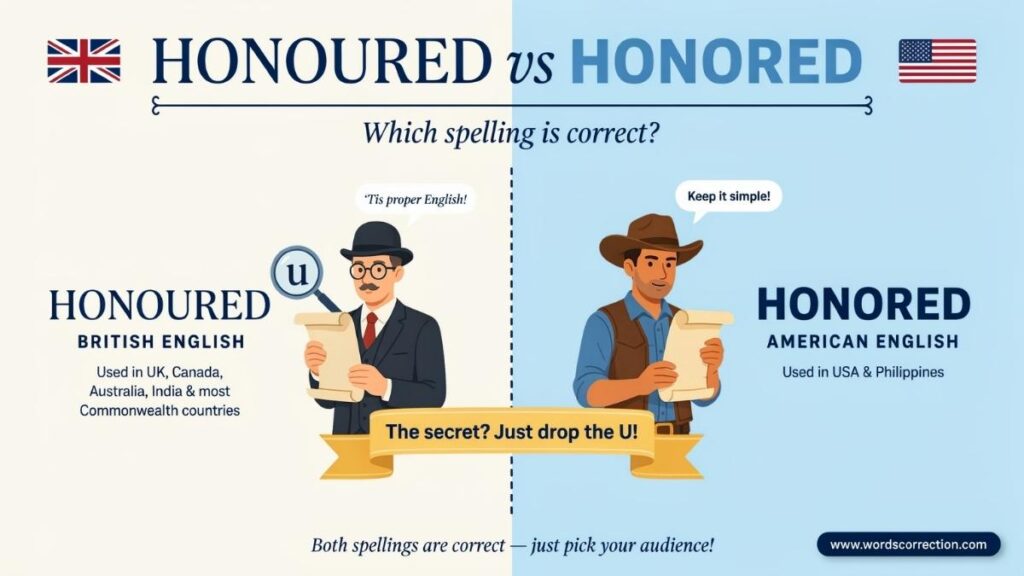
English has a talent for turning one little letter into a big question. The spelling honoured or honored is a classic example. At first glance, the extra “u” may seem like a grammatical troublemaker, but there’s no need to panic. Both spellings are correct; the difference comes down to regional English. American English generally prefers “honored,” while British English and many Commonwealth varieties use “honoured.” Neither spelling changes the meaning or pronunciation. In this guide, you’ll discover the honoured or honored meaning, understand the difference between the two forms, and explore clear examples that make this spelling confusion simple, memorable, and easy to get right.
Honoured or Honored Quick Answer
The short answer is simple:
- Honored is the standard American English spelling.
- Honoured is the standard British English spelling.
- Both spellings have the same meaning.
- Both are grammatically correct.
- The extra “u” in honoured does not change the word’s basic pronunciation.
- Your choice should match the English variety used throughout your writing.
For example
American English I was honored to receive the award.
British English I was honoured to receive the award.
The meaning doesn’t change. Both sentences express the same idea: the speaker feels privileged, proud, or grateful to receive the award.
Therefore, if you’re asking which is correct, honored or honoured, the answer is that both are correct in their respective varieties of English.
What Does Honored or Honoured Mean?
To understand the honoured or honored meaning, it’s helpful to begin with the base words honor and honour.
Honored and honoured are forms of the verb honor/honour. Depending on the context, the word can describe receiving recognition, showing respect, feeling privileged, or fulfilling an obligation.
Honored Meaning
The honored meaning generally relates to respect, recognition, dignity, appreciation, or privilege.
For example:
She was honored for her years of community service.
Here, honored means that she received recognition for her contribution.
Consider another example:
I feel honored to be part of this project.
In this sentence, honored expresses a feeling of privilege and appreciation.
The word can also refer to fulfilling an agreement, promise, or obligation:
The company honored its promise to replace the damaged product.
Here, honored means kept or fulfilled.
So, when someone asks, “What does honored mean?” the answer depends on context. It can mean receiving recognition, feeling privileged, showing respect, or fulfilling a commitment.
Honoured Meaning
The honoured meaning is the same as honored. The only difference is the spelling.
For example:
The university honoured her achievements with a special award.
This means that the university recognized her achievements.
Another example is:
I feel honoured to represent my country.
Here, honoured expresses a sense of privilege and pride.
Therefore, if you’re wondering what does honoured mean, it has the same core meanings as honored. The spelling simply reflects a different English variety.
Learn the difference between confusing more English words step by step
Presence or Presense Which Spelling Is Correct?
Honored vs Honoured: What Is the Difference?
The honored vs honoured difference is a matter of spelling rather than meaning.
| Feature | Honored | Honoured |
| Main English variety | American English | British English |
| Meaning | Same | Same |
| Basic pronunciation | Same | Same |
| Base word | Honor | Honour |
| Past tense | Honored | Honoured |
| Past participle | Honored | Honoured |
| Extra “u” | No | Yes |
| Regional preference | United States | United Kingdom and many Commonwealth contexts |
The same pattern appears with the base words honor and honour.
This means the honored vs honoured spelling follows the same general regional distinction as honor vs honour.
Honored and Honoured Difference in Practice
Imagine two newspapers reporting the same award ceremony.
An American publication might write:
The actor was honored at the annual ceremony.
A British publication might write:
The actor was honoured at the annual ceremony.
Neither publication has made a spelling mistake. Each is following its own regional English convention.
That is the essential difference between honored and honoured: the spelling changes, but the meaning does not.
Honor or Honour: Meaning and Spelling
The question of honor or honour comes before the question of honored or honoured because these forms come from the same base word.
Honor and honour can function as both nouns and verbs.
As a noun, the word can refer to respect, dignity, recognition, or a privilege:
It was a great honor to meet the president.
In British English:
It was a great honour to meet the president.
As a verb, the word can mean to show respect or fulfill an obligation:
We honor those who served.
In British English:
We honour those who served.
Honor vs Honour
The honor vs honour distinction is primarily regional.
- Honor is the American English form.
- Honour is the British English form.
The same distinction continues into related forms:
- Honor → honored → honoring
- Honour → honoured → honouring
Therefore, if you’re searching for the honor or honour spelling, remember that both forms are standard. The appropriate choice depends on the English variety you’re following.
Learn the difference between everyday English mistakes
To or Too Clear Difference, Meaning and Usage
The Origin of Honored and Honoured
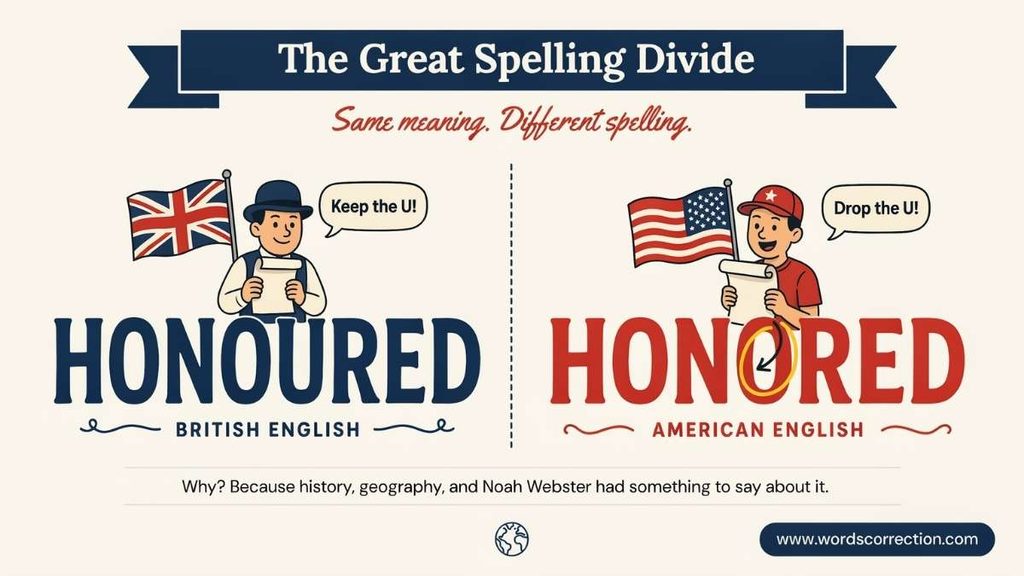
The history of honored and honoured goes back much further than modern American and British English.
The word ultimately comes from Latin honor, which carried meanings associated with dignity, esteem, respect, reputation, and distinction. The word entered English through French influence and developed into forms associated with the English word honour.
Over centuries, English spelling developed differently in Britain and North America. British English generally retained the “u” in words such as honour, colour, favour, labour, and behaviour.
American English increasingly adopted shorter spellings such as honor, color, favor, labor, and behavior.
This difference became part of the broader development of American and British spelling conventions.
Why Is Honored Spelled Without U?
If you’ve wondered why is honored spelled without u, the answer lies in the development and standardization of American English spelling.
American English adopted a number of shorter spellings that removed the “u” found in traditional British forms. This pattern appears in several familiar word pairs:
| American English | British English |
| honor | honour |
| color | colour |
| favor | favour |
| labor | labour |
| behavior | behaviour |
The spelling without “u” is not an informal abbreviation. Honored is the standard American English spelling.
Why Is Honoured Spelled With U?
If you’re wondering why is honoured spelled with u, the answer is that British English traditionally retains the “u” in honour and related forms.
This produces the following pattern:
honour → honoured → honouring
American English uses:
honor → honored → honoring
The additional letter does not create a different meaning. It simply reflects a different regional spelling system.
Learn the difference between commonly misused words
Inact or Enact Which Spelling Is Correct?
American English vs British English Spelling
Understanding regional spelling makes the honored or honoured spelling much easier to remember.
When to Use “Honored”
Use honored when you’re writing in American English.
This is appropriate for writing intended primarily for readers in the United States, including:
- American schools and universities
- U.S. businesses
- American news publications
- U.S. government communication
- American websites
- Professional documents following U.S. English conventions
Examples:
We are honored to announce the winner.
She was honored for her outstanding achievement.
I would be honored to attend the ceremony.
If you’re asking, “Is honored the American spelling?” the answer is yes.
When to Use “Honoured”
Use honoured when you’re following British English spelling conventions.
Examples include:
- British publications
- UK institutions
- British academic writing
- Formal documents using UK spelling
- Many Commonwealth English contexts
Examples:
We are honoured to welcome our guests.
She was honoured for her contribution.
I would be honoured to attend the ceremony.
If you’re asking, “Is honoured the British spelling?” the answer is yes.
Which Is Correct: Honored or Honoured?
The answer depends on the English variety.
If you’re writing in American English, use honored.
If you’re writing in British English, use honoured.
Neither spelling is universally “more correct.”
The most important rule is consistency. A document that uses American spellings such as color, center, and favor will normally look more consistent with honored. A document using colour, centre, and favour will normally fit better with honoured.
Learn the difference between basic English word mistakes
Maxxed or Maxed: Which Spelling Is Correct?
Honored or Honoured in Canada
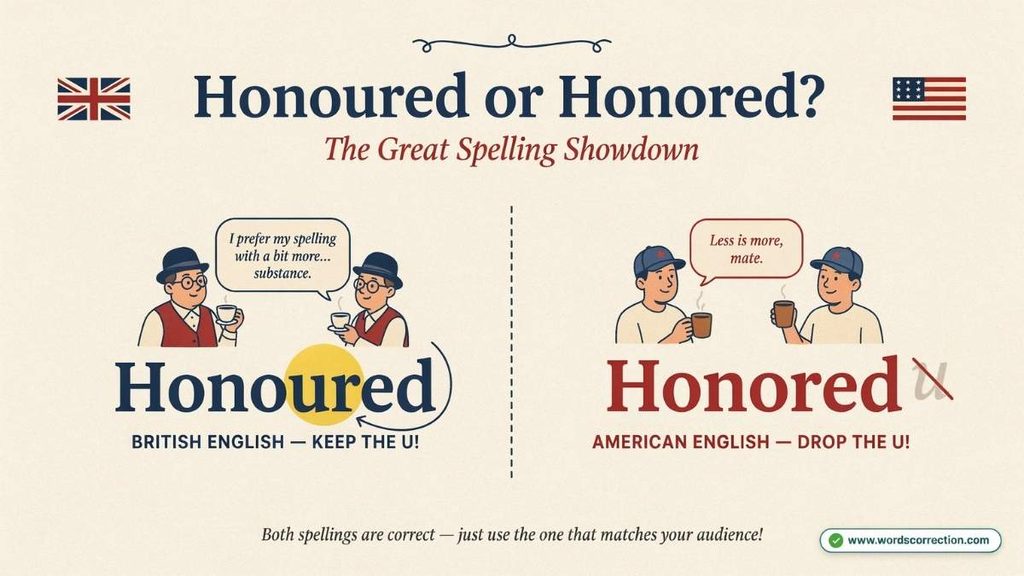
The question of Canadian spelling, honored or honoured, is slightly more complicated because Canadian English has developed under the influence of both British and American English.
Canadian English commonly uses honour and honoured, particularly in formal and institutional contexts. However, Canadian spelling isn’t simply a perfect combination of British and American rules.
Different Canadian organizations and publications may follow different style guides.
Therefore, when writing for a Canadian audience, check the required style guide if one exists. If no specific guide applies, consistency throughout the document is the safest approach.
So, for honored or honoured in Canada, don’t automatically assume that only one spelling can ever be correct.
Honored or Honoured in Australia
Australian English generally follows British spelling conventions for words of this type.
As a result, honoured is the usual form in Australian English.
For example:
She was honoured for her contribution to Australian literature.
Therefore, when writing specifically for an Australian audience, honoured will generally be the natural choice.
Commonwealth Spelling: Honoured
Many Commonwealth varieties of English use honoured rather than honored.
This makes the following pattern useful:
- American English: honored
- British English: honoured
- Commonwealth English: often honoured
- Australian English: generally honoured
- Canadian English: commonly honoured, with some variation
However, English varieties don’t always follow one rigid rule. Institutions, publishers, governments, and professional organizations can have their own style requirements.
When an official style guide exists, follow it.
Learn the difference between often confused words
Unattentive or Inattentive Meaning and Usage
Honored or Honoured: Grammar and Verb Forms
Honored and honoured are both forms of the verb honor/honour.
Understanding their grammatical role makes the spelling much easier to use correctly.
Past Tense of Honor
The past tense of honor in American English is honored.
The committee honored the scientist last year.
Past Participle of Honor
The past participle of honor is also honored.
She has been honored for her research.
The American pattern is:
honor → honored → honored
The first form is the base verb. The second is the past tense. The third is the past participle.
Past Tense of Honour
The past tense of honour in British English is honoured.
The city honoured the firefighter.
Past Participle of Honour
The past participle of honour is also honoured.
He has been honoured for his service.
The British pattern is:
honour → honoured → honoured
This is why the same written form can function as both the past tense and past participle.
How to Use Honored or Honoured in a Sentence
Knowing the spelling is only half the job. You also need to understand how the word works in real sentences.
Honored or Honoured as Feeling Privileged
One common use describes a person’s feeling of privilege or gratitude.
American English:
I feel honored to be invited.
British English:
I feel honoured to be invited.
This construction frequently appears when someone receives an award, invitation, appointment, or opportunity.
Honored or Honoured as Recognition
Another common use describes giving someone formal recognition.
The university honored her for her achievements.
British English:
The university honoured her for her achievements.
Here, the word means that the university recognized and celebrated her achievement.
Honored or Honoured as Showing Respect
The verb can also describe an act of respect or tribute.
The community honored the firefighters who lost their lives.
British English:
The community honoured the firefighters who lost their lives.
The meaning here is closer to paying tribute or showing respect.
Learn the difference between confusing word pairs
Handle or Handel Correct Spelling, Meaning, and Usage
Honored or Honoured as Fulfilling an Obligation
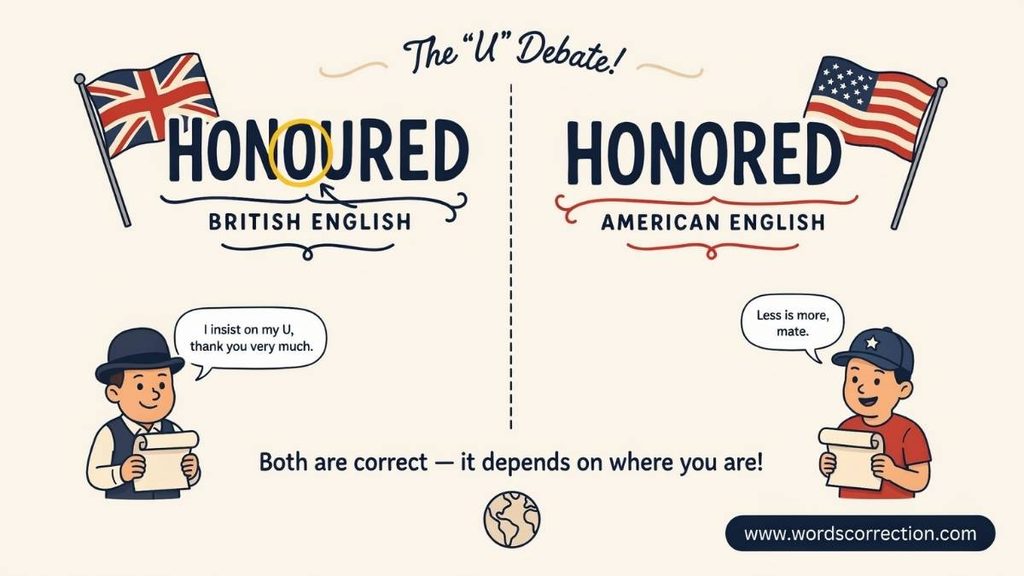
Honor can also mean to fulfill or keep something that was promised or agreed.
The company honored the agreement.
British English:
The company honoured the agreement.
Here, the word doesn’t mean giving someone an award. It means respecting the terms of an agreement.
This distinction matters because context determines the precise meaning.
Common Expressions With Honored or Honoured
Several expressions appear frequently in everyday English and formal writing.
I Would Be Honored or I Would Be Honoured
Both versions are correct.
American English:
I would be honored to accept your invitation.
British English:
I would be honoured to accept your invitation.
The expression communicates gratitude and a sense of privilege.
I Feel Honored or I Feel Honoured
American English:
I feel honored to receive this recognition.
British English:
I feel honoured to receive this recognition.
This phrase is common when someone receives an award or another form of recognition.
We Are Honored or We Are Honoured
American English:
We are honored to welcome our guests.
British English:
We are honoured to welcome our guests.
This construction frequently appears in announcements, invitations, speeches, and professional communication.
Honored to Be or Honoured to Be
Examples include:
I am honored to be part of this organization.
I am honoured to be part of this organization.
Both sentences are grammatically correct.
Honored to Meet You or Honoured to Meet You
These expressions are often used in polite professional or formal situations.
It was a pleasure to meet you, and I was honored to hear your perspective.
British English can use the same sentence with honoured.
Honored to Receive or Honoured to Receive
This expression is particularly common when discussing awards and recognition.
She was honored to receive the leadership award.
She was honoured to receive the leadership award.
Honored With an Award or Honoured With an Award
Use this construction when discussing recognition involving an award or distinction.
The scientist was honored with an award for her research.
British English:
The scientist was honoured with an award for her research.
Honored to Host or Honoured to Host
We are honored to host this year’s conference.
We are honoured to host this year’s conference.
The phrase works naturally in announcements and formal invitations.
Honored to Serve or Honoured to Serve
He was honored to serve as chairman.
He was honoured to serve as chairman.
The expression indicates that the person considers the role a privilege.
Honored to Attend or Honoured to Attend
We are honored to attend this important event.
We are honoured to attend this important event.
Again, only the regional spelling changes.
Learn the difference between tricky grammar more words
Inconsolable or Unconsolable Which Is Correct?
Common Grammar Patterns

Certain prepositions commonly appear with these forms.
Honored to
Use honored to or honoured to when describing something you feel privileged to do.
I am honored to represent the organization.
Honored for
Use honored for when explaining why someone received recognition.
She was honored for her dedication to education.
The phrase following for normally identifies the achievement, service, quality, or contribution being recognized.
Honored with
Use honored with when introducing an award, title, distinction, or other form of recognition.
He was honored with a lifetime achievement award.
Honored by
Use honored by when identifying the person or organization that gave the recognition.
She was honored by the university.
These prepositions have different grammatical functions. Choosing the right one makes your writing more precise and natural.
Honored or Honoured in Different Types of Writing
The spelling you choose can depend on the audience and the type of publication you’re preparing.
Formal Writing
Both forms are appropriate in formal writing.
Common examples include:
- official letters
- award announcements
- speeches
- certificates
- institutional statements
- invitations
The key is to follow the regional spelling system consistently.
Business Writing
For an American company:
We are honored to partner with your organization.
For a British company:
We are honoured to partner with your organization.
Neither version is more professional. The difference comes from regional writing conventions.
Academic Writing
Academic writers should follow the style requirements of their institution, publisher, or assignment.
If the work uses American English, use honored.
If it follows British English, use honoured.
Consistency matters throughout the entire document.
News Writing
Professional publications generally follow established editorial style guides.
A U.S. publication will normally use honored, while a British publication will normally use honoured.
Invitations
Both forms work naturally in formal invitations.
We are honored to invite you to our annual ceremony.
We are honoured to invite you to our annual ceremony.
Choose the form that matches the audience and overall spelling style.
Learn the difference between commonly mixed-up more words
Where or When Difference and correct usage
Case Study: One Message in Two English Varieties
Consider a university announcing that a professor has received a major award.
American English
We are honored to announce that Dr. Morgan has been honored with the Distinguished Research Award for her outstanding contribution to environmental science.
British English
We are honoured to announce that Dr. Morgan has been honoured with the Distinguished Research Award for her outstanding contribution to environmental science.
The grammar, sentence structure, and meaning remain the same.
Only the regional spelling changes.
This example clearly demonstrates the difference between honored and honoured. Neither form changes the message.
Common Mistakes With Honored or Honoured
The spelling rule is straightforward, but several mistakes can still cause confusion.
Mixing Both Spellings
A document might begin with:
The organization honored the winner.
Later, it might say:
The ceremony honoured several volunteers.
If the document follows one regional style, this inconsistency can look like an editing error.
Choose one spelling system and use it throughout.
Assuming Honoured Is More Formal
The additional “u” doesn’t make honoured more formal.
Likewise, honored isn’t casual simply because it has fewer letters.
The difference is regional, not a difference in formality.
Assuming Honored Is Wrong
Some writers see honored in American publications and assume it is a spelling mistake.
It isn’t.
Honored is the standard American English form.
Assuming Honoured Is Wrong
The reverse mistake is equally common.
In British English, honoured is the standard spelling. The “u” isn’t unnecessary.
Confusing Honor or Honour With Honored or Honoured
Keep the word family consistent:
honor → honored → honoring
honour → honoured → honouring
Switching between these systems without a reason can make your writing look inconsistent.
Using the Wrong Preposition
Compare these structures:
- honored to receive
- honored for an achievement
- honored with an award
- honored by an organization
They express related ideas, but their grammatical roles differ.
Learn the difference between confusing more English words
Doggie or Doggy Which Spelling Is Correct?
Honored vs Honoured vs Honor vs Honour
These four forms are closely related but serve different grammatical roles.
| Word | American English | British English | Typical role |
| Base form | honor | honour | Noun or verb |
| Past tense | honored | honoured | Verb |
| Past participle | honored | honoured | Verb |
| Present participle | honoring | honouring | Verb |
For example:
honor her work.
We honored her work.
have we honored her work.
The British equivalents simply use honour and honoured.
Understanding the entire word family prevents spelling mistakes.
Honored or Honoured Synonyms
Depending on context, useful synonyms for honored and honoured include:
- respected
- esteemed
- recognized
- admired
- praised
- commended
- celebrated
- distinguished
- appreciated
However, these words aren’t interchangeable in every sentence.
For example:
The organization honored her for her achievement.
can naturally become:
The organization recognized her for her achievement.
But:
I am honored to meet you.
doesn’t always work naturally if honored is replaced with recognized.
The best synonym depends on whether the original sentence expresses respect, admiration, recognition, privilege, appreciation, or fulfillment of an obligation.
Learn the difference between tricky words and use them correctly
Insight or Insite? What’s the Correct English Word?
Honored or Honoured Pronunciation
The honored pronunciation and honoured pronunciation are essentially the same in standard English.
The written “u” in honoured doesn’t create an additional syllable.
Likewise, honor pronunciation and honour pronunciation generally don’t differ simply because of the spelling.
Regional accents can produce small pronunciation differences, but those differences aren’t caused by the presence or absence of the letter “u.”
So, if you’re learning how to pronounce honored or how to pronounce honoured, focus on the normal pronunciation of the word rather than trying to pronounce the written “u” separately.
Honored or Honoured: Real-World Sentence Examples
Here are several examples that show how the two spellings work in context.
| American English | British English |
| I was honored to receive the award. | I was honoured to receive the award. |
| She was honored for her service. | She was honoured for her service. |
| We are honored to welcome you. | We are honoured to welcome you. |
| The school honored its graduates. | The school honoured its graduates. |
| He felt honored by the recognition. | He felt honoured by the recognition. |
| The company honored the agreement. | The company honoured the agreement. |
These examples demonstrate the central rule: the spelling changes, but the meaning and grammar remain the same.
How to Spell Honored and Honoured
If you’re wondering how to spell honored, the American spelling is:
honored
If you’re wondering how to spell honoured, the British spelling is:
honoured
A simple way to remember the difference is to start with the base word:
honor → honored
honour → honoured
Once you know which version of the base word your writing uses, the related forms become much easier to spell correctly.
Learn the difference between similar English words the easy way
Employees or Employee’s: Which One Is Correct?
Which Is Correct: Honored or Honoured?
The answer depends on your chosen variety of English.
Use Honored If:
- You’re writing in American English.
- Your audience is primarily in the United States.
- Your publication follows U.S spelling.
- Your document already uses American spellings such as color and favor.
Use Honoured If:
- You’re writing in British English.
- Your audience is primarily in the United Kingdom.
- Your publication follows British spelling.
- Your document already uses spellings such as colour and favour.
For an International Audience
If you’re writing for an international audience, identify the primary audience or follow the style guide of the organization publishing the content.
Don’t switch randomly between regional spellings.
For example, if an article consistently uses American English, use honored throughout. If it consistently uses British English, use honoured.
Consistency makes written English look deliberate and professional.
Practice Session
Fill in the Blanks
Complete each sentence with the correct form: honored or honoured. Use American English for odd-numbered sentences and British English for even-numbered sentences.
- I am deeply ______ to receive this prestigious award.
- She was ______ for her outstanding contribution to the community.
- We are ______ to welcome you to this important ceremony.
- He felt ______ when he was selected for the prestigious position.
- The organization ______ its founder during the annual event.
- I would be ______ to accept your invitation.
- The university ______ several outstanding students for their achievements.
- They were ______ to meet the distinguished author.
- She was ______ with a lifetime achievement award.
- We feel ______ to have you as our guest.
- The committee ______ the scientist for her groundbreaking work.
- He said that he was ______ to represent his country.
- The guests were ______ by the warm reception.
- I am ______ to be part of this important occasion.
- The school ______ its former principal at the ceremony.
- She felt truly ______ to receive such recognition.
- We are ______ to have been invited to the event.
- The athlete was ______ for his remarkable performance.
- I would feel ______ to work with such an experienced team.
- They were deeply ______ by the recognition they received.
- The organization ______ the volunteers for their dedication.
- We are ______ to have the opportunity to participate.
- The company ______ its employees for their years of service.
- She was ______ to receive the highest distinction.
- I am ______ to share this achievement with my colleagues.
Answer Session
- honored — American English
- honoured — British English
- honored — American English
- honoured — British English
- honored — American English
- honoured — British English
- honored — American English
- honoured — British English
- honored — American English
- honoured — British English
- honored — American English
- honoured — British English
- honored — American English
- honoured — British English
- honored — American English
- honoured — British English
- honored — American English
- honoured — British English
- honored — American English
- honoured — British English
- honored — American English
- honoured — British English
- honored — American English
- honoured — British English
- honored — American English
Quick Rule
- Honored = standard American English
- Honoured = standard British English and commonly used in Canadian and Australian English
The meaning is the same. The difference is primarily regional spelling.
Here’s a trusted source for clear more words Comparison:
Grammar Update
Frequently Asked Questions
Is “honored” or “honoured” correct in British English?
“Honoured” is the standard spelling in British English. The same spelling is commonly used in other varieties of English influenced by British conventions.
Is “honored” or “honoured” correct in American English?
“Honored” is the standard spelling in American English. American English typically omits the u found in the British spelling “honoured.”
Which spelling does Canada use: “honored” or “honoured”?
Canadian English generally prefers “honoured.” However, spelling conventions can vary by publication or style guide, so consistency is important.
Is “honored” or “honoured” correct in Australian English?
“Honoured” is the standard spelling in Australian English, following the traditional British form.
What does “honored” mean?
“Honored” means treated with respect, recognized for an achievement, or made to feel privileged. For example, “She was honored for her outstanding service.”
Is it correct to say “I’m honoured”?
Yes. “I’m honoured” is grammatically correct and is commonly used in British, Canadian, Australian, and other varieties of English that follow the -our spelling. In American English, the preferred form is “I’m honored.”
What does “I would be honored” mean?
“I would be honored” is a polite expression used to show that you would feel privileged, pleased, or proud to accept an invitation, opportunity, or responsibility.
What is the difference between “honored” and “honoured”?
There is no difference in meaning or pronunciation between the two forms. The difference is primarily regional. “Honored” is standard in American English, while “honoured” is standard in British English and commonly used in several Commonwealth varieties.
How do you spell “honored” in Canada?
In Canadian English, “honoured” is generally preferred. Canadian spelling often retains the u in words such as “honour” and “honoured.”
Do Americans spell it “honor” or “honour”?
Americans generally use “honor.” British English uses “honour.” This distinction also appears in related forms, such as honored/honoured and honoring/honouring.
Can “honored” be used as an adjective?
Yes. “Honored” can function as an adjective to describe someone who feels privileged or receives special recognition. For example, “I was honored to receive the award.”
Can “honored” be used as a verb?
Yes. “Honored” is the past tense and past participle of the American English verb “honor.” For example, “The university honored her for her achievements.”
What is the past tense of “honor”?
The past tense is “honored” in American English and “honoured” in British English.
What is the past participle of “honor”?
The past participle is “honored” in American English and “honoured” in British English. For example, “He was honored for his contribution to the community.”
How do you use “honored” in a sentence?
Use “honored” to express respect, recognition, or a sense of privilege. For example, “I’m honored to accept this prestigious award.”
How do you use “honoured” in a sentence?
Use “honoured” in the same contexts as “honored” when following British or Commonwealth spelling conventions. For example, “We are honoured to welcome you to the ceremony.”
What does “I feel honored” mean?
“I feel honored” means that you feel privileged, respected, or pleased because you have received recognition, an invitation, or a special opportunity.
What does “I feel honoured” mean?
“I feel honoured” has the same meaning as “I feel honored.” The difference is simply the regional spelling.
What does “honored to meet you” mean?
“Honored to meet you” is a polite expression that indicates you feel privileged or pleased to meet someone you respect or admire.
Is “honored” formal English?
Yes. “Honored” is appropriate in formal and professional English, particularly in speeches, award ceremonies, official statements, invitations, and other respectful contexts.
Is “honoured” more formal than “honored”?
No. Neither spelling is inherently more formal. The choice depends on the variety of English being used. “Honored” is standard in American English, while “honoured” is standard in British English and several other varieties.
Is “honored” the same as “respected”?
Not always. The words are closely related, but “honored” often suggests receiving special recognition or feeling privileged, whereas “respected” generally means being regarded with admiration or esteem.
What is another way to say “deeply honored”?
Depending on the context, alternatives include “deeply privileged,” “truly honored,” “greatly honored,” and “profoundly honored.” In British English, use the corresponding “honoured” spelling when appropriate.
What is another way to say “highest honor”?
Depending on the context, alternatives include “highest distinction,” “greatest distinction,” “top accolade,” and “most prestigious recognition.” These expressions are particularly useful when referring to awards or significant achievements.
Conclusion
The confusion between honored and honoured may look like a grammar problem, but it’s really a matter of regional spelling. Both forms are correct and carry the same meaning. Honored is the standard spelling in American English, while honoured is preferred in British English and is also commonly used in Canadian and Australian English.
The easiest way to remember the difference is to focus on the letter u. American English leaves it out, giving you honored. British-style spelling keeps it, giving you honoured. There’s no need to declare one spelling the winner because both have their proper place.
The real mistake is not choosing one form over the other. It’s mixing spelling conventions within the same piece of writing. Once you know your target variety of English, the choice becomes simple.
So, whether you’re honored to receive an award or honoured to welcome an important guest, you’re on the right track. Just keep your spelling consistent, and this little English mystery can officially retire!

Stella AJS is an experienced blogger and dedicated English language writer at Words Correction. She turns confusing grammar, word meanings, spelling, and usage into clear, practical insights that readers can easily understand and apply. With a passion for precise and engaging writing, Stella helps readers avoid common language mistakes, strengthen their vocabulary, and communicate with greater clarity and confidence.




